 |

Family • Apocynaceae
Chinese cryptolepis
Cryptolepis sinensis Merr.
CHINESE WAX-LEAF CLIMBER
Bai ye teng
| Scientific names | Common names |
| Aganosma edithae Hance | Chinese cryptolepis (Engl.) |
| Apocynum orixense Rottler ex Hook.f. | Chinese wax-leaf climber (Engl.) |
| Cryptolepis edithae (Hance) Benth. & Hook.f. ex Maxim. | |
| Cryptolepis elegans Wall. ex G.Don | |
| Cryptolepis elegans var. ciliata Pierre ex Costantin | |
| Cryptolepis laxiflora Blume | |
| Cryptolepis pauciflora Wight | |
| Cryptolepis sinensis Merr. | |
| Cryptolepis sinensis var. ciliata (Costantin) P.H.Ho | |
| Echites pauciflorus Rottler ex Hook.f. | |
| Emericia sinensis (Lour.) Roem. & Schult. | |
| Nerium pauciflorum Roxb. ex Hook.f. | |
| Periploca chinensis Spreng. | |
| Pergularia sinensis Lour. | |
| Streptocaulon chinense (Spreng.) G.Don | |
| Strophanthus divaricatus Wall. ex G.Don | |
| Vallaris sinensis (Lour.) G.Don. | |
| Cryptolepis sinensis is an accepted species. KEW: Plants of the World Online | |
| Other vernacular names |
| CHINA : Bai ye teng. |
| INDIA: Gedesugandhapala, Malatiyaralu, Paala theega (Telugu); Kinik-riube (Miri); Bansha khapuri (Oria). |
| VIETNAM: An lan. |
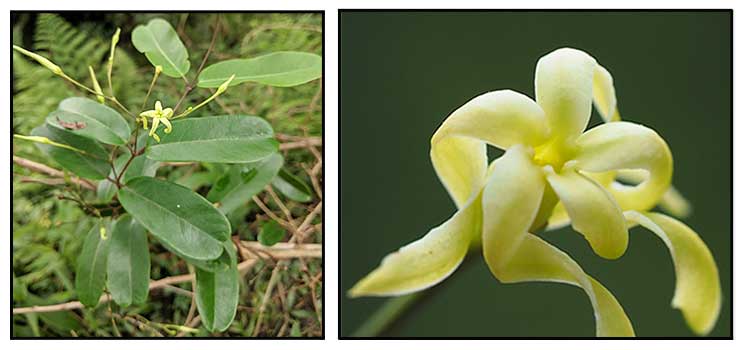 |
Gen info • Chinese Wax-Leaf Climber is a slender climber, with leaves oblong to linear oblong, 4.2-6 x 1.4-3 cm. Flower tube is 4-5 mm long; petals 1.1-1.5 cm long, curved and twisted often recurved. Corona scales are tiny 1 mm long, not noticeable. Flower-cluster-stalks are 1.5-3 cm long, branches 1-2 cm; flower-stalks 8-17 mm, sepals about 2 x 1.5 mm. Flowers are borne in few flowered cymes, which are very laxly branched. Branches are without persistent scaly bracts, very slender. Leaves have tip blunt apiculate to tapering, base blunt flat, rarely heart-shaped, veins not so numerous and parallel, somewhat leathery; leaf-stalks 8-10 mm, very slender. Seed-pods are long and slender, 13-17 x 0.7 cm, without 2 lateral flanges. (Flowers of India) Distribution - No studies found. Parts used Stems, leaves. Uses Edibility - No information found on edibility. Folkloric - No reported medicinal use in the Philippines. - In China and Vietnam, stems and leaves used externally for treatment of snake bites, traumatic injuries, and scabies. - Poultice of leaves applied to inflamed areas, wounds, and bruises to relieve pain. Others - Fiber: A fine, strong bast fiber is obtained from the inner bark; used for making rope. - Food source: The plant is one of the food sources of the common crow (Euploea core), a common butterfly found in South Asia. Studies Availability |
May 2026

 |
| PHOTOS / ILLUSTRATIONS |
| IMAGE SOURCE: Cryptolepis sinensis - flower close-up . by 葉子 / PUGLIC DOMAIN / No rights reserved / Click on image or link to go to source page / iNaturalist |
| O0THET IMAGE SOURCE: Cryptolepis sinensis / © Cheng-Te Hsu / Some rights reserved / CC BY 4.0 Internations / Click on image or link to go to source page / iNaturalist |
Additional
Sources and Suggested Readings |
• |
DOI: It is not uncommon for links on studies/sources to change. Copying and pasting the information on the search window or using the DOI (if available) will often redirect to the new link page. (Citing and Using a (DOI) Digital Object Identifier) |
| List of Understudied Philippine Medicinal Plants |
| New plant names needed The compilation now numbers over 1,750 medicinal plants. While I believe there are hundreds more that can be added to the collection, they are becoming more difficult to find. If you have a plant to suggest for inclusion, native or introduced, please email the info: scientific name (most helpful), local plant name (if known), any known folkloric medicinal use, and, if possible, a photo. Your help will be greatly appreciated. |
• |
 |
|
