 |

Family • Araceae
Dukalang
Schismatoglottis calyptrata (Roxb.) Zoll. & Moritzi
DROP TONGUE
Guang xi luo yan
| Scientific names | Common names |
| Calla calyptrata Roxb. | Alipdayi |
| Homalomena calyptrata (Roxb.) Kunth | Apusaw |
| Schismatoglottis calyptrata (Roxb.) Zoll. & Moritzi | Dukalang (Bik., Bis.) |
| Zantedeschia calyptrata (Roxb.) K.Koch | |
| Accepted infraspecifics (6) | |
| Schismatoglottis calyptrata var. calyptrata | |
| Colocasia humilis Hassk. | |
| Colocasia humilis var. minor Hassk. | |
| Colocasia kotoensis Hayata | |
| Schismatoglottis calyptrata f. albidomaculata Hallier f. | |
| S. calyptrata var. albidomaculata (Hallier f.) Ridl. | |
| Schismatoglottis calyptrata var. concolor Hallier f. | |
| Schismatoglottis calyptrata f. dahlii (Engl.) Engl. | |
| Schismatoglottis calyptrata var. dahlii Engl. | |
| Schismatoglottis calyptrata f. glaucescens Hallier f. | |
| Schismatoglottis calyptrata var. maculata Hallier f. | |
| Schismatoglottis calyptrata f. olivacea Hallier f. | |
| Schismatoglottis calyptratoides Alderw. | |
| Schismatoglottis dorensis Gibbs | |
| Schismatoglottis kotensis (Hayata) Huang, Hsiao & Yeh | |
| Schismatoglottis calyptrata var. celebica Koord. | |
| Schismatoglottis calyptrata f. grandifolia Engl. | |
| Schismatoglottis calyptrata f. minor Engl. | |
| Schismatoglottis calyptrata f. multimarginata Alderw. | |
| Schismatoglottis calyptrata var. ornata Ridl. ex Engl. | |
| Schismatoglottis calyptrata is an accepted species. KEW: Plants of the World Online | |
| Other vernacular names |
| BORNEO: Natu. |
| CHINESE: Guang xi luo yan. |
| PAPUA NEW GUINEA: Kukaruk. |
| SWEDISH: Spindelkalla. |
 |
Gen info Distribution Properties Availability |


November 2026

 |
| PHOTOS / ILLUSTRATIONS |
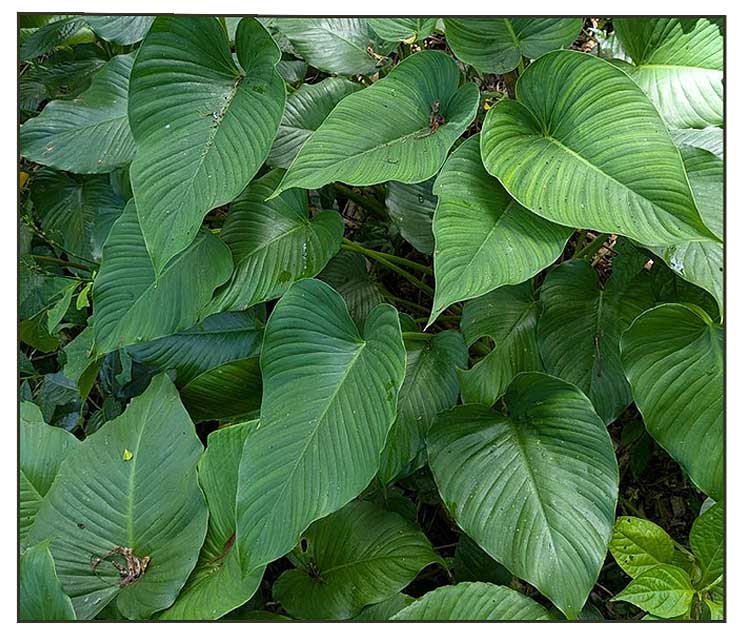
| IMAGE SOURCE: Schismatoglottis calyptrata leaves / by Obsidian Soul / CC0 / PUBLIC DOMAIN / Click on image or link to go to source page / Wikimedia Commons |
| OTHER IMAGE SOURCE: Schismatoglottis calyptrata leaves / by Kenraiz / CC BY-SA 3.0 / Image modified / Click on image or link to go to source page / Wikimedia Commons |
| IMAGE SOURCE: Schismatoglottis calyptrata var. calyprata / by galanhsnu / CC BY-NC 4.0 / Click on image or link to go to source page / gbif |
| IMAGE SOURCE: Kalak kambing (Finlaysonia obovata) / © Ron Yeo / Non-commercial use / Image modified / Click on image or link to go to source page / The Tide Chaser |
| OTHER IMAGE SOURCE: Finlaysonia obovata Leaf and splitting fruit / © uforest.org / Non-commercial use / Images modified / Click on images or link to go to source page / URBANFOREST |
| OTHER IMAGE SOURCE: Finlaysonia obovata splitting fruit and seeds / © Teo Siyang / Non-commercial use / Images modified / Click on images or link to go to source page / FloraofSingapore |
| IMAGE SOURCE: Hedyotis costata / Subject Database of China Plant <http://www.naturemuseum.net/album/ShowPhoto.aspx?photoid=2671c974-77ca-44f9-b304-0f16660a06f7> Helixcn |
| OTHER IMAGE SOURCE: /Gliricidia sepium (JacqBarcelona Kunth ex Walp. - quickstick GLSE2 / Steve Hurst @ USDA-NRCS PLANTS Database / USDA |
| OTHER IMAGE SOURCE: / File:Fruit of Syzygium samarangense / Wax apple / Plate from book / Flora de Filipinas / Francisco Manuel Blanco (OSA) / Public Domain / Wikimedia Commons |
| IMAGE SOURCE: / Photos (2) / Pterocaulon redolens (Willd.) F.-Vill. / © Collected by www.plant.ac.cn / ZHIWUTONG / CLICK ON IMAGE TO GO TO SOURCE PAGE |
| IMAGE SOURCE: / Line drawing / Pterocaulon redolens (Willd.) F.-Vill. / © Collected by www.plant.ac.cn / ZHIWUTONG / CLICK ON IMAGE TO GO TO SOURCE PAGE |
| IMAGE SOURCE:Phyllantaceae : Flueggea flexuosa / Leaf / Copyright © 2018 by P B Pelser & J F Barcelona (contact: pieter.pelser@canterbury.ac.nz) [ref. DOL131909] / Non-Commercial Use / Image modified / Click on image or link to go to source page / Phytoimages.siu.edu |
| OTHER IMAGE SOURCE: / Flower close-up / dracobotanicus -- Wayne Dumbleton / Creative Commons Attribution / flickr / Click on graphic to see original image / flickr |
| OTHER IMAGE SOURCE: Mexican tea / Dysphania ambrosioides / © J Richard Abbott / Some rights reserved / NC BY-NC / Click on image or link to go to source page / iNaturalist |
| OTHER IMAGE SOURCE: / Illustration / Cissampelos pareira L. [5809-247450-161657] / Indian medicinal plants, vol. 1: t. 42 / PlantIllustrations.org |
| ebay |
| IMAGE SOURCE: Pterocaulon redolens (Willd.) F.-Vill. / © Collected by www.plant.ac.cn / ZHIWUTONG / CLICK ON IMAGE TO GO TO SOURCE PAGE / iNaturalist |
| flickr |
| iNaturalistUK |
| IMAGE SOURCE: Erythrina fusca (Ngatae fisi) / Tau'olunga / CC BY-SA 3.0 / Click on image or link to go to source page / Wikipedia |
| Pacific Island Ecosystems at Risk (PIER) |
| Photos ©Godofredo Stuart / StuartXchange |
| Content © Godofredo Stuart / StuartXchange |
| Content / Photos © Godofredo Stuart / StuartXchange |
| Photos © Godofredo Stuart / StuartXchange |
Additional
Sources and Suggested Readings |
α•(5) |
PHOTOS / ILLUSTRATIONS |
DOI: It is not uncommon for links on studies/sources to change. Copying and pasting the information on the search window or using the DOI (if available) will often redirect to the new link page. (Citing and Using a (DOI) Digital Object Identifier) |
| List of Understudied Philippine Medicinal Plants |
| New plant names needed The compilation now numbers over 1,830 medicinal plants. While I believe there are hundreds more that can be added to the collection, they are becoming more difficult to find. If you have a plant to suggest for inclusion, native or introduced, please email the info: scientific name (most helpful), local plant name (if known), any known folkloric medicinal use, and, if possible, a photo. Your help will be greatly appreciated. |
α•(5) |
 |
• |
|


