
HOME      •      SEARCH      •      EMAIL    •     ABOUT


Family Phyllanthaceae
Iba-ibaan
Glochidion philippicum (Cav.) C.B.Rob.
PHILIPPINE BUTTONWOOD
Tian ye suan pan zi

Scientific names Common names
Actinodaphne sieboldiana Miq. Iba-ibaan (Tag.)
Bradleia philippensis Willd. Buttonwood (Engl.)
Bradleia philippica Cav. Daintree cheese tree (Engl.)
Coccoglochidion erythrococcus K.Schum. Little cheese tree (Engl.)
Diasperus compressicaulis (Kurz ex Teijsm. & Binn.) Kuntze Philippine abacus plant (Engl.)
Diasperus philippinensis (Müll.Arg.) Kuntze Philippine buttonwood (Engl.)
Diasperus kurzianus (Müll.Arg.) Kuntze  
Diasperus quercinus (Müll.Arg.) Kuntze  
Glochidion compressicaule Kurz ex Teijsm. & Binn.  
Glochidion ferdinandi var. mollis (Benth.) F.M.Bailey  
Glochidion formosanum Hayata  
Glochidion quercinum (Müll.Arg.) Boerl.  
Glochidion philippicum (Cav.) C.B.Rob.  
Glochidion philippinense Benth.  
Glochidion querinum (Müll.Arg.) Boerl.  
Glochidion sieboldianum (Miq.) Koidz.  
Gyrostemon blancoi Llanos  
Iozoste sieboldiana (Miq.) Kuntze  
Phyllanthus compressicaulis (Kurz ex Teijsm. & Binn.) Müll.Arg.  
Phyllanthus ferdinandi var. mollis  
Phyllanthus kurzianus Müll.Arg.  
Phyllanthus philippinensis Müll.Arg.  
Phyllanthus quercinus Müll.Arg.  
Glochidion philippicum is an accepted species. KEW: Plants of the World Online
Note: Iba-ibaan (Glochidion philippicum) is a common name shared with Ibaiba-an (Phyllanthus urinaria).

Other vernacular names
CHINA: Tian ye suan pan zi.
INDONESIA: Aging.
JAPAN: Namban-kankonoki.

Gen info
• Glochidion is a genus of flowering plants in the family Phyllanthaceae, known as cheese trees or buttonwood in Australia and leafflower trees in scientific literature. It contains about 170 species.
• The species was first described by Antonio Jose Cavanilles, later renamed and corrected by Charles Budd Robinson.

Botany
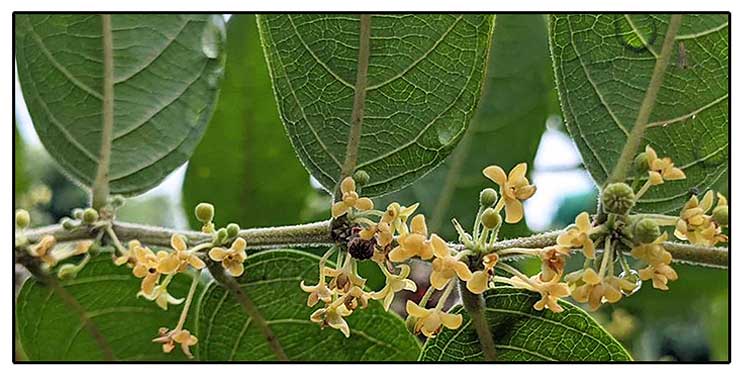
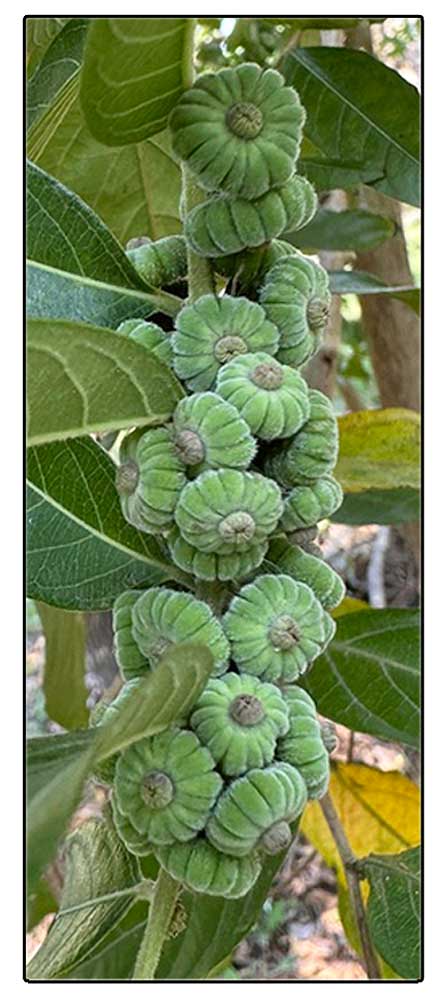
Trees to 12 m tall, monoecious; branchlets pubescent when young, glabrescent. Stipules ovate-triangular, 1-1.5 mm; petiole 4-6 mm; leaf blade ovate-lanceolate or oblong, 5-15 × 2.5-5.5 cm, papery or subleathery, shining dark green adaxially, brown when dry, paler abaxially, glabrous on both surfaces, base acute or broadly cuneate, usually oblique, apex acuminate to obtuse; lateral veins 6-8 pairs. Inflorescence an axillary cluster, 4-10-flowered. Male flowers: pedicels 6-7 mm; sepals 6, oblong or obovate-oblong, 1.5-2.5 mm, glabrous, yellowish green; stamens 3, connate into a cylindric column. Female flowers: pedicels 2-4 mm; sepals 6, as in male; ovary globose, pubescent, 5- or 6-locular; style column shortly conical, 5-7-fid at apex. Capsules depressed globose, 4.5-5.5 × 8-12 mm, apex with much-impressed and persistent styles, deeply 10-14-grooved, densely to sparsely pubescent; fruiting pedicels 3-8 mm. Seeds red, hemispheric, 3-3.5 mm. (Flora of China)

• This small tree has widely spreading branches and the leaves are borne alternately along the branches, they are in the one plane rather than being spirally arranged. Because many branches appear short, they are often mistaken for compound leaves. The underneath surface of the leaf is pubescent. The insignificant flowers are born e in clusters in the axils, these are followed by depressed- lobular, fruit ribbed so that it resembles a small wheel of cheese or, a small Queensland blue pumpkin, greyish-green with 10-15 small lobes. When the outside splits then orange to red seeds are revealed, the color is due to the aril. This plant is being spread on campus by birds who eat the seeds. (JamesCookUniveristyAustralia)

Distribution
- Native to the Philippines. (1) (2)
- In Guimaras, Leyte; in Luzon:
Apayao, Aurora, Benguet, Bulacan, Cagayan, Isabela, Laguna, Nueva Vizcaya, Pangasinan, Quezon, Rizal, Zambales; Masbate, Mindanao. (1)
- Common in thickets and forested ravines at low and medium elevation. 0-275 m.
- Also native to Bismarck Archipelago, Borneo, Jawa, Lesser Sunda Is., Maluku, New Guinea, Northern Territory, Queensland, Solomon Is., Sulawesi, Sumatera, Taiwan, Vanuatu. (2)

Constituents
- Study of roots isolated seven new ent-cleistanthane-type diterpenoids, glochiphenols A-G (1-7), along with 2 known analogs (8,9). (see study below) (6)
- Leaves of a Glochidion species, probably Glochidion philippicum (Cav.) C. B. Rob., of the family Euphorbiaceae, contain three new interrelated imidazole alkaloids, glochidine (I), glochidicine (II), and Na-4?-oxodecanoylhistamine (III), together with the known alkaloid Na-cinnamoylhistamine. The bark of this species contains only glochidicine and Na-cinnamoylhistamine. (7)
- Phytochemical screening of leaf and stem bark for secondary metabolites revealed steroids, terpenoids, flavonoid, alkaloid, phenol and saponin. (8)

Properties
- Studies have suggested antioxidant, immunomodulatory, DGKζ inhibitory properties.

Parts used
Leaves, roots, stem bark.

Uses

Edibility
- No reports found on edibility or culinary use.
Folkloric
- No reported medicinal use in the Philippines.
- In Indonesia, the Gayo Lues tribe use the stem bark for treatment of common cold, (fresh), diarrhea, (decoction), diabetes (decoction), hypercholesterolemia (decoction), and wounds (paste).
Others

- Butterflies: Food plant for larval stages of the Blue Moonbeam butterfly. (3)
- Dye: Bark yields a red dye.
- Wood: Durable. A general-purpose timber for light construction and for making tools.
(4)
- Fuel: Wood used as fuel.

Studies
Antioxidant / Leaves:
Study evaluated the antioxidant properties of G. philippicum leaf extracts using FTIR with chemometric analyses, and invitro and invivo evaluations. FTIR identified functional groups contributing to antioxidant activity. In in vitro assays using ABTS and FRAP methods revealed 70% ethanol and water extracts with highest antioxidant activity. In vivo study showed the ethanol-based microwave-assisted extract significantly improved survival of auto-inflammatory PGRP-LBa mutant larvae exposed to heat-killed E. coli. Quantitative PCR analysis indicated effect was dependent on endogenous antioxidant gene activation. Results suggest the leaf extracts as a natural source of bio-active compounds with exogenous antioxidant properties and potential for therapeutic applications. (5)
New ent-Cleistanthane Diterpenoids / Inhibitory Effect on  DGKζ / Roots: Study of roots isolated seven new ent-cleistanthane-type diterpenoids, glochiphenols A-G (1-7), along with 2 known analogs (8,9). Bioactivity assays showed compounds 1 and 2 exhibited potent inhibitory effects against DGKζ, with IC50s of 1.19 and 1.28 µM, respectively. (Note: (DGKζ (diacylglycerol kinase zeta) is a lipid kinase enzyme encoded by the DGKZ gene . It turns diacylglycerol (DAG) into phosphatidic acid (PA), acting as a central off-switch for DAG-driven cellular signals. It controls immune responses, brain cell function, and cancer growth.) (6)

Availability
- Wild-crafted.

August 2026

                                                 PHOTOS / ILLUSTRATIONS
IMAGE SOURCE: Glochidion philippicum / by Steve Fitzgeral / CC BY SA 4.0 International / Click on image or link to go to sour page / Wikimedia Commons
OTHER IMAGE SOURCE: Glochidion philippicum / © Jaw-Jian La / Some rights reserved / CC BY 4.0 International / Image modified / Click on image or link to go to source page / iNaturalist
OTHER IMAGE SOURCE: Glochidion philippicum / © Wen-Hsiang Cheng / Some rights reserved / CC BY NC / Image modified / Click on image or link to go to source page / iNaturalist

Additional Sources and Suggested Readings
(1)
Phyllanthaceae: Glochidion philippicum / Co's Digital Flora of the Philippines
(2)
Glochidion philippicum / KEW: Plants of the World Online
(3)
Glochidion / Wikipedia
(4)
Glochidion philippicum / Ken Fern: Tropical Plants Database / Useful Tropical Plants
(5)
Chemical fingerprinting and antioxidant properties of Glochidion philippicum / Khairuddin Khairuddin, Marianti A Manggau, Herlina Rante, Widya Hardiyanti, Firzan Nainu et al / Narra J., 2025; 5(1): e1886 / DOI: 10.52225/narra.v5i1.1886 / PMID: 40352194 / PMCID: PMC12059818
(6)
Dehydrogenated and Aromatized ent-Cleistanthane Diterpenoids From the Roots of Glochidion philippicum / Yang Yao, Chong-Xian Li, Yao-Yue Fan, Jian-Min Hue et al / CHEMISTRY & BIODIVERSITY, 2025; 22(10): e01481 /  https://doi.org/10.1002/cbdv.202501481
(7)
New imidazole alkaloids from a Glochidion species (family Euphorbiaceae) / SR Johns, JA Lamberton / Aust J Chem., 1967; 20(3): pp 555-560
(8)
Phytochemical screening and antibacterial activity of ethnomedicinal plants from Gayo Lues Highland, Indonesia / Hawa Purnama Celala Ary Cane, Musri Musman, Kana Puspita et al / Journal of Pharmacy and Pharmacognosy Research, 2023; 11(1): pp 117-128 / DOI: 10.56499/jppres22.1526_11.1.117 / ISSN: 0719-4250

DOI: It is not uncommon for links on studies/sources to change. Copying and pasting the information on the search window or using the DOI (if available) will often redirect to the new link page. (Citing and Using a (DOI) Digital Object Identifier)

                                                            List of Understudied Philippine Medicinal Plants
                                          New plant names needed
The compilation now numbers over 1,750 medicinal plants. While I believe there are hundreds more that can be added to the collection, they are becoming more difficult to find. If you have a plant to suggest for inclusion, native or introduced, please email the info: scientific name (most helpful), local plant name (if known), any known folkloric medicinal use, and, if possible, a photo. Your help will be greatly appreciated.

HOME      •      SEARCH      •      EMAIL    •     ABOUT