
HOME      •      SEARCH      •      EMAIL    •     ABOUT


Family Fabaceae
Kabay-kabay
Dendrolobium umbellatum (l.) Benth.
HORSEBUSH
San hua jia mu dou

Scientific names Common names
Aeschynomene arborea L. Huyat-bagio (Bisaya)
Dendrolobium australe (Willd.) Benth. Kabay-kabay (Tagalog)
Dendrolobium umbellatum (L.) Benth. Matang-ureng (Bikol)
Dendrolobium umbellatum var. hirsutum Pedley Golden horsebush (Engl.)
Dendrolobium umbellatum f. hirsutum (DC.) H.Ohashi Golden shower tree (Engl.)
Dendrolobium umbellatum var. majus Miq. Horsebush (Engl.)
Dendrolobium umbellatum var. obsusissimum Blume ex Miq.  
Desmodium arboreum (Roxb.) G.Don.  
Desmodium australe (Willd.) DC.  
Desmodium grandiflolium DC.  
Desmodium umbellatum (L.) DC.  
Desmodium umbellatum var. hirsutum DC.  
Hedysarum arboreum Roxb.  
Hedysarum australe Willd.  
Hedysarum ellipticum Zipp. ex Miq.  
Hedysarum grandifolium Hornem.  
Hedysarum ovatum Noronha  
Hedysarum reflexum Reinw. ex Blume  
Hedysarum thunbergianum Steud.  
Hedysarum umbellatum L.  
Meibomia australis (Willd.) Kuntze  
Meibomia umbellata (L.) Kuntze  
Ormocarpum australe Desv.  
Ormocarpum oblongum Desv.  
Ormocarpum umbellatum Desv.  
Dendrolobium umbellatum is an accepted species. KEW: Plants of the World Online

Other vernacular names
CHINA : San hua jia mu dou.
INDIA: Chanoop (Andaman & Nicobar); Jenu kaddi gida (Kannada); Pandhra chikta (Marathi).
INDONESIA: Blanakan, Balanak (Javanese); Kanyere laut (Sundanese); Gowou (Ternate); Daun buaya (the Moluccas); Koia (Tomia).
MALAYSIA: Petai laut, Petai belalang, Dendulang, Dedulang (Peninsular).
PAPUA NEW GUINEA: Barakau.
THAILAND: Khamin naang, Chamaep, Thua rae thale.
VIETNAM: Ba ohe tan, Thoc lep tan, Trang qua tan.

Gen info
- Dendrolobium is a genus of flowering plants in the legume family, Fabaceae. It includes 21 species of mostly trees and shrub, and rarely, herbs.
- Etymology: The genus name Dendrolobium derives from Greek words Dendron, meaning tree or wood, and lobos, meaning pods, together "woody pods". The specific epithet umbellatum derives from Latin for umbels, referring to the flower cluster arrangement in which stalks of nearly equal length spring from a common center and form a flat or curved surface.

Botany
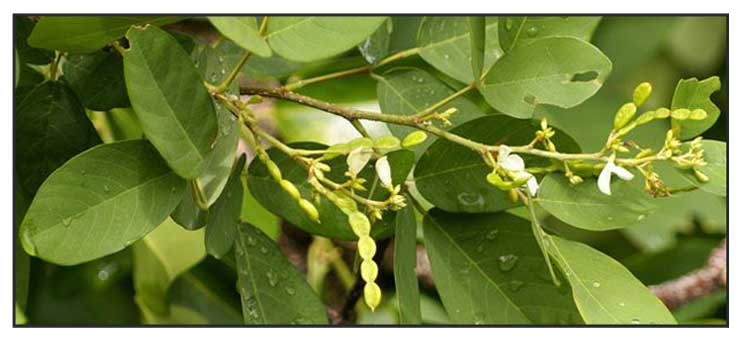
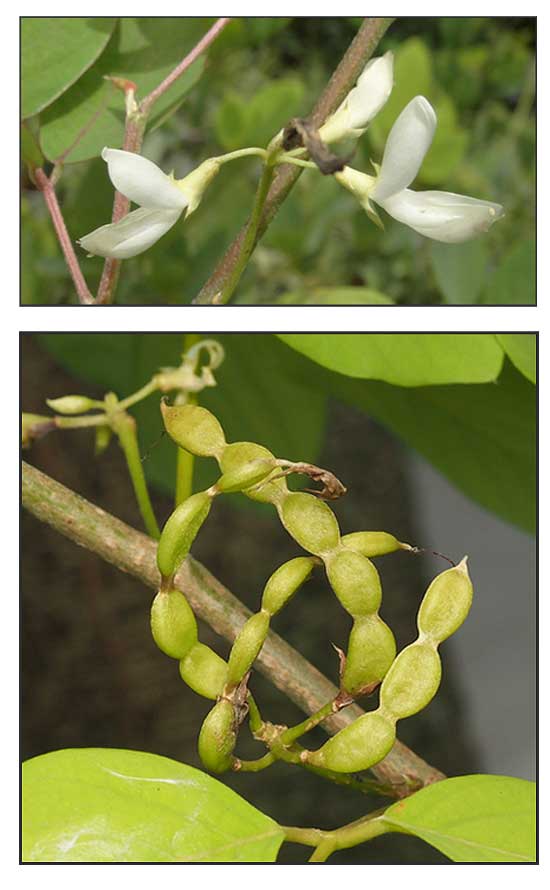
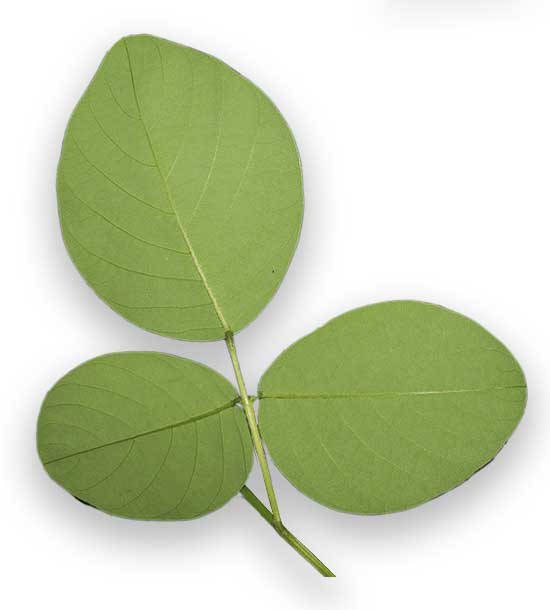
Dwarf shrubs to shrubs or small trees, to 3 m tall. Young shoots terete, densely appressed sericeous. Leaves 3-foliolate; petiole 2-5 cm; terminal leaflet blade elliptic or ovate to orbic­ular or broadly ovate, 5-14(-17) × 3-7(-8.5) cm, lateral leaflets slightly smaller, abaxially appressed long hairy, adaxially gla­brescent, lateral veins 7-12 on each side of midvein, reaching margin. Umbels often 10-20-flowered. Pedicel 3-7 mm at an­thesis, 5-12 mm in fruit. Calyx 4-5 mm, upper lobe 2-toothed at apex. Corolla white; standard broadly obovate or elliptic, 1-1.3 cm × 6-10 mm, clawed; wings narrowly elliptic, 1.1-1.2 cm × 1-2 mm, clawed; keel broader than wings, 1.1-1.2 cm × 3-5 mm, clawed. Stamens ca. 1 cm. Pistil to 1.5 cm; ovary seri­ceous; style ca. 1.2 cm, glabrous. Legume narrowly oblong, 2-3.5 × 0.4-0.6 cm, (3-)8-jointed; articles broadly elliptic or ob­long. Seed elliptic or broadly elliptic, ca. 4 × 3 mm.
(Flora of China)

Growth form: A tree up to 6 m tall. Foliage: Pinnate, stalked leaves have leaflets that are elliptic to broadly egg-shaped, the underside of which are covered with fine hairs. The terminal leaflet is 5–17 by 2.5–8.5 cm, and the lateral leaflets 3–11 by 1.5–6 cm. Flowers: Flowering cluster consists of 10–20, 13 mm-long, white flowers. Fruit: Thick, elongated, leathery fruit pods consist of 3–8 segments that are 1-seeded, broadly elliptical-oblong to oblong, and 5–10 by 3.5–5 mm. (Flora & Fauna Web)

• A shrub or small tree up to 3(-6) m tall, branches terete, lenticellate, glabrescent, young parts (4-)6-7-gonous. Leaves 3-foliolate, petiole (1-)2-5(-6) cm long, stipules early caducous, leaflets elliptical to broadly ovate, base obtuse to acute, apex obtuse to acute, continuously appressed-sericeous when young, upper surface glabrescent, lower surface remaining covered with appressed fine hairs, terminal leaflet 5-14(-17) cm × (2.5-)3.5-7(-8.5) cm, lateral leaflets 3-11 cm × 1.5-6 cm. Axillary inflorescence shortly peduncled or long racemose, 10-20-flowered, primary bracts 2-2.5 mm × 1-1.5 mm, early caducous. Calyx 4-5 mm long, corolla white, standard obovate or elliptical, wings narrowly elliptical, keel petals much broader than the wings, androecium 8.5-10 mm long, gynoecium 14-15 mm long, ovary densely appressed-sericeous. Pod sessile or slightly stalked, narrowly oblongoid, 3-5(-8)-jointed, rarely 1-seeded by abortion, glabrescent, both sutures not thickened, upper suture slightly undulate, lower suture undulate and constricted between the seeds, articles in outline broadly elliptical-oblong to oblong, (5-)7-8(-10) mm × 3.5-5 mm. (PROSEA)

Distribution
- Native to the Philippines. (1) (2)
- On rocky or sandy seashores or tidal mud, monsoon forest edges, riverbanks, rocky cliffs, savanna, and secondary forests; sea level to 180 m altitude
- Also native to Andaman Is., Bangladesh, Bismarck Archipelago, Borneo, Cambodia, Caroline Is., China Southeast, Comoros, Fiji, India, Jawa, Kenya, Lesser Sunda Is., Madagascar, Malaya, Maldives, Maluku, Marianas, Mauritius, Myanmar, Nansei-shoto, New Caledonia, New Guinea, Nicobar Is., Niue, Queensland, Réunion, Samoa, Seychelles, Sri Lanka, Sulawesi, Sumatera, Taiwan, Tanzania, Thailand, Tonga, Vanuatu, Vietnam, Wallis-Futuna Is. (1)

Constituents
- Proximate analysis of leaves of D. umbellatum revealed dry matter nutrient content of 29.66%, organic matter 92.62%, crude fiber 13.37%, and crude protein 17.98%. Comparatively, dry matter and organic matter content are low, 60.06% and 59.13% respectively; crude protein and fiber content are lower 17.93% to 19.44%. (Comparatively lower crude protein and fiber content may be attributable to growing in a coastal area with low nutrient content.)

Properties
- Studies have suggested antibacterial properties.

Parts used
Leaves, shoots, flowers.

Uses

Edibility
- Leaves are edible: young leaves eaten as vegetable or used as seasoning; sometimes eaten raw in the Moluccas and Malaysia.
Folkloric
- No reported folkloric medicinal use in the Philippines.
- In Papua New Guinea, crushed leaves and shoots use to massage an enlarged spleen caused by malaria. Decoction of leaves drunk as a general tonic. Solution used to bathe the body to prevent a slight chill developing into a fever. (3)
- In the Moluccas, plant used as an astringent; young leaves used as ingredient of post-partum medicine used after childbirth. (3)
- In Fiji, leaves used for treatment of scaly skin. (3)
- In Taiwan, decoction of flowers used for treatment of gonorrhea and irregular menstruation. (3)
- In
Bangladesh, used for treatment of enlarged spleen, fever, headache and malaria. (5)
- In India, fresh tubers taken orally as childbirth medicine, treatment of gonorrhea, scaly skin, irregular menses, and scaly skin.
Others

- Fodder: In India, plant used as fodder; particularly favored by horses. (3)
- Wood: Used as fuel. In construction, used for posts and small posts.
- Agroforestry: Suitable for protection of planting and erosion control on beaches and sand dunes. (4)

Studies
Antibacterial / Leaves:
Study evaluated fresh, aqueous and methanol extracts of leaves of D. umbellatum (horse bush) and Psophocarpus tetragonolobus (winged beans),and Cassia alata (candle bush) for individual and synergistic activities against Gram-positive Staphylococcus aureus (ATCC 25923) and Gram-negative E. coli (ATCC 25922) using agar well diffusion method. The ME of horse bush showed 12.0 mm zone of inhibition against S. aureus. In synergistic studies, all combinations showed inhibition of S. aureus. None of the extracts showed inhibition of E. coli, which may be due to the presence of harder cell wall structure in E. coli compared to S. aureus. (7)

Availability
- Wild-crafted.
- Seeds in the cybermarket.

April 2026

                                                 PHOTOS / ILLUSTRATIONS
IMAGE SOURCE: Dendrolobium umbellatum (Horse bush) / © Marina Khaytarova / Non-commercial use / Image modifired / Click on image or link to go to source page / Top Tropicals
IMAGE SOURCE: Dendrolobium umbellatum (Horse bush) / © Jacob de Vlas / Non-commercial use / Image modifired / Click on image or link to go to source page / Flora of Sri Lanka
IMAGE SOURCE: Dendrolobium umbellatum (Horse bush) flowers / © Jacob de Vlas / Non-commercial use / Image modifired / Click on image or link to go to source page / Flora of Sri Lanka
IMAGE SOURCE: Dendrolobium umbellatum (Horse bush) / © Fiora Li / Some rights reserved / CC BY-NC / Image modifired / Click on image or link to go to source page / iNaturalist

Additional Sources and Suggested Readings
(1)
Dendrolobium umbellatum / KEW: Plants of the World Online
(2)
Fabaceae: Dendrolobium umbellatum / Co's Digital Flora of the Philippines
(3)
Dendrolobium umbellatum / N O Aguilar / PROSEA
(4)
Dendrobium umbellatum / Ken Fern / Useful Tropical Plants
(5)
Medicinal species of Fabaceae occurring in Bangladesh and their conservation status
/ Ishrath Jahan, MA Rahman, MA Hossain / Journal of Medicinal Plant Studies, 2019; 7(4): pp 189-195
(6)
Dendrobium umbellatum /
OSADHI - Online Structural and Analytics based Database for Herbs of India
(7)
Evaluation of Nutrient Content of Animal Feed Crops in Tropical Islands Region (Case Study of Tomia Timur District, Wakatobi Regency, Indonesia) / Syamsuddin, Ali Bain, Mardianto, Andi Murlina Tasse, Deki Zulkarnain / International Journal of Scientific Research in Science, Engineering and Technology, 2025;p 12(2): pp 735-767 / pISSN: 2395-1990 / eISSN: 2394-4099 / DOI: 10.32628/IJSRSET25122108
(8)
An Investigation of the Antibacterial Potential of Selected Local Medicinal Plants Belonging to the Fabaceae Family / HGH Gallage, J Perera, S Jeevathayaparan, HPS Jayaweera, NS Muthunayake / International Research Symposium of Rajarata University of Sri Lanka, 2025

DOI: It is not uncommon for links on studies/sources to change. Copying and pasting the information on the search window or using the DOI (if available) will often redirect to the new link page. (Citing and Using a (DOI) Digital Object Identifier)

                                                            List of Understudied Philippine Medicinal Plants
                                          New plant names needed
The compilation now numbers over 1,750 medicinal plants. While I believe there are hundreds more that can be added to the collection, they are becoming more difficult to find. If you have a plant to suggest for inclusion, native or introduced, please email the info: scientific name (most helpful), local plant name (if known), any known folkloric medicinal use, and, if possible, a photo. Your help will be greatly appreciated.

HOME      •      SEARCH      •      EMAIL    •     ABOUT