 Gen info
- Rubiaceae is a family of flowering plant, commonly known as coffee, madder, or bedstraw family, consisting terrestrial trees, shrubs, lianas, or herbs. It is the 4th-largest angiosperm family, containing about 14,200 species in about 615 genera. (16)
- Taxonomy: Rubiaceae (nomen conservandum) was published in 1789 by Antoine Laurent de Jussieu. (16)
-
Mussaenda philippica is a plant species in the Rubiaceae family, commonly grown as an ornamental.
- Varieties: Known varieties include: Donna Luz (pink), Alicia Luz (dark pink), Queen Sirikit (light pink), Donna Aurora (white) and Donna Evangellina (dark red).
(15)
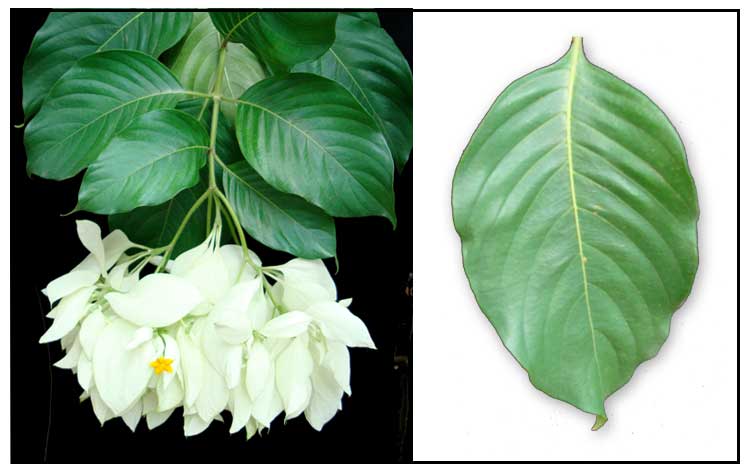
- Doña Aurora is named after the wife of former President Manuel L. Quezon. It was first found in 1915 in Mt. Makiling as a spontaneous mutant of the species Mussaenda Philippica, and has been utilized as one of the parents in developed mussaenda hybrids.
(15)
- Etymology: The family name Rubiaceae is named after d, a name used by Pliny the Elder in his Naturalis Historia for madder (Rubia tinctorum). The genus name Mussaenda is a New Latin adaptation from the Sinhalese vernacular name for plants in the genus. The specific name philippica is a Latinized geographical origin, meaning "of the Philippines".
Botany
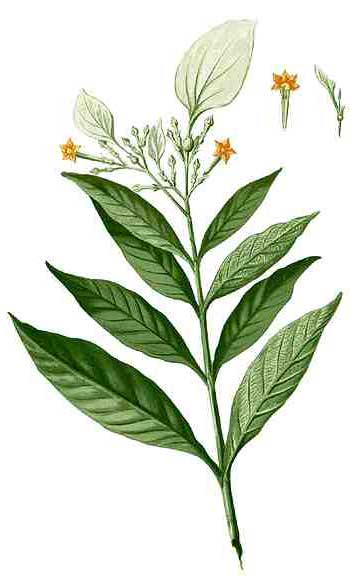
Kahoi-dalaga is a shrub or small tree
3 to 5 meters high, more or less hairy or nearly smooth. Leaves are
opposite, dark green and glossy, oblong-ovate to oblong-lanceolate, 6 to 14 centimeters long, pointed in
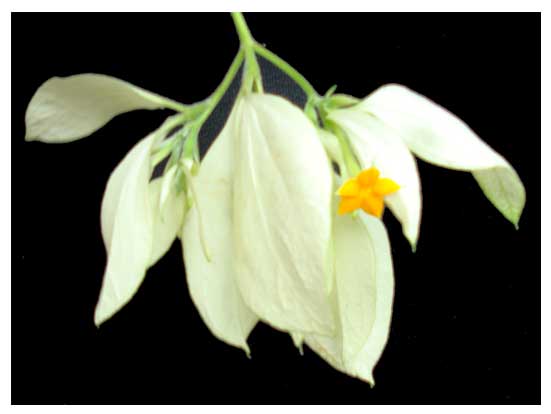
both ends, and furnished with stipules about 4 millimeters long. Flowers are borne in small numbers in terminal, hairy cymes. Calyx is about 7 millimeters long, with four of the teeth as long as the tube, one very much enlarged into a white, leaflike, long petiole, elliptic-ovate appendage, the blade 4 to 8 centimeters long. Corolla is yellow, hairy, about 2 centimeters long, and enlarged upward. Fruit is about 1.5 centimeters long.
Distribution
- Native to the Philippines.
-
In thickets and secondary
forests at low and medium altitudes, in almost all islands and provinces.
- Ornamental cultivation.
- Introduced into Bangladesh, Caroline Is., Solomon Is., Thailand.
- M. philippica "
Aurorae" reportedly well distributed throughout India, Southeast Asia and the Philippines.
 Constituents
- Flowers yielded saponins, flavonoids, tannins, carbohydrates and resins.
- Phytochemical screening revealed presence of alkaloids, protein and amino acids, flavonoids, terpenoids, phenolics, glycosides, carbohydrate, saponins, steroids, tannins, and fixed oil.
- Study of sepals isolated three iridoid glycosides: 5-hydroxy davisioides, 4-acetoxy-7-methody secologanin and 6-methoxy mussaenoside, along with two flavones, 5,7,4'-trihydroxy-3'-methoxy flavone and 5,7-dihydroxy-6,3',4'-trimethoxy flavone.
(17)
- Screening of methanol extract of leaves for secondary metabolites revealed tannins, flavonoids, alkaloids, steroids, and saponins. (see study below) (18)
- Phytoconstituent screening of benzene, diethyl ether, and chloroform leaf extracts revealed phytosterols and flavonoids in all three extracts, while phenolic compounds and tannins were additionally detected in the chlorofom extract. (see study below) (20)
Properties
- Studies have suggested antibacterial, anticonvulsant, antiulcer, hepatoprotective, antitumor, diuretic, analgesic, antioxidant, anti-inflammatory, wound-healing properties.
Parts used
Roots, leaves, sepals.
 Uses
Edibility
- Not grown or consumed as food crop.
Folkloric
- Plant is used for
dysentery and snake bites.
• Decoction of roots and leaves used for affections of the chest
and lung.
• Roots and the while, full-grown sepals are used in jaundice.
• Bark used for stomach ache.
• Externally, decoction of leaves used as emollient.
• Crushed
fresh leaves applied to cuts, ulcers, and insect bites to help healing.
• For influenza, the tambalan healers of Samar use the scrapping of the bark of M. philippica and C.
dichotoma. Mixed and pounded, the expressed juice strained and mixed with lemon extract; taken three times daily.
Studies
• Antibacterial / Leaves: A methanol extract of leaves, flowers, stems and barks, hexane and ethyl acetate extracts of stems/bark showed mild inhibition of Bacillus subtilis growth. (2)
• Anticonvulsant / Leaves and Sepals: Study evaluated the anticonvulsant activity of hydroalcoholic extracts of leaves and sepals and its fractions against PTZ, MES, STR, Picrotoxin induced convulsions at different dose levels. Results showed dose-dependent effects which may have potential in the control of grandmal and petit mal epilepsy. (3)
• Antitumor: Study evaluated the antitumor and antioxidant activity of Mussaenda philippica against MCF-7 and Caco2 cell lines induced breast and colon cancer in mice. (4)
• Diuretic / Flowers: Study evaluated the diuretic activity of flowers of Mussaenda philippica var. Donya Luz. Results showed the crude extract of possess potential diuretic activity which could be further explored in the treatment of hypertension. (5)
• Analgesic: In a screening study of ten medicinal plants of Bangladesh for analgesic activity on Swiss albino mice, M. philippica effectively inhibited acetic acid-induced writhing. The reference drug was diclofenac. (6)
• Antioxidant / Antibacterial: Study evaluated the phytochemical, antioxidant and bacterial profile of flowers of selected ornamental plants from Nueva Viscaya, Philippines. Results showed M. philippica was bioactive against Staphylococcus aureus and E. coli. (7)
• Antitumor / Antioxidant / Sepals: Study evaluated the antitumor and antioxidant activity of an EA extract of Mussaenda philippica sepals against Caco-2 cell line in male mice for colon cancer and MCF-7 cell line in female mice for breast cancer. Results showed antitumor and antioxidant effects by modulating lipid peroxidation and augmenting antioxidant defense system in Caco-2 and MCF-7 bearing mice. (10)
• Hepatoprotective / Anti-Tubercular Drug Toxicity / Stems: Study of a methanolic extract of M. philippica against isoniazid and rifampicin induced hepatotoxicity in an experimental rat model showed significant hepatoprotective activity. (11)
• Antiulcer / Anti-Secretory / Cytoprotective / Leaves: Study evaluated the antiulcer property of M. philippica leaves using pylorus ligated, ethanol induced, and NaOH induced ulcer models in rats. Results showed substantial reduction in ulcer index, decrease in gastric volume, increase in pH in the pylorus ligation model, probably through alteration in the mucosal barrier. In the ethanol induced model, there was significant antiulcer effect, which may be due to leukotriene antagonistic effect or inhibition of the 5-lipoxygenase pathway. In the NaOH model, the antiulcer effect was attributed to effect on pH and ulcer index. (12)
• Antimicrobial / Leaves: Study evaluated the antibacterial and antifungal activity of three solvent extracts of A. pavonina and Mussaenda philippica on microbes isolated from dairy cattle. The extracts exhibited antibacterial activity against Salmonella enteritidis, Klebsiella pneumoniae, Bacillus subtilis, Staphylococcus aureus, Escherichia coli and Pseudomonas aeruginosa. (13)
• Antibacterial / Leaves: Study evaluated a methanolic extract of M. philippica leaves and its cultivars for antibacterial activity against Gm(+) B. subtilis and S. aureus and Gm(-) E. coli. screened for possible secondary metabolites. All extracts showed inhibition against tested microorganisms. Crude extracts showed highest activity against E. coli and B. subtilis. The Aurora cv. showed largest antibacterial activity against S. aureus. (see constituents above) (18)
• Antibacterial / Isoquercitrin and Astragalin / White Sepals: Study evaluated antibacterial activity and bioactive compounds from white modified sepals using a bioassay-guided approach. Two compounds were isolated: isoquercitrin, which showed MICs ranging from 28.12 µg/mL against S. epidermis and E coli to62.5 µg/mL against S. aureus. Compound 2, astragalin, showed MICs between 21.87 µg/mL against E. coli and V. cholerae and 125 µg/mL against S. aureus. (19)
• Anti-Inflammatory / Leaves: Study evaluated the phytochemical constituents and evaluated the in-vitro anti-inflammatory activity of benzene, diethyl ether, and chloroform extracts of M. philippica leaves. In anti-inflammatory testing, the extracts exhibited concentration dependent inhibition of albumin denaturation with IC50s of 14.40 mg (benzene), 13.30 mg (diethyl ether), and 9.89 mg (chloroform) for the extracts, compared to standard diclofenac sodium with IC50 of 11.40 mg. (see constituents above) (20)
• Wound Healing / Ointment Formulation of Leaves: Study evaluated the wound healing efficacy of M. philippica leaf extract using topical ointments at 1%, 5%, and 10% concentrations on excised wounds in male mice, with 10% povidone-iodine and plain ointment as positive and negative controls. Acute toxicity testing confirmed the extract's safety. The 10% formulation showed most potent wound-healing activity, evidenced by complete epithelization within 14 days, comparable to 10% povidone-iodine group. Results suggest potential as a safe, cost-effective alternative to synthetic wound care agents. (21)
Availability
Wild-crafted
|