Gen info
- Gymnema is a genus in family Apocynaceae, first described as a genus in 1810.
- Etymology: The genus name Gymnema derives from Greek gymnos, meaning naked, and nema, meaning thread.
 Botany Botany
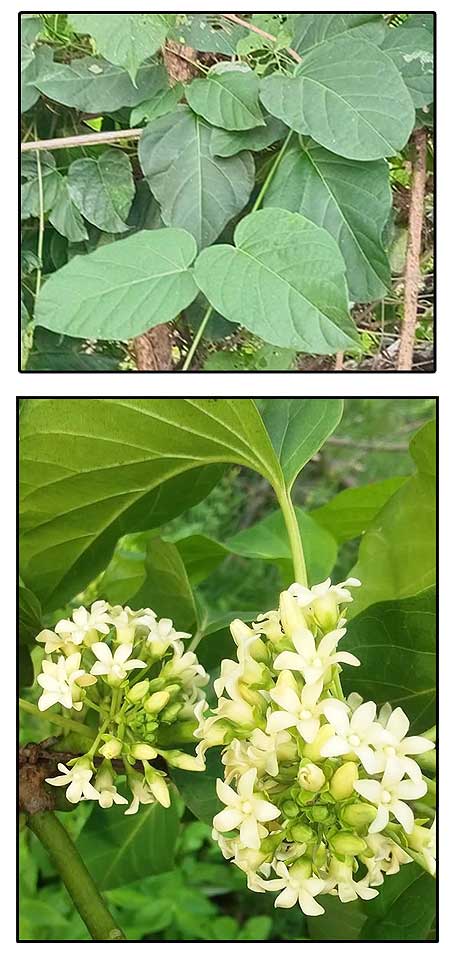
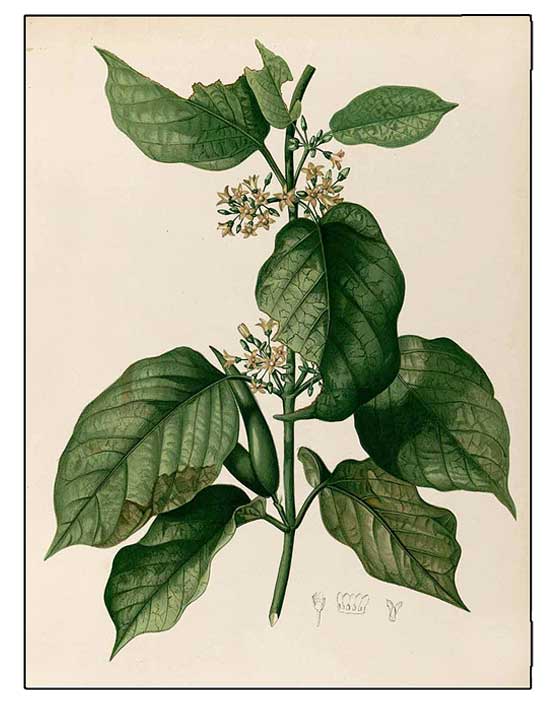
• A climbing shrub or liana up to 25 m long; leaves ovate-oblong to ovate or broadly ovate, 4-14 cm × 2-9 cm, petiole 2-6 cm long; corolla minutely puberulent outside, yellow, corona lobes included; follicle 8-16 cm × 2.5-3 cm, glabrous, weakly beaked. (1)
• Scentless Cowplant is a large climber up to 10 m, with stems hairless; young branchlets pale gray, warty, finely velvet-hairy. Inflorescences are eventually raceme-like with stalkless umbel-like cymes arranged in spiral, up to 4 cm, carried on flower-cluster-stalk 1-2 cm. Flowers are yellowish, 6-7 mm, minutely finely velvet-hairy outside; tube cylindric, hairless except for longitudinal bands of stiff hairs alternating with petals. Petals are oblong, 3-4 x 1.6-1.8 mm, tip rounded, hairless except for fringed with hairs margin. Stigma is head dome-shaped, protruding from flower tube. Flower-stalks are 1-1.5 cm, sepals oblong, 2-3 x 1.4 mm, shorter than flower tube, finely velvet-hairy, fringed with hairs. Leaf-stalks are 2-6 cm; leaf blade membranous, ovate-oblong to ovate or broadly ovate, 4-13 × 2-9 cm, hairless or thin finely velvet-hairy along veins, base rounded to shallowly heart-shaped, tip tapering to with a tail; lateral veins 4-6 pairs. Seedpods are lance-shaped in outline, up to 16 x 3 cm, wall thick and slightly fibrous, hairless. (Flowers of India)
Distribution
- Native to the Philippines.
(2) (3)
- In Luzon:
Bataan, Benguet, Cavite, La Union, Laguna, Pangasinan, Rizal, Sorsogon; in Mindanao: Bukidnon; Palawan, Panay. (3)
- Low elevation thickets and secondary growth.
- Also native to Andaman Is., Assam, Bangladesh, Borneo, China South-Central, China Southeast, East Himalaya, Hainan, India, Jawa, Malaya, Myanmar, Nepal, Thailand, Vietnam, West Himalaya. (2)
Constituents
- SGC-MS analysis of extract reported 16 compounds with major compounds of linolenic acid (24.91%), n-hexadecanoic acid (palmitic acid) (16.98%), and methylparaben (11.58%), along with phytol, squalene, γ-tocopherol, dl-α-tocopherol, and stigmasterol. (see study below) (4)
- HPLC-UV analysis of leaves showed highest gymnemic acid concentrations in air-dri9ed and roasted 1-day-fermented leaf extracts (0.1258 µg/ml). Total phenolic content of fresh leaf extracts from ethanol, methanol, and water were 0.19, 0.21, and 0.10 µg GAE/g respectively. Total flavonoid contents were 74.56, 71.88, and 10.74 µg QE/g, respectively. (see study below) (9)
- LC-QTOF.MS analysis of fresh leaf extract showed 6-hydroxykaempferol 7-rutinoside as the most abundant compound. (9)
Properties
- Studies have suggested anti-inflammatory, antioxidant, antidiabetic, anti-obesity, cytoprotective, cardioprotective, insulin mimetic, antibacterial, anti-biofilm properties.
Parts used
Leaves, shoots, aerial parts.
 Uses Uses
Edibility
- In the Moluccas, young leaves and shoots eaten raw or cooked. In northern Thailand, young aerial parts consumed as vegetable. (1)
- In Thailand, used for making commercial herb tea products.
Folkloric
- No reported folkloric use in the Philippines.
- In the Moluccas, roots used for treatment of chest tightness; also as antidote against poisoning. Poultice of leaves used as galactagogue. (1)
- In China, all plant parts used for treatment of infantile paralysis and pulmonary tuberculosis. (1)
- Leaves used for treatment of diabetes, rheumatoid arthritis, and gout. (1)
- In India, leaves extracts taken orally for treatment of infantile paralysis and tuberculosis of lymph nodes. (8)
Others
- Dye: Plant yields a blue or greenish-blue dye. (1)
Studies
• Antioxidant / Anti-Inflammatory / Leaves: Study of evaluated an extract of Gymnema inodorum leaves (GIE) for antioxidant and anti-inflammatory effects. GC-MS analysis yielded 16 volatile compounds. GIE exhibited antioxidant activity by scavenging intracellular reactive oxygen species (ROS) production and increasing SOD2 mRNA expression in LPS plus IFN-γ-induced RAW264.7 cells. GIE showed anti-inflammatory activity by suppressing nitric oxide (NO), pro-inflammatory cytokine production IL-6, and down-regulation of expression of COX-2, iNOS, and IL-6 mRNA levels in LPS plus IFN-γ-induced RAW264.7 cells. Mechanism studies showed GIE suppressed NF-kB p65 nuclear translocation and slightly decreased phosphorylation of NF-kB p65 protein. Study suggest GIE may prevent oxidative damage by scavenging intracellular ROS production and activating the antioxidant gene, SOOD2, expression. Results suggest potential for development of a novel antioxidant and anti-inflammatory agent to treat diseases related to oxidative stress and inflammation. (see constituents above) (4)
• Cytoprotective / Antioxidant / Anti-Inflammatory / Leaves: Study evaluated the cytoprotective efficacy of G. inodorum leaf extract (GIE) in a rat cardiac myoblast, H9c2, subjected to an invitro hypoxia. Results showed GIE notably enhanced cell viability, preserving membrane integrity. GIE significantly reduced hypoxia-induced intracellular ROS production, attributable to inherent antioxidant properties. GIE also significantly reduced IL-1ß, IL-6 mRNA expression level and tended to reduced TNF-α mRNA expression. Results underscore the potential of GIE in mitigating hypoxia-induced myocardial injury, highlighting its robust antioxidant and anti-inflammatory attributes. (5)
agent to treat diseases related to oxidative stress and inflammation. (see constituents above) (4)
• Gymnemic Acids / Anti-Obesity / Inhibition of 3T3-L1 Cell Differentiation into Adipocytes / Tea: G. inodorum was shown to reduce plasma glucose levels in healthy humans. It is renowned for the gymnemic acid and its ability to suppress glucose absorption. Study evaluated the effects of gymnemic acids derived from GI tea on adipogenesis. GiA-7 and stephanosides C and B were purified from GI tea, which inhibited adipocyte differentiation in 3T3-L1 cells. The compounds also suppressed expression of peroxisome proliferator-activated receptor gamma (Pparγ)-dependent genes, indicating inhibition of lipid accumulation and the early stage of 3T3-L1 preadipocyte differentiation. GiA-7 induced expression of uncoupling protein 1 (Ucp1) and pparγ coactivator 1 alpha (Pgc1a), suggesting it induces mitochondrial activity and beige-like adipocytes. Results suggest GiA-7 and stephanosides C and B from GI tea can help prevent obesity. (6)
• Cytoprotective / Antioxidant / Anti-Inflammatory / Leaves: Study evaluated the protective effects of G. inodorum leaf extracts on PbANKA-induced hypoglycemia, dyslipidemia, liver damage, and acute kidney injury in mice. PbANKA infection in mice is a well-known model of malaria-induced acute kidney injury. (7)
• Antioxidant / Phytochemicals / Leaves: Study evaluated the phytochemical content and antioxidant potential of G. inodorum leaves. Highest free radical scavenging activity via DPPH assay was found in baked leaf extract with IC50 8.99 mg/mL; via ABTS assay in baked and roasted leaf extract with IC50 of 1q.05 mg/mL. FRAP showed highest free radical scavenging activity in baked leaf extract with 0.0085 mM Fe2+/g sample. (see constituents above) (9)
• Anti-Inflammatory / Antioxidant / Leaves: Endothelial dysfunction via oxidative and nitrosative stress (RNS-excess of reactive nitrogen species) is a critical factor in the pathogenesis of diabetes-related vascular complications Study evaluated the antioxidant and anti-inflammatory effects of the leaf (GiL) extracts and its flavonoid constituents, kaempferol and quercetin, on human umbilical vein endothelial cells (HUVECs) exposed to peroxynitrite-induced stress.
Treatment with GiL extract reversed damage induced by pro-inflammatory cytokines that led to oxidative stress and cellular damage. GiL enhanced antioxidant defenses through upregulation of enzymatic mRNA expression and suppression of inflammation via downregulation of cytokine gene expression. Protective effects were attributed to active phytocompounds, with kaempferol and quercetin exhibiting significant free radical scavenging and modulation of inflammatory signaling pathways. High doses of GiL showed greater efficacy in restoring cellular homeostasis and preventing oxidative damage. Results underscore the potential of GiL for prevention and management of endothelial dysfunction and other stress-related complications of diabetes. (10)
• Cardioprotective During Malaria Infection / Leaves: Malaria-associated cardiac injury has been reported as a primary cause of death in severe malaria. Study evaluated the efficacy of G. inodorum leaf extract (GIE) on cardiac function in mice infected with Plasmodium berghei. GIE exerted a protective effect on cardiac injury induced by PbANKA infection, evidenced by improved parasitemia percentage, CPK, HW/BW ration and echocardiography findings. Results suggest cardio-protective effect during malaria infection in mice. (11)
• Extraction of Gymnemic Acid from Leaves / Dry Powder Production Using Maltodextrin: Study reports on maximization of gymnemic acid (GA) extraction from Phak Chiang Da (PCD) leaves using a GA-enriched PCD powder. Results showed concentration of 50% (v/v) ethanol at 70°C for 2 h resulted in higher GA concentration of 8307 mg/kg from dried PCD leaves. Maltodextrin was used during the drying process at concentration of 0.5% (w/v), which produced extract powder with maximum GA concentration. Antioxidant assay showed 0.1g of PCD extract powder neutralized 75.8% of DPPH free radicals. Results suggest potential use of the PCD extract powder as source of neutraceuticals or as a functional food ingredient. (12)
• Antihyperglycemic / Leaves as Tea: Study evaluated the antihyperglycemic effects of G. inodorum leaves, its inhibition of alpha-glucosidase, and ability to lower blood glucose in T2 diabetic rats. Ethanol maceration of leaves yielded gymnemic acids, saponins, and flavonoids. In vivo study involved administering Chiang Da tea to diabetic rats for 8 weeks. Results showed a significant reduction in blood glucose levels, comparable to synthetic drug metformin. In vitro,the extract showed concentration-dependent inhibition of alpha-glucosidase, with IC50 of 45 µg/mL, indicating moderate potency in delaying glucose absorption. Results suggest potential of Chiang-Da as a natural alternative for managing T2D and/or as combination therapy with conventional drugs to enhance therapeutic outcomes. (13)
• Relationship of Antioxidant Activity and Phytochemicals / Leaves: Study evaluated GI leaves for phytochemicals and their antioxidant activities. Study of GI materials revealed high contents of phenolics, flavonoids, quercetin and kaempferol, and showed a significant relation to antioxidation and protection in endothelial cell death suppressed by reactive oxygen species. Study suggests GI leaves with high phenolic compounds are a promising source of raw materials to develop an antioxidant functional food. (14)
• Gymnemic Acid / Antifungal Against Mango Anthracnose Disease: Study reports on a suitable extraction method for gymnemic acid and its ability to control Colletrotrichum gloeosporioides (Cg), the causal agent of mango anthracnose disease. Crude extracts at concentration of 1000 ppm showed significant ability to inhibit Cg mycelial growth by 26.43% to 30.20%. Results suggest Cg from aqueous extract could be used in postharvest disease control of mango and serve as alternative to chemicals. (15)
• Effect on Postprandial Peak Plasma Glucose: Study evaluated the effect of GI consumption on peak plasma glucose in healthy subjects. Consumption of GI 15 min after oral glucose load showed significant lowering of glucose concentration. There was neither increase in insulin level nor inhibition of α-glucosidase enzyme, suggesting the hypoglycemic effect involved other mechanisms than activation of ß-cell or enzymatic inhibition of carbohydrate absorption. (16)
• Antihyperglycemic Effect in STZ-Induced Rats / Leaves: Study evaluated the effect of aqueous extract of GI leaves on blood glucose levels in streptozotocin (STZ)-induced diabetic rats. Rats treated with 250 and 500 mg/kg of extract showed significantly lower FBS levels compared to control (p<0.05). The glucose lowering effect was not different from that of metformin. (17)
• Oleanane Triterpenoids / Insulin Mimetic Activities / Leaves: In the search for insulin mimetic compounds, the leaves of G. inodorum showed stimulatory effect on glucose uptake in 3T3-L1 adipocyte cells. Bioassay-guided fractionation of 70% ethanol extract isolated nine compounds: two new, two known oleanane triterpenoids with a methyl anthranilate moiety, together with five new oleanane triterpenoids. The isolated compounds (1-9) were evaluated for their stimulatory activities on glucse uptake in differentiated 3T3-L1 adipocyte cells. Three compounds (3,5 and 9) showed stimulatory effects on uptake of 2-NBDG in 3T3-L1 adipocyte cells. Results suggest leaves of Gi have potential as antidiabetic functional food or tea. (18)
• Inhibitory Effects on Carbohydrate Digestion and Intestinal Absorption / Saponins / Leaves: G. inodorum has been used for diabetic treatment since ancient times. Of of its mechanisms is possible related to triterpene glycoside (3β, 16β)-16,28-dihydroxyolean-12-en-3-yl-O-β-D-glucopyranosyl-β-D-glucopyranosiduronic acid (GIA1) in inhibiting carbohydrate digestive enzymes and intestinal absorption in the gut. Extracts from 75%v/v and 95%v/v ethanol and GIA1 significantly delayed glycemic absorption by lowering α-glucosidase activity and glucose transportation of SGLT1. Differences in GIA1 content and anti-g;ycemic properties of the GI leaf extract was dependent on ethanol concentrations. (19)
• Cytoprotective / Anti-Aging: Repeated UV exposure, air pollution, and toxins promote skin oxidative stress. Inflammation and injury to skin cells degrade accelerate aging, cause wrinkles, firmness loss and dermatologic disorders. Study evaluated various concentrations of water and ethanol extracts of GI for antioxidant capacity, and radical scavenging efficacy. Cytoprotective effects of GIE against HJ2O2-induced human dermal fibroblast injury were investigated by cell viability, intracellular ROS production and signaling pathways. Results showed GIE possess antioxidant and anti-inflammatory capabilities that can reduce H2O2-induced fibroblast oxidative stress and damage, thereby preventing skin aging and targeting cancer-associated fibroblasts. (20)
• Effect on Hematologic Parameters in Plasmodium berghei-Infected Mice / Leaves: Study evaluated the efficacy of G. inodorum leaf extract (GIE) on hematological alteration in Plasmodium berghei infection in mice. GIE normalized the hematological alteration induced by PbANKA infection in GIE treated-group compared to healthy and untreated groups. Highest efficacy was observed at dose of 500 mg/kg. Results suggest a potential role for GIE in the treatment of hematological alteration during malaria infection. (21)
• Phytosome Supplements / Prevention of Inflammation in Macrophages and Insulin Resistance in Adipocytes: GI leaf extract has been developed as a dietary supplement for metabolic diabetic control. Study reports on the development of phytosome formulations of GI extract to improve anti-inflammatory and anti-insulin-resistant activities of phytonutrients in macrophages and adipocytes, respectively. Phytosome structures allowed phenolic acids, flavonoids, and triterpene derivatives to be embedded in the phospholipid membrane. The phytosome delivery system significantly exhibited anti-inflammatory activity, evidenced by lower production of nitric oxide from inflamed macrophages. However, the phospholipid component of phytosomes slightly interfered with the anti-insulin-resistant effects of the GIE by decreasing the glucose uptake activity and increasing the lipid degradation of adipocytes. Study suggests the nano-phytosome is a potent carrier for transporting GI phytochemicals to prevent early stage T2DM. (22)
• Antibacterial / Antibiofilm / Antioxidant / Leaves: Vancomycin-resistant Enterococcus faecium (VREF) causes nosocomial infections with high mortality and morbidity rates. Study evaluated the antibacterial and antibiofilm activities of crude extract of GI leaf extracts against VREF ATCC 700221 strain. SEM analysis showed GIE treatment caused morphological changes suggesting disruption of bacterial cells. GIE also inhibited and eradicated biofilms formed by VREE. Extract exhibited antioxidant activity by DPPH and ABTS assays. (23)
• Drug Interactions: Moderate interactions: Medications changed by liver (Cytochrome p450 1A2 (CYP1A2) substrates) interact with Gymnema
Availability
- Wild-crafted.
- Seeds, powders, herbal teas in the cybermarket. |