 Gen info Gen info
- Fabaceae or Leguminosae, commonly known as the legume pea, or bean family, is a large and agriculturally important family of flowering plants that includes trees, shrubs, and perennial or annual herbaceous plants, which are easily recognized by their fruit (legume) and their compound, stipulate leaves. It is widely distributed and is the third largest land plant family, behind only Orchidaceae anbd Asteraceae, with about 765 genera and nearly 20,000 known species.
-
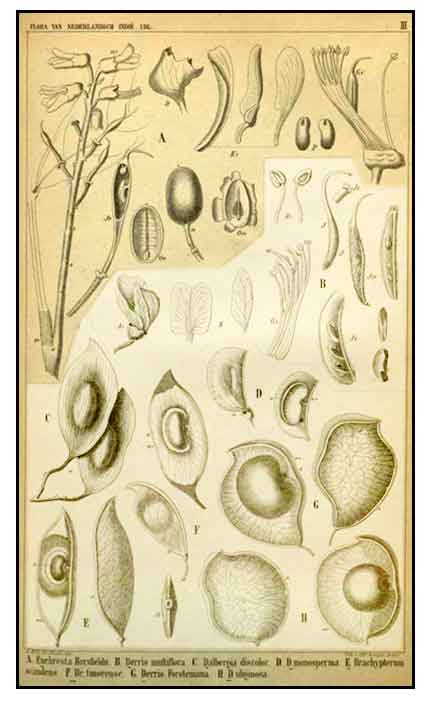
Euchresta is a genus of flowering plants in the Fabaceae family. Euchresta horsfieldii is its type genus.
- Euchresta horsfieldii is a
species of pea first described by Jean Baptiste Leschenault de la Tour, and given its current name by John Johannes Joseph Bennett.
Botany
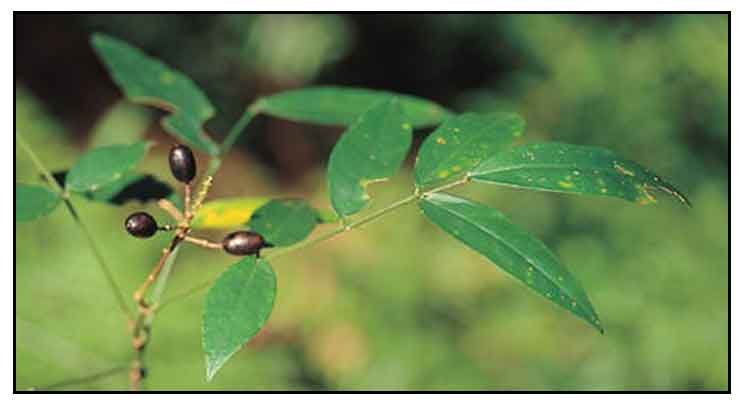
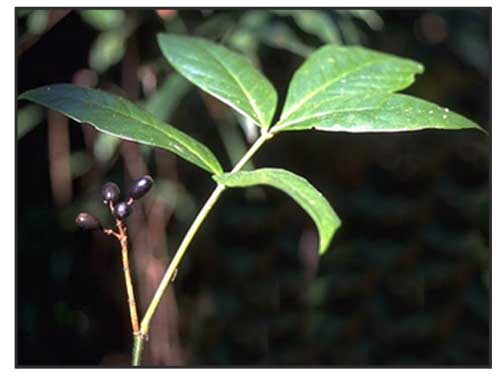
• Laguan is an erect, tough, unarmed shrub about 0.5 to 1.5 meters high. Leaves are alternate, smooth, long-petioled, and odd-pinnate, with 3 to 5 leaflets which are oblong, 10 to 15 centimeters in length, often rounded at the base and pointed at the tip. Flowers are borne in considerable numbers in simple, peduncled, axillary racemes. Corolla is white, about 1.25 centimeters long or twice the length of the calyx. Pods are oblong, 1 to 2 centimeters long, and very turgid, purplish black when mature, and contain a single, large seed.
• Erect shrub to 1.5 m tall; young shoots and inflorescence axes puberulous. Leaves alternate, imparipinnate, usually 5-foliolate; petioles (including rachis) 15–20 cm long, longitudinal grooved and sharply ridged or narrowly winged above. Leaflets opposite, coriaceous, elliptic, obovate to oblong, 8–20 by 3.5–8.5 cm, the terminal one the largest, apex abruptly acute to acuminate, base cuneate, upper surface dark green, glabrous, lower surface pale, puberulous; midrib sunken above, prominent beneath; lateral veins very thin, 6–8 pairs, reticulation inconspicuous; petiolules very short or sessile. Inflorescence terminal, racemose sometimes leaf-opposed, 3–5 cm long (up to 15 cm long in fruit). Flowers white; pedicels ca 5 mm long, hairy. Calyx tubular, very oblique and gibbous at the back, deflexed against the pedicels, ca 1 m long, hairy; teeth 5, shallowly dentate. Corolla: standard narrowly oblong-obovate, ca 18 by 5 mm, emarginate, gradually narrowed into a long claw; wings oblong, ca 16.5 by 4 mm, obtuse, with a long claw; keel ± as long as wings. Stamens 10, diadelphous. Ovary long stipitate, glabrous. Pods oblong-ellipsoid, 1.5–2 by 1.3–1.5 cm, purplish black, glossy; pericarp thin; stipe ca 1 cm long. Seeds oblong, ca 15 by 8 mm; testa very thin, fragile. (eFlora of Thailand)
Distribution
- Native to the Philippines.
-
Of local occurrence on the higher mountains from northern Luzon to Mindanao.
- Also native to Assam, China South-Central, East Himalaya, Jawa, Laos, Lesser Sunda Is., Myanmar, Sumatera, Thailand, Tibet, Vietnam.
 Constituents Constituents
- Seeds contain cytisine.
- Study isolated two new prenylflavanones, euchrenones a7 and a8 from the roots and stems.
- Study yielded 40 chemical compounds. The highest, kaur-16-ene, was found in the root (51.29%) and stem (36.13%). Palmitic acid was 16.7% in roots, 34.79% in stems, 23.55% in leaves, 13.79% in skin of seed,
and 36.13% in seeds. Vitamin C was highest in the seed skin. (3)
- Roots yielded three new flavonoids, viz., 5,2',4'-trihydroxy-6-(3,3-dimethylallyl-6''',6'''-dimethylpyrano[2''',3''':7,8)] flavanone(euchrenone a9),5,4'-dihydroxy-6(3,3-dimethylallyl)-5'''-hydroxyisoproyldihydrofurano [2",3":7,8]isoflavone(euchrenone b10) and 2-methoxymaackiain, together with known compounds kushenol E, 6,8-di(3,3-dimethylallyl)genistein, osajin, warangalone, derrone 4'-O-methyl ether, alpinumisoflavone 4'-methyl ether and feruloyl hexadecayl ester. (4)
- GC-MS analysis of seed extract yielded 9 compounds, among which were eugenol 17%, terpenoid compounds (trans-caryophyllene 17.55% and a-humulene 1.67%),
and carboxylic acid group (hexadecanoic acid 1.30%, 9.12-hexadecadienoic acid 3.66%, hexanedioic acid 10.06%, and 1,2-benzenedicarboxylic acid 2.30%.), along with the alkaloid compound (matrine 8.45%). (see study below) (7)
- GC-MS analysis of stems, roots, and seeds of E. horsfieldii revealed mome inositol, sophoridane, and fally acids such as palmitic acid and stearic acid as main components. Roots revealed most varied constituents with alkaloids, tannins, flavonoids, saponins, and terpenoids.
(see study below) (11)
- Study of stems isolated four prenyl (=3-methyl-2-butenyl)isoflavones, euchrenones b6-b9,
along with four known isoflavones (warangalone, osajin, 6,8-di(3-methyl-2-butenyl)genistein and 8-O-methylretusin) and two pterocarpans (maackiain and sophoracarpan B). (14)
Properties
- Seeds are bitter and poisonous.
- Considered tonic and aphrodisiac.
- Study has shown
hypolipidemic, antioxidant, antidiabetic, antibacterial, alpha-glucosidase inhibitory properties.
Parts used
Roots, leaves, fruit, seeds.
 Uses Uses
Edibility
- Not consumed as vegetable or dietary food
-
Seeds are bitter, considered poisonous in large amounts. However, traditional practitioners in Bali and Java use small amounts of seeds and fruits in preparation of traditional tonics for stamina and body freshness.
Folkloric
- In the Philippines, roots are chewed as a cure for snake bites.
- Plant used as antidote for poisons of any description.
- Leaves used for treatment of diabetes, asthma, hemoptysis and cough. Also used as snake venom antidote
and to induce vomiting in food poisoning. (9)
- Seeds are used for diseases of the chest.
- Although considered poisonous,
used as a tonic and aphrodisiac.
- In Bali, Indonesia, pranajiwa seeds and fruits are commonly used for body freshness and stamina. (11)
Others
- Black magic: In Bali,, use as oral and non-oral medicine for medical and non-medical diseases (black magic). (12)
Studies
• Hypolipidemic / PPARα Activation / Fruit: Study of EH fruit extracts showed significant PPARα activation, increased PPARa target gene expression and regulated protein expression for lipid metabolism. Results indicate that E. horsfieldii shows potential as a natural lipid-lowering agent. (1)
• Antidiabetic / Antioxidant / Leaves: Study showed E. horsfieldii leaf extract can prevent oxidative stress by decreasing the levels of MDA (malondialdehyde) and can improve the histopathological profile of pancreatic ß-cell damage in alloxan induced diabetic Wistar rats at 140 mg/kbw dose. (5)
• Antioxidant Capacity / Effect on SOD and GPx Activities: Study evaluated the effect of an ethyl acetate extract of E. horsfieldii leaves on increasing activity of SOD (superoxide dismutase) and GPx in blood plasma of Wistar rats with maximum physical activity. Results showed antioxidant capacity with IC50 of 393.95 mg/l on DPPH assay and total flavonoid level of 6619.72 mg QE/100g or 6.62% QE. (6)
• Antihyperglycemic / Repair of Damaged Pancreatic ß-Cells / Seeds: Study evaluated the effectiveness of seed extract in repairing ß-cell pancreatic damage in alloxan induced hyperglycemic Wistar rats. Results showed pranajiwa seed extract at 5mg/kbw reduced the rate of ß-cell destruction and structural changes of pancreatic ß-cell tissue histopathology in the Wistar rats. (see constituents above) (7)
• Antibacterial / Stems, Roots, Seeds: Study evaluated the phytochemical content and antibacterial activity of roots, stems, seeds, and leaves of E. horsfieldii. Stems and roots showed antibacterial activity against S. aureus Inacc-B-334 and S. aureus InaccB4, whille seeds showed activity against B. subtilis Inacc-B-334 and S. aureus InaccB4. Results suggest potential of E. horsfieldii as alternative source of antibacterial agents. (see constituents above) (11)
• Alpha-Glucosidase Inhibitory / Antioxidant / Leaves, Fruits, Stems, Roots, Seeds: Study evaluated methanolic extracts of all parts of E. horsfieldii. Results showed the leaf extract exhibited the highest antioxidant activity with IC50 215.11 µg/ml. Root extract showed highest alpha-glucosidase inhibitory activity and total phenolic content with IC50 29.76 µg/ml and 763 mg GAE/100mg dry extract. Results suggest a potential source of antioxidant and alpha-glucosidase inhibitor agents. (13)
Availability
Wild-crafted.
Herbal capsules in the cybermarket.
|