
HOME      •      SEARCH      •      EMAIL    •     ABOUT


Family Convolvulaceae
Lakmit
Distimake vitifolius (Burm. f.) Pisuttimarn & Petrongari
GRAPE-LEAF WOOD ROSE

Zhang ye yu huang cao

Scientific names Common names
Camonea vitifolia (Burm. f.) A.R.Simões & Staples Kalalakmit (Sul.)
Convolvulus angularis Burm.f. Lakmit (Tag.)
Convolvulus vitifolius Burm.f. Grape-leaf wood rose (Engl.)
Distimake vitifolius (Burm.f.) Pisuttimarn & Petrongari Grapeleaf merremia (Engl.)
Ipomoea angularis (Burm.f.) Choisy  
Ipomoea vitifolia (Burm.f.) Sweet  
Ipomoea vitifolia Burm.f.  
Ipomoea vitifolia var. angularis (Burm.f.) Choisy  
Merremia vitofolia (Burm. f.) Hallier f.  
Merremia vitifolia (Burm. f.) Hallier f. is an synonym of Disstimake vitifolius.
Distimake vitifolius is an accepted species. KEW: Plants of the World Online

Other vernacular names
BANGLADESH: Dudh lota.
CAMBODIA: Var moba mek.
CHINESE: Zhang ye yu huang cao.
INDIA: Navli (Marathi); Digi-lewa, Toskrai-rikang (Mikir); Gajaudi-doukha, Dijaobideing (Kachari); Parnemrang (Kuki); Dukhumi-bidu (Garo); Manja kolambi valli, Manja vayaravalli (Malayalam); Thiannu (Mizo).
INDONESIAN: Ginda purang utang, Areuy kawoyang, Dewulu, Bilajang bulu.
MALAYSIA: Akar lulang bulu, Ulan raya, Lulang bulu.
THAI: Ching chaw, Jingjoa, Jing-jor.
VIETNAMESE: B[if]m l[as]nho.

Gen info
• Distimake vitifolius is a species of climbing herbaceous vine in the family Convulvulaceae, native to topical and subtropical Asia, thriving in wet tropical biomes as a perennial twiner with stems reaching up to 4 meters in length. (11)
• Previously known as Camonea vitifolia or Merremia vitifolia, the plant was reclassified into the genus Distimake in 2023 base on phylogenetic and morphological analyses. (11)
Etymology: The genus name Distimake derives from Greek prefix "dis-," meaning twice, and "stigma," referring to the characteristic wide-branched (boglobose) stigma structure observed in species of the genus. Specific epithet vitifolius derives from Latin vitis (vine or grapevine) and folius (leaved), referring to the palmately lobed leaves resembling grapevines. (11)

Botany
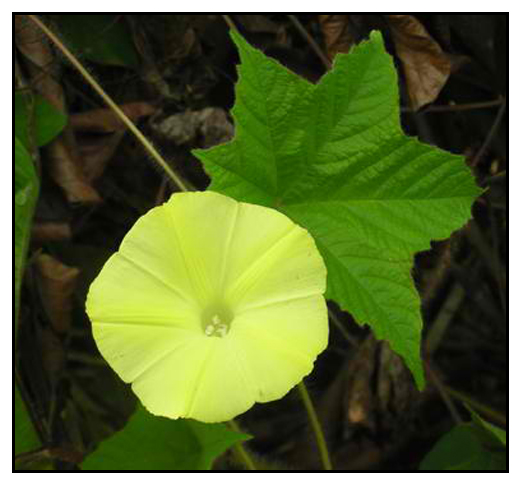
• Lakmit is a hairy, woody climber with slender stems. Leaves are rounded, 5 to 15 centimeters wide, palmately 5-lobed, and heart-shaped at the base. Sepals are hairy, ovate, 10 to 15 millimeters in length, and longer in the fruit. Corolla is yellow, bell-shaped, and 3.5 to 4 centimeters long. Capsule is rounded and 10 to 15 centimeters in diameter. Seeds are dark brown, smooth, about 5 millimeters in diameter.

• Grape-leaf Wood Rose is large twinning or prostrate herb. The stems are purplish when old, and grow to 4 m long. Leaf blade is circular in outline, 5-18 by 5-16 cm, cordate at the base, palmately 5-7-lobed. Flower-buds narrow-ovoid, acute. Flower tube is funnel shaped -6 cm long, glabrous, bright yellow, paler towards the base. Anthers spirally twisted. (Flowers of India)

Distribution
- Native to the Philippines.
- Found in the Laguna Province in Luzon; and in Palawan, Balabac, Semirara, and Negros, in open grasslands by deserted dwellings, and in thickets at low altitudes.

- Also native to Assam, Bangladesh, Borneo, Cambodia, China South-Central, China Southeast, East Himalaya, Hainan, India, Jawa, Laos, Lesser Sunda Is., Malaya, Maluku, Myanmar, Nepal, Nicobar Is., Sri Lanka, Sulawesi, Sumatera, Taiwan, Thailand, Vietnam. (2)
- Found both in regions with a feeble and in those with a rather strong dry season, in open grasslands, thickets, and hedges, along fields, in teak-forests, along edges of secondary forests, on river-banks and waysides.

Constituents
- Leaves yield a glycoside, which on hydrolysis yields hydrocyanic acid and benzaldehyde.
- Phytochemicals in stems and leaves include alkaloids, terpenoids, phenolic compounds, tannins, carbohydrates, saponins, and flavonoids. (6)
- Study of fraction of aqueous extract of leaves for secondary metabolites yielded alkaloid, carbohydrate, flavonoid, tannin, triterpenoids, and phenols. (see study below) (9)
- Phytochemical screening of methanolic extract from dried and powdered leaves revealed presence of alkaloids, flavonoids, saponns, tannins, phenolic compounds, and steroids. (see study below) (15)

Properties
- Hairs on the leaves are irritating.
- Juice considered diuretic and cooling.
- Studies have suggest anti-Staphylococcal, antioxidant, thrombolytic, antiarthritic, antinociceptive, antibacterial-enhancing, antipyretic, anthelmintic, hepatoprotective, hypoglycemic properties.

Parts used
Stem, roots, fruits, plant juice.

Uses

Edibility
- Juice considered cooling and is given with milk and sugar.
- Immature, unripe fruits are chewed.
Folkloric
- Infusion is drunk for high fevers.
- Juice used for poulticing soreness and inflammation.
- In
Kerala, India, used for strangury and urethral discharges—immature unripe fruits are chewed or roots are cooked and eaten. (3)
- Roots ingested as stomachic.
- In Konkan, juice given with milk and sugar for fevers.
- In Peninsular Malaysia, infusion is drunk for high fever
- In Cambodia, infusion of stem used internally and externally for malaria and small pox.

- The Khasia and Bengali folk practitioners of Khakiachora village in Sylhet district of Bangladesh apply macerated whole plant to insect bite areas. (5)
- Used by people in Luwu, Southern Sulawesi, Indonesia, ans cure for diabetes mellitus. (8)
- Used for treatment of malaria, small pox, high fever, stomach problems.
Others
- Sahasthara: Sahasthara is a Thai traditional medicine derived from Ayurveda. Merremia vitifolia is one of 21 plant ingredients in the Sahasthara formula used for muscle pain and as anti-inflammatory. (4)
- Agroforestry: The plant plays a role in supporting biodiversity in secondary forests and agricultural margins, with its woody stems and climbing habit aiding in habitat structuring. (11)

Studies
Prussic Acid Plant:
According to F. Weehuizen, Merremia vitifolia is another prussic acid plant, whose leaves have the distinct odor of bitter almond oil. It yields 0.04% prussic acid, which in addition to benzaldehyde can be split off enzymatically. (7)
Flavonoid Content:
Study evaluated the flavonoid content of M. vitifolia (Bilajang bulu). The sample was prepared from air-dried leaves by maceration method using 96% ethanol. Flavonoid content by spectrophometry UV-Vis, using quercetin as standard, yielded a flavonoid content of 163.4 mg/L or equivalent to 0.01634%. (8)
Antioxidant / Thrombolytic / Anti-Arthritic / Anti-Nociceptive / Leaves:
Study evaluated the biologic efficacy if aqueous fraction of leaves through invitro and invivo experimental models. The aqueous fraction showed strong antioxidant effects high scavenging activity (IC50 146.61 µg/ml) and reducing power in a dose dependent manner. Extract showed notable clot lysis effect and substantial anti-arthritic activity at higher doses (500 µg/ml). Anti-nociceptive activity in Swiss albino mice showed promising reduction of number of writhing and duration of paw licking in acetic acid induced writh8ing and formalin-induced paw licking in a dose dependent manner. (see constituents above) (9)
Anti-Staphylococcus aureus / Leaves:
Study evaluated the activity of ethanol extract of the leaves of Bilajang Bulu Merremia vitifolia against Staphylococcus aureus bacteria. Results showed the 20% concentration gave the most optimal activity with an average 9.5 mm clear zone. (10)
Silver Nanoparticles / Enhanced Antibacterial Activity:
Study reports on the rapid, eco-friendly, easy, energy-efficient and cost-effective synthesis of silver nanoparticles using D. vitifolius extract. The AgNPs showed moderate antibacterial activity with inhibition of growth of amoxicillin-resistant P. aeruginosa with ZOI of 15.83 mm and K. pneumonia with ZOI of 10.03 mm. Antioxidant study of DV-AnNP suspension solution showed IC50 of 0.58 mM. IC50 of the crude extract was 752, categorizing it as very weak antioxidant activity. (12)
Antipyretic / Stem :
Study demonstrated the antipyretic activity of methanolic stem extract of M. vitifolia. The extract significantly reduced fever in mice. Molecular docking study yielded active compounds, particularly pheophorbide A and quercetin, which effectively bind to the COX-2 enzyme. Results support its traditional use and potential as a natural antipyretic agent. (14)
Antipyretic / Anthelmintic / Antioxidant / Hepatoprotective / Leaves:
Study evaluated the antioxidant, anthelmintic, antipyretic, and hepatoprotective effects of methanolic extract of M. vitifolia leaves. Compared to albendazole, extract at 100 mg/ml caused paralysis and death to Pheretima posthuma in 3± and 8± mins, respectively. In antipyretic study, extract showed significant dose-dependent reduction in fever at 400 mg/kg. In hepatoprotective analysis,the extract (400 mg/kg) significantly reduced ALT, ALP, and AST levels, suggesting effects comparable to silymarin. Histopath confirmed improved liver architecture, supporting the biochemical findings. (15)
Hypoglycemic / Hepatoprotective / Stem:
Study evaluated the hypoglycemic and hepatoprotective effects of M. vitifolia on animal models, using methanol stem extract at 200 and 400 mg/kg orally. The highest dose showed significant (p<0.01) reduction in blood glucose, with maximum glucose reduction of 52.1% at 400 mg/kg extract with 3.5 mmol/L, compared to reference glibenclamide (10 mg/kg) at 25.2% reduction with 4.4 mmol/L. Reduction of alkaline phosphatase and alanine transaminase were moderately (p<0.01) and minimally (p<0.05) significant at 400 mg/kg, respectively. (16)

Availability
Wild-crafted.

                  Abuse and Plagiarism of the Compilation on Philippine Medicinal Plants Under the Guise of Fair Use

Updated July 2026 / March 2020 / August 2016

PHOTOS / ILLUSTRATIONS
IMAGE SOURCE: Merremia vitifolia / Creative Commons: Attribution-NonCommercial 3.0 Unported (CC BY-NC 3.0) / Click on image to go to source page / Convolvulaceae Unlimited
IMAGE SOURCE: Distimake vitifolius / by Nativeplants garden / CC BY-SA 4.0 International / Click on image or link to go to source page /Wikimedia Commons
IMAGE SOURCE: Merremia vitifolia / by Jeevan Jose (Jee & Rani Nature Photography) / CC BY-SA 4.0 International / Click on image or link to go to source page / Wikimedia Commons
IMAGE SOURCE: Merremia vitifolia / by Vengolis / CC BY-SA 3.0 Unported / Image modified / Click on image or link to go to source page / Wikimedia Commons
Additional Sources and Suggested Readings
(1)
CONVOLVULACEAE / Merremia Dennst. ex Endl.
/ Gen. Pl., Suppl. 1: 1403 (1841).
(2)
Distimake vitifolius / KEW: Plants of the World Online
(3)
WILD EDIBLE CONVOLVULACEAN MEMBERS USED BY THE ULLADA TRIBES OF ALEPPEY DISTRICT, KERALA / Joseph M.A*and AntonyV.T / Journal of Science, Vol 4, Issue 7 (2014) pp 425-427.
(4)
ANTI-INFLAMMATORY ACTIVITY OF THAI TRADITIONAL REMEDY EXTRACT FOR MUSCLE PAIN TREATMENT CALLED SAHASTHARA AND ITS PLANT INGREDIENTS / MR. NARIN KAKATUM / Thesis / 2011
(5)
Medicinal Plants Used by the Folk and Tribal Medicinal Practitioners in Two Villages of Khakiachora and Khasia Palli in Sylhet District, Bangladesh / Md. Enamul Kabir Shaheen, Md. Afser Syef, Sudhangshu Shekhar Saha, Md. Shariful Islam, Md. Din Al Hossain, Md. Ariful Islam Sujan, Mohammed Rahmatullah /
Advances in Natural and Applied Sciences, 2010; 5(1): pp 9-19
(6)
PHYTOCHEMICAL SCREENING OF SELECTED SPECIES FROM CONVOLVULACEAE / MARIA EMILIA MASCARENHAS*, CIBANI RAMESH MANDREKAR, PRATIKSHA BHARAT MARATHE, LUENA JOEY MORAIS /
International Journal of Current Pharmaceutical Research, 2017; 9(6) / DOI: http://dx.doi.org/10.22159/ijcpr.2017v9i6.23438
(7)
Annual Report on Essential Oils, Synthetic Perfumes, & C . . . / Schimmel & Co. Aktiengesellschaft, Miltitz bei Leipzig / Google EBook
(8)
Analysis of Flavonoid Contents from Extracet Ethanol Bilajang Bulu Leaf (Merremia vitifolia) / Ella Hasanah, Ni Komang Ayu, Dela Puspila, Sukarti / Indonesia Chimica Acta, June 2019; 12(1)
(9)
Pharmacologic insights into Merremia vitifolia (Burm.f.) Hallier f. leaf for its antioxidant, thrombolytic, anti-arthritic and anti-nociceptive potential / Sahida Akter, Israt Jahan, Mst Riniara Khatun, Mhammed Forhad Khan, Laiba Arshad, Md Jakaria, Md Areeful Haque / Bioscience Reports, 2021; 41(1): BSR20203022 / DOI: https://doi.org/10.1042/BSR30303022
(10)
Activity Test of Leaf Ethanol Extract Bilajang Bulu Merremia vitifolia Againsts Staphylococcus aureus Bacteria / Ella Hassanah, Sukarti, Ni Komang Ayu, Dela Puspita / Al-Kimia, 2020; 8(1): pp 29-35 /
DOI: 10.24252/al-kimiav8i1.6368
(11)
Distimake vitifolius / Grokipedia
(12)
Silver Nanoparticle Biosynthesis using Distimake vitifolius Extract for Enhancement of Antibacterial and Antioxidant Activity / Candra Yulius Tahya, Karnelasatri Karnelasatri, Wahyu Irawati, Sri Wahyu Ningsih Munthe / Molekul, 2024; 19(2): 281 / DOI: 10.20884/1.jm.2024.19.2.10295
(13)
Grape-leaf Wood Rose / Flowers of India
(14)
Exploring the antipyretic efficacy of Merremia vitifolia (Burm. fil.): from traditional use to molecular docking insights / Fakhrul Islam, Muhammad Tawhid, Md Estiac Jan, Muhammed Amanat, Khamender Kumar / Discover Plants, 2025; 2(Art 213) / DOI: 10.1007/s44372-025-00301-5
(15)
An insight into the Phytochemistry, antioxidant, anthelmintic, antipyretic, and hepatoprotective effects of Merremia vitifolia leaves: A trailblazing approach / Tania Sultana, Nor Mohammad, Anwar Parvez, Md Hasanuzzaman et al / Journal of Pharmacognosy and Phytochemistry, 2025; 14(1): pp 299-308 /
DOI: 10.22271/phyto.2025.v14i1d.15251
(16)
HYPOGLYCEMIC AND HEPATOPROTECTIVE EFFECT OF MERREMIA VITIFOLIA IN MICE / Kawser Ahmed, Mohammad Hasanuzzaman, Prodip Kumar Baral / International Journal of Pharmaceutical Sciences and Research, 2024 / DOI: 10.13040/IJPSR.0975-8232.15(8).2314-19
 

DOI: It is not uncommon for links on studies/sources to change. Copying and pasting the information on the search window or using the DOI (if available) will often redirect to the new link page. (Citing and Using a (DOI) Digital Object Identifier)

                                                            List of Understudied Philippine Medicinal Plants
                                          New plant names needed
The compilation now numbers over 1,750 medicinal plants. While I believe there are hundreds more that can be added to the collection, they are becoming more difficult to find. If you have a plant to suggest for inclusion, native or introduced, please email the info: scientific name (most helpful), local plant name (if known), any known folkloric medicinal use, and, if possible, a photo. Your help will be greatly appreciated.

HOME      •      SEARCH      •      EMAIL    •     ABOUT