
HOME      •      SEARCH      •      EMAIL    •     ABOUT


Family Ericaceae
Logaway
Gaultheria leucocarpa Blume
WINTERGREEN
Bai guo bai zhu

Scientific names Common names
Brossaeae leucocarpa (Blume) Kuntze Logaway (Bagobo)
Gaultheria leucocarpa Blume Wintergreen (Engl.)
Accepted infraspecifics (5)  
Gaultheria leucocarpa var. hirta Valeton ex J.J.Sm.  
Gaultheria leucocarpa var. leucocarpa  
Brossaeae bandongensis Kuntze  
Gaultheria leucocarpa f. pubescens J.J.Sm.  
Gaultheria leucocarpa var. melanocarpa J.J.Sm. ex Steenis  
Gaultheria leucocarpa f. melanocarpa J.J.Sm. ex Amshoff  
Gaultheria leucocarpa var. psilocarpa (H.F.Copel) Sleumer  
Gaultheria psilocarpa H.F.Copel  
Gaultheria leucocarpa var. seminuda J.J.Sm.  
Gaultheria bandongensis Zoll. ex Miq.  
Gaultheria leucocarpa f. scandens Hochr.  
Gaultheria leucocarpa Blume is an accepted species. KEW: Plants of the World Online
Note: Not uncommon in the nomenclatural ecosystem in the Philippines, common names are shared between Gaultheria leucocarpa and G. cumingiana: Logauai, among others.

Other vernacular names
CHINA: Bai guo bai zhu.
FRENCH: Petit the des pois.
INDONESIA: Gondopuro (Javanese); Kering, Cantigi bodas (Sundanese).
THAILAND: Chamayomdoi.
VIETNAME: Ch[aa]u th[uj].

Gen info
- Ericaceae are a family of flowering plants, commonly known as the heath or heather family, commonly found in acidic and infertile growing conditions. It is a large family with about 4,250 known species spread across 124 genera, making it the 14th most speciose family of flowering plants.
- Taxonomy: Antoine Laurent de Jussieu first used the term Ericaceae. The names derives from the Greek word ereike. While the exact meaning is unclear, some say it means "heather". The name was formalized when Linnaeus described Erica in 1753, and then again when Jussieu described Ericaceae in 1789. (3)
- Gaultheria is a genus of about 283 species of shrubs in the family Ericaceae.
- Etymology: The genus name Gaultheria commemorates Jean Francois Gaultier of Quebec, an honor bestowed by Scandinavian Pehr Kalm in 1748 and taken up by Carl Linnaeus in Species Plantarum.
- Leonardo Co's Database lists 16 Gaultheria species in the Philippines, of which 13 are endemic. (2)

Botany
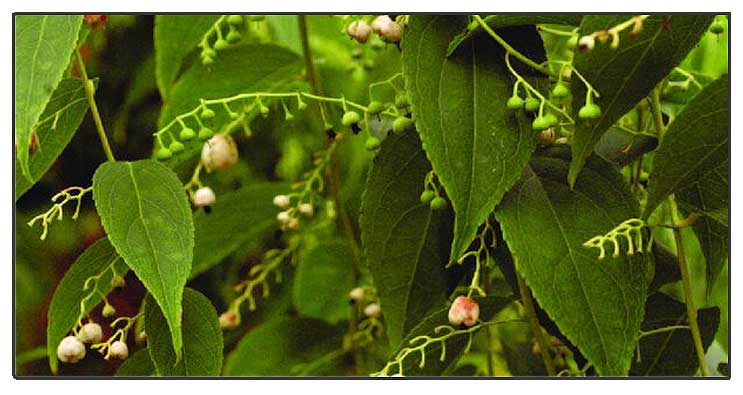
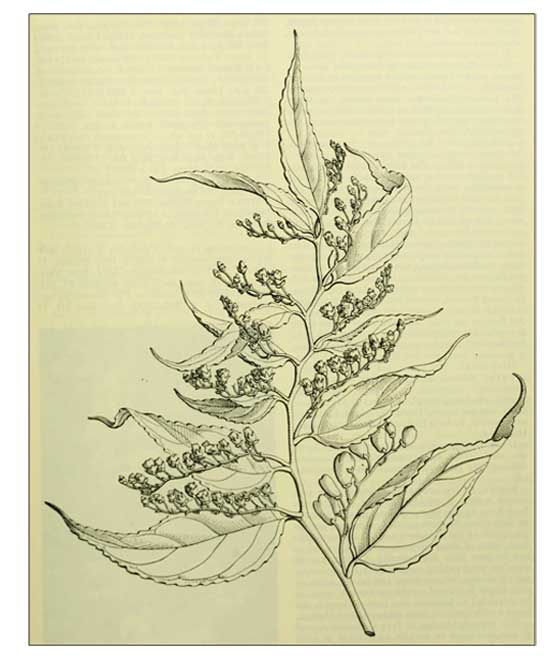
Shrubs erect, 0.5–2 m tall, glabrous. Twigs terete, often flexuous. Leaves scattered; petiole 3–8 mm; leaf blade ovate, elliptic, or oblong-lanceolate, 4–14.5 × 2–6.5 cm, papery, rarely thickly so, abaxially inconspicuously papillate, secondary veins 3 or 4 pairs, fine veins raised abaxially, slightly raised or slightly impressed adaxially, base obtuse to rounded or subcordate, margin serrate, apex acuminate to caudate-acuminate. Inflorescences axillary, racemose, 3–6(–10) cm, (1–)4–12-flowered, slender, often flexuous; bracts triangular-lanceolate, ca. 2.5 mm. Pedicel usually recurved, 3–9 mm; bracteoles apical, broadly ovate, densely ciliolate. Calyx lobes broadly triangular, ca. 1.5 mm, ciliolate. Corolla white, campanulate, 6–7 mm; lobes triangular, 1.5–2 mm. Filaments spindle-shaped, ca. 1.8 mm, papillate, glabrous; anthers 0.8–1.2 mm, thecae 2-awned. Ovary densely sericeous. Calyx at fruiting purplish black; capsule globose or depressed-globose, 4–7 mm in diam., tomentellous. (Flora of China)

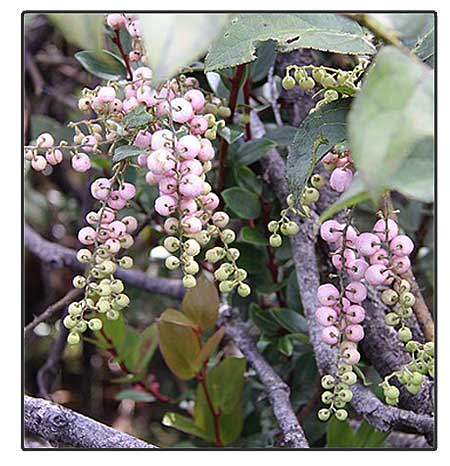
• Slender shrub, 0.25—2(—3) m tall, climbing or somewhat decumbent. Branches flexuous, often pendulous; branchlets reddish or purplish. Leaves arranged spirally; petiole 3—9 mm long, purplish; blade ovate to lanceolate-ovate, 3.5—14 cm x 2—6.5 cm, base mostly subcordate, margin regularly, obtusely crenate-serrate with glandular, orange teeth, apex long acuminate to subcaudate, with a small terminal gland, firmly coriaceous, dull dark green above, paler beneath, glabrous or pubescent beneath. Inflorescence a simple, axillary, lax raceme, up to 10 cm long, many-flowered, glabrous or densely pubescent; pedicel recurved, 3—10 mm long; bracts and bracteoles ovate-lanceolate, ciliate; calyx about 2.5 mm long, deeply 5-partite, glabrous on both sides or puberulous inside, lobes ciliate and pale green or red; corolla campanulate, 3—4 mm long, usually glabrous, whitish. Fruit 6—9 mm in diameter, white, rose-tinged or red to black-purple. Seed triangular-obovoid, 0.5 mm long, brown. (PROSEA)

Distribution
- Native to the Philippines. (1) (2)
- In Luzon: Benguet, Laguna; in Mindanao: Bukidnon, Davao, Davao del Sur; Mindoro, Negros.
- 1300-3000 m.
- Also native to Jawa, Malaya, Sumatera, Taiwan, Vietnam. (1)

Constituents
- Main constituent of wintergreen oil is methyl salicylate. Oil from this species contain 96% methyl salicylate. (5)

Properties
- Fresh leaves and flowers are hardly scentless, but the characteristic odor reveals when crushed and stored for a short time. Methyl salicylate is then formed by hydrolysis of glycosides. (5)
- Concerns: Used in small amounts, the essential oil is rated GRAS (generally recognized as safe) in America. In large amounts, the main constituent of the oil - methyl salicylate - is toxic and may cause problems similar to those caused by high doses of aspirin. (5)
- While leaves and flowers of several Gaultheria species yield wintergreen oil, Gaultheria dose so similarly, but yields much less wintergreen oil. (6)
- Studies have suggested anti-Alzheimer's, antimalarial properties.

Parts used
Rhizomes, leaves.

Uses

Edibility
- Fruit of Gaultheria species is edible, raw or cooked.
- Herbal tea is made from fermented leaves. (5)
Folkloric
- No reported folkloric medicinal use in the Philippines.
- In Chinese traditional medicine, used for treatment of rheumatoid arthritis, swelling, and pain.
- The variety G. leucocarpa yunnanensis is widely used medicinally in southern China (tou gu cao) for its rich content of salicylic acid. (5)
- Leaves used in traditional medicine for treatment of cough, tuberculosis, fever and pain.
- Decoction of rhizomes used for to resolved clots and bruising, stimulate blood circulation, and promote bone-knitting and tissue repair. Used for treatment of cirrhosis, ascites, traumatic injuries, rheumatoid arthritis, and pains in the back and joints. Leaf paste applied externally for chest complaints. Also used as prophylactic before and after childbirth. Leaves used for treatment of cough, tuberculosis, fever and pain. (5)
Others

- Wintergreen oil: Leaves and flowers of Gaultheria species yield wintergreen oil. The oil was extensively used to flavor drink, best known use in root beers and cola drinks. Also used for candles, chewing gum and toothpaste. (5)
- Scent use: Oil is a component of insecticidal and insect repellent preparations.
- Crafts: Seeds used in handicrafts. (5)

Studies
Neuroprotective / Anti-Alzheimer's / Inhibition of Aß Fibril Formation:
Alzheimer's disease (AD) pathology involves amyloid-beta (Aß) accumulation and neuronal toxocity. Study identified G. leucocarpa as a medicinal plant with promising neuroprotective potential. G. leucocarpa extract (GE), especially the GPF fraction, significantly inhibited Aß fibril formation. The GPF improves the viability of PC-12 cells treated with Aß peptides and fibrils. GPF activates mitophagy through AMPK-mTOR pathway, promoting degradation of AD-related proteins. GPF alleviates AD-related pathology and behavioral defects via mitophagy induction in C. elegans. (7)
Antimalarial: Study evaluated the antimalarial activity of 25 herbal medicines from west Yunnan. Plant materials were extracted with 75% ethanol and water using reflux method. Dried samples were screened for anti-malarial actiity using an assay of inhibition of ß-hematin formation. Twelve plants, including G. leucocarpa, showed weak to moderate activity to inhibit ß-hematin formation. Ethanol and aqueous extracts of G. leucocarpa showed moderate bioactivity, with IC50 over 1388.9 µg/ml, with inhibition rates of 46.0 and 45.4 at concentration of 1,388 µg/ml. (8)

Availability
- Wild-crafted.

July 2026

                                                 PHOTOS / ILLUSTRATIONS
IMAGE SOURCE: Fruiting branchlets of Gaultheria leucocarpa with immature fruits / © L Zhou / Non-commercial use / Image modified / Click on image or link to go to source page / ResearchGate
OTHER IMAGE SOURCE: Gaultheria leucocarpa / by gbohne / CC BY-SA 2.0 / Image modified / Click on image or link to go to source page / Wikimedia Species
OTHER IMAGE SOURCE: Illustration: Gaultheria leucocarpa / Fig 67: Branch with flowers and fruits / Image modified / Click on image or link to go to source page / Useful Temperate Plants

Additional Sources and Suggested Readings
(1)
Gaultheria leucocarpa / KEW: Plants of the World Online
(2)
Ericaceae: Gaultheria leucocarpa / Co's Digital Flora of the Philippines
(3)
Ericaceae / Wikipedia
(4)
Gaultheria / Wikipedia
(5)
Gaultheria leucocarpa / Ken Fern: Tropical Plants Database / Useful Tropical Plants
(6)
Gaultheria leucocarpa / LSL Chua, S Sunarti / PROSEA: Plant Resources of South-East Asia
(7)
Gaultheria leucocarpa inhibits Aβ fibrillization and enhances mitophagy-mediated degradation of pathogenic proteins / Yue Zhang, Lan Deng, Jing Wei, Anguo Wu et al / Neurotherapeutics, 2025; 22(6): e00721 / DOI: 10.1016/j.neurot.2025.e00721 / PMID: 40817000 / PMCID: PMC12664514
(8)
Evaluation of the antimalarial activity of 25 herbal medicines from west Yunnan. /
Xiao Chaojiang, Xu Mei, Liu Ziqi et al / Zhongguo Bingyuan Shengwuxue Zazhi: Journal of Pathogen Biology, 2014; 9(6): pp 542-545

DOI: It is not uncommon for links on studies/sources to change. Copying and pasting the information on the search window or using the DOI (if available) will often redirect to the new link page. (Citing and Using a (DOI) Digital Object Identifier)

                                                            List of Understudied Philippine Medicinal Plants
                                          New plant names needed
The compilation now numbers over 1,750 medicinal plants. While I believe there are hundreds more that can be added to the collection, they are becoming more difficult to find. If you have a plant to suggest for inclusion, native or introduced, please email the info: scientific name (most helpful), local plant name (if known), any known folkloric medicinal use, and, if possible, a photo. Your help will be greatly appreciated.

HOME      •      SEARCH      •      EMAIL    •     ABOUT