|
Gen info
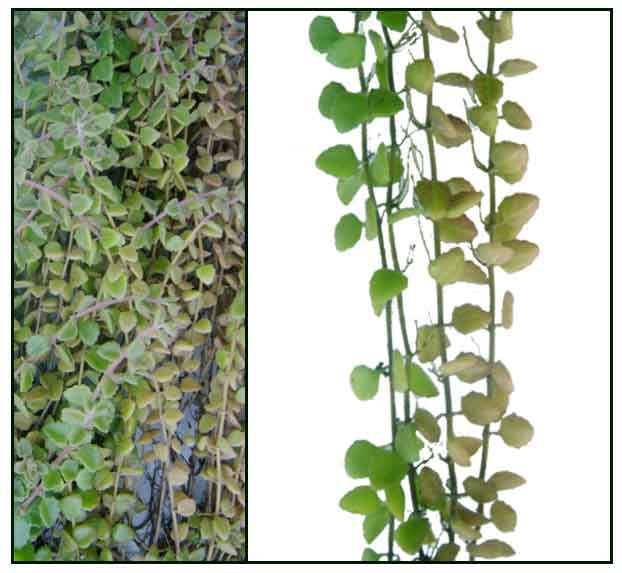
- Euphorbia is the third major genus of flowering plants, with about 2000 species with a worldwide distribution. At least 750 species occur in continental Africa and about 150 species in Madagascar and the Indian Ocean islands.
- More than 5% of the species of Euphorbia are used in traditional medicine, mainly as emetic and purgative agents, for treatment of digestive, respiratory, and skin disorders, among many others.
- In the IUCN Red List
of 243 threatened Euphorbia species, 170 (70%) are threatened with extinction. (26)
-
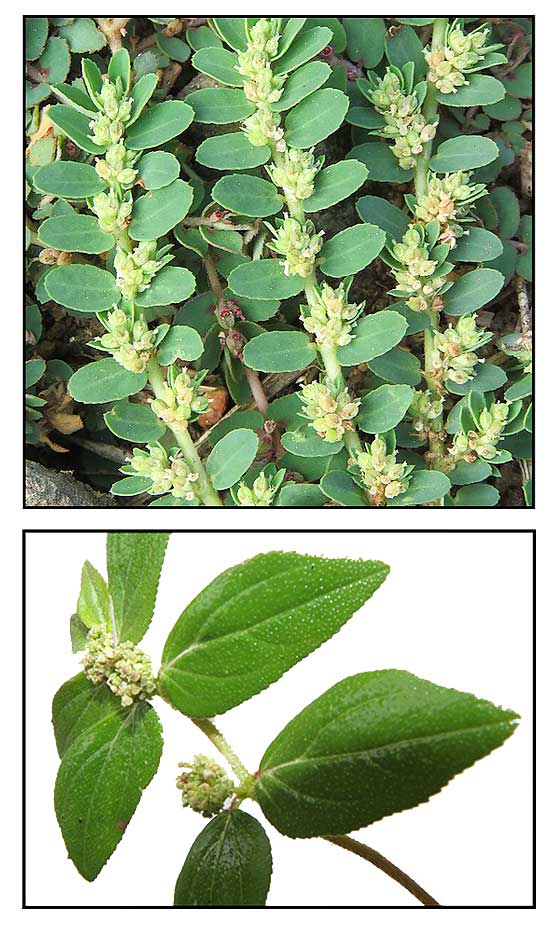
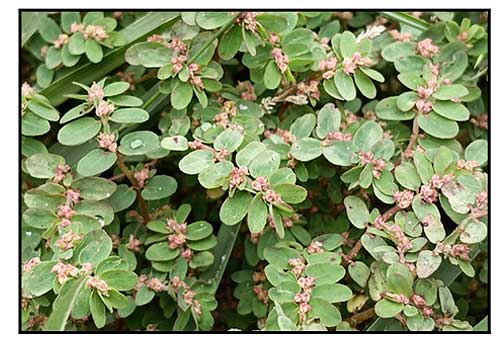
Euphorbia thymifolia, the red caustic-creeper, is a prostrate annual herb of the family Euphorbiaceae.
 Botany
• Makikitot is an annual, spreading or prostrate,
much branched, slender, smooth or somewhat hairy herb. Stems are usually
reddish, growing up to 20 centimeters in length. Leaves are opposite, distichous, somewhat oblique, elliptic to
oblong, 4 to 7 millimeters long and obscurely crenulate. Involucres are about 1 millimeter long, purplish and borne on
the axils of much reduced leaves or bracts on crowded short branchlets
from the leaf axils. Fruits are capsules, hairy, 3-angled and about 1.5 millimeters long.
• Herbs, annual, 10-20 cm tall. Root fibrous. Stems slender and thin, many from base, usually prostrate, 1-2(-3) mm thick, with many adventitious roots, sparsely pilose. Leaves opposite; stipules lanceolate or linear, 1-1.5 mm, easily fallen; petiole ca. 1 mm; leaf blade rounded or cordate, margin usually finely serrulate, occasionally entire, both surfaces pubescent. Cyathia single or numerous clustered and axillary, peduncle 1-2 mm, sparsely pilose; involucre campanulate to turbinate, ca. 1 × 1 mm, outside shortly pilose, marginal lobes 5, ovate; glands 4, appendage white. Male flowers few, slightly exserted from involucre. Female flower: pedicel short; ovary shortly pubescent; styles free; stigma 2-lobed. Capsule 3-angular-ovoid, ca. 1.5 × 1.3-1.5 mm, smooth, shortly pubescent. Seeds ovoid-tetragonal, ca. 0.7 × 0.5 mm, dark red, each side with 4 or 5 transverse furrows; caruncle absent. (Flora of China)
Distribution
- Introduced. (14)
- Naturalized. In open waste places, road sides, fallow rice paddies. (11)
- Pantropic.
- Native to Argentina Northeast, Argentina Northwest, Belize, Bolivia, Brazil North, Brazil Northeast, Brazil South, Brazil Southeast, Brazil West-Central, Colombia, Costa Rica, Cuba, Dominican Republic, Ecuador, El Salvador, Florida, French Guiana, Galápagos, Guatemala, Guyana, Haiti, Honduras, Jamaica, Leeward Is., Mexico Central, Mexico Gulf, Mexico Northeast, Mexico Northwest, Mexico Southeast, Mexico Southwest, Nicaragua, Panamá, Paraguay, Peru, Puerto Rico, Suriname, Trinidad-Tobago, Venezuela, Venezuelan Antilles, Windward Is. (14)
- A common weed of cultivated and waste ground, often on sandy or gravelly soils, up to 1650 m altitude.
Constituents
- Contains quercetin, a crystalline
alkaloidal principle.
- Studies revealed phenolics, tannins, flavonoids, steroids.
- Phytochemical screening yielded alkaloids, flavanoids, sterols, triterpenoids, and saponins. (17)
- Study of methanolic extract of whole herb isolated flavan-3-ol isomers, compounds 1 and 2, as catechin and epicatechin, respectively.
Catechins are the part of flavan-3-ols including (+)-catechin, (-)-epicatechin, (-)-ent-catechin, (+)-ent-epicatechin and their derivatives (C-3-O-esters). (21)
Properties
- Traditionally used as an aromatic, astringent, demulcent, stimulant,
vermifuge, antidermatoses, anthelmintic, and laxative.
- Slightly acidic tasting and cooling.
- Studies have suggested antimicrobial, antiviral, antispasmodic, anti-asthmatic, antifungal, anti-inflammatory, hypoglycemic,
antibacterial, anti-anaphylactic, CNS depressant, muscle relaxant, laxative, anthelmintic properties.
Parts
utilized
· Entire plant.
· Collect from May to October.
· Rinse and sun-dry.
 Uses Uses
Edibility
· No reports found on edibility.
· Generally considered inedible because of its toxic, caustic, and purgative milky latex.
Folkloric
· Acute bacillary dysentery,
enteritis, diarrhea: use 15 to 30 gms dried material in decoction.
· Anaphylactic dermatitis, eczema, skin pruritus: use decoction
of fresh material and apply as external wash.
· Poultices of leaves to counteract effects of snake bites.
· Leaves used as efficient vulnerary.
· Latex used for corneal opacities.
· Juice of powdered plants mixed with wine for venomous bites;
also applied externally to the bite.
· Mixed with ammonium chloride, used for dandruff and ringworm.
· Used for coughs as expectorant.
· In Konkan juice used for ringworm.
· In Indo-China plant used as a cathartic.
· In La Reunion plant used for diarrhea and dysentery.
· In Java infusion used for diarrhea and dysentery.
· Root decoction for amenorrhea and gonorrhea.
· Seeds and small leaves are aromatic and astringent and given in powder form for bowel complaints of children.
· In northern India used as stimulant and laxative.
· Javanese and Arabs use the leaves for wounds.
· Poultice of leaves applied to areas of dislocated bones and skin complaints.
· Used for asthma.
· In India, leaves
used as ingredient in vegetable soup for diarrhea, bleeding hemorrhoids.
Also, as anthelmintic.
· Latex used for ringworm, dandruff and boils.
· Root used for amenorrhea. Leaf as astringent in diarrhea.
· Leaf, seeds and latex used as purgative.
· In Ayurveda, plant pacifies vitiated vata, flatulence, constipation, bleeding hemorrhoids, chronic cough, asthma, bronchitis, skin disease.
· Dried leaves and seeds in butter-milk given to children for bowel complaints. (20)
· Oil used in medicinal soaps for treatment of erysipelas. (20)
· Plant juice applied with ammonium chloride for treatment of dandruff. (20)
- Widely used in Africa as decoction or infusion against dysent4ery, enteritis, diarrhea, and venereal disease. Decoction of aerial parts applied externally to treat dermatitis, eczema, and skin inflammations. Infusion of leafy stems taken as bitter diuretic. Latex drunk by women for treatment of menorrhagia (heavy menstruation). Plaster of crushed plants applied as plaster to treat sprains. Latex applied to warts.
In Sierra Leone, wet pulped leaves applied for headaches. Leaf decoction drunk for treatment of cystitis and kidney ailments In Cote d'Ivoire and Congo, whole plant decoction drunk for lung problems. In Congo, fresh ground leaves rubbed to treat intercostal pain. Infusion of macerated dried leaves drunk to facilitate childbirth, claimed to stimulate uterine contractions. In Mauritius, decoction of plant and seeds taken as galatagogue and for treatment of hypertension and venereal diseases. Decoction of whole plant drunk for treatment of amenorrhea; also used as eye wash to treat conjunctivitis. In Rodriguez, crushed plant applied to measles and skin eruptions. (22)
- In southern India, latex applied for treatment of ringworm and scabies. Plant also used for treatment of impotence. Crush plants rubbed on scalp
to strengthen skull bones of children to enable carrying of heavy loads as adults; also used as mild irritating rubefacient to treat alopecia. In Trinidad, plant decoction drunk to treat fever, influenza, hpertension, and venereal diseases. (22)
Others
· Repellent: Oil used as spray to repel flies and mosquitoes. (20)
· Veterinary: Oil used as vermifuge for dogs and farm foxes. (20)
Toxicity concerns
• Latex: Latex can cause contact dermatitis and blisters in sensitive individuals.
• Pregnancy: Strongly advised against used during pregnancy because of reported abortifacient properties due to uterine contraction-stimulating properties.
Studies
• Anti-viral: Study showed anti-HSV2 activity by inhibiting multiplication
through reduction of virus infectivity. (1)
• Review: Review
reports on antimicrobial activities, antibacterial against E coli
and S flexneri, antioxidant and antiviral (HSV2) activities, anti-lipid
peroxidation activity, free-radical scavenging, anti-superoxide radical
formation, etc. (2)
• Antioxidant / Anti-HSV-2 Activities: The water extract and pure compounds of E thymifolia exhibited superoxide radical and hydroxyl radical scavenging activities. Results concluded that ET possess antioxidant and anti-HSV2 activities. (3)
• Anthelmintic Activity: Study on the methanolic and aqueous extracts of Euphorbia thymifolia on Pheretima posthuma and Ascardia galli showed significant anthelmintic activity. (4) Ethanol extracts and and petroleum ether and ethyl acetate fractions showed significant anthelmintic activity against adult Indian earthworm Pheretima posthuma. (17)
• Diuretic / Laxative Activity: Study of crude ethanol extracts in albino rats showed significant diuretic and laxative activities with potentiation by the fractions. Furosemide and agar-agar were used as standards, respectively. (5) Study of crude ethanolic extract and fractions showed significant dose dependent diuretic activity. (20)
• Laxative Activity: Study of crude aqueous extract of Euphorbia thymifolia produced a significant laxative effect in a dose-dependent manner. (6)
• Anti-Inflammatory / Antioxidant: Study of an ethanolic extract of E. thymifolia showed significant anti-inflammatory activity by carrageenan-induced rat paw edema method and antioxidant activity through Nitric Oxide free radical assay. (16)
• Protection Against Female Reproductive Dysfunction / Antioxidant / Root: Study evaluated an ethanolic extract of root in treating stress induced female reproductive dysfunctions induced by Forced Swimming Stress and Restraint Stress methods. Results showed an antioxidant effect against stress induced female reproductive dysfunction. (18)
• CNS Depressant / Anxiolytic / Muscle Relaxant / Phytosterol: Study evaluated the CNS activity profile of an enriched phytosterol fraction using thiopental induced hypnosis, locomotor activity and rotarod testing. The Euphorbia thymifolia steroid showed marked CNS depressant and muscle relaxant activity with sub-maximal anti-stress and anxiolytic effect. (19)
• Flavon-3-ols / Catechin: Study of methanolic extract of whole herb isolated flavan-3-ol isomers, compounds 1 and 2, as catechin and epicatechin, respectively. Catechins are the part of flavan-3-ols including (+)-catechin, (-)-epicatechin, (-)-ent-catechin, (+)-ent-epicatechin and their derivatives (C-3-O-esters). (21)
• Anti-Anaphylactic / Antiasthmatic: Study evaluated the anti-anaphylactic, mast cell stabilizing and antiasthmatic activity of methanol and ethanol extracts of E. thymifolia (ET), 250 and 500 mg/kg p.o. to experimental animals. Anaphylaxis was inducted by horse serum and triple antigen vaccine I.P. to albino Wistar rats. Antiasthmatic activity was studied on histamine-induced bronchospasm in guinea pigs. In vitro mast cell stabilizing activity was evaluated on compound 48/80-challendged rat intestinal mesenteric mast cells. ET treatment produced significant decrease in asthma score and normalized increased total WBC, differential counts, serum IgE, TNF-α, IL-4, and IL-5 in BALF. Pretreatment with extract showed significant reduction in degranulation of mesenteric mast cell numbers. ET treatment significantly increased time of PCD (preconvulsive dyspnea). Results showed potential for treatment of anaphylaxis and asthma. (23)
• Wound Healing Gel: Study evaluated the wound healing potential of a gel formulation using extract of Euphorbia thymifolia. The gel showed wound healing potential superior to that of standard wound dressing. The gel was found non-irritant. Phytochemical screening of the extract revealed presence of flavonoids, tannins, alkaloids, and glycosides, contributing to its healing abilities. Further studies were suggested to evaluate mechanism of action. (24)
• Antimicrobial Bio-Responsive Hydrogel for Chronic Wound Environment: Study evaluated a smart hydrogel-based delivery system from a hydrogel formulated using bio-compatible poymers and incorporated with ethanol leaf extract of E. thymifolia. Formulation was designed to respond to pH shifts typically associated with infected wounds (alkaline pH 7.5-8.5), enabling controlled, localized antimicrobial release. Results showed broad spectrum antimicrobial efficacy with significant inhibition of S. aureus, P. aeruginosa, and C. albicans. A maximum of 88.6% bioactive release was observed under simulated infected conditions (pH 8.5). Results exemplify convergence of traditional phytotherapy and modern biometerial science. (25)
Availability
Wild-crafted.
|