
HOME      •      SEARCH      •      EMAIL    •     ABOUT


Family Apocynaceae
Melegates
Kibatalia maingayi (Hook.f.) Woodson
JELUTONG PIPIT

Scientific names Common names
Holarrhena daronensis Elmer Melegates (Zamboanga)
Kibatalia daronensis (Elmer) Woodson  
Kibatalia maingayi (Hook.f.) Woodson  
Paravallaris maingayi (Hook.f.) Kerr  
Vallaris daronensis (Elmer) Merr.  
Vallaris maingayi Hook.f.  
Kibatalia maingayi is an accepted species. KEW: Plants of the World Online

Other vernacular names
BORNEO: Bintuas, Mentaos, Pelai liling.
INDONESIA: Bentaos susuh (Palembang, Sumatra), Mengkelai (Bangka), Pulai liling (West Kalamintan.
MALAYSIA: Jelutong pipit.
 

Gen info
- Kibatalia is a genus of trees and shrubs in the family Apocynaceae, tribe Malouetieae, first described as a genus in 1826. (3)
- Etymology: The genus name Kibatalia derives from Sundanese words, combining ki, meaning "wood" and benteli, meaning "spear", referring to the traditional use of the wood for crafting spear shafts. The specific epithet maingayi commemorates William Grant Maingay (1836-18269), a British surgeon, naturalist, and prolific plant collector in the Malay Peninsula during the mid-19th century. (5)
- Kibatalia maingayi was first described by Joseph Dalton Hooker as Vallaris maingayi in Flora of British India in 1882, but was later transferred to the genus Kibatalia by Robert Everard Woodson in 1936. (5)

Botany
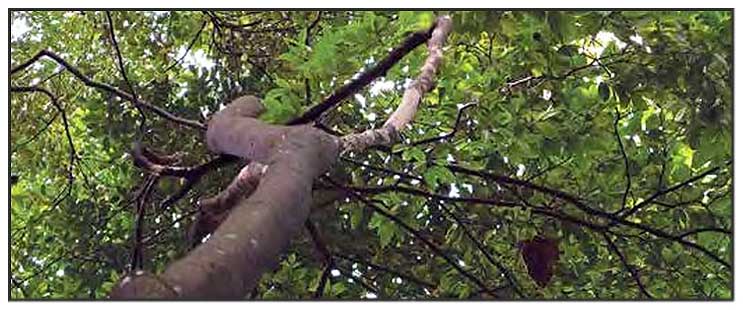
Kibatalia maingayi grows as a tree up to 40 meters (130 ft) tall, with a trunk diameter of up to 120 centimeters (50 in). The bark is pale brown, dark gray or whitish. Inflorescences bear up to 25 flowers. Flowers feature a white or pale yellow corolla. Fruits are cylindrical, up to 0.6 cm (0.2 in) long. (2)

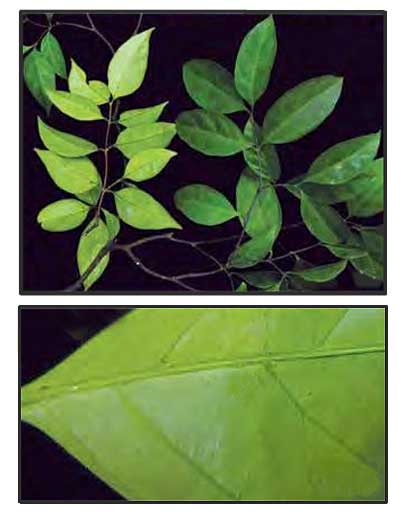
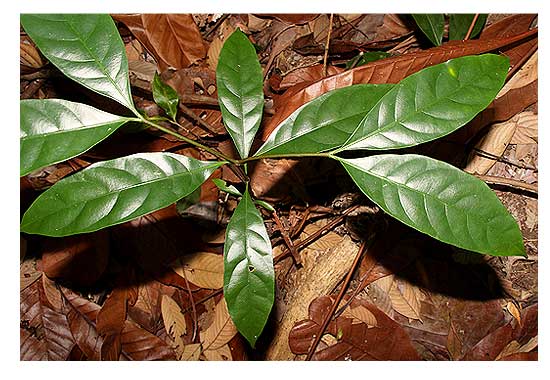
• Tree to 25 m. Branches transversely fissured; sparsely lenticellate; glabrous. Leaves: petiole 4–7 mm long; blade coriaceous to papery, elliptic, 5.4–12 x 1–4.5 cm, apex acuminate, base cuneate; glabrous. Inflorescence 3 cm long; 4–25 flowered. Sepals ovate, 1.7–2.1 x 1–1.2 mm, apex acute; ciliate, otherwise glabrous. Corolla white; tube 7–9 mm long; lobes 11–13 mm long, oblong; tube glabrous outside, pubescent inside; lobes pubescent on both surfaces. Stamens inserted at the top of the corolla tube; anthers 2.3–2.4 x 0.5–0.6 mm. Ovary pubescent, 1.4 mm long; style + pistil head glabrous, 3.5–7.3 mm. Fruit 8–50 x 0.4–0.6 cm. Seed grains 20–35 x 1.5–3 mm; beak 5–7 cm long; hairs 1–8 cm long. (eFlora of Thailand)

Distribution
- Native to the Philippines. (1) (2)
- In Mindanao: Agusan, Agusan del Norte, Davao, Davao del Sur, Lanao del Sur, Misamis Occidental, Zamboanga del Norte. (1)
- In forests at low elevation.
- Also native to Borneo, Malaya, Philippines, Sumatera, Thailand. (2)

Constituents
- Study of dichloromethane stem bark extract isolated seven compounds, including five amide alkaloids (2-6), one indoloquinazoline alkaloid (1), and one lignan (7). Among these are: N-benzoyl-L-phenylalanine methyl ester (3) recorded for the first time within the Apocynaceae family, while tryptanthrin (1), pinoresinol (7), and the remaining amide alkaloids are reported for the first time in the genus Kibatalia. (7)

Properties
- An understudied plant.
- Study have suggested antimalarial properties.


Parts used
Roots, leaves.

Uses

Edibility
- Kibatalia flowers are cooked and eaten as vegetable. (3)
Folkloric
- In the Philippines, leaves externally applied for treatment of enlarged spleen. (3)
Others

- Wood: Heartwood is while; texture is fine and even, straight-grained; soft, light in weight, not very durable, readily attacked by sapstain fungi. (4) Used for medium-heavy construction under cover; but more often for small objects like musical instruments, handicrafts, picture frames, utensils, toothpicks and matches, knife sheaths, and for carving. (3) (4)

Studies
Antiplasmodial / Alkaloids / Stem Bark:
Screening of chloroform extract of stem bark of K. maingayi showed antiplasmodial activity in vitro with IC50 of 1.1 µg/mL with selectivity index of 86.8. Wood extract showed weaker activity, but with abundance of alkaloids compared to the stem bark. A total of 20 metabolites were detected in the woods part of K. maingayi. Alkaloids were of the indole alkaloid class. Indole alkaloids like penduflorines A to E are known to have good pharmacological potential such as antiplasmodial activity. Study recommends characterization of the indole alkaloids to validate the dereplication of K. maingayi extract and investigate its biologic and antimalarial potential. (8)

Availability
- Wild-crafted.

March 2026

                                                 PHOTOS / ILLUSTRATIONS
IMAGE SOURCE: Kitabalia maingayi - Leaves / by loupok / CC BY-NC-ND / Click on image or link to go to source page / Useful Tropical Plants
OTHER IMAGE SOURCE: Kitabalia maingayi / © PKF Leong / From Singapore Botanic Gardens' Rain Forest, Chia et al. SING2018-788 / Non-commercial use / Click on image or link to go to source page / ResearchGate.Net

Additional Sources and Suggested Readings
(1)

Apocynaceae: Kitabalia maingayi / Co's Digital Flora of the Philippines
(2)
Kitabalia maingayi / Wikipedia
(3)
Kibatalia / PROSEA
(4)
Kibatalia maingayi / Ken Fern: Tropical Plants Database / Useful Tropical Plants
(5)
Kibatalia maingayi / Grokipedia
(6)
Kibatalia maingayi / PROSEA
(7)
Chemical constituents from Kibatalia maingayi (Apocynaceae) and its chemotaxonomic significance / Hidayatul Atiqah Abd Karim, Nor Hadiani Ismail, Ceh Puteh Osman et al / Biochemical Systematics and Ecology, 2026; Volume 125: 105209 / DOI: 10.1016/j.bse.2025.105209
(8)
Metabolites Annotation of Dichloromethane Extract of Kibatalia maingayi Woods using Orbitrap High-Resolution Mass Spectrometry / Hidayatul Atiqah Abd Karim, Nurulfazlina Edayah Rasol, Che Puteh Osman et al / Malaysian Journal of Chemistry, 2022; 24(4): pp 161-172 / Presented at the International Conference on Natural Products 2022 (ICNP 2022)

DOI: It is not uncommon for links on studies/sources to change. Copying and pasting the information on the search window or using the DOI (if available) will often redirect to the new link page. (Citing and Using a (DOI) Digital Object Identifier)

                                                            List of Understudied Philippine Medicinal Plants
                                          New plant names needed
The compilation now numbers over 1,750 medicinal plants. While I believe there are hundreds more that can be added to the collection, they are becoming more difficult to find. If you have a plant to suggest for inclusion, native or introduced, please email the info: scientific name (most helpful), local plant name (if known), any known folkloric medicinal use, and, if possible, a photo. Your help will be greatly appreciated.

HOME      •      SEARCH      •      EMAIL    •     ABOUT