Gen info
- Lamiaceae is a large and diverse family of flowering plants in the oder Lamiales, comprising approximately 236 genera and more than 7,000 species.
-
Mosla is a genus of about 20 species of aromatic annual herbs in the mint family Lamiaceae,
- The genus Mosla was first established by George Bentham in 1834. It was elevated to full generic status in 1875 by Carl Johann Maximowicz in his treatment of East Asian Labiatae, where he validated Mosla (Benth.) Buch.-Ham. ex Maxim based on Bentham's work. As of 2024, POWO accepts 15 species.
- Etymology: The genus name may be a direct Latinization of the colloquial Bengali and Assamese word Mosla, which translates to "spice" or "condiment". The specific epithet dianthera derives from Greek, literally translating to "two-anthered".
- The moniker miniature beefsteak plant is from its physical similarities to Perilla frutescens, the larger beefsteak plant. Both plants belong to the mint family Lamiaceae, and share deep-green to purplish-red leaves that resemble the color of red meat.
- In the Philippines, only one species is listed in Co's Digital Flora database, native Mosla dianthera
. (1)
 Botany Botany
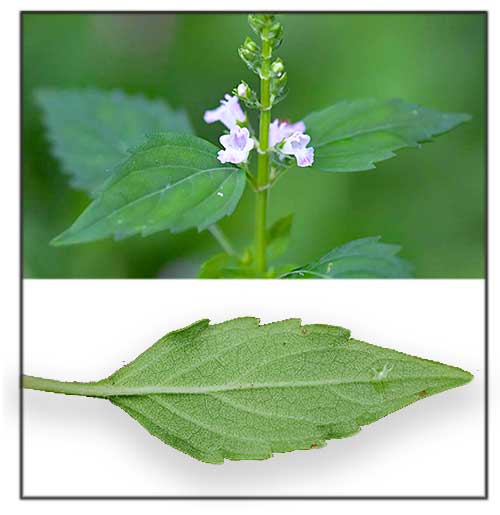
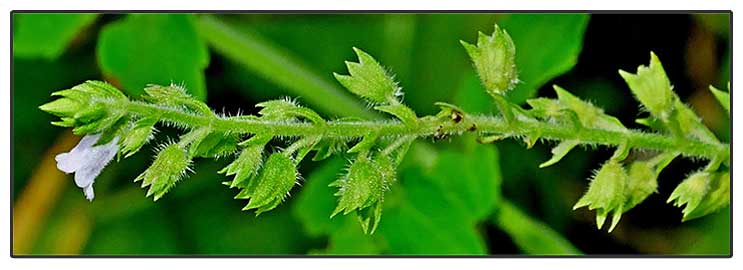
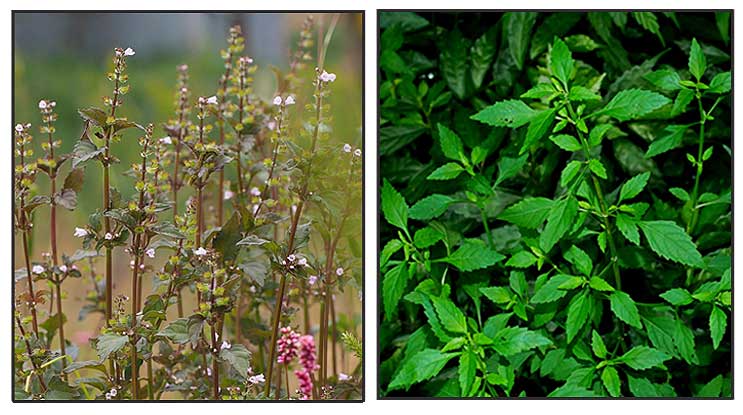
• Two-Flower Mosla is an annual, rather slender, pleasingly aromatic herb. Stems are usually branched, erect, 15-80 cm, quadrangular, leafy. Leaves are ovate, 25-35 x 15-20 mm, regularly sawtoothed, pointed, wedge-shaped, almost hairless. Leaf-stalks on lower leaves about 1.5 cm, less above. Inflorescence is unbranched to much branched. Verticillasters are 5-15, each with 2 flowers, often on one side. Bracts are narrow oblong-elliptic, 2-3 mm, as long as the flower-stalks. Calyx in flower about 1.5 mm, soon in fruit expanding to 5-5.5 mm with two lower lobes longer than the bell-shaped tube and a subentire-flat shortly 3-toothed upper lip, 10-nerved. Flowers are purplish or white marked pink or purple, inprominent, soon falling off, about 2-2.5 mm, upper and lower lobes weakly differentiated. Two-Flower Mosla is found in the Himalayas, N. India, east to China, Amur, Japan, Malaysia, at altitudes of 700-2100 m. (Flowers of India)
• Annual, rather slender, pleasingly aromatic. Stems usually branched, erect, 15-80 cm, quadrangular, with few very short retrorse hairs mainly on angles of stem, leafy. Leaves ovate, 25-35 x 15-20 mm, regularly serrate, acute, cuneate, glabrous or with a sparse indumentum of very short eglandular hairs, gland-dotted; petiole on lower leaves c. 15 mm, less above. Inflorescence unbranched to much branched. Verticillasters 5-15, each with 2 often secund flowers. Bracts narrow oblong-elliptic, 2-3 mm, as long as the pedicels. Calyx in flower c. 1.5 mm, soon in fruit expanding to 5-5.5 mm with two lower lobes longer than the campanulate tube and a subentire-truncate shortly 3-toothed upper lip, 10-nerved; indumentum of short pilose hairs, glabrescent, gland dotted; throat villous. Corolla purplish or white marked pink or purple, inconspicuous, soon deciduous, c. 2-2.5 mm, upper and lower lobes weakly differentiated. Stamens 2; thecae divergent. Nutlets brown, almost globose, c. 1.2 x 1.2 mm, with a prominent raised reticulum. (Flora of Pakistan)
Distribution
- Native to the Philippines. (1)
(2)
- In Luzon: Ifugao, Mountain Province. 1000-1800 m. (1)
- Also native to Amur, Assam, Bangladesh, China North-Central, China South-Central, China Southeast, East Himalaya, Japan, Khabarovsk, Korea, Kuril Is., Malaya, Manchuria, Myanmar, Nansei-shoto, Nepal, Philippines, Primorye, Sumatera, Taiwan, Transcaucasus, Vietnam, West Himalaya. (2)
Constituents
- GC-MS analysis of chloroform extract of aerial parts identified 55 compounds contributing to 84.6% of total extract, with major components of tetrapentacontane (21.8%), 7-methoxy-hydroxyflavone (8.1%), and hexatriacontane (6.6%). Extract yielded good amount of total phenolics (19.01 mg/g of GAE), flavonoids (41.04 mg/g of CNE), and orthodihydric phenols (7.43 mg/g of CLE). (see study below) (3)
- Hydrodistillation and GC-MS analysis for essential oil revealed presence of 29 components accounting for 97.74% of phenolic sesquiterpenes and aromatic compounds. Major compounds were elemicin (16.51%), thymol (14.77%), ß-caryophyllene (14.49%), iso-elemicin (9.22%), asarone (6.09%), and α-caryophyllene (5.26%). (see study below) (4)
-
GC-MS analysis for volatile flavor compounds of miniature beefsteak plant identified 62 compounds. Most abundant constituents were (±)-carvone and (±)-limonene, followed by (Z)-limonene oxide, ß-caryophyllene, and α-humulene. (see study below) (8)
Properties
- Leaves considered carminative.
-
Studies have suggested antioxidant, anti-inflammatory, antibacterial, antifungal, antifeedant, herbicidal properties.
Parts used
Oil, leaves, aerial parts.
Uses
Edibility
- Young shoots are edible, cooked. However, not very pleasant.
- In various Asian culinary traditions, used for their aromatic qualities as seasonings or fresh herbs to impart a mint-like flavor reminiscent of perilla. Leaves and young shoots used as spice in Korean, Chinese, Japanese, and Vietnamese dishes, adding a minty aroma to stir-fries, soups, and vegetable preparations.
Folkloric
- No reported folkloric medicinal use in the Philippines.
- Traditionally, due to its characteristic aroma, used for colds, headaches, intestinal and skin diseases.
- In Vietnam, used for treatment of dyspepsia, diarrhea, and epidermophytosis. (3)
- Leaves used for heartburn.
- In India, leaf paste applied to skin allergic eruptions. (9)
Studies
• Antioxidant / Anti-Inflammatory / Aerial Parts: Study of evaluated the chemical composition, antioxidant, and in vitro anti-inflammatory activity of chloroform extract of Mosla dianthera aerial parts. Antioxidant activity by DPPH radical scavenging, hydroxyl radical scavenging, nitric oxide radical scavenging, superoxide radical scavenging, reducing power and metal chelating (3) showed IC50/RP50 values of IC50 169.56 µg/mL, IC50 124.66 µg/mL, IC50 144.78 µg/mL, IC50 132.44 µg/mL, RP50 204.21 µg/mL, and IC50 231.81 µg/mL respectively. Extract also showed in vitro anti-inflammatory activity by inhibition of albumin denaturation method with IC50 of 120.83 µg/mL. (see constituents above) (3)
• Anti-Influenza / Essential Oils: Study evaluated the chemical composition of M. dianthera essential oil (MDEO) and its anti-influenza effects in influenza A (IVA) infected mice. Mice were treated with MDEO for 5 consecutive days at doses of 90-360 mg/kg post-infected. Results showed significant decrease in lung viral titers, inhibition of pneumonia, and reduced levels of serum IFN-γ and IL-4, and enhanced antioxidant activity in the lung tissue of IVA infected mice. Results suggest therapeutic effects in IVA infected mice via suppression of IVA replication and inflammatory mediators and as promoter of antioxidant potentials. MDEO presents as a safe and effective therapeutic candidate for treatment of influenza and subsequent viral pneumonia. (4)
• Carvone and Essential Oil / Biologic Activities / Antioxidant, Herbicidal, Antibacterial, Antifungal, Antifeedant / Aerial Parts: Study evaluated the EO analyzed by GC-MS and its major isolated compound, carvone, for biologic activities. GC-MS analysis of aerial parts identified 49 components contributing 96.2% of EO with carvone (41.9%) as the most abundant constituent. The EO and carvone showed good to moderate antioxidant potentials by radical scavenging, reducing power, and metal chelating activities. Carvone showed good anti-inflammatory activity (78.0%) compared to EO (74.2%). Both showed excellent herbicidal activity against Raphanus raphanistrum subsp. sativus seeds. Both showed significant antibacterial activity against Bacillus cereus and Escherichia coli.The EO showed stronger antifungal activity than carvone against Alternaria alternata and Curvularia lunata. Both showed dose-dependent antifeedant activity against third instar larvae of Spilosoma obliqua. Results showed excellent potential of both EO and carvone as bioactive source of natural antioxidants, herbicide, and effective antifungal and antifeedant agents. (5)
• Anti-Allergic / Inhibition of Mast Cell-Mediated Allergic Reactions: Mast cell-mediated allergic disease is involved in diseases such as asthma, sinusitis, and rheumatoid arthritis. Study evaluated an aqueous extract of M. dianthera (AEMD) on a mast cell-mediated allergy mode and its possible mechanism of action. AEMD inhibited compound 48/80-induced systemic reactions in mice. AEMD decreased immunoglobulin E-,mediated local allergic reactions, passive cutaneous anaphylaxis. AEMD attenuated intracellular calcium release and release of histamine from rat peritoneal mast cells activity by 48/80. The inhibitory effect of AEMD on pro-inflammatory cytokines was NF-kB dependent. AEMD decreased PMA and A23187-induced degradation of IkBα and nuclear translocation of NF-kB. Results provide evidence that α inhibits mast cell-derived immediate-type allergic reactions and involvement of pro-inflammatory cytokines and NF-kB in these effects. (6)
• Aroma Active Compounds / Carvone: GC-MS analysis for volatile flavor compounds of miniature beefsteak plant identified 62 compounds. Most abundant constituents were (±)-carvone and (±)-limonene, followed by (Z)-limonene oxide, ß-caryophyllene, and α-humulene. Aroma extract dilution analysis detected 20 aroma-active compounds, the most intense of which were: linalool (floral/sweet lemon), (-)-carvone (spearminty) and 1-octen-3-one (mushroom/earthy). Based on aroma characteristics and intensity, study concludes (-)-carvone was responsible for the characteristic aroma of miniature beefsteak plant. (8)
Availability
- Wild-crafted.
|





.jpg)