Gen info
- Convulvulaceae family comprises 60 genera with approximately 1,650 species of herbaceous vines, trees, shrubs, herbs, and food tubers.
- Xenostegia tridentata, commonly known as Narrowleaf morning glory, is a perennial creeper in the family Convulvulaceae.
- Etymology: The genus name Xenostegia derives from Greek xenos (strange, foreign, alien) and stegia (covering, roof), likely referring to the distinctive, often enlarged, outer sepals. The specific epithet tridentata derives from Latin tri- (three) and dens (tooth), referring to the features of the leaves: an arrow-shaped base with three prominent, tooth-like lobes or teeth.
 Botany Botany
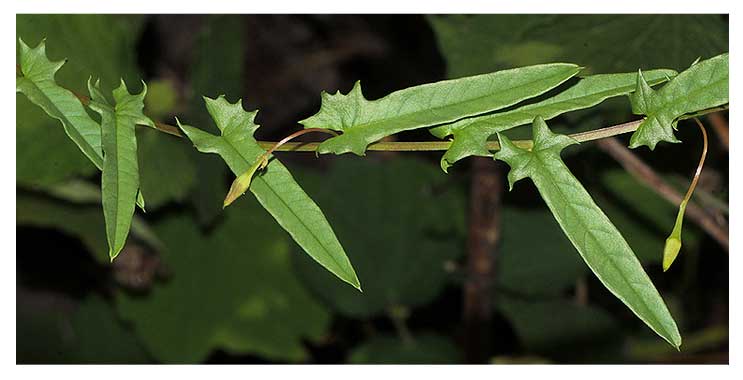
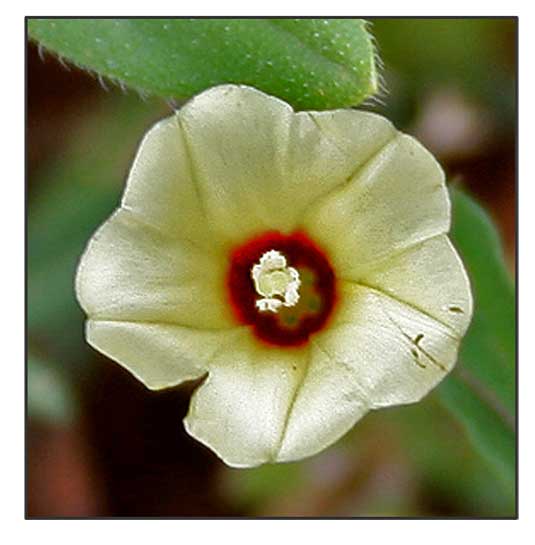
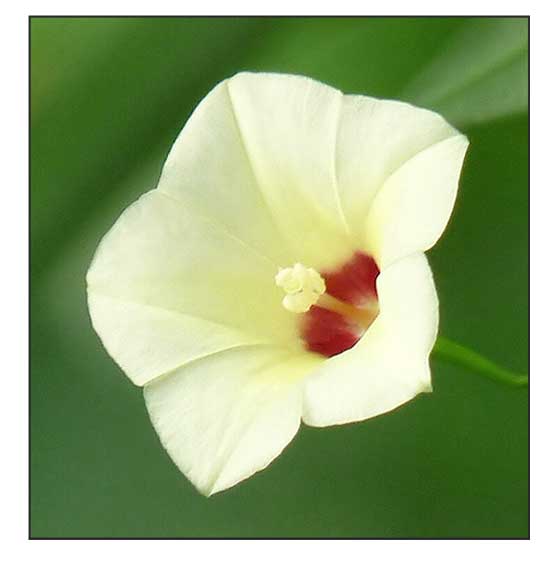
• A slender vine not exceeding a stem diameter of 2 cm. Leaves: Leaf blades about 12-55 x 3-12 mm, petioles absent or about 0.5-1 mm long. Leaf blade margins with 2-5 teeth on each side but only near the base of the leaf blade. Lateral veins difficult to discern. Peduncles slender, about 30-40 mm long. Flowers: Pedicels about 8-10 mm long. Sepals, glabrous, ovate or narrowly ovate, about 4-6 x 2 mm. Corolla trumpet-shaped, about 8-12 x 7-12 mm. Stamens about 5 mm long. Ovary globose, about 0.6-0.7 mm diam. Style about 5-5.5 mm long. Stigmas 2, globose, surface pappilose. Ovules 2 per locule. Fruits: Fruits globose, about 5 x 5-7 mm, enveloped by the persistent sepals. Seeds up to 4 per fruit, each seed angular, about 4 x 3 mm, shaped like an orange segment. Cotyledons bilobed, crumpled and folded in a complex fashion with lenses of endosperm between the folds. Radicle curved, about 2-6 mm long. (Australian Tropical Rainforest Plants)
Distribution
- Native to the Philippines.
- Also native to Angola, Assam, Bangladesh, Benin, Borneo, Botswana, Burkina, Burundi, Cambodia, Cameroon, Cape Provinces, Caprivi Strip, Caroline Is., Central African Republic, Chad, China South-Central, China Southeast, Christmas I., Comoros, DR Congo, Eswatini, Ethiopia, Free State, Gabon, Gambia, Ghana, Guinea, Gulf of Guinea Is., Hainan, India, Ivory Coast, Jawa, Kenya, KwaZulu-Natal, Laos, Lesser Sunda Is., Liberia, Madagascar, Malawi, Malaya, Mali, Maluku, Mozambique, Myanmar, Namibia, New Guinea, Nigeria, Northern Provinces, Northern Territory, Queensland, Rwanda, Saudi Arabia, Senegal, Sierra Leone, Solomon Is., Somalia, Sri Lanka, Sudan-South Sudan, Sulawesi, Sumatera, Taiwan, Tanzania, Thailand, Togo, Uganda, Vietnam, Western Australia, Zambia, Zimbabwe. (1)
- Typically grows in sandy soils, coastal areas, wastelands, and cultivated fields, flowering throughout the year.
(18)
 Constituents Constituents
- Aerial parts contain flavonoids diometin, luteolin, and 7-O-beta-D-glucosides. (5)
- Nutritional analysis of whole plant revealed carbohydrate (63.10%), fat (1.05%), fiber (15.55%), protein (3.28%), ash (7.29%) and moisture (9.73%). (6)
- LC-MS/MS metabolomics analysis and bioassay-guided isolation of ethyl acetate subfraction for anti-allergic constituents revealed major components of 3,5-dicaffeoylquinic acid, quercetin-3-O-rhamnoside, kaempferol-3-O-rhamnoside and luteolin-7-O-glucoside. (see study below) (15)
- Phytochemical screening of methanol extract of aerial parts showed
presence of phenols, tannins, flavonoids, carbohydrates, and alkaloids; acetone extract showed carbohydrates, alkaloids, steroids, phenols, tannins, and flavonoids; chloroform extract revealed carbohydrates; and petroleum ether extract, steroids. (16)
Properties
- Studies have suggested anticancer, wound healing, antidiabetic, antioxidant, photocatalytic, antimicrobial, anticancer, anti-ulcer, anti-inflammatory properties.
Parts used
Seeds, roots, leaves.
Uses
Edibility
- Plant parts used for salad in Myanmar and Korea. In Argentina, roots used as food by some indigenous people. In Guinea-Bissau, West Africa, leaves cooked as vegetables.
Folkloric
- In the Philippines, roasted seeds taken as anthelmintic. Root decoction used as mouthwash for toothache. (14)
-
In Indo-China and India, aerial partsused as laxative. (2)
- In India, whole plant or roots used for hemiplegia, piles, swellings, and urinary disorders.
Roasted seeds are used as diuretic and antibilious. In Peninsular Malaysia, leaf poultice applied to the head for fever. (2)
- Decoction of whole plant used for various ophthalmias. Combined with natron, used for treatment of gonorrhea. Poultice of leaves applied to snakebites. Decoction of roots used as mouthwash for relieving toothaches. Sap from grated roots used to treat ophthalmias. (3)
- In Ayurveda, mainly used for
joint pains and musculoskeletal problems. It is the main ingredient of the classic ayurvedic formulation prasaranadi Kashayam, used for treatment of joint pains and Vata diseases. (5)
- In Africa, macerated leaves drunk as antivenom after snake bites. In Togo and Benin, decoction of mixture of plant parts drunk for candida infections of the mouth, digestive tract or anus. Infusion of aerial parts with Hyptis suaveolens used as mouthwash to treat stomatitis and aphthae. Leaf decoction with leaves of Ocimum spp. given to babies to drink or as enema for stomach aches. Vapor bath of leafy twigs used for jaundice. In Niger, pound leaves with Ficus thonningii taken orally for liver problems. (14)
-
In Nigeria, whole plant decoction taken for gonorrhea. In Tanzania, decoction of macerate of plant used as bath for children against malaria. In Zimbabwe, ointment from leaves used for inflammation of the navel cord. In Senegal and Cote d'Ivoire, decoction of whole plant of root sap used as eye drops for conjunctivitis; in Congo, decoction of grated roots used for the same. In Nambia, root tea used for cardiac pain induced by anger and vapours of plant decoction inhaled for headache. (14)
- Aerial parts used to stimulate hair-growth.(16)
Others
- Fodder / Supplementary Feed: Suitable for inclusion in livestock diet. (6) Study showed ad-libitum supplement of browse plant M. tridentata to grass Panicum maximum led to significant increase in total food intake of sheep. The protein content was higher than grass and the tannin content not sufficient to make it unpalatable. (10)
Studies
• Lutein / Anticancer Against A549 Lung Cancer Cells / NSCLC / Hyaluronidase Enzyme Inhibitory: Hyaluronidase is an emerging potential target for cancer treatment. Study evaluated the anticanc effect of ethanol extract of X. tridentata and fractions against A549 NSCLG cells and hyaluronidase inhibitory activity. In Hyaluronidase inhibition, the hexane subfraction showed most potent cytotoxicity, and the EA fraction showed potential for inhibition of cancer cell migration. Of 10 compounds isoated, lutein (compound 5), previously reported as anti-lung cancer agent, showed strongest inhibition on hyalyronidase enzyme activity. Resu8lts suggest hyaluronidase as a potential target for anticancer activity of lutein. (4)
• Wound Healing: Study evaluated the wound healing activity of M. tridentata on excision, incision, and dead space wound models in animals using different solvent fractions of total extract. The ethyl acetate fraction demonstrated highest tensile strength, which was attributed to various flavonoids, especially luteolin. (5)
• Antidiabetic / Root: Study evaluated the antidiabetic effect of aqueous extract of M. tridentata root in normal, glucose-loaded hyperglycemic and streptozotocin (STZ)-induced diabetic rats. Oral doses of 50, 100, and 150 mg/kg were used. Effect was more pronounced in the 100 and 150 mg/kg dose. The MTRAE also significantly increased serum insulin, body weight, and glycogen content in liver and skeletal muscle of STZ-induced rats, along with significant reduction in serum triglycerides and total cholesterol. MTRAE showed significant antilipid-peroxidative effect in the pancrease of STZ-induced diabetic rats. Effect was compared to glibenclamide. (7)
• Antioxidant / Aerial Parts and Roots: Study evaluated the total phenolic contents and antioxidant properties of aerial parts and roots of M. tridentata. The acetone extract of roots revealed relatively higher levels of total phenolics (35.1 g/100g extract) and exhibited significant free radical scavenging and antioxidant properties. Hot water extract of aerial parts showed maximum iron chelation. Results from in vitro models suggest M. tridentata as a natural source of antioxidants. (8)
• Anti-Inflammatory / Anti-Arthritic: Study evaluated various extracts of M. tridentata for anti-inflammatory and anti-arthritic activities using carrageenan-induced rat paw edema model and Freund's adjuvant induced arthritis model in male albino rats. Indomethacin (10 mg/kbw was used as standard). The ethanol extract showed significant dose-dependent activity in acute inflammation with 38.3% and 42.8% inhibition with doses of 100 and 200 mg/kbw respectively. In the arthritis model, the extract showed 49.0% and 51.7% inhibition compared to indomethacin at 55.5%. Bot doses of extract showed significant anti-inflammatory and anti-arthritic activities. (9)
• Anti-Ulcer / Antioxidant / Roots: Study evaluated the antioxidant and anti-ulcer effects of Merremia tridentata root. Pretreatment with EA fraction (50, 100, and 200 mg/kbw) significantly protected the ethanol-induced gastric ulcer in rats. Antioxidant enzyme levels of SOD, catalase, and glutathione in stomach tissues were significantly increased with pretreatment. Results suggest the MEF has therapeutic potential to prevent ethanol-induced gastric ulceration. (11)
• Silver Nanoparticles / Antimicrobial / Anticancer / Leaves: Study reports on the environmentally green synthesis of silver nanoparticles using X. tridentata as reducing agent. The most potent were synthesied Cell/XTLL 60 mM AgNO3 that showed strong antimicrobial activity against E. coli, S. aureus, Trichoderma viride, and Fusarium oxysporum, DPPH and ABTS scavenging, and highly inhibitory effect on human tumor cell proliferation in MCF7 cervical cancer cell lines by MTT assay. (12)
• Anti-Allergic: Study evaluated the in vivo and in vitro anti-allergic activities of crude ethanol extract of Xenostegia tridentata using passive cutaneous anaphylaxis reaction assay and RBL-2H3 cell degranulation assay. The extract exhibited promising activities compared with dexamethaxone and ketotifen fumarate. The ethyl acetate fraction showed highest anti-allergic activity, attributed to abundance of total phenolic and flavonoid contents in the subfraction. (see constituents above) (15)
• Acute and Sub-Acute Toxicity Study / Stem: Study evaluated the acute and subacute toxicity of M. tridentata in Swiss albino mice using OECD guidelines. Oral administration of stem extract (MSE) showed no treatment-related mortality or body weight change up to a single dose of 30,000 mg/kbw in acute toxicity testing. At 15,000 mg/kbw/day there were no significant variations in clinical signs, body weight, gross pathology, organ weight, and hematology (except platelet count). Results suggest MSE showed LD50 of greater than 5000 mg/kbw/day, hence, suggesting potential for a safe pharmaceutical product. (17)
Availability
- Wild-crafted.
- Seeds in the cybermarket.
|


_in_Hyderabad,_AP_W2_IMG_7974.jpg)
.jpg)