
HOME      •      SEARCH      •      EMAIL    •     ABOUT


Family Lindsaeaceae
Necklace fern
Lindsaea ensifolia Sw.
GRACEFUL NECKLACE FERN
Jian ye lin shi jue

Scientific names Common names
Adiantum ensifolium (Sw.) Poir. Graceful necklace fern (Engl.)
Adiantum lancea Blanco Necklace fern (Engl.)
Lindsaea angustata Wall.  
Lindsaea ensifolia Sw.  
Lindsaea ensifolia var. gigantea B.K.Nayar & Geev.  
Lindsaea erecta Mirb.  
Lindsaea griffithiana Hook.  
Lindsaea lanceolata Labill.  
Lindsaea longipinna Wall.  
Lindsaea membranaceae Kunze  
Lindsaea mertensiana Kunze  
Lindsaea oligoptera Kunze  
Lindsaea pentaphylla Hook.  
Lindsaea polita Wall.  
Lindsaea pteroides Desv.  
Lindsaea rutlandia R.D.Dixit & B.Ghosh  
Lindsaea schizoloma Ettingsh.  
Lindsaea sublobata Kunze  
Lindsaea vittata Zoll.  
Litobrochia polita J.Sm.  
Pteris angulata C.Presl  
Pteris angustata Wall.  
Pteris polita Wall.  
Schizolegnia ensifolia (Sw.) Alston  
Schizoloma ensifolium (Sw.) J.Sm.  
Schizoloma ensifolium var. clarkeanum Domin  
Schizoloma ensifolium var. normale Domin  
Schizoloma ensifolium var. griffithianum (Hook.) Domin  
Schizoloma ensifolium var. longipinnum Domin  
Schizoloma griffithianum (Hook.) Fée  
Schizoloma javae Fée  
Schizoloma lanceolatum C.Presl  
Schizoloma pentaphyllum (Hook.) Fée  
Lindsaea ensifolia is an accepted species. KEW: Plants of the World Online

Other vernacular names
CHINESE: Jian ye ling chi jue.
FRENCH: Lindsée ensifoliée.
THAI: Hang nok kaling.
VIETNAMESE: Rang lien son.

Gen info
- Lindsaeacea is a pantropical family of ferns in the order Polypodiales. It contains 6 or 7 genera of about 220 species, some of which extend into the more temperate regions of eastern Asia, New Zealand and South America. (8)
- Taxonomical journey: For more than a century, the ferns were considered part of the Davalliaceae. In mid-20th century it was transferred to Dennstaedtiaceae. In 1970, molecular data supported the separation on Lindsaeaceae into its own family. Lindsaeaceae is considered among the most basal of the families in the order Polypodiales. (8)
- Lindsaea, commonly known as necklace gerns, is a genus of ferns in the family Lindsaeaceae, comprising about 195 species of mostly terrestrial or epiphytic plants.
- Etymology: The genus Lindsaea was established in 1793 by James Edward Smith, honoring John Lindsay (1785-1803), known for his studies on fern spore germination.

Botany
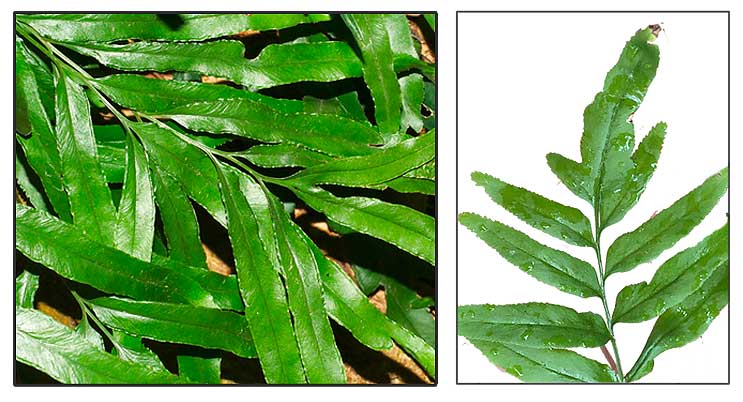
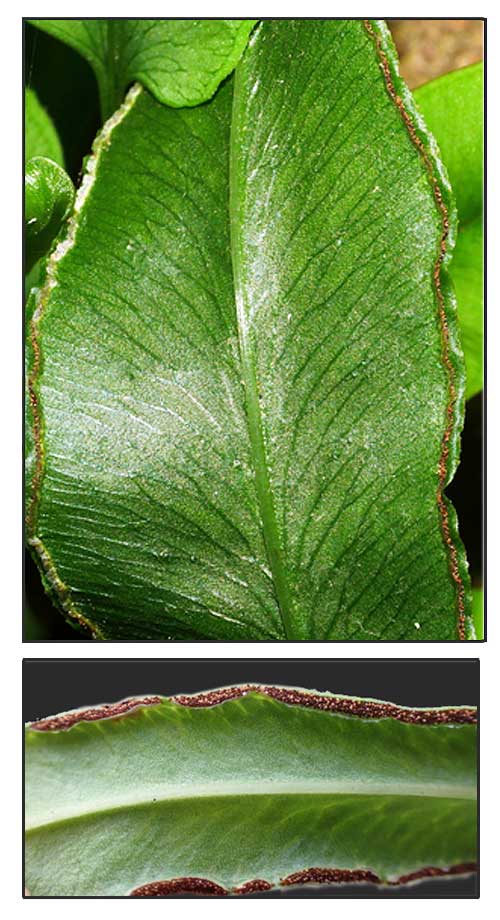
Rhizomes long creeping, densely scaly; scales appressed, reddish brown, 2-6 cells wide at base and acicular at apex. Fronds approximate or distant, 0.5-1 cm apart; stipe castaneous, 10-30 cm, quadrangular; lamina oblong, 15-40 × 10-25 cm, herbaceous to papery, 1-pinnate; pinnae 1-8 pairs, subopposite at base, alternate apically, narrowly lanceolate, shortly stalked or sessile, base broadly cuneate, margin entire or serrate in sterile pinnae, apex acuminate; terminal pinnae similar to lateral ones; veins anastomosing, veins uniting to 2 rows of areoles along each side of costae, other veins free, visible on both surfaces. Sori marginal, terminal on veinlets; indusia linear, continuous. (Flora of China)

Growth form: Terrestrial fern with clustering foliage, up to 2 cm apart, sometimes found growing on the surface of rocks. Foliage: Blade is thin, pinnate, simple when young, 15 - 45 cm long. Each leaflet is lanceolate to linear, measuring 10 - 22 cm long and 0.4 - 2.5 cm wide with a smooth margin. Sterile leaflets tend to have toothed margins. They are held on a long, angular stalk, 10 - 35 cm long, straw-coloured to reddish brown, parallel grooves may be present lengthwise. Reproductive Parts - Non-flowering plant: Sori is continuous, linear, produced along the margins, protected by a indusia, 0.4 - 0.5 mm wide. Other morphology: Rhizomes are short-creeping, up to 2.0 mm long and 1.0 - 2.5 mm wide, covered in light reddish brown scales that are bristle-like, stiff, toothed at the base. (Flora & Fauna Web)

Note: Fronds extremely variable in form and size especially in different habitats; in open sunny places, the pinnae become less than 5 mm broad, in shady places more than 2.5 cm broad in fertile conditions; the bases of the pinnae usually broadly cuneate but sometime narrow or auricled. (7)

Distribution
- Native to the Philippines. (1) (2)
- In Bohol, Guimaras; in Luzon: Benguet, Camarines Norte, Cavite, Rizal. (2)
- Also native to
Andaman Is., Assam, Bangladesh, Bismarck Archipelago, Cambodia, Cape Provinces, Caroline Is., China South-Central, China Southeast, East Himalaya, Gabon, Ghana, Guinea, Hainan, India, KwaZulu-Natal, Laos, Lesser Sunda Is., Madagascar, Malaya, Maluku, Mauritius, Mozambique, Myanmar, Nansei-shoto, Nepal, New Guinea, Nicobar Is., Nigeria, Northern Territory, Queensland, Réunion, Seychelles, Solomon Is., Sri Lanka, Sulawesi, Sumatera, Taiwan, Tanzania, Thailand, Vanuatu, Vietnam, Western Australia. (1)

Constituents
- Acetone extract of leaves of L. ensifolia yielded flavonoids, phenols and terpenes. (see study below) (3)
- Phytochemical screening of methanol extract by FTIR analysis revealed presence of functional groups such as pyridines, hydrocarbons, 1,2,3-trisubt benzene, vinyl, alkyl sulfoxides, silanes, sulfonyl chloride, primary amides, aliphatic benzene ring in aromatic, vinyl ethers, aldehydes, phosphines, aliphatic and alcohols and phenols. (4)

Properties
- Considered sedative, depurative.
- Studies have suggested antibacterial properties.


Parts used
Fronds.

Uses

Edibility
- Reported as edible; sold in local markets in Brunei and Cambodia.
- Fronds gathered from the wild and used as vegetable or local green in traditional diets.
Folkloric
- No reported medicinal use in the Philippines.
- Fronds used for treatment of chronic enteritis.
- Crushed leaves applied topically for treatment of sor4s, ulcers, and various skin diseases.
- In Vietnam, whole plant used as diuretic and for treatment of diarrhea. (5)
Others

- Dye: Fronds reportedly used to produce a red dye. (3) Mordant needed to fix the color to fibers.

Studies
Antibacterial in Skin Diseases / Fronds:
Study of evaluated various solvent extracts of leaves of Lindsaea ensifolia for antibacterial potential using disc diffusion method against certain pathogenic bacteria involved in human skin diseases. Acetone and methanol extract showed maximum antibacterial activity compared to petroleum ether and water extracts. Acetone extract showed MIC and MBC of 12.5 and 25 mg/ml towards Micrococcus luteus, and 25 and 50 mg/ml towards S. aureus and P. aeruginosa. Results suggest presence of antibacterial principles that can hinder the growth and multiplication of some multidrug resistant bacterial strains. (7)

Availability
- Wild-crafted.

August 2026

                                                 PHOTOS / ILLUSTRATIONS
IMAGE SOURCE: Graceful Necklace Fern (Lindsaea ensifolia) - Close-up of leaf / © Jacy Chen / Some rights reserved / CC BY 4.0 International / Image modified / Click on image or link to go to source page / iNaturalist
OTHER IMAGE SOURCE: Graceful Necklace Fern (Lindsaea ensifolia) - Leaves / © Jacy Chen / Some rights reserved / CC BY 4.0 International / Image modified / Click on image or link to go to source page / iNaturalist
OTHER IMAGE SOURCE: Graceful Necklace Fern (Lindsaea ensifolia) - Leaves / © Greg Tasney / Some rights reserved / CC BY-SA 4.0 International / Image modified / Click on image or link to go to source page / iNaturalist
OTHER IMAGE SOURCE: Graceful Necklace Fern (Lindsaea ensifolia) - 2 images: Close-up of leaves / Randal / No rights reserved / PUBLIC DOMAIN / Image modified / Click on image or link to go to source page / iNaturalist

Additional Sources and Suggested Readings
(1)
Linsaea ensifolia / KEW: Plants of the World Online
(2)
Lindsaeaceae: Lindsaea ensifolia / Co's Digital Flora of the Philippiness
(3)
Preliminary antibacterial evaluation of Lindsaea ensifolia Sw. against bacteria involved in skin disease
/ Toji Thomas / Medicinal Plants - International Journal of Phytomedicines and Related Industries
, 2011; 3(1) / DOI: 10.5958/j.0975-4261.3.1.011
(4)
PHYTOCHEMICAL ANALYSIS OF METHANOLIC EXTRACT OF LINDSAEA ENSIFOLIA SW. COLLECTED FROM KOTHIYAR, KANYAKUMARI DISTRICT, TAMIL NADU, INDIA
/ J John Peter Paul / European Journal of Biomedical and Pharmaceutical Sciences, 2018; 5(4): pp 1001-1004 / Corpuse ID: 250276880 / ISSN: 2349-8870
(5)
Lindsaea ensifolia / ePharmacognosy, 2022
(6)
Lindsaea / Grokipedia
(7)
Lindsaea ensifolia / eFlora of Thailand
(8)
Lindsaeaceae / Wikipedia

DOI: It is not uncommon for links on studies/sources to change. Copying and pasting the information on the search window or using the DOI (if available) will often redirect to the new link page. (Citing and Using a (DOI) Digital Object Identifier)

                                                            List of Understudied Philippine Medicinal Plants
                                          New plant names needed
The compilation now numbers over 1,750 medicinal plants. While I believe there are hundreds more that can be added to the collection, they are becoming more difficult to find. If you have a plant to suggest for inclusion, native or introduced, cultivated or naturalized, please email the info: scientific name (most helpful), local plant name (if known), any known folkloric medicinal use. Your help will be greatly appreciated.

HOME      •      SEARCH      •      EMAIL    •     ABOUT