 Gen info Gen info
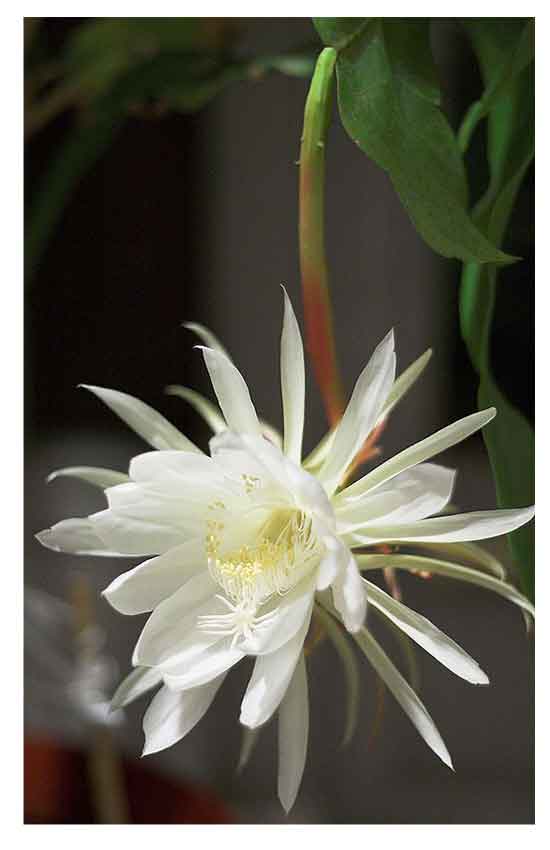
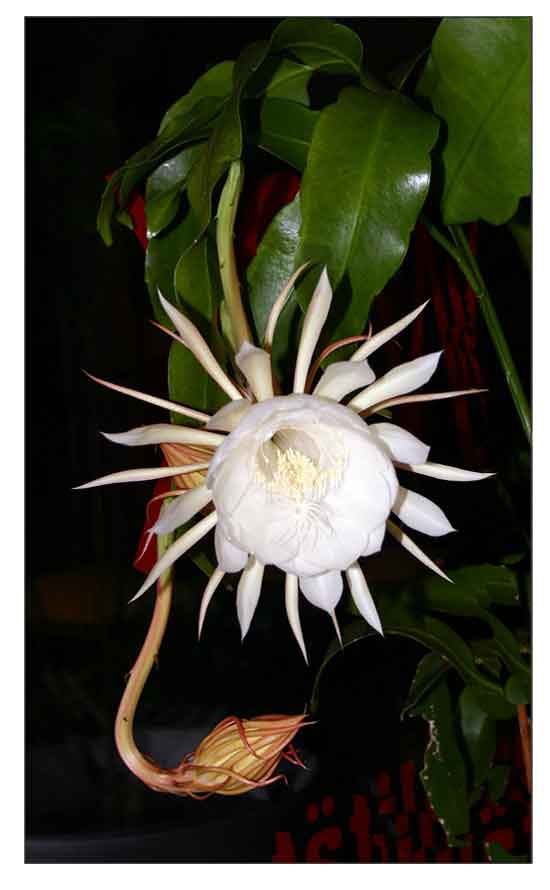
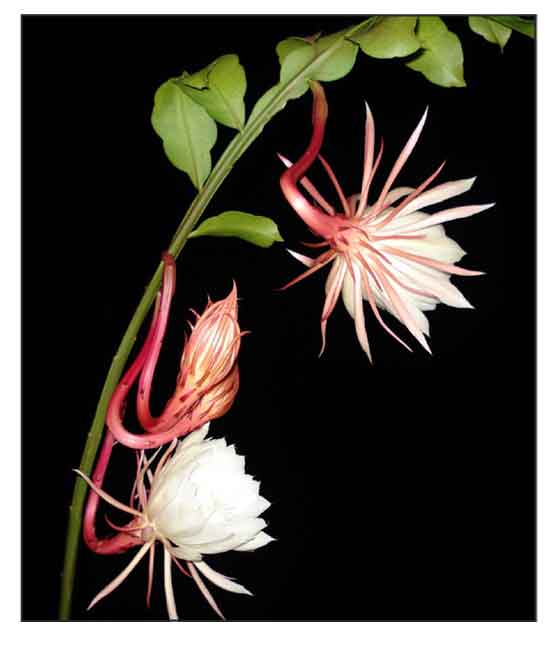
- Epiphyllum oxypetalum is a species of cactus. It blooms nocturnally, and its flowers wilt before dawn.
The species are usually epiphytic.
-
Etymology: The genus Epiphyllum derives from Greek epi, 'upon; and phullon, 'leaf', meaning "upon the leaf" which refers to the epiphytic nature and growth within the forest canopy. The specific epithet oxypetalum refers to the acute or pointed petal tips.
- E. oxypetalum is a widely and easily cultivated and fast growing Epiphyllum. Large specimens can produce several crops of flowers in one season.
(2)
- There is disagreement on the use of the common name "Brahma kamal". Some suggest the name is specific for Saussurea obvallata.
Botany
• Shrubs epiphytic, freely branched, 2-6 m tall, with aerial roots. Old stems and basal extension shoots terete, to 2 m or more, woody; branches numerous, dark green, laterally flattened, leaflike, lanceolate to oblong-lanceolate, 15-100 × 5-12 cm, glabrous, base cuneate, attenuate, or stalked, margin undulate to deeply crenate, apex acute to acuminate; midrib 2-6 mm wide, stout. Areoles small, spineless. Flowers nocturnal, fragrant, funnelform, 25-30 × 10-27 cm. Receptacle tube 13-18 cm, base green, 4-9 mm in diam., slightly angled, with triangular to lanceolate scales 3-10 mm. Sepaloids often recurved, pale green or pinkish red, linear to oblanceolate. Petaloids white, oblanceolate to obovate, 7-10 × 3-4.5 cm. Filaments white, 2.5-5 mm; anthers cream, 3-3.5 mm. Style white, 20-22 cm; stigmas 15-20, cream, narrowly linear, 1.6-1.8 mm. Fruit rare, purplish red, oblong, ca. 16 × 5.7 cm. Seed 2-2.5 × ca. 1.5 mm. (Flora of China)
Distribution
- Introduced.
- Naturalized.
- Native to Belize, El Salvador, Guatemala, Honduras, Mexico Central, Mexico Gulf, Mexico Southeast, Mexico Southwest, Nicaragua. (1)
- Cultivated for its attractive and fragrant flowers.
 Constituents Constituents
- Nutrient analysis of leaf powder yields a carbohydrate content of 0.02 mg/0.5 mL, protein content 14 mg/g, lipids 4.6 mg/g, niacin 0.18 mg/g. Phenolics, flavonoids, and tannins are 19.09 g/0.6 mL, 8.728 g/mL, and 31.32% respectively.
(3)
- Proximate principles of air-dried stem and leaf yielded (g/100g): moisture 22.61 and 10.46, crude fiber 24.82 and 32.17, total extract 15.98 and 27.21, crude protein 1.05 and 0.71, total carbohydrate 1.02 and 1.27, reducing sugar absent, non-reducing sugar 1.02 and 1.27, respectively. (4)
- Elemental analysis of air-dried stem and leaf (g/100g) yielded: calcium 0.03 and 0.11, magnesium 0.029 and 0.71, carbon 65.47 and 68.96, hydrogen 2.50 and 1.16, nitrogen 0.16 and 0.11, sulphur 2.32 and 9.51, respectively. (4)
- GC-MS analysis of leaves have revealed presence of various compounds: ethanone, 1-(2- hydroxy-5-methylphenyl)-; 4-Hydroxy-2- methylacetophenone; Megastigmatrienone; Cycloocta- 1,3,6-triene,2,3,5,5,8,8-hexamethyl; 2,5-Dihydroxy-4 isopropyl-2,4,6-cycloheptatrien-1-one; n- Hexadecanoic acid; 4-((1E)-3 Hydroxy-1-propenyl)-2- methoxyphenol ;Octadecanoic acid; Phytol; 6-octen-1- ol,3,7-dimethyl; Stigmasterol; Cholesta-22,24-dien-5- ol,4,4- dimethyl; 22-stigmasten-3-one, Allyldimethyl (prop-1-ynyl) silane; Sulfurous acid, cyclohexylmethyl hexyl ester; Heptacosane; Nonadecane, 2-methyl-; Hexadecane, 2,6,10,14- tetramethyl-; Octadecane, 2- methyl-; Eicosane, 2-methyl-; Spinasterone; 4,22- Stigmastadiene-3-one; Tetracosane; Hentriacontane; Stigmast-4-en-3-one and Testosterone cypionate respectively. (5)
- Phytochemical screening of various extracts of leaves yielded phenolic compounds, glycosides, saponins, steroids, terpenoids, tannins, and resins in the leaves. (see study below) (5)
- Phytochemical screening of four different extracts of flowers yielded alkaloids,(hexane, ethanol), saponin (Hx), protein (chloroform), terpenoids (Hx, chloroform, ethanol, aqueous). flavonoids (aqueous) tannin (aqueous), and steroids (aqueous). (8)
Properties
Studies have suggested antimicrobial, antioxidant, antihyperuricemic, anti-inflammatory, antidiabetic, analgesic, corrosion inhibitor, antiviral, wound healing properties.
Parts used
Stems, leaves, flowers.
 Uses Uses
Edibility
- Mucilaginous flower often eaten in a vegetable soup.
- In Taiwan, flowers are harvested at night and dried the next day.
Folkloric
- Plant used to treat pulmonary tuberculosis with cough, hemoptysis, uterine bleeding, pharyngitis, pain and inflammation.
- Stem of the plant used for cardiac problems and dropsy.
- Used for insomnia, headaches, joint pains, and painful menstruation.
- Flowers used for treating abscesses and hastening wound healing.
- In Vietnam, petals of faded blooms used to make soups, are believed to have tonic and aphrodisiac properties. (5)
- Plant used for treatment of sexually transmitted diseases, liver infection, and viral diseases.
- Dried flowers soaked in honey used for sore throat.
- Flowers used as tonic for treating liver infections, chlolecystitis, cancer, cholelithiasis, renal stones, urinary infections, gynecological infections, freckles, and elevated cholesterol. (8)
Others
- Myths: In Central Java, if one sees the flowers while blooming, his wishes will be granted and achieve success. Many believe the flower brings luck. (3)
Studies
• Antihyperuricemic / Antidiabetic / Anti-Inflammatory / Leaves: A methanol extract of E. oxypetalum leaf showed inhibition of α-amylase, causing reduction in rate of glucose absorption and reduction in postprandial rise in plasma glucose. Flavonoids group of compounds were shown to inhibit the activity of xanthine oxidase and superoxidase, reducing the formation of uric acid. Flavonoids also affected wound healing by modulating the expression of cytokines and nitric oxide in the inflammatory phase. (3)
• Antioxidant / Dried Leaves: Study evaluated aqueous and ethanol extracts of dried leaves of E. oxypetalum for antioxidant activity by H2O2 scavenging and DPPH assay. Ethanol extract showed highest % DPPH inhibition (60.73%) compared to aqueous extract with 334.23%. Maximum percentage inhibition was 2000 µg/mL for ethanol extract and 500 µg/ml for aqueous extract. (5)
• Antimicrobial / Leaves: Study evaluated various extracts of leaves for antimicrobial activity against, S. aureus, E. coli, B. subtilis, K. pneumonia, Aspergillus terreus, A. oryzae, A. niger, and Rhizopus oryzae using concentrations of 25, 50, 75, and 100 mg/ml with disc diffusion method. Results showed promising antimicrobial activity except for test fungi A. terreus, A. niger, and R. oryzae. (see constituents above) (5)
• Antiviral / Antibacterial / Molecular Docking Analysis: Study evaluated the leaves of Epiphyllum oxypetalum against Treponema pallidum, Zika virus, and liver cirrhosis. Molecular docking analysis was done against virulent bacterial and viral enzymes. Proteins responsible for bacterial and viral diseases were studied and retrieved from Protein Data Bank. Bioactive compounds of E. oxypetalum were docked against Treponema pallidus, liver cirrhosis, and Zika virus (ZIKA). Molecular docking interactions showed better potential of inhibition against virulent enzymes. Thebioactive compounds of EO leaves could be used as lead for treating diseases like syphilis, liver cirrhosis, and ZIKV. (6)
• Anticancer / Colon Cancer: Colon carcinogenesis is a multistep process that arises by accretion of genetic alterations - genetic and epigenetic changes that transform normal colonic epithelium into aberrant crypt foci which is responsible for penetration. Study evaluated the anticancer activity of ethanolic extract of E. oxypetalum in colon cancer in rats induced by using N-methylnitrosourea by intra-rectal instillation method. GC-MS analysis of ethanolic extract showed presence of phenolic compound (4-hydroxy-2-methylacetophenone), diterpene, and steroids. Doses of 100 mg/kg and 200 mg/kg of EA were administered orally daily for 8 weeks. Treatment with dose of 200 mg/kg showed better anticancer activity compared to lower dose. (see constituents above) (7)
• Wound Healing / Leaves: Study evaluated the wound healing properties of topical application of E. oxypetalum leaves in an incision wound model in STZ-induced diabetic mice. Leaf extract 10 and 20% ointment formulations were used. Results showed significant wound healing in mice treated with extract ointment in measures of wound contraction, number of macrophages and fibroblast count. Best activity was shown by the 20% formulation. (10)
• Corrosion Inhibitor for Mild Steel / Leaves: Due to growing environmental regulations and ecological awareness for sustainable and environmentally friendly environments, there is a search for biodegradable, nontoxic, environmentally friendly substitutes to organic and inorganic corrosion inhibitors. Study evaluated E. oxypetalum leaf extracts for corrosion inhibitory properties for mild steel in 3M H2SO4 solutions. Optimization results showed inhibition efficiency of 82.93% at optimum combination of extract concentration, acid concentration, temperature and immersion time. Results suggest EO leaf extract is a good inhibitor for mild steel in acidic solutions. (11)
• Antidiabetic / Anti-Inflammatory / Leaves: Study evaluated a methanol extract of E. oxypetalum leaves for in vitro anti-diabetic and anti-inflammatory activities. Results showed 32% inhibition of albumin denaturation for anti-inflammatory activity. In vitro antidiabetic activity by alpha-amylase enzyme showed 26% inhibition. (12)
Availability
- Wild-crafted.
- Ornamental cultivation.
|


 Constituents