
HOME    •    SEARCH      •      EMAIL    •     ABOUT  •     DONATE


Family • Lamiaceae
Pamulaklakin
Symphorema luzonicum (Blanco) Fern.-Vill.
MULAWING-BAGING

Scientific names Common names
Litsea luzonica Blanco Mulawing-baging (Tagalog)
Sczegleewia luconensis Turcz. Pamulaklakin (Tag.)
Symphorema cumingianum Briq.  
Symphorema glabrum Hassk.  
Symphorema luconense (Turcz.) Vidal  
Symphorema luzonicum (Blanco) Fern.-Vill.  
Symphorema luzonicum is an accepted species. KEW: Plants of the World Online

Gen info
- Lamiaceae, commonly known as the mint or dead nettle family, is a large and diverse family of flowering plants in the oder Lamiales, comprising approximately 236 genera and more than 7,000 species.
- Symphorema is a genus of flowering plants in the family Lamiaceae, first described in 1805. It contains three species: Symphorema luzonicum, which is native to the Philippines, and S. involucratum and polyandrum.
- S. luzonicum was first described by Francisco Manuel Blanco, and given the correct name by Fern.-Vill.
- Etymology: The genus name Synphorema derives from Greek word symphoreo, which means "borne together" or "brought together", referring to the dense, crowded clusters of flowers that are heavily surrounded by specialized leaves (bracts). The species epithet luzonicom refers to Luzon, the Philippines' largest island, where it was first documented. The Tagalog name Pamulaklakin refers to a plant with flowering propensity.

Botany
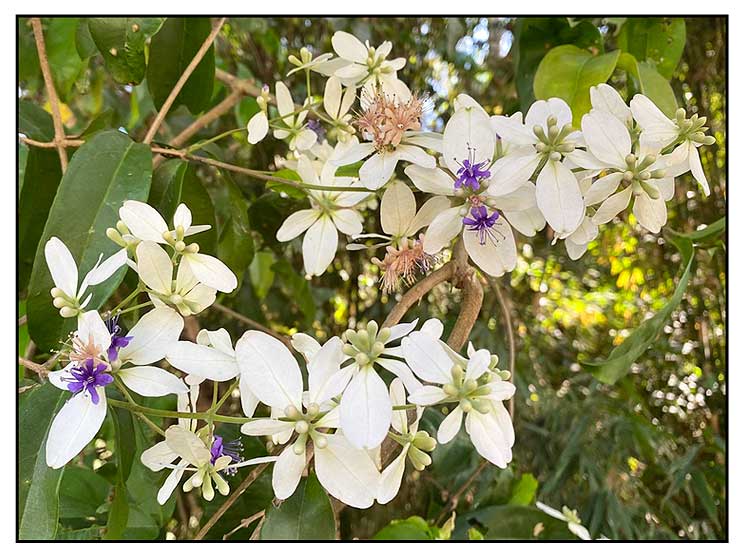
• Growth form: A woody climber or liana that uses trees for vertical support. For most of the year, it forms a dense, tangled mass of vines. Stems: Features stellate (star-shaped) hairs typical of the genus. Leaves: Leaves are simple, opposite, margins entire or serrate. Flowers: Features dense capitate (head-like) cymes on peducnles with striking blue-violet flowers. Bracts: Flowers are prominently subtended by pale pink or colorful bracts rendering the blooming vine visually striking.

Distribution
- Native to the Philippines. (1) (2)
- In Balabac, Busuanga, Lagen; In Luzon: Albay, Bataan, Batangas, Bulacan, Ilocos Norte, Laguna, NCR, Nueva Ecoja, Pampanga, Quezon, Rizal, Zambales; Mindoro, Palawan, Pangulasian. (1)
- In lowland secondary and primary forests. (1)
- Also native to Lesser Sunda Is. (2)

Constituents
- Study of crude extract of 8 woody vine stems yielded alkaloids, steroids, terpenoids, and tannins. Ethanolic extract of S. luzonicum showed higher amounts of total phenolic content(398.94 mg GAE/g dried extract. (see study below) (4)

Properties
- Despite its strikingly colorful flowers, it is rare in home cultivation because of its seasonal single-bloom habit and propensity for being a tangled mass for the rest of the months.
- Study suggested antioxidant and antimicrobial properties.


Parts used
Stems.

Uses

Edibility
- No information on human edibility.
Folkloric
- No reported folkloric medicinal use in the Philippines.

Studies
• Antibacterial / Antioxidant / Stems:
Study evaluated stems of 8 forest woody vine species for phytochemical components, total phenolic content, antioxidant, and antimicrobial activities. Symphorema luzonicum and Strychnos minor showed highest extraction yield of 6.25 and 6.28% respectively. Extract showed strong antioxidant activity by DPPH assay. On FRAP assay, S. luzonicum showed highest antioxidant activity with 2.68 µmol TE/g dried extract. On antimicrobial assay by well diffusion method, S. luzonicum showed activity against S. aureus with inhibition zone of 21.3 mm. (see constituents above)   (4)

Availability
- Wild-crafted.

Novermber 2026

                                                 PHOTOS / ILLUSTRATIONS
IMAGE SOURCE: Symphorema luzonicum / © mikejordan / Some rights reserved / CC BY-NC International / Image modified / Click on image or link to go to source page / iNaturalist

Additional Sources and Suggested Readings
(1)
Laniaceae: Symphorema luzonicum
/ last edited by Pieter B Pelser, Nov 2024 / Co's Digital Flora Database
(2)
Symphorema luzonicum / KEW: Plants of the World Online
(3)
Symphorema luzonicum / Wikipedia
(4)
Evaluation of Phytochemicals, Total Phenolic Content, Antioxidant, and Antimicrobial Activities of Philippine Forest Woody Vines / Kim Wilmer M Balagot, Kimberly M Delica, Rebecca B Lapuz et al / Philippine Journal of Science, 2023; 152(3): pp 1053-1063 / DOI: 10.56899/152.03.25

•

DOI: It is not uncommon for links on studies/sources to change. Copying and pasting the information on the search window or using the DOI (if available) will often redirect to the new link page. (Citing and Using a (DOI) Digital Object Identifier)

                                                            List of Understudied Philippine Medicinal Plants
                                          New plant names needed
The compilation now numbers over 1,830 medicinal plants. While I believe there are hundreds more that can be added to the collection, they are becoming more difficult to find. If you have a plant to suggest for inclusion, native or introduced, please email the info: scientific name (most helpful), local plant name (if known), any known folkloric medicinal use, and, if possible, a photo. Your help will be greatly appreciated.
•

•
HOME      •      SEARCH      •      EMAIL    •     ABOUT