
HOME      •      SEARCH      •      EMAIL    •     ABOUT


Family Fabaceae
Pullet
Pakpaket

Puhuaea sequax (Wall.) H.Ohashi & K.Ohashi
PUHUAEA
Chang bo ye shan ma huang

Scientific names Common names
Desmodium ancistrotrichum K.Schum. & Lauterb. Pakpaket (Ilk.)
Desmodium dasylobum Miq. Pulat (Ifugao)
Desmodium hamulatum Franch. Pullet (Ifugao)
Desmodium sequax Wall. Upey (Ifugao)
Desmodium sequax var. sinuatum (Miq.) Hosok. Puhuea (General)
Desmodium sinuatum (Miq.) Blume ex Baker  
Desmodium strangulatum var. sinuatum Miq.  
Dolinera sequax (Wall.) Schindl.  
Meibomia dasyloba (Miq.) Kuntze  
Meibomia sequax (Miq.) Kuntze  
Meibomia sinuata (Wall.) Kuntze  
Ototropis sequax (Wall.) H.Ohashi & K.Ohashi  
Puhuaea sequax (Wall.) H.Ohashi & K.Ohashi  
Ototropis sequax is listed in Co's digital flora Fabaceae database as the sole Ototropis species, and as native to the Philippines.
While Ototropis sequax is listed as a synonym of Puhuaea sequax, it does not list its presence in the Philippines. POWO
Puhuaea sequax is an accepted species. KEW: Plants of the World Online

Other vernacular names
CHINA: Chang bo ye shan ma huang.
INDIA: Soru-biyoni-sabta, Horu-biyoni-sabta (Assamese),

Gen info
- Puhuaea is a genus of flowering plants in the legume family, Fabaceae. It includes two species of shrubs native to tropical south and southeast Asia, southern China, Malesia, and New Guinea. (3)
- Taxonomy: Recent taxonomic revisions, notably in 2019, reassigned the plant from genus Desmodium to the newly established genus Puhaeae, which contains just two species.
- IUCN Red List Status: Least Concern.

Botany
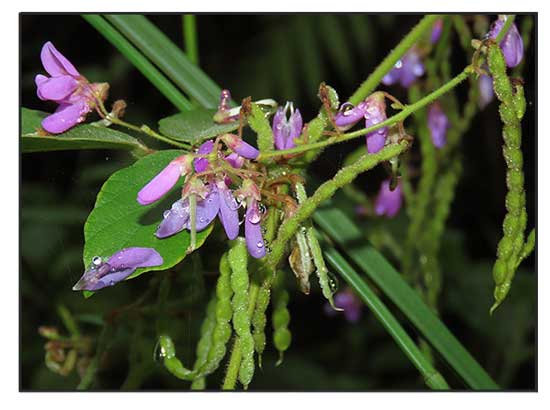
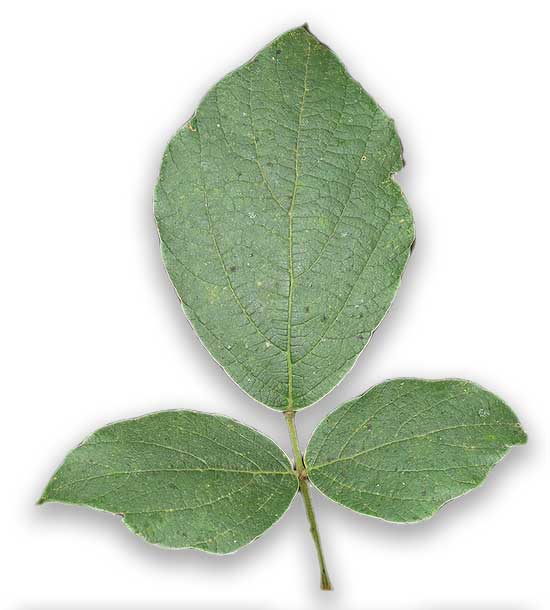
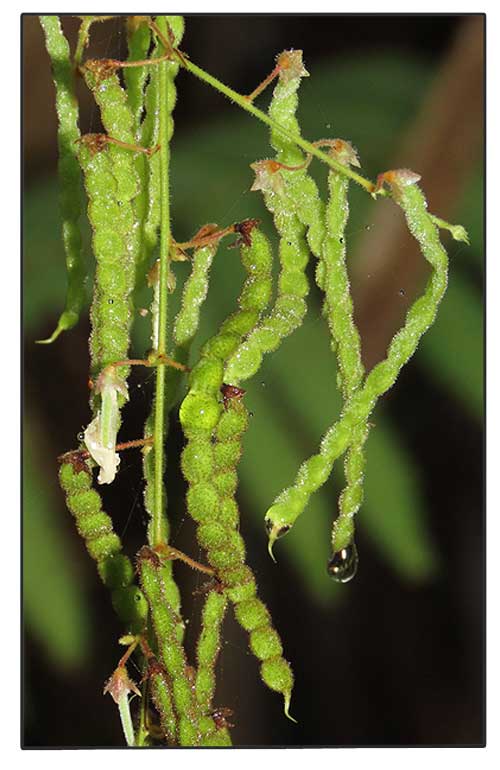
Shrubs, erect, 1-2 m tall, much branched. Young branches rust-colored pubescent, sometimes intermixed with minute hooked hairs. Leaves 3-foliolate; petiole 2-3.5 cm, hairy as young branches; terminal leaflet blade ovate-elliptic or orbicu­lar-rhombic, 4-10 × 4-6 cm, abaxially adpressed pubescent and intermixed with minute hooked hairs, adaxially densely puberu­lent or glabrescent, base cuneate to obtuse, margin undulate above middle, apex acute. Racemes terminal and axillary or usually terminal panicles, to 12 cm; rachis densely spreading or upward hirsute or minutely tomentose, 2-flowered at each node. Pedicel 3-5 mm, slightly elongated at fruiting. Calyx ca. 3 mm; lobes ca. as long as tube. Corolla purple, ca. 8 mm; standard elliptic to broadly elliptic; wings narrowly elliptic, auriculate, clawed; keel long clawed. Stamens monadelphous. Legume moniliform, 3-4.5 × ca. 0.3 cm, with dense rust-colored or brown minute hooked hairs, both sutures constricted, 6-10-jointed; articles nearly quadrate. (Flora of China)

Distribution
- Native to the Philippines. (1)
- In Luzon: Abra, Benguet, Kalinga, Mountain Province; in Mindanao: Bukidnon, Davao.
- Montane thickets, ravines and forests. 850 m to 1200-2400 m. (1)

- Native to Assam, Bangladesh, China South-Central, China Southeast, East Himalaya, India, Jawa, Malaya, Maluku, Myanmar, Nepal, New Guinea, Sulawesi, Sumatera, Taiwan, Tibet, Vietnam, West Himalaya. (2)

Properties
- Considered antiseptic, diaphoretic.
- Studies have suggest antifungal, antioxidant, MAO-B
inhibitory, tyrosinase inhibitory, skin whitening properties.


Parts used
Leaves, roots.

Uses

Edibility
- No information found on edibility
Folkloric
- In Tinoc, Ifugao, crushed leaves applied on wounds. (7)
- Chewed leaves applied topically as poultice on wounds.
- Root mixtures used to alleviate toothache.
- In China, plant considered diaphoretic.

Studies
Antifungal against Fungal Plant Pathogens / Whole Plant:
A methanol extract of whole plant showed efficient suppression of fungal plant diseases. It remarkably controlled rice blast (RCB), tomato grey mold (TGM), and red pepper anthracnose (PAN) in vivo. Bioassay-guided fractionation isolated lupeol (compound 1). Lupeol exhibited moderate inhibition against mycelial growths of Rhizotonia solani, Collectrotrichum orbiculare, and Magnaporthe oryzae in vitro. It also showed in vivo antifungal efficacy against TGM and tomato late blight (TLB). Results suggest D. sequax as a promising plant resource, with lupeol as antifungal constituent to control fungal plant pathogens. (4)
Antioxidant / MAO-B Inhibition: MAO-B is a vital enzyme in dopamine metabolism and oxidative damage in the central dopaminergic system. MAO-B inhibitors . . . In a study of seven Taiwanese Desmodium species, D. sequax was one of 3 with highest radical scavenging activity and reducing power, effectively neutralizing superoxide anions. D. sequax demonstrated most selective inhibitory effect on MAO-B activity. (5)
Antioxidant / Chlorogenic Acid: In a study of crude extracts of 10 Desmodium species, Desmodium sequax was the most active in ABTS, DPPH, FRAP, and reducing power assays Correlation coefficient (R2) values of TEAC with phenolic compounds induced strong positive correlations, except for total flavonoid content. HPLC study quantified chlorogenic acid and vitexin. Chlorogenic acid showed strong antioxidant activities in the antioxidant assays. Antioxidant activity correlated with phenolic components, and chlorogenic acid may be the important factor in its antioxidant activity. (6)
Tyrosinase Inhibition / Whitening Activity / Invention: Invention related to process of preparation using Desmodrium sequax extract or fraction for a cosmetic composition for skin whitening, a health functional food, a pharmaceutical composition for preventing and treating dermatologic pigmentary diseases. (8)

Availability
- Wild-crafted.

July 2026

                                                 PHOTOS / ILLUSTRATIONS
IMAGE SOURCE: Puhuaea sequax / © chiulluan / Some rights reserved / CC BY-4.0 International / Image modified / Click on image or link to go to source page / iNaturalist
IMAGE SOURCE: Puhuaea sequax - trifoliate leaves / © chiulluan / Some rights reserved / CC BY-4.0 International / Image modified / Click on image or link to go to source page / iNaturalist
IMAGE SOURCE: Puhuaea sequax pods / © chiulluan / Some rights reserved / CC BY-4.0 International / Image modified / Click on image or link to go to source page / iNaturalist

Additional Sources and Suggested Readings
(1)
Fabaceae: Ototropis sequax / Co's Digital Flora Database
(2)
Puhuaea sequax / KEW: Plants of the World Online
(3)

Puhuaea / Wikipedia
(4)
Potential use of extracts and active constituent from Desmodium sequax to control fungal plant diseases
/ THT Do, TH Pham, GV Pham, KA Vo, TTT Nguyen, XC Nguyen, VH Vu et al / International Journal of Agricultural Technology, 2022; 18(2): pp 489-502
(5)
Exploring the Neuroprotective Potential of Desmodium Species: Insights into Radical Scavenging Capacity and Mechanisms against 6-OHDA-Induced Neurotoxicity / Hung-Chi Chang, Jin-Cherng Lien et al / Plants (Basel), 2024; 13(13): 1742 / DOI: 10.3390/plants13131742
(6)
Antioxidant activities of phenolic components from various plants of Desmodium species / Jen-Chieh Tsai, GJ Huang, Tai-Hui Chiu, Chao-Ying Lee et al / African Journal of Pharmacy and Pharmacology, 2011; 5(4): pp 468-476 / DOI: 10.5897/AJPP11.059 / ISSN: 1996-0816
(7)
Evaluation of DPPH Free Radical Scavenging Activity and Phytochemical Screening of Selected Folkloric Medicinal Plants in Tinoc, Ifugao, Cordillera Administrative Region, Philippines / MAC Galvez / International Journal of Scientific and Research Publication, 2015; 5(12) / ISSN: 2250-3153
(8)
Tyrosinase inhibition and whitening activity of solvent extract of Desmodium sequax Wall or a fraction thereof / KR101971679B1 / Google Patents

DOI: It is not uncommon for links on studies/sources to change. Copying and pasting the information on the search window or using the DOI (if available) will often redirect to the new link page. (Citing and Using a (DOI) Digital Object Identifier)

                                                            List of Understudied Philippine Medicinal Plants
                                          New plant names needed
The compilation now numbers over 1,750 medicinal plants. While I believe there are hundreds more that can be added to the collection, they are becoming more difficult to find. If you have a plant to suggest for inclusion, native or introduced, please email the info: scientific name (most helpful), local plant name (if known), any known folkloric medicinal use, and, if possible, a photo. Your help will be greatly appreciated.

HOME      •      SEARCH      •      EMAIL    •     ABOUT