Gen info
- Selaginella, also known as spikemosses or lesser clubmosses is a genus of leucophyte. It is the only genus in the family Selaginellaceae, with over 750 known species. (3)
- The family is distinguished from Lycopodiaceae (clubmosses) by having scale-leaves bearing a ligule and by having spores of two types. They are sometimes included in an informal paraphyletic group called the "fern allies". (3)
- Etymology: The genus name Selaginella derives from Latin selago, meaning "clubmoss". The specific epithet repanda derives from Latin, meaning "bent backward", "spread out" or having an "irregular wavy or scalloped margin".
 Botany Botany
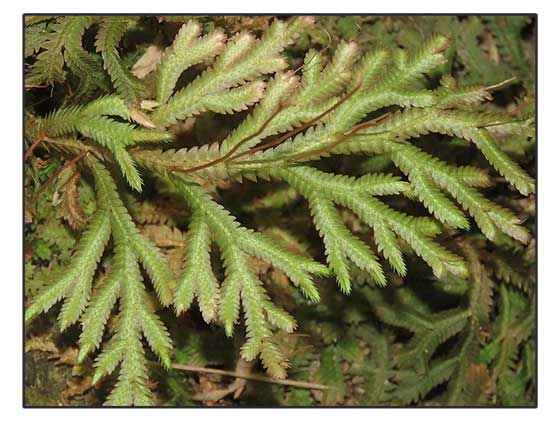
• Plants terrestrial or epilithic, seasonally green, ascending from decumbent base, 8-30 cm, with creeping subterranean rhizome and stolons. Rhizophores borne from base to upper part of main stem or restricted to creeping rhizomes and stolons (sometimes also on lateral branches), on ventral side in axils of branches. Main stems branched from near base upward, pinnately branched, stramineous, unbranched main stem 8-15 cm tall, oval or terete, apex of main stem and lateral branches sometimes flagelliform; primary leafy branches 2-6 pairs, once or twice pinnately branched, secondary branches once or twice forked, branchlets dense, adjacent primary branches on main stem 1.5-3 cm apart, leafy portion of main stem including leaves 4.4-6.6 mm wide at middle, ultimate branches 3-4.5 mm wide including leaves. Axillary leaves on main stems larger than those on branches, ovate or ovate-lanceolate, base not peltate, obtuse; axillary leaves on branches ± symmetrical, ovate, 2-3 × 1-1.4 mm, base exauriculate, margin ciliolate. Dorsal leaves asymmetrical, those on main stems in leafy portion slightly larger than those on branches; dorsal leaves on branches approximate, obliquely ovate, 0.7-1.6 × 0.4-0.9 mm, not carinate or slightly carinate, base obliquely subcordate, not peltate, margin long ciliolate (denticulate to apex), apex long acuminate to shortly aristate, parallel to axis or often reflexed. Ventral leaves asymmetrical, those on main stem larger than those on branches; ventral leaves on branches approximate, spreading, oblong-falcate, 2.5-3 × 1-1.5 mm, margin minutely denticulate, apex acute; basiscopic base rounded, margin ciliolate with a few long cilia at base, denticulate to apex; acroscopic base rounded, not overlapping stem and branches, margin ciliolate in basal half (denticulate to apex). Strobili solitary, terminal, compact, subtetragonal or subcomplanate, 3-7 × 1.5-3 mm; sporophylls unlike sterile leaves, submonomorphic or sometimes dorsal sporophylls longer, not obviously white-margined; dorsal sporophylls ovate, sharply carinate, margin ciliolate, apex acuminate; ventral sporophylls ovate, margin ciliolate; megasporophylls in basal portion on lower side of strobilus or ± randomly distributed on both sides; microsporangia orbicular, rather thin, cells uniform; microspores orange-red or red, coarsely granular, megaspores yellowish orange, baculate. (Flora of China)
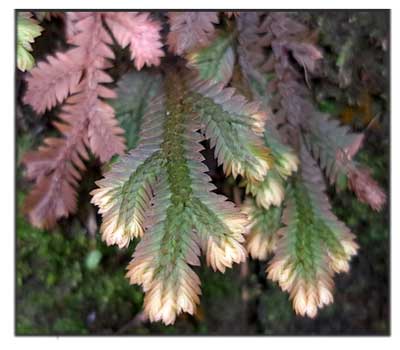 • Plants to 25 cm tall. Main stems rooting near the base, 0.8–1.3 mm in diameter, bearing uniform brown leaves rather closely, branching throughout; lateral branches largest in middle or upper portion, pinnate or bipinnate; ultimate branches 2–3 mm wide. Ventral leaves oblong, narrowing towards moderately acute apex, subcordate at base, to 2.5 mm long, 1.5 mm broad, edges with white cartilaginous membrane, dentate or ciliate near basal portion, texture soft papyraceous, green to deep green; dorsal leaves oblong, or narrower with long-acuminate apex, dentate to ciliolate. Spikes about 1 mm in diameter; sporophylls ovate-subtriangular with long tails at apex, white-margined, minutely dentate at margin. (Flora of Thailand) • Plants to 25 cm tall. Main stems rooting near the base, 0.8–1.3 mm in diameter, bearing uniform brown leaves rather closely, branching throughout; lateral branches largest in middle or upper portion, pinnate or bipinnate; ultimate branches 2–3 mm wide. Ventral leaves oblong, narrowing towards moderately acute apex, subcordate at base, to 2.5 mm long, 1.5 mm broad, edges with white cartilaginous membrane, dentate or ciliate near basal portion, texture soft papyraceous, green to deep green; dorsal leaves oblong, or narrower with long-acuminate apex, dentate to ciliolate. Spikes about 1 mm in diameter; sporophylls ovate-subtriangular with long tails at apex, white-margined, minutely dentate at margin. (Flora of Thailand)
Distribution
- Native to the Philippines. (1)
(2)
- In Luzon: Apayao, Bataan, Benguet, Bulacan, Cagayan, Ifugao, Kalinga-Apayao, La Union, Laguna, Mountain Province, NCR, Nueva Ecija, Nueva Vizcaya, Pampanga, Quezon, Rizal; Panay. (2)
- Also native to Assam, Bangladesh, Cambodia, China South-Central, China Southeast, East Himalaya, Hainan, India, Jawa, Laos, Lesser Sunda Is., Malaya, Myanmar, Nepal, Sumatera, Taiwan, Thailand, Vietnam, West Himalaya. (1)
Constituents
- HR-LC-MS analysis of crude extract revealed diverse chemical components, including fatty acids, alcohol, sugar, flavonoids, alkaloids, terpenoids, coumarins, and phenolics. (see study below) (4)
Properties
- Studies have suggested antibacterial, antioxidant, anticancer properties.
Parts used
Roots.
Uses
Edibility
- Although young leaves and shoots of a few Selaginella species are used as minor vegetables, S. repanda is not commonly consumed as food.
Folkloric
- No reported medicinal use in the Philippines.
- In Orissa, India, root paste is applied on white patches in case of leprosy. (8) About 10 g of root powder is mixed with boiled water to make a paste, applied externally on white patches of leprosy. Paste advised to be removed after 5-7 minutes because of possible irritation. (9)
Studies
• Anticancer / Antioxidant / Antibacterial: Study evaluated the antibacterial, antioxidant, anticancer activity of ethanolic crude extract of Selaginella repanda. Extract exhibited favorable antioxidant activity by DPPH and H2O2 assays with IC50s of 231.6 µg/mL and 288.3 µg/mL, respectively. It showed effective anticancer activity against three malignant cancer cell lines in a dose/time dependent manner, with higher activity against lung (A549) with IC50 341.1 µg/mL, followed by colon (HCT-116 IC50 378.3 µg/mL) and breast (MCF-6 IC50 428.3 µg/mL). Extract showed promising antibacterial activity against tested pathogenic bacteria S. aureus, P. aeruginosa, E. coli and S. flexneri. (see constituents above) (4)
• Anti-metastatic in Non-Small Cell Carcinoma / Molecular Mechanisms: Study evaluated the potential anti-metastatic properties of ethanol crude extract of S. repanda in human non-small cell lung (A-549) and colorectal cancer (HCT-116) cells and possible mechanisms. The crude extract inhibited cell growth of metastatic cells in a dose and time dependent manner. In migration and invasion assay, the extract significant inhibited cellular migration and invasion in both A-5409 and HCT-116 cells.
Results suggest inhibition of motility and invasion of malignant cells were likely associated with decrease in MMP-2/-9 expression of both A-549 and HCT-116 cells. Study suggests a potential source of anti-metastasis agent for cancer therapy. (5)
• Antibacterial: Study evaluated the antibacterial activity of two species of Gisella: Selaginella repanda and S. bryopteris against 8 potent human pathogenic bacteria (E. coil, P. oleaginous, E. cloacae, Chromebacterium violaceum, P. mirabilis, E. fergusonii, S. enterica and E. faecalis)
using four solvents viz., ethyl acetate, acetone, chloroform, and methanol by agar well diffusion method. The ethyl acetate extract of S. repanda showed positive results and inhibitory zones against all pathogens. (6)
• Comparative Antibacterial Effects of Extracts and Antibiotic: Study evaluated the antibacterial effect of extract from dried and fine-powdered plant material against 6 different bacterial specie (Gram-positive and Gram-negative) using Diffusion Assay. Results showed no significant difference in antibacterial activity among methanol, ethanol, and aqueous extracts, as well as the antibiotic Cefotaxime. No single extract consistently outperformed the others. (7)
Availability
- Wild-crafted.
|