 |

Family • Acanthaceae
Sage swampweed
Hygrophila phlomoides Nees.
BURMA LINSEED
Mao shui suo yi
| Scientific names | Common names |
| Cardanthera longifolia Buch.-Ham. ex Nees | Burma linseed (Engl.) |
| Hygrophila angustifolia var. phlomoides (Nees) Benoist | Sage swampweed (Engl.) |
| Hygrophila obovata Griff. | |
| Hygrophila phlomoides Nees | |
| Hygrophila phlomoides var. angusta Ridl. | |
| Ruellia phlomoides Wall. | |
| Hygrophila phlomoides is an accepted species. KEW: Plants of the World Online | |
| Other vernacular names |
| CHINA : Mao shui suo yi. |
| INDIA: Ising langthrei. |
| MYANMAR: Migyaung-kunbat, Hsay-dan, Meegyaung-kun-hpat. |
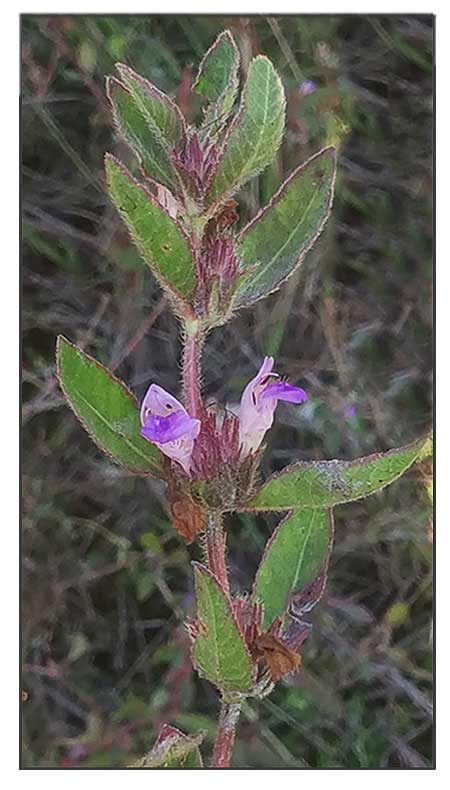
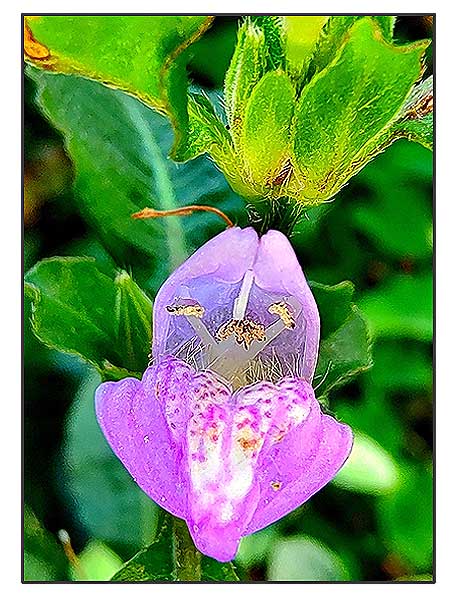
Gen info • Sage Swampweed is a perennial herb up to 1 m tall, erect. Flowers are borne in leaf-axils, several clustered or in whorls upward, like sage plants. Flowers are 1.8-2.2 cm, purplish, velvet-hairy; lower lip oblong, sparely hairy, 3-lobed; upper lip triangular, 2-lobed. Stamens are 4; longer pair about 5 mm, shorter pair about 3 mm; Ovary hairless; style about 1.8 cm, velvet-hairy. Bracteoles linear-oblong, about 5 x 2 mm, hairy. Sepal-cup is about 1.1 cm, white hairy, 5-lobed to middle; lobes linear. Stems are 4-angled, brown bristly. Leaf-stalks are 0-3 mm, hairy; leaf blade elliptic, obovate, or oblong, 2-9 x 1-3 cm, papery, both surfaces hairy, secondary veins 8-15 on each side of midvein, base usually narrowed and decurrent onto leaf-stalk, margin entire or wavy, tip pointed to sometimes blunt. (Flowers of India) Distribution Constituents Parts used Studies |
July 2026

 |
| PHOTOS / ILLUSTRATIONS |
| IMAGE SOURCE: Hygrophila phlomoides / by S.More / No rights reserved / PUBLIC DOMAIN / Click on image or link to go to source page / iNaturalist |
| IMAGE SOURCE: Hygrophila phlomoides - Flower close-up / © tangming / Some rights reserved / CC BY-NC / Click on image or link to go to source page / iNaturalist |
Additional
Sources and Suggested Readings |
• |
DOI: It is not uncommon for links on studies/sources to change. Copying and pasting the information on the search window or using the DOI (if available) will often redirect to the new link page. (Citing and Using a (DOI) Digital Object Identifier) |
| List of Understudied Philippine Medicinal Plants |
| New plant names needed The compilation now numbers over 1,750 medicinal plants. While I believe there are hundreds more that can be added to the collection, they are becoming more difficult to find. If you have a plant to suggest for inclusion, native or introduced, please email the info: scientific name (most helpful), local plant name (if known), any known folkloric medicinal use, and, if possible, a photo. Your help will be greatly appreciated. |
• |
 |
|
