
HOME      •      SEARCH      •      EMAIL    •     ABOUT


Family Passifloraceae
Saka-saka
Bin
oyok-boyok
Adenia heterophylla (Blume) Koord.
LACEWING VINE
Yi ye shuo lian

Scientific names Common names
Adenia heterophylla (Blume) Koord. Binoyok-boyok (Tag.)
Microblepharis heterophylla (Blume) M.Roem. Saka-saka (Ilk.)
Modecca heterophylla Blume Tabungau (Mindoro)
Accepted infraspecifics (5) Lacewing vine (Engl., Australia)
Adenia heterophylla subsp. andamanica W.J.deWilde  
Adenia heterophylla subsp. arcta (Craib) W.J.deWilde  
Adenia cardiophylla var. arcta Craib.  
Adenia peirrei Gagnep.  
A. heterophylla subsp. australis (R.Br.ex DC.)W.J.deWilde  
Adenia australis (R.Br. ex DC.) Engl.  
Adenia populifolia (Blume) Engl.  
Erythrocarpus populifolius (Blume) M.Roem.  
Modecca australis R.Br. ex DC.  
Modecca populifolia Blume  
Adenia heterophylla var. celebica (Koord.) W.J.deWilde  
Adenia celebica Koord.  
Modecca celebica Koord.  
Adenia heterophylla subsp. heterophylla  
Adenia acuminata (Blume) King  
Adenia cardiocarpa Koord.  
Adenia chevalieri Gagnep.  
Adenia coccinea Merr.  
Adenia cordifolia Gagnep.  
Adenia diversilolia Hallier f.  
Adenia formosana Hayata  
Adenia longifolia Merr.  
Adenia maclurei Merr.  
Adenia oblonga Koord.  
Adenia palmatifolia Merr.  
Adenia pandurata Hallier f.  
Adenia parviflora C.Cusset  
Adenia pinnatisecta H.H.Pham  
Adenia populifolia K.Schum. & Lauterb.  
Adenia sumbawana Hallier f.  
Adenia zucca Merr.  
Microblepharis acuminata (Blume) M.Roem.  
Modecca acuminata Blume  
Modecca cardiocarpa Hassk.  
Modecca coccinea Blanco  
Modecca formosana Hayata  
Modecca oblonga Hassk.  
Modecca trilobata Blanco  
Passiflora coccinea Blanco  
Passiflora zucca Blanco  
Adenia heterophylla is an accepted species. KEW: Plants of the World Online

Other vernacular names
CAMBODIA: Var kombo.
CHINA: Yi ye shuo lian.
INDONESIA: Areuy patuk manuk (Sundanese), Kabelo (Kangean), Sasariwu (Talaud Island).
LAOS: Khua 'phak poun, Khua ngouang bouang.
PAPUA NEW GUINEA: Malasibi.
VIETNAM: Th[uw] di[eej]p d[ij] di[eej]p.
 

Gen info
- Adenia is a genus of perennial flowering plants of herbs, vines, shrubs, and trees in the passionflower family Passifloraceae. It contains about 100 species distributed in the Old World tropics and subtropics.
- Adenia heterophylla is a climbing plant in the family Passifloraceae. It has a broad distribution spanning the equator, from the south eastern corner of China, through Indochina and Malesia, to northern Australia.
- Taxonomy: The plant was first described as Modecca heterophylla by German-Dutch botanist Carl Ludwig Blume in 1826, subsequently reviewed by Dutch botanist Sijfert Hendrik Koorders, who gave it the current binomial name and published it in 1912 in the work Exkursionsflora von Java. (3)
- Etymology: The genus name Adenia derives from aden, reported as the Arabic name for the plant by Peter Forssskal, the author of the genus. (4) The specific epithet heterophylla derives from Greek hetero-, meaning different, and phyllus, meaning leaved, referring to the variability in degree of leaf division in the species - from entire to lobed. (9)

Botany
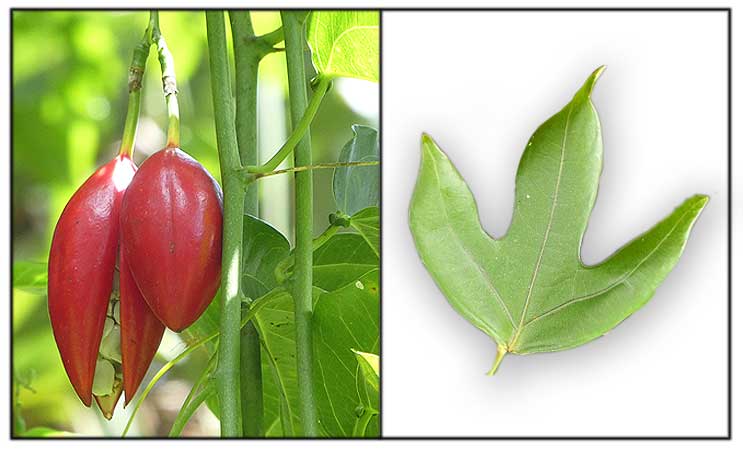
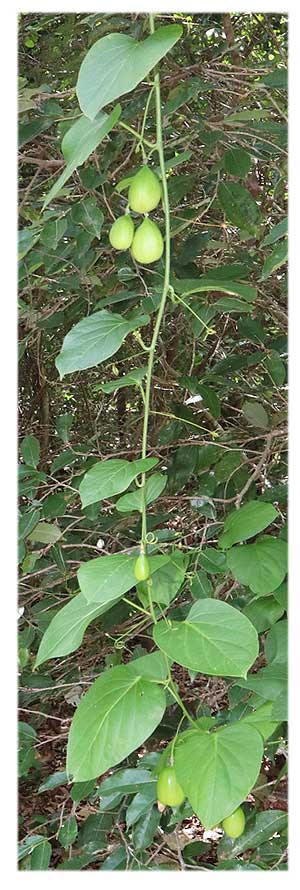
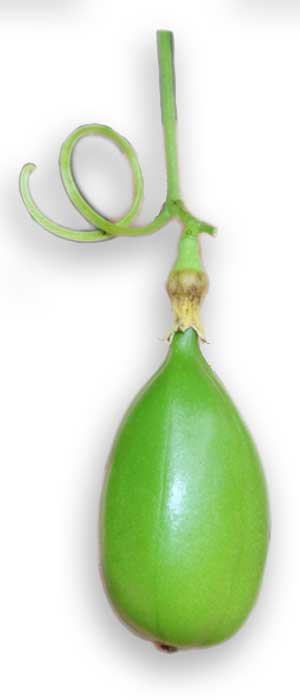
Canopy lianas, to 30 m long. Roots fleshy, thickened. Stems terete, to 5 cm in diam.; internodes 2-20 cm; tendrils (3-forked or) simple, to 25 cm. Stipules flattened-triangular, ca. 1 mm; petiole 1-10 cm, glands at blade-petiole junction 2, on concave 2-4 mm in diam. auriculate extensions at apex of petiole in mature leaves, 1-3 mm in diam.; leaf blade ovate to lanceolate, membranous to leathery, glands often present, dotlike, base of mature leaf oblong, unlobed or (2 or)3-lobed with distal 1/3 of leaf often slightly constricted from slight lobation, margin entire to serrate, apex acute to acuminate. Plants (monoecious or) dioecious. Inflorescences often with tendril emerging from center, peduncle to 20 cm, to 40-flowered in males, 2-4-flowered in females; bracts and bracteoles narrowly triangular, ca. 1 mm, apex acute. Pedicel 0.5-13 mm. Flowers tubiform-urceolate, 15-25 × 2-5 mm, including stipe 1-15 mm. Hypanthium urceolate to cupuliform, wall fleshy-leathery, ca. 0.5 mm thick, 3-6 mm deep. Calyx tube 2-3 mm; lobes reflexed, triangular, 1-3 mm, rounded to acute, entire. Petals oblanceolate to triangular, 2-4 × 0.5-1 mm, red punctate, base hastate, apex entire to undulate, rounded to acute. Septa 0.25-3 mm high. Corona absent. Disk glands linear, to 3 mm high, truncate. Male flowers: filaments 1-4 mm, connate up to 2 mm, inserted at base of hypanthium; anthers ca. 3 × 1 mm, acute, up to 0.5 mm apiculate; vestigial ovary ca. 1 mm, gynophore to 1 mm. Female flowers: staminodes 1-3 mm, connate to 1 mm, inserted at base of hypanthium; ovary subglobose to oblong, ca. 4 × 2.5 mm; gynophore ca. 3 mm; style arms ca. 1 mm, free or connate for ca. 0.5 mm; stigmas globose, papillate. Capsules 1-3 per inflorescence, outside deep red at dehiscence, ellipsoid, fruit body to 13 cm, with gynophore to 3 cm, fruit wall leathery. Seeds to 60 per capsule, orbicular; funicles of seeds 5-15 mm. (Flora of China)

Climber to 30 m. Leaves membranous (herbaceous) to coriaceous, entire to 5-partite, orbicular to ovate to lanceolate, top rounded to acute, up to 3 cm acuminate, base acute to cordate, (3½-)5-25by (1½-)2½-19 cm, 3-5(-7)-plinerved to pinni-nerved by 4-10 pairs of nerves, margin entire or up to ½ cm dentate; Inflorescences peduncled up to 20 cm, rarely in short-shoots, in ♂ up to 40-flowered, in ♀ (1-)2-4(-8)-flowered; Fruits 1-3(-4), ellipsoid to oblong-lanceolate, sometimes ± 3-ribbed, base and top obtuse or acute, excluding the (½-)1-3(-4) cm long gynophore 2-13 by 1¾-4½ cm; Seeds 10-60, orbicular to obliquely triangular, (4-)5-10 by 4½-10 by 2½-3½ mm, pitted, sometimes muricate; (Flora Malesiana)

Distribution
- Native to the Philippines. (1)
- In forest and scrub, often in secondary vegetation; 0-1000 m. (1)
- Also native to Andaman Is., Bismarck Archipelago, Borneo, Cambodia, China Southeast, Hainan, Jawa, Laos, Lesser Sunda Is., Maluku, Myanmar, New Guinea, Northern Territory, Queensland, Sulawesi, Sumatera, Taiwan, Thailand, Vietnam, Western Australia. (1)

Constituents
- Other than heterophyllin (below), no information found on phytoconstituents.

Properties
- Studies have suggested cytotoxicity, apoptotic properties.

Parts used
Caudex.

Uses

Edibility
- Note: Confusing, somewhat contradictory information on edibility. Plant and seeds reported toxic. Fruit reported as poisonous, sometimes used for hunting, while the aril (the white bit of fruit) is described as edible, juicy and sweet. In short, caution: Not worth the risk.
Folkloric
- In the Philippines, root decoction used for treatment of stomach troubles. (Note: see poison concern)
Others

- Food plant: In Australia, it serves as food plant for larvae of the glasswing, red lacewing, and cruiser butterflies.
- Poison:
Whole plant reportedly poisonous, especially the fruit; used as poison for hunting. (5) Poison from the fruit used in the Andaman Islands as arrow-poison. (6)
- Ornamental:
Ornamental use in rituals and cultural practices.


Studies
Heterophyllin / Type 2 RIP / A New Adenia Toxic Lectin:
Ribosome-inactivating proteins (RIPs) are plant toxins that were identified for their ability to irreversibly damage ribosomes, Study demonstrated the presence of a galactose-specific lectin, heterophyllin, which exhibits characteristics of a type 2 RIP. Heterophyllin exhibited high cytotoxicity towards different human-derived cell lines. Studies have demonstrated RIPs induce apoptosis as the main cell death pathway. Heterophyllin is a potential candidate for use, both as single agent in loco-regional treatments, and as toxic component of immunotoxins, for systemic treatment of tumors or other pathologies. (7)
Cytotoxicity / Heterophyllin: Cytotoxicity effects and pathways of cell death induced by heterophyllin, a type-2 RIP isolated from A. heterophylla were assessed in three human-derived cell lines: MCF7, NBV100, and T24 and compared to ricin (a well-studied type 2 RIP). Heterophyllinr was found to entirely eliminate cell viability at nanomolor concentrations, inducing strong apoptosisd wiithout necrosis, alongside oxidative stress and necroptosis. (8)

Availability
- Wild-crafted.

April 2026

                                                 PHOTOS / ILLUSTRATIONS
IMAGE SOURCE: Adenia heterophylla ssp. heterophylla / by Steve Fitzgerald / CC BY-SA 4.0 / Image modifed / Click on image or link to go to source page / Wikipedia
OTHER IMAGE SOURCE: Adenia heterophylla leaf / © crassa.cocolog-nifty / Non-commercial use / mage modifed / Click on image or link to go to source page / Crass.cocolog
OTHER IMAGE SOURCE: Adenia heterophylla / © Thomas Mesaglio / Some rights reserved / CC BY-4.0 International / Image modified / Click on image or link to go to source page / iNaturalist
OTHER IMAGE SOURCE: Adenia heterophylla green fruit / © Thomas Mesaglio / Some rights reserved / CC BY-4.0 International / Image modified / Click on image or link to go to source page / iNaturalist

Additional Sources and Suggested Readings
(1)
Passifloraceae: Adenia heterophylla / Co's digital Flora of the Philippines
(2)
Adenia heterophylla / KEW: Plants of the World Online
(3)
Adenia heterophylla / Wikipedia
(4)

Adenia / Wikipedia
(5)
Adenia heterophylla / Flora Malesiana
(6)
Adenia heterophylla / Muhammad Mansur / PROSEA: Plant Resources of South-East Asia
(7)
Heterophyllin: A New Adenia Toxic Lectin with Peculiar Biological Properties / Massimo Bortolotti, Francesco Biscotti, Andrea Bolognesi et al / Toxins (Basel), 2023; 16(1) / DOI: 10.3390/toxins16010001
(8)
Review of the ethnobotany, phytochemistry, pharmacology, and toxicity studies of the genus Adenia
/ Iliassou L Mouafon, David R Katerere / Frontiers in Pharmacology, 2025; Sec. Ethnopharmacology, Vol 16 / DOI: 10.3389/fphar.2025.1581659
(9)
Adenia heterophylla / Flora of Australia

DOI: It is not uncommon for links on studies/sources to change. Copying and pasting the information on the search window or using the DOI (if available) will often redirect to the new link page. (Citing and Using a (DOI) Digital Object Identifier)

                                                            List of Understudied Philippine Medicinal Plants
                                          New plant names needed
The compilation now numbers over 1,750 medicinal plants. While I believe there are hundreds more that can be added to the collection, they are becoming more difficult to find. If you have a plant to suggest for inclusion, native or introduced, please email the info: scientific name (most helpful), local plant name (if known), any known folkloric medicinal use, and, if possible, a photo. Your help will be greatly appreciated.

HOME      •      SEARCH      •      EMAIL    •     ABOUT