
HOME      •      SEARCH      •      EMAIL    •     ABOUT


Family Crassulaceae
Tabbatabba
Kalanchoe integra (Medik.) Kuntze
NEVER DIE
Chi ye jia lan cai

Scientific names Common names
Bryophyllum serratum Blanco Tabbatabba (Tag.)
Cotyledon acutiflora (Haw.) W.T.Aiton Flame kalanchoe (Engl.)
Cotyledon hybrida Dum.Cours. Life plant (Engl.)
Cotyledon integra Medik. Never die (Engl.)
Cotyledon spathulata (DC.) Poir.  
Escheveria spathulata (DC.) W.Bull ex E.Morren  
Kalanchoe acutiflora (Andrews) Haw.  
Kalanchoe annamica Gagnep.  
Kalanchoe corymbosa Wall.  
Kalanchoe dixoniana Raym.-Hamet  
Kalanchoe garambiensis Kudo  
Kalanchoe hybrida Desf. ex Steud.  
Kalanchoe integra (Medik.) Kuntze  
Kalanchoe integra var. annamica (Gagnep.) H.Ohba  
Kalanchoe nudicaulis Buch.-Ham. ex C.B.Clarke  
Kalanchoe schumacheri Koord.  
Kalanchoe spathulata DC.  
Kalanchoe spathulata var. annamica (Gagnep.) H.Ohba  
Kalanchoe spathulata var. baguioensis H.Ohba  
Kalanchoe spathulata var. ciliata  
Kalanchoe spathulata var. dixoniana (Raym.-Hamet) H.Ohba  
Kalanchoe spathulata var. garambiensis (Kudo) H.Ohba  
Kalanchoe spathulata var. schumacheri (Koord.) H.Ohba  
Kalanchoe spathulata var. simlensis H.Ohba  
Kalanchoe spathulata var. staintonii H.Ohba  
Kalanchoe subamplectens Wall.  
Kalanchoe varians Haw.  
Kalanchoe yunnanensis Gagnep..  
Vereia acutiflora Andrews  
Vereia spathulata (DC.) D.Dietr.  
Kalancho integra (Medik.) Kuntze is accepted. KEW: Plants of the World Online

Other vernacular names
BANGLADESH: Him sagor.
BRAZIL: Fohla de costa.
CHINA: Chi ye jia lan cai.
GHANA: Gbo, Kru-bete kpokorokpo.
INDIA: Bish kobra, Kumuda gedde, Parnabija, Slundhuru, Zakhme hayat, Zakhmihayat.
NIGERIA: Harfifi, Unwa, Eleti, Eti, An ear.
SIERRA LEONE: Mende Gbola, Kpola, Kpulu-la.
SPANISH: Doradilla, Madre de la bruja.

Gen info
- Kalanchoe is a genus of about 125 species of tropical, succulent plants in the stonecrop family Crassulaceae, mainly native to Madagascar and tropical Africa.  A kalanchoe species was one of the first plants sent into space on a resupply to Soviet Salyut 1 space station in 1979. (3)
- Historical snippet: Long ago prized by indigenous healers in the Guinea Savannah of West Africa as the "miracle leaf". (see folkloric use below) (15)

Botany
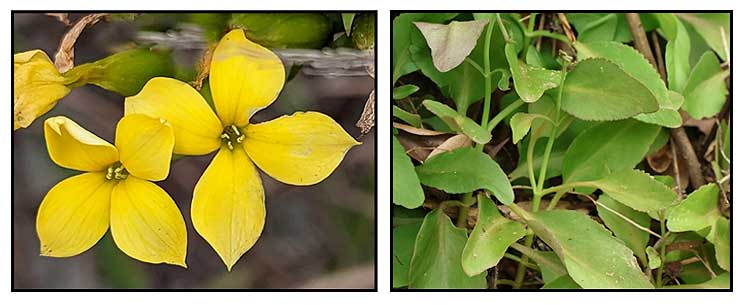
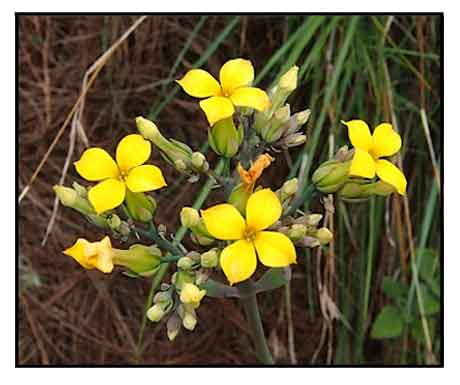
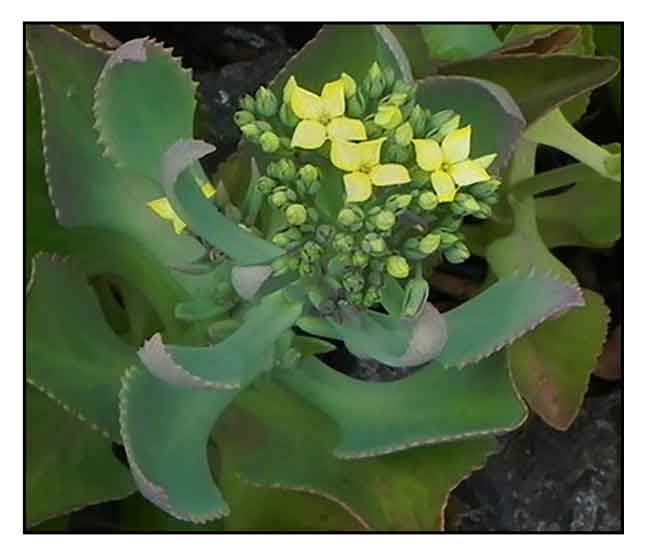
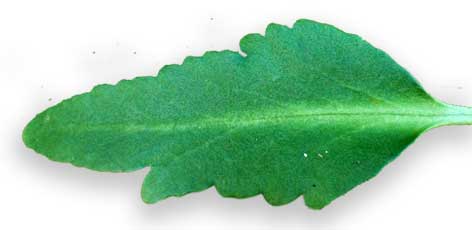
• Kalancho integra is an herb, perennial, 40-120 cm tall, glabrous. Leaves subsessile, amplexicaul; leaf blade spatulate-oblong, 5-7 × 1.5-3.5 cm, base attenuate, margin irregularly lobed to rarely subentire, apex obtuse. Inflorescences cymose, ca. 10 cm, elongated in fruit; bracts linear. Sepals linear-ovate to narrowly triangular, apex acuminate. Corolla yellow, 1.5-2 cm; lobes acuminate at apex. Stamens inserted at corolla throat; filaments short. Nectar scales linear, ca. 3 mm. (Flora of China)

• Perennial, glabrous, succulent herb. Stem 30-120 cm high, branched, erect, stout. Leaves simple, opposite, succulent, spathulate-oblong or spathulate, crenate, crenate-serrate, obtuse, 8-17 x 2.5-8 cm, petiole 2-5 cm long. Inflorescence axillary corymbose or paniculate. Flowers erect, large, bisexual, 4-merous, pedicel 3-8 mm long. Calyx lobes united at base, triangular, glabrous, acute, 7-10 x 2-4 mm. Corolla glabrous, yellow, lobes ovate, acute, 5-21 x 4-7 mm. Filaments inserted at the middle of corolla. Carpels 4, styles smaller than ovary, ovules numerous per locule. Nectar scales linear, 3-4 x 0.2-0.3 mm. Follicles, 6-10 x 2-4 mm. Seeds oblong, with longitudinal striae, 0.5-1 x 0.1-0.2 mm. (Flora of Pakistan)

Distribution
- Native to the Philippines.
- Also native to Assam, Cambodia, China, Himalaya, India, Jawa, Laos, Lesser Sunda Is., Nansei-shoto, Nepal, Sulawesi, Taiwan, Thailand, Tibet, Vietnam. (1)
- Grows primarily in subtropical biome.

Constituents
- Study of leaves and flowers identified a glycoside, patuletin 3,7-di-O-rhamnoside, together with patuletin, quercetin, quercetin 3-O-glucoside-7-O-rhammnnoside, kaempferol, and kaempferol 3-O-rhamnoside. (11)

Properties
- Studies have shown antioxidant, antihypertensive, analgesic, anti-inflammatory, antiasthmatic, antihistaminic, mast cell stabilizing, antibacterial properties.

Parts used
Whole plant, leaves, sap, stems, roots.

Uses

Folkloric
- No reported folkloric medicinal use in the Philippines.
- In Ghana, traditionally used for treatment of hypertension.
- In Bangladesh, warmed leaf juice drunk for cough. Pounded leaves are soaked overnight and the mucilaginous water is drunk on an empty stomach for bloody dysentery. Leaf juice with sugar given for gonorrhea. (12)
- Centuries ago, prized as "the miracle leaf" by indigenous healers of Guinea Savannah of West Africa. Locals used crushed leaves for dressing wounds, with rapid reduction in swelling and pus. In Mali and Burkina Faso, griots sang songs in praise of its use of boiled leaf infusions for malarial fevers. Oral traditions also recount use for snake bites and infection control. (15)
- Mashed leaf poultices used for sprains; leaf-infused oils for arthritic discomfort; abnd stewed-leaf teas for low grade fevers. (15)
- In West Africa, warmed leaf sap used for treating ear ache. In Ghana, boiled leaves used for asthma, Leaf infusion drunk for palpitations and as sedative. In Nigeria, leaf infusion and decoction taken for asthma and as sedative. In Yoruba, whole plant decoctions used as anthelmintic enema; root decoction taken as tonic during pregnancy; fresh roots used as snuff or chewed to treat colds. In the Ivory Coast, leaf sap used as antiemetic and for intercostal and intestinal pain; leaves used to staunch bleeding and rubbed on feverish infants. In Taganyika, leaf sap drunk as galactagogue; root and leaf sap used as antimalarial In Zaire, leaf sap used to cicatrize wounds, cure colds and eye and ear troubles. (13)
- In Nepal, crushed stems and leaves applied over boils to hasten bursting and healing. (14)

Studies
Antioxidant / Leaves:
Study evaluated the antioxidant activity of methanol and aqueous leaf extract of two Kalanchoe species i.e. K. pinata and K. integra. Phytochemical analysis showed the leaf extracts were rich in total flavonoid and phenolic compounds. Total phenolic content of aqueous extract of K. integra at 340 mg/g was significantly higher than aqueous extract of K. pinnata. Aqueous extracts of both Kalancho species showed excellent antioxidant activity. The aqueous extracts were less effective.  Scavenging effect of aqueous extract on DPPH radical was excellent. (6)
Micro and Macro Element Composition / Adjuvant Treatment for Hypertension / Leaves: Study evaluated the macro- and microelemental content of K. integra and correlate them with its traditional use in the management of hypertension. Analysis revealed 12 macro and 26 micro elements in water extract and blended whole leaves of fresh K. integra leaves. The high content of calcium, potassium, and magnesium may have a positive role in the management of hypertension and arrhythmia. (7)
Anti-Inflammatory / Analgesic / Leaves: Study evaluated the anti-inflammatory and analgesic properties of Kalancho spathulata using carrageenan induced paw edema and tail flick method respectively. Results showed that dose range of 100 and 200 mg/kg showed promising anti-inflammatory and analgesic activity in experimental animals. (8)
Anti-Asthmatic Potential / Antihistaminic / Mast Cell Stabilizing / Leaves: Kalanchoe integra is known to possess antihistaminic and mast cell stabilizing effect. Study evaluated the anti-inflammatory effect of K. integra aqueous leaf extract on bronchial hyper-responsiveness in ovalbumin-sensitized guinea pigs. Results showed the extract exhibited significant dose-dependent reduction in histamine-induced vasodilation of cutaneal blood vessels and contractile responses of isolated trachea to histamine. Study showed the extract has potential of alleviating signs of bronchial hyper-responsiveness and skin allergies in ovalbumin-sensitized guinea pigs. (9)
Effect on Inflammatory Wound: Study evaluated the clinical observation of K. spathulata promoting wound healing rapidly leaving no scar. In a small study of ten patients, fresh leaves were crushed, gently warmed, and applied to the wounds. Study validates the ancient concept of Ayurveda that without surgery several medicinal plants may cure diseases very well. (9)
Antimicrobial / Leaves and Stems: Study evaluated the antimicrobial efficacy of K. integra phyto-chemicals from leaves and stems using agar well diffusion method against clinically selected pathogenic bacteria i.e., Shigella sonnei, H. influenza, S. typhi, , S. pneumoniae, S. typhi, and E. coli. Phytochemical screening revealed flavonoids, phenolics, and saponins in both leaves and stems; tannins only in leaves. Salmonella typhi showed most sensitivity with largest zone of inhibition (20.5mm) with methanol leaf extract. Methanol leaf and stem extracts showed activity on all bacteria except for S. sonnei. Leaf and stem water extracts significantly inhibited growth of E. coli (14.5 and 11.5 mm). (16)

Toxicity concerns
Acute Toxicity Study / Leaves:
Study evaluated toxicity of leaves of K. integra in different animals. The aqueous extract was found most toxic, with 24hr LD50 of 230 and 560 mg/kg i.p. in mice and rats, respectively. Because of delayed toxicity in mice, LD50 based 48 and 72 h mortality data were calculated. The extract was found non-poisonous orally in doses up to 2g/kg in mice and rats. The toxicity of the extract to various species in descending order showed: rabbits > dogs > buffalo calves > mice > rats > sheep. Deaths in mices were preceded by anoxic convulsions, gasping, and coma; while dogs and buffalo calves died in a state of central depression. (17)

Poisoning / Antidotal Treatment / Experimental Poisoning:
In India, study reports on experimental acute poisoning in sheep. The crude powder and decoction of whole plant were lethal to sheep. Symptoms were suggestive of cyanide poisoning and of cholinergic nature. Death was due to respiratory failure. The most effective treatment was the universal antidote: 10 g activated charcoal, 5 g light magnesium oxide, 5 g kaolin, 5 g tannin acid and water to 250cc, exerting its effect by reducing absorption of the extract and precipitation of the alkaloid in the leaf. (10)

Availability
Wild-crafted.

Updated March 2026
December 2022

PHOTOS / ILLUSTRATIONS
IMAGE SOURCE: Kalanchoe integra / © Jackywu   / Some rights reserved / CC BY 4.0 International / Image modified / Click on image to go to source page / iNaturalist
OTHER IMAGE SOURCE: Kalanchoe integra leaf / © Allen Chen   / Some rights reserved / CC BY 4.0 International / Image modified / Click on image to go to source page / iNaturalist
OTHER IMAGE SOURCE: Kalanchoe integra leaves / © lubukun   / Some rights reserved / CC BY 4.0 International / Image modified / Click on image to go to source page / iNaturalist
IMAGE SOURCE: Kalanchoe spathulata / © Jardinerong Sunog (the Burnt Garnerner)  / click on image to go to source page / Jardinerong Sunog
OTHER IMAGE SOURCE: Kalanchoe spathulata / B. Henry / Creative Commons Attribution-Share Alike 4.0 / Image modified / Click on image to go to source page / Wikimedia Commons

Additional Sources and Suggested Readings
(1)
Kalancho integra (Medik.) Kuntze / KEW: Plants of the World Online
(2)
Kalancho integra (Never die) / CABI: Digital Library
(3)
Kalanchoe / Wikipedia
(4)
Antidotal treatment of experimental Kalanchoe integra poisoning (India). Short Communication: 1986 / R K Varma / Indian Journal of Animal Sciences, 1986; 56(4) / AGRIS
(5)
Kalanchoe integra / Flora of China
(6)
Comparative stsudy of two kalanchoe species: total flavonoid, phenolic contents and antioxidant properties / Isaac Julius Asiedu-Gyekye, Daniel Ansong Antwi, Kwasi Agyei Bugyei, Charles Awortwe / African Journal of Pure and Applied Chemistry, 2012; 6(5): pp 65-73 / DOI: 10.5897/AJPAC11.088 / ISSN: 1996-0840
(7)
Micro and Macro Element Composition of Kalanchoe integra Leaves: An Adjuvant Treatment for Hypertension in Ghana / S Frimpong-Manso, I J Asiedu-Gyekye, J P Naadu et al / International Journal of Hypertension, Vol 2015, Article ID 579497 / DOI: 10.1155/2015/579497
(8)
Evaluation of Analgesic and Anti-Inflammatory Activity of Kalanchoe spathulata Leaves Extract / Neeraj K Sharma et al / Journal of Advanced Scientific Research, 2011; 2(4): pp 71-73
(9)
Preliminary investigation of the anti-asthmatic potential of Kalanchoe integra leaf extract using a model of allergic airway inflammation / I J Asiedu-Gyeke, C Awortwe, NAB Tagoe, E Nkansah et al / European Journal of Medicinal Plants, 2014; 4(5): pp 542-562 / ISSN: 2231-0894 / DOI: 10.9734/EJMP/2014/7377
(10)
Preliminary clinical study of Kalanchoe spathulata DC. on inflammatory wound
/ C L Yadav, C S Yadav / Ancient Science of Life, 1985; 5(1): pp 30-31 / PMID: 22557495
(11)
Flavonoid glycosides of Kalanchoe spathulata / K N Gaind, James W Wallace et al / Phytochemistry, 1981; 20(3): pp 530-531 / DOI: 10.1016/S0031-9422(00)84187-4
(12)
Documentation of Medicinal Plants at the Village of Kholabaria of Natore District, Bangladesh
/ Rajia Sultana, A H M Mahbubur Rahman / Academic Journal of Life Sciences, 2017; 3(9): pp 52-78 / eISSN: 2415-2137 / pISSN: 2415-5217
(13)
Kalanchoe integra Medic O Ktze (family Crassulaceae) /  Useful Plants of West Tropical Africa / JSTOR: Global Plants
(14)
Ethnomedicinal Plants Used Against Skin Diseases in Some Villages of Kali Gandaki, Bagmati, and Tadi Likhu Watersheds of Nepal / Ananda Raj Joshi, Kunjani Joshi / Ethnobotanical Leaflets, 2007; 11: pp 235-246

(15)
Kalanchoe integra / Dr Snehal Vidhate / Ask Ayurveda
(16)|
Activity of Kalanchoe integra against Selected Pathogenic Bacteria / MR Umuhoza, T Habyarimana, FN Niyonzima / OAJMB) Open Access Journal of Microbiology & Biotechnology / ISSN: 2576-7771 /
DOI: 10.23880/oajmb-16000197

(17)
TOXICOLOGIC STUDIES ON KALANCHOE INTEGRA-AN INDIGENOUS PLANT / ACUTE TOXICITY STUDY / RK Varma, A Ahmad, MU Kharole, BD Garg / Indian Journal of Pharmacology, 1979; 11(4): pp 301-305

DOI: It is not uncommon for links on studies/sources to change. Copying and pasting the information on the search window or using the DOI (if available) will often redirect to the new link page. (Citing and Using a (DOI) Digital Object Identifier)

                                                            List of Understudied Philippine Medicinal Plants
                                          New plant names needed
The compilation now numbers over 1,750 medicinal plants. While I believe there are hundreds more that can be added to the collection, they are becoming more difficult to find. If you have a plant to suggest for inclusion, native or introduced, please email the info: scientific name (most helpful), local plant name (if known), any known folkloric medicinal use, and, if possible, a photo. Your help will be greatly appreciated.

HOME      •      SEARCH      •      EMAIL    •     ABOUT