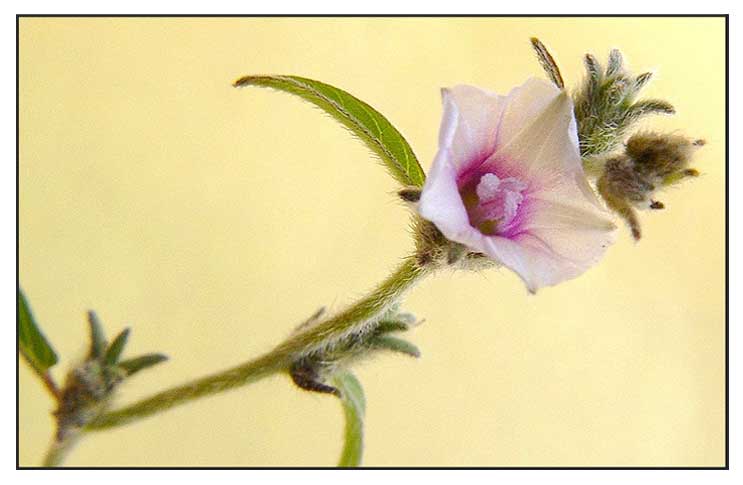
 Gen info Gen info
- Ipomoea is the larges genus in the plant family Convolvulaceae, with over 600 species. The large diverse group has common names like morning glory (most common), water convolvulus or water spinach, sweet potato, bindweed, moonflower, among others. The genus occurs throughout the tropical and subtropical regions of the world, consisting of annual and perenn8ial herbaceous plants, lianas, shrubs, and small trees; most are twining climbing plants. (2)
- Etymology: The genus name Ipomoea derives from Ancient Greek ἴψ, meaning wormwood, and homoios, meaning "resembling", referring to their twining habit. (2) Alternatively, Ipomoea means "worm-like", referring to the coiled flower bud, and eriocarpa, meaning "woolly fruit".
 Botany
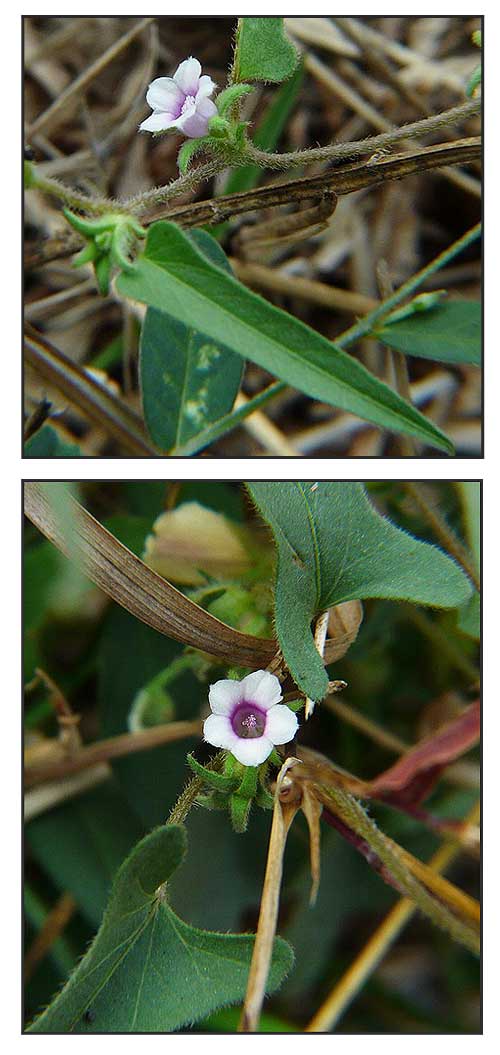
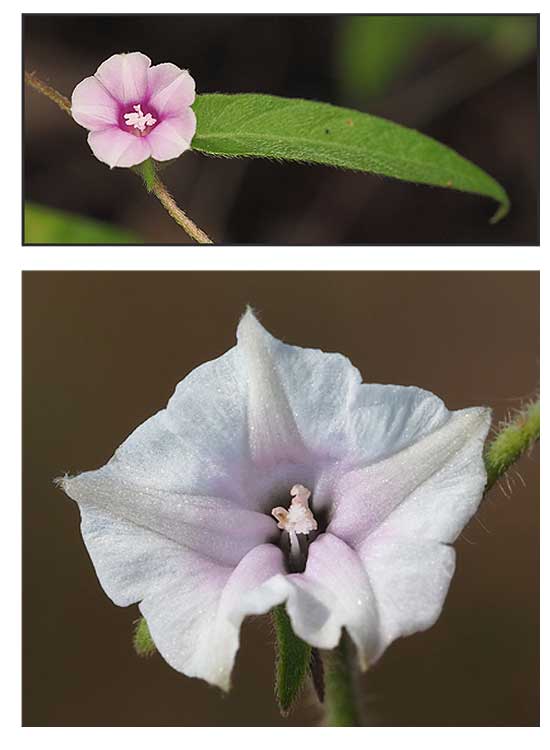
• Annual herb, stems twining or prostrate, pubescent or hispid, up to 2 m long. Leaves petiolate, 2.5 - 8 x 0.8 - 5 cm, ovate to narrowly oblong, base usually subhastate with rounded auricles, apex acute, both surfaces pilose to glabrescent; petioles 1 - 6 cm. Inflorescence of axillary subsessile or shortly pedunculate compact cymes; peduncles 0 - 15 mm; bracteoles linear; pedicels 2 - 5 mm; sepals subequal, 8 - 9 x 3 - 4 mm, ovate, acuminate, hispid-pilose, spreading in fruit; corolla 6 - 9 mm long, narrowly funnel-shaped, white, pink or mauve, hirsute, limb c. 1.5 cm diam. Capsules globose, 5 - 7 mm diam., pubescent, often enclosed by the calyx; seeds 2.5 mm, black, glabrous, punctate. ( Foundation Mongraph of Ipomoea) (13)
Distribution
- Native to the Philippines. (1)
- Also native to Afghanistan, Angola, Assam, Benin, Botswana, Burkina, Burundi, Cambodia, Cameroon, Cape Verde, Central African Republic, Chad, China South-Central, Comoros, Congo, DR Congo, East Himalaya, Egypt, Ethiopia, Gambia, Ghana, Guinea, Guinea-Bissau, Gulf of Guinea Is., India, Ivory Coast, Jawa, Kenya, Lesser Sunda Is., Liberia, Madagascar, Malawi, Malaya, Mali, Mauritania, Mozambique, Myanmar, Nepal, New Guinea, Nigeria, Northern Provinces, Northern Territory, Pakistan, Queensland, Rwanda, Saudi Arabia, Senegal, Sierra Leone, Somalia, Sri Lanka, Sudan-South Sudan, Sulawesi, Sumatera, Tadzhikistan, Tanzania, Togo, Uganda, Vietnam, West Himalaya, Western Australia, Zambia, Zimbabwe. (1)
Constituents
- Phytochemical analysis of petroleum ether and ethanol extracts of aerial parts revealed presence of alkaloids +, phenols +++, phytosterols +++, and terpenoids ++; with saponins + only in the ethanol extract. GC-MS analysis yielded 11 constituents in the IEP and 9 in the IEE. (see study below) (3)
- Preliminary phytochemical screening of dried and powdered leaf extracts yielded alkaloids, phenols, saponins, phytosterols, flavanoids and terpenoids. (see study below) (4)
- Qualitative phytochemical analysis of whole plant revealed phenolics, alkaloids, flavonoids, triterpenes, tannins, and unsaturated steroids. Total phenolics, total flavonoids, and total alkaloids were 94.6 mg gallic acid equivalent (GAE)/g, 81.25 mg quercetin equivalent (QE)/
g, and 44.32 mg atropine equivalent/g.
(15)
Properties
- Studies have suggested insecticidal, anthelmintic, antidiabetic, anti-arthritic, antiurolithiatic, antimicrobial, antioxidant, anti-inflammatory, antinociceptive properties.
Parts used
Leaves, stems, aerial parts.
 Uses Uses
Edibility
- In India and west Africa, leaves commonly eaten as cooked vegetable.
- Seeds also nutritious with 22% proteins, 10% fat/oil, 44% carbohydrate. (16)
Folkloric
- No reported folkloric medicinal use in the Philippines.
- In India, oil extracted from plant used for treatment of headache, rheumatism, leprosy, epilepsy, and ulcers. (4)
- In Uganda, roots decoction drunk to relieve menstrual pain. (10)
- In 16th-century compendium "Dravyaguna Vijnana", note is made of powdered seeds mixed with sesame oil applied to the scalp to strengthen hair follicles. British colonial surveys in the 1800s note its used as traditional hair tonic. A 1885 travelogue by James Cameron mentions Bengali women rubbing leaf decoction onto the scalp to reduce dandruff. (11)
- In rural household in Andhra Pradesh, it continues to be part of postpartum hair care rituals: dried seeds are toasted, ground, then mixed in rice water to rinse the hair - local elders swear by thicker hair within weeks. (11)
- In Tamil Nadu, leaf paste mixed with coconut milk applied to soothe sunburned skin. (11)
- In Sri Lanka, whole plant decoctions used for treatment of minor arthritis pains. (11)
- Seeds reported to contain an irritant purgative resin.
Others
- Veterinary: Oil extract applied to neck sores in bulls and wounds in cattle. (4) (10)
- Agroforestry: Plant considered an effective soil-binder and smotherer of weeds.
- Fodder: In India, cultivated as arable crop to provide green fodder for cattle. As fodder it is equated with sunnhemp (Crotalaria juncea) and harvested at flowering stage, giving analysis of: moisture 16%, proteins 16%, ether extract 2%, carbohydrates 35%, fiber 21%, among others. It is useful for milch (milking) cattle. (16)
Studies
• Insecticidal / Antitermite / Anthelmintic / Aerial Parts: Study evaluated the insecticidal and anthelmintic activities of petroleum ether and ethanol extracts of aerial parts of I. eriocarpa. Both extracts showed potent anthelmintic activities against earthworm Eudrilus eugeniae. Mebendazole was used as standard. Both extracts showed considerable insecticidal activity against termites Coptotermes formosanus. Standard drug was chloropyrifos. (see constituents above) (3)
• Antidiabetic / Antiarthritic / Leaves: Study evaluated extracts (water, chloroform, petroleum ether) of dried and powdered leaves. Extracts showed significant anti-arthritic activity against protein denaturation. Chloroform and petroleum ether extracts showed potent α-amylase enzyme inhibitory activity compared to the water extract, probably due to presence of terpenoids, which was absent in the water extract. (see constituents above) (4)
• Antiurolithiatic Against Ethylene-Glycol Induced Lithiasis / Leaves: Study evaluated the preventive and curative effect of ethanol extract of Ipomoea eriocarpa (IEE) in ethylene-induced urolithiasis in rats. Chemical parameters such as phosphorus, calcium, magnesium, urea, and creatinine levels were evaluated. Treatment (prophylactic and curative) significantly (p<0.001) restored the parameters in urine, serum, and kidney homogenate to near-normal level. Histopath exams revealed calcium oxalate crystal deposits in the renal tubules and congestion and dilation of the parenchymal blood vessels were significantly reverted after IEE treatment. (5)
• Antimicrobial / Antioxidant / Leaves, Bark, Inflorescence: Study evaluating ethanol extracts of leaves, bark,and inflorescence showed antimicrobial and antioxidant potential. Antimicrobial potential ranged from 9.6 to 6.0 mm with maximum activity by the ethanolic extract of bark against E.. coli. Leaves exhibited activity against A. oryzae with 14.8 mm and bark against A. niger with 12.6 mm. Highest amount of flavonoids was found in the ethanol extract of leaves (39.3 µg/ml), with DPPH radical scavenging varying from 223.3 to 76.5% compared to standard BHT at 87.7%. (6)
• n-Hexadecanoic Acid / Antibacterial / Antioxidant / Leaves: Study evaluated the antioxidant and antibacterial activity of n-hexadecanoic acid (n-HDA) from aqueous ethanol extract of leaves. Antioxidant activity of n-HDA at 100-500 µg/ml were: DPPH 30.19%, ABTS 42.18%, reducing power 0.02-0.16%, nitric oxide 18.65-73.17%, and superoxide 17.18-81.21%. The n-HDA showed moderate antibacterial activity against S. aureus, B. subtilis, E. coli, and K. pneumonia with 7.96 mm, 10.96 mm, 11.10 mm, and 11.93 mm at maximum concentration of 50 µg/ml. Results suggest potential as natural antioxidant and antibacterial. (7)
• Inhibition of Struvite-based Urolithiasis / Antioxidant / Leaves: Study evaluated water, ethanol, and chloroform leaf extracts for antioxidant activity and in-vitro growth inhibition of struvite crystals. The ethanol extract showed highest phenolic, flavonoid, and terpenoid contents and better antioxidant properties. The EE was the only one that showed growth inhibition properties. (8)
antioxidant and antibacterial. (8)
• Silver Nanoparticles / Anti-Inflammatory / Leaves: Study reports on the simple and eco-friendly synthesis of silver nanoparticles (AgNPs) using leaf extract of I. eriocarpa as reducing and capping agent. AgNPs were screened for in-vivo anti-inflammatory activity using carrageenan-induced paw edema in male Wistar rats. The AgNPs showed significant (p<0.05) anti-edemic effect, superior to the aqueous extract and standard diclofenac. (9)
• Antinociceptive / Whole Plant: Study evaluated the analgesic activity of petroleum ether extract of I. eriocarpa whole plant (PEIE) in chemical models of nociception in mice, PEIE doses of 100, 200, and 400 mg/kg p.o. produced 29.22%, 51.80% and 79.87% inhibition of abdominal writhing induced by acetic acid in mice. In formalin test, same doses produced dose-dependent analgesic effect on the second phase (15-40 min) with inhibitions of licking time of 31.54%, 45.27% and 60.52% respectively. Results suggest the peripheral analgesic effect may be attributed to inhibition of prostaglandin release and other mediators involved. The results supports the traditional claims of the plant. (12)
• Effect on Carbuncles and Cellulitis / Leaves: Extract of I. eriocarpa have shown significant antibacterial activity against carbuncles and cellulits, with most carbuncles caused by S. aureus. An ethanolic extract showed antibacterial activity against S. aureus with ZOI range from 0.5 to 1.1 cm. Study evaluated an oil-based ointment formulation from ethanol extracts of dried and powdered leaves of I. eriocarpa for antibacterial effect on the treatment of carbuncles or cellulitis. Results showed the formulation was safe and with potent antibacterial activity. (14)
• Antioxidant / Whole Plant: Study of hydroalcoholic extract of whole plant for antioxidant activity yielded IC50s of 14.04 DPPH and 36.12 FRAP scavenging assays. Antioxidant activity was attributed to presence of phenols and flavonoids. (see constituents above) (15)
Availability
- Wild-crafted or cultivated.
|






.jpg)
_(3038411526).jpg)