 Botany Botany
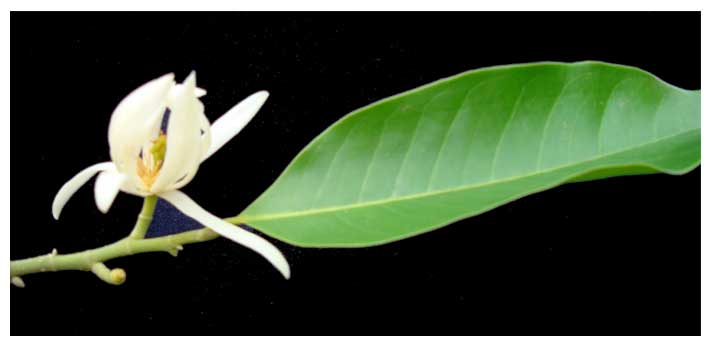
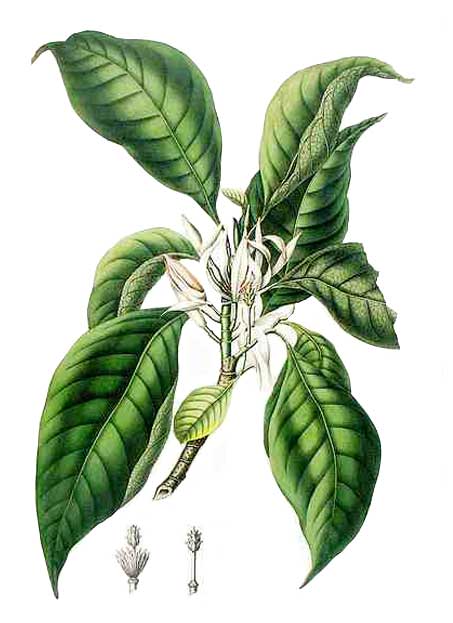
Tsampakang-puti is a small tree, up to 10 meters high. Leaves are oblong, acuminate, up to 20 cm long, glossy, dark green above, pale below. Flowers are white and fragrant; the petals, thin, leathery and narrow.
Distribution
Ornamental cultivation.
Found in towns and cities in the Philippines.
Constituents
- Volatile oil, 0.0125% -
linalool, methyl eugenol, methy ethyl-- acetic ester, acetic acid.
- Study isolated ten compounds from the leaves: (-)-N-formylanonaine, (-)-oliveroline, (+)-nornuciferine, lysicamine, (+)-cyperone, (+)-epi-yangambin, ficaprenol-10, pheophytin a, aristophyll C and michephyll A.
Parts used
Flowers
Uses
Folkloric
- Infusion of flowers used as vaginal wash.
Others
- Perfume: Essential oil from flowers used in perfumery; also for tea-perfuming.
Studies
• Antioxidant / Human Tyrosinase Inhibitor: Tyrosinase is the first and rate limiting enzyme in the synthesis of melanin pigments for coloring of the hair, skin and eyes. Study yielded a natural product, (-)-N-formylanonaine, from the leaves of Michelia alba. The compound exhibited antioxidant activities and showed tyrosinase and melanin reducing activities in human epidermal melanocytes without apparent toxicity to human cells.
• Phytochemicals / Antioxidant / Michephyll A: Study yielded 10 compounds from the leaves, including michephyll A, a new compound with antioxidant activity.
• Antibacterial: Study of 22 essential oils fro Thai medicinal plants against 5 strains of Propionibacterium acnes showed 19 with inhibitory activity on P acnes growth, and four, including michelia oil, with the strongest antibacterial activity. The essential oils suggest a possible alternative treatment for acne.
• Essential Oil Constituents: Essential oil yielded 24 constituents: campbene, β-pinene, α-phellandrene, β-myrcene, limonene, 1,8-cineole, ocimene, 3-carene, o-cymene, α-cubebene, trans-linalool oxide, β-cubebene, linalool, cis-caryophyllene, β-selin- erie, trans-carveol, methyl, eugenol, β-bisabolene, methyl isoeugenol, isoaristolene, among others.
• Photoaging Prevention: UV radiation from the sun can cause skin photoaging by inducing matrix metalloproteinases (MMPs). Study investigated M. alba's polyphenols for protective activity. Results showed MA treatment may prevent UVB-induced extracellular matrix damage by inhibiting the expression of MMP-1 and MMP-3.
• Antiasthmatic: Study on guinea-pig showed that MA flowers can antagonize tracheal spasm induced by histamine or acetylcholine, increase perfusion flow and prolong the incubation period of induced asthma and relax asthma symptoms.
• Cytotoxic Constituents: Study of methanol extract of leaves of M. alba yielded one new chlorophyll, michephyll A (a novel furanone) and 28 known compounds. (-)-anonaine was the major constituent and showed cytotoxicity against HeLa cells.
Availability
Wild-crafted.
Leaf essential oil and flower oil in the cybermarket.
|