Gen info
- Fabaceae or Leguminosae, commonly known as the legume pea, or bean family, is a large and agriculturally important family of flowering plants that includes trees, shrubs, and perennial or annual herbaceous plants. t is widely distributed and is the third largest land plant family, behind only Orchidaceae and Asteraceae, with about 770 genera and nearly 20,000 known species. (3)
- Etymology: Fabaceae derives from the defunct genus Faba, now included in Vicia. Faba derives from Latin, meaning "bean". Leguminosae, an older but still accepted name, refers to the fruit of the plants, which are called legumes. (3) The genus name Tephrosia derives from Greek tephros, meaning "ash-colored", referring to the gray hairs covering most species. The species epithet, candida, derives from Latin candidus,-a,-um, meaning "pure white".
Botany
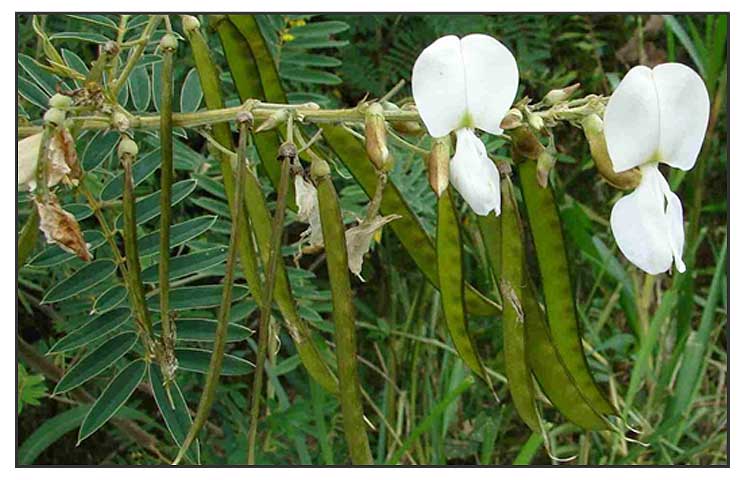
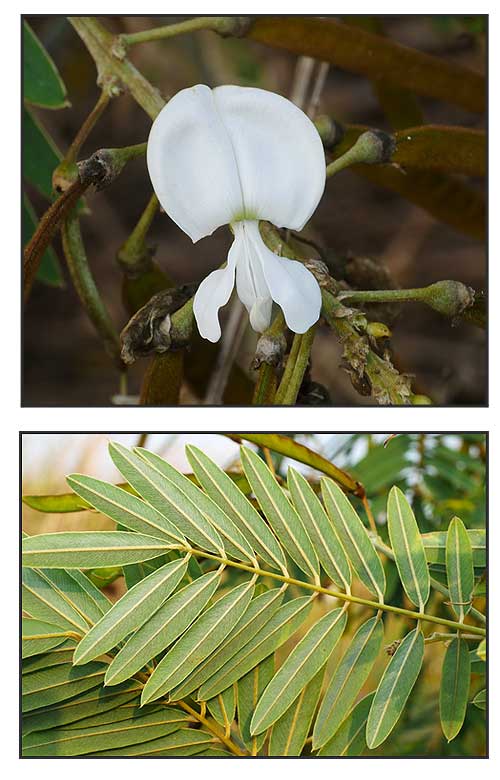
• Bushy shrub to 3m. Leaves alternate, compound odd-pinnate; leaflets 8-12pairs+1, lance-like, to 5cm, gray-green, silky beneath, tip sharp. Flowers occur in clusters in terminal and upper axils; white, 3cm long. Fruit is a pod to 10cm. (Cook Islands Biodiversity)
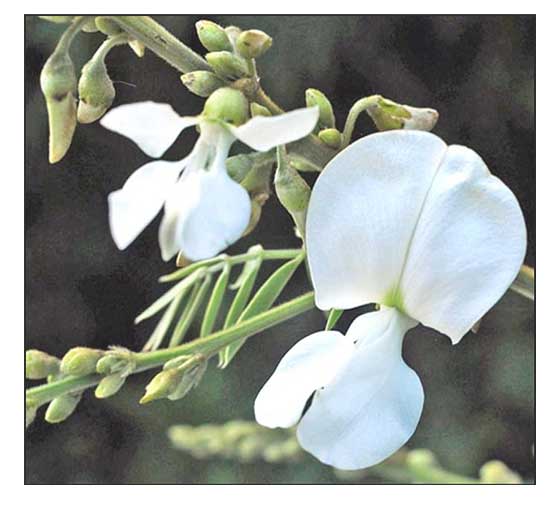 • Herbs, perennial, suffrutescent, 1-3.5 m tall. Stems ridged, grayish white tomentose, trichomes ca. 1 mm. Leaves 17-25-foliolate; rachis 15-25 cm, including petiole 1-3; leaflet blades oblong, 3-6 × 0.6-1.4 cm, abaxially densely sericeous, adaxially glabrous, secondary veins 30-50 on each side of midvein. Pseudoracemes terminal or lateral, 15-20 cm. Pedicel ca. 1 cm, densely white villous. Flowers ca. 2 cm. Calyx ca. 5 × 5 mm; teeth equal, ca. 1 mm, apex rounded. Corolla white, rarely yellow or pale pink; standard densely sericeous. Ovary tomentose, with numerous ovules. Legume linear, 8-10 cm × 7.5-8.5 mm, straight, brown tomentose with a mixture of long and short trichomes, apex truncate and with a straight ca. 1 cm beak. Seeds 10-15 per legume, olive-green with dark patches, ellipsoid, ca. 5 × 3.5 mm, smooth. (Flora of China) • Herbs, perennial, suffrutescent, 1-3.5 m tall. Stems ridged, grayish white tomentose, trichomes ca. 1 mm. Leaves 17-25-foliolate; rachis 15-25 cm, including petiole 1-3; leaflet blades oblong, 3-6 × 0.6-1.4 cm, abaxially densely sericeous, adaxially glabrous, secondary veins 30-50 on each side of midvein. Pseudoracemes terminal or lateral, 15-20 cm. Pedicel ca. 1 cm, densely white villous. Flowers ca. 2 cm. Calyx ca. 5 × 5 mm; teeth equal, ca. 1 mm, apex rounded. Corolla white, rarely yellow or pale pink; standard densely sericeous. Ovary tomentose, with numerous ovules. Legume linear, 8-10 cm × 7.5-8.5 mm, straight, brown tomentose with a mixture of long and short trichomes, apex truncate and with a straight ca. 1 cm beak. Seeds 10-15 per legume, olive-green with dark patches, ellipsoid, ca. 5 × 3.5 mm, smooth. (Flora of China)
Distribution
- Introduced, cultivated and naturalized in Philippines.
(1)
- In Luzon: Laguna.
(1)
- Native to Assam, Bangladesh, East Himalaya, India, Nepal. (2)
- Invasiveness: It is on the Global Register of Introduced and Invasive Species
of Brazil, Palua, Samoa, Cook Islands, Federated States of Micronesia, DR of Congo, Niue, Saint Vincent and the Grenadines.
(3)
Constituents
- Approximate composition of dry leaves of T. candida per 100 g: N 2.4-3.8 g, P 0.12g, K 1.15 g, Ca 0.3g, N 1.18 g, P 0.07 g, K 0,47 g, Ca 0.14 g. Seeds and leaves contain small amounts of rotenoids, tephrosis, and flavonoids.
(6)
- Study of a methylene chloride-methanol (1:1) extract of air-dried aerial parts isolated two new prenylated flavonoids, tephrocandidins A and B (1,2), a new prenylated chalcone, candidachalcone (3), a new sesquiterpene (4), and a previously reported pea flavonoids phytoalexin, pisatin (5).
(see study below) (7)
- The natural flavone, candirone, assumed to be 5,4′-dihydroxy-3,6,8-trimethoxyflavone, was revised to 5,4′-dihydroxy-3,6,7-trimethoxyflavone, penduletin on the basis of spectral data.
(9)
- Study reports on the isolated from seeds and separation of tephrosin and 12
α-hydroxyrotenone by HPLC; caffeic acid, ß-sitosterol, and its glucoside. (10)
- Study of hexane and ethyl acetate extract of roots isolated a new rotenoid,12a-hydroxy-β-toxicarol, together with a series of known ones, identified as: deguelin, α-toxicarol, tephrosin, 6a,12a-dehydro-deguelin, 12a-hydroxy-α-toxicarol, 6a,12a-dehydro-α-toxicarol and 6a,12a-dehydro-β-toxicarol.
(11)
Properties
- Studies have suggested biomulch potential, estrogenic, insecticidal properties.
Parts used
Leaves, fruits.
 Uses Uses
Edibility
- No information found on edibility.
Folkloric
- No reported medicinal use in the Philippines.
Others
- Agroforestry: In the Philippines, introduced as green manure plant. (3) In Zimbabwe, different taxa of the genus studied for enriching the soils by intercropping when growing maize, which allows continual nourishment of the soil. The slow release of nitrogen in T. candida species is able to synchronize with the nitrogen demand of the maize. It hosts rhizobia, a gram-negative nitrogen-fixing bacterium that converts atmospheric nitrogen into ammonia(NH3) through nitrogen fixation. Other agricultural benefits include erosion control, increase soil fertility, shade and shelter, and weed suppression. (3)(4)(5)
- Fish poison / Hazards: Bark and roots reported used as fish poison in India, probably attributable to rotenoid content. Rotenoids used traditionally as fish poison, to kill or stun the fish making easier catch, while remaining edible for mammals. The WHO classified Rotenonoids as moderately hazardous.
- Landscaping: Used for making hedges along contours, fields, and home gardens. Not eaten as forage by domestic animals i.e., buffaloes and goats. Provides mulch for upland crops. (4)
- Insecticide: Powdered leaves used as insecticide. (4)
- Fuel: Aged trees provide fuel source.
- Ornamental: Occasionally grown as ornamental .
Studies
• Potential as Bio Mulch: Study reviewed Tephrosia candida properties as an effective biomulch for improving soil physical, biological, and chemical properties ultimately leading to improvements in crop yield and quality. It is effective in accumulating and retaining high amount of essential nutrients in improving soil microclimate by improving soil moisture content, soil bulk density, soil acidity, soil enzymatic activities, soil organic carbon, soil biomass carbon,and biomass nitrogen, etc. It higher biomass content, slow decomposition rate of leaf litter, and higher carbon content of up to 40% make it a compelling choice for sustainable agriculture, providing a viable solution to enhance soil quality, mitigate pest pressures, and boost crop yields in farming systems. (5)
• Estrogenic Activity / Aerial Parts: Study of a methylene chloride-methanol (1:1) extract of air-dried aerial parts isolated two new prenylated flavonoids, tephrocandidins A and B (1,2), a new prenylated chalcone, candidachalcone (3), a new sesquiterpene (4), and a previously reported pea flavonoids phytoalexin, pisatin (5). Using an estrogen receptor (ERα) competitive-binding assay, compound 3 showed most potent estrogenic activity, with IC50 of 80 µM, compared with 18 nM for natural steroid 17ß-estradiol. (7)
• Insecticidal Activity Against Bean Aphid (Aphis favae) / Aerial Parts: Study evaluated the effectiveness of Tephrosia candida and T. vogelli extracts against bean aphid (Aphis fabae). Although T. vogelii showed higher mortality rates than T. candida, both were significantly found effective. They were not as effective as synthetic insecticide in reducing aphid population. (8)
• Effects of In Vitro Fermentation on Mixture of T. candida Leaves and Guinea Grass as Ruminant Feed: Study reports on the use of mixture of T. candida leaves and Guinea grass as a strategy for improved livestock performance. Tephrosia forages contained condensed tannin and steroids. Inclusion levels of legume increased total gas production, metabolizable energy, organic matter digestibility and methane. Results suggest T. candida forage may be a good combination with Guinea grass for livestock production but may be higher than 50% inclusion in order to minimize energy loss through methane. (12)
• Anticancer Activity / Flavonol Glycoside: Study of 50% EtOH extract of aerial part of T. candida led to observation of activity against human epidermoid carcinoma of the nasopharynx in tissue CL. Solvent fractionation of EtOH extractive of air dried plant located the anticancer activity in the defatted n-BuOH soluble fraction. (13)
Availability
- Wild-crafted.
- Ornamental cultivation.
|