|
Etymology
- The generic name Trema derives from the Greek word for hole alluding to the pitted seeds. The specific name orientalis is Latin for orient or eastern.
 Botany Botany
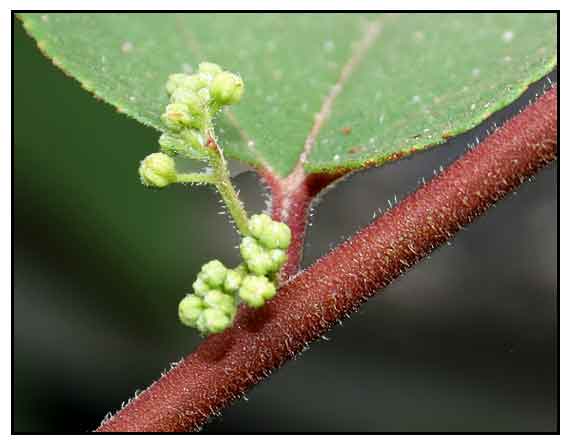
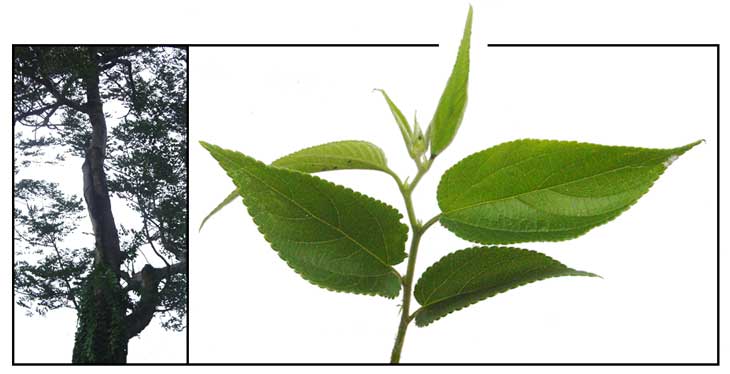
Anabiong is a small tree, 5 to 8 meters high, with elongated
branches. Leaves are distichous, the upper surface rough; the lower,
pale and covered with soft dense hairs, oblong-ovate to lanceolate,
8 to 15 centimeters long, with the base frequently unequal, broad and heart-shaped,
and the apex long and thinly pointed, and prominently 3-nerved with finely
toothed margins. Cymes are dense, hairy, 1 to 2.5 centimeters long. White flowers
are numerous, about 3 millimeters long. Fruit is ovoid, about 3.5 centimeters long.
Distribution
- In deserted clearings, thickets, and second-growth forests, often abundant, and found throughout the Philippines, at low and medium altitudes, in some places ascending to 2,000 meters.
- Also occurs in India to southern China and southward to northeastern Australia and Polynesia.
- Often planted as a shade-tree.
Constituents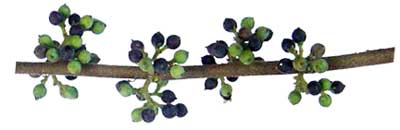
- Bark contains a
little tannin.
- Study of extracts of trunk bark and root bark isolated three new compounds: (9S*,10S*)-3-[7-(3,10-dihydroxy-9-hydroxymethyl-2,5-dimethoxy)-9,10-dihydrophenanthrenyl] propenal (1), (9S*,10S*)-3-[7-(5-O-β-glucopyranosyl-10-hydroxy-9-hydroxymethyl-2,6-dimethoxy)-9,10-dihydrophenanthrenyl] propenal (2), and (3R*,3aR*,4R*,5S*)-6-O-α-arabinopyranosyl-8-hydroxy-3-(4-hydroxyphenyl)-4-(4-hydroxyphenyl)-5-(3,5-dihydroxyphenyl)-3,3a-dihydrocyclopenta[1,2,3-de]isobenzopyran-1-one (3, orientoside A).(5)
- Study yielded the presence of tannins and phenolic compounds, fixed oils, fats, phytosterols, and flavonoids.
- Study yielded 8 compounds: ampelopsin F, (-) epicatechin, (+)-catechin, (+) syringaresinol, cinnamic acid among others.
- Study of extracts of trunk and root barks isolated 16 compounds. Spectral analysis identified them as Methylswertianin, decussatin, glycosides of decussatin, sweroside, scopoletin, (-)- epicatechin, lupeol, p-hydroxybenzoic acid, 3,4-dihydroxy- benzoic acid, adian-5-en-3-one, 2a, 3a, 23-trihydroxyurs- 12-en-28-oic acid, 2a, 3b-dihydroxyurs-12-en-28-oic acid, ß-sitosterol, 3-O-b-glucopyranosyl-b-sitosterol and hexacosanoic acid. (1)
- Study isolated from stem-bark of TO a new pentacyclic triterpenoid alcohol, trematol. (3)
- Phytochemical screening of powdered sample of plant yielded alkaloids, saponins, tannins, and cardiac glycosides. Proximate analysis yielded
crude protein 4.20 ±1.00%, crude fiber 13.00 ±1.00%, ether extract 12.00 ±10.00%, ash 8.00 ±1.00%, dry matter 89.00 ±10.00%. (22 )
- Phytochemical screening of petroleum ether and methanolic extracts of whole plant (stem, bark, leaves, roots) of T. orientalis
yielded phytosterols, triterpenoids, fixed oils and fats, tannins, phenolics, flavonoids, and carbohydrates. (see study below) (33 )
Properties
- Studies have shown antibacterial, glucose-lowering, anticonvulsive, analgesic, anti-inflammatory, iron- chelating properties.
Parts
used
Bark, leaves, seeds, stems, twigs.
Uses
Edibility
• Leaves and fruit reportedly eaten in African countries.
• Young leaves eaten as spinach
by the Zulus.
Folkloric
• In the Philippines, juice obtained from macerating
the soft wood is used for poulticing swellings.
• Fruit, leaves, bark, stems, twigs and seeds are used in traditional
East and West Africa, Tanzania and Madagascar medicine.
• In various folk medicine, root used for treatment of trauma, hematuria, gastrointestinal bleeding, blood stasis; stem bark decoction used as vermifuge and antidysenteric; stem bark and leaf decoction used for treatment of malaria, muscle pain, bone pain, and venereal diseases; stem bark and leaf decoction used as gargle, and relief of toothache. (26)
• Leaves and bark used to treat cough, asthma, bronchitis, toothache, sore throat. Also used for gonorrhea, yellow fever, and as antidote to poisoning.
• Bark infusion used for dysentery.
• Stem bark used as vermifuge.
• Decoction of leaves mixed with leaves of Bidens pilosa, Citrus aurantifolia and peels of unripe pineapple used for jaundice. Macerated leaves in lemon juice used for cough. Leaf decoction used as anthelmintic for roundworm and hookworm. (17)
• In Cote-d'Ivoire, leaf decoction used for hypertension.
• In southwest Nigeria, bark used as hematinic. Decoction of a mixture of T. orientalis bark, X. aethiopica fruits, T. alnifolia bark , and H. madagascariensis bark drunk twice daily for anemia.
• Zulus use the roots and bark as traditional medicine.
- In Nigeria, used for treatment of malaria.
(30)
- In Africa, used for diarrhea, arthritis, and neuralgia; in mixed preparations with Cordyline terminalia and Ricinus communis oil for diarrhea, arthritis, neuralgia, rheumatism, sprain; and fracture. (36)
Others
- Oil: Seed yields a dark green fixed oil.
-
Rope: The bast used in making string or rope.
- Craft: The wood which is soft is used in making wooden shoes. Light wood used for making fruit boxes.
- Dye: Leaves yield a coffee-colored dye. Bark yields a dark brown to black dye. Tannin used in roughening and coloring fishing lines.
- Veterinary: Leaf decoction used to deworm dogs. (•) In Zambia, T. orientalis is component of concoction of roots, bark and leaves given to cattle as a drench for Corridor disease (Theileriosis), foot and mouth disease, black leg, lumpy skin disease, coughing, bloating, and worms in cattle.(32)
- Fodder: Leaves, pods, and seeds used as fodder. In the Philippines, fed to cattle, goats, and water buffalo. High fiber content and toxins limit the use of leaf meal in feeds—the limitation can be overcome by extracting protein from the leaves. (19)
- Fuel: Coppices to provide for firewood and charcoal. (19)
- Fiber: Appropriate for paper and pulp production. Paper has good tensile strength and folding endurance. (19)
Studies
• Ethnobotanical Study / Blood Pressure Lowering: Trema orientalis was one of 33 species of plants used for treatment of hypertension. Used as a leaf decoction, its effect was attributed to polyphenols, potassium retention and the promotion of diuresis. (4)
• Anti-Convulsive Effect: Study of a methanol extract from dried leaves showed anticonvulsive activity on tonic flexion and tonic extension. (6)
• Glucose-Lowering: Study was done on the glucose-lowering effect of the aqueous stem bark extract in normal and streptozotocin-induced diabetic rats. Results showed T. orientalis stem bark extract significantly reduces blood glucose in STZ-induced diabetic rats by a mechanism different from the of sulfonylurea agents. (7)
• Chromium and Nickel Tolerance: Callus from contaminated and uncontaminated sources of Trema orientalis were tested in vitro for tolerance to chromium and nickel. Results showed seeds from contaminated sites were tolerant to chromium and nickel, suggesting a potential for use in sustainable revegetation programmes on chromiferous mine wastes. (9)
• Antibacterial / Bark Extracts: Study evaluated the antibacterial efficacy of aqueous bark extracts of T. orientalis on six selected bacterial strains. Results showed the selected bacterial strains were highly susceptible to the test materials, and corroborates its application in traditional medicine. (10)
• Reinforcement of Jute Pulp with Trema Orientalis Pulp: The addition of jute fiber pulp to the T. orientalis pulp increased tear strength. The pulp blends showed increased sheet density. Tensile index and burst index of blended pulp increased with beating degree and proportion of T. orientalis increased. (11)
• Iron Chelating / Antiradical Activity / Leaves: A methanol soluble fraction extracted from leaves showed antiradical activity of 69.73% on a DPPH assay, almost similar to ascorbic acid. Iron chelating activity was 40.74%. The results suggest a potential for processing industries and a good source for an iron chelator. (12)
• Black Powder for Blasting and Fireworks Purposes: Study of generated flames exhibited characteristics of black powder used for blasting purposes. The flames from ignition of black powder of Trema orientalis were comparable to that of foreign black powder. Results showed a potential for use of T. orientalis black powder for blasting in dimensional stone quarries, sporting and fireworks uses. (13)
• Anti-Sickling Powder for Blasting and Fireworks Purposes: Study evaluated the effect of anthocyanins extracts from T. orientalis on sickle cells. The anthocyanin extracts exhibited antisickling activity, possible through interference with intracellular polymerization of HbS or scavenging of free radicals preventing erythrocyte sickling or hemolysis. (14)
• Safety / Genotoxicity Testing: Study evaluated the safety of five plants widely distributed in Africa. Using bacterial reverse mutation, T. orientalis was one of four that showed negative results, suggesting potential safety of the plants for use as supplements in high doses. (15)
• Laxative Effect: Aqueous extract was shown to have a laxative effect, inducing stimulation of rabbit duodenum contractility. Also, an aqueous extract exerted cholinimimetic and anticholinesterase effects. (17)
• Mosquito Larvicidal Potential: In a study of four plants for mosquito larvicidal potential against Culex quinquefasciatus, a crude extract of Trema orientalis showed an LC50 2.95%. (18)
• Analgesic / Antidiarrheal: Study evaluated the potential analgesic and anti-diarrheal activity of methanol and aqueous extracts of leaves in experimental acetic acid induced writhing and castor oil induced diarrhea in mice. The aqueous extract showed significant (p<0.001) analgesic effect. In anti-diarrheal screening, both extracts increased latent period (p<0.025) and decreased the number of stools (p<0.025) comparable to standard loperamide. (20)
• In Vitro Thrombolysis / Clot Lysis Effect: Study evaluated the clot lysis effect of crude extracts of five Bangladesh plants viz., Trema orientalis, B. monnieri, C. frutescens, B. oleracea and U. sinuata in an invitro thrombolytic model using streptokinase as positive control. Chloroform fractions showed the highest clot lysis activity with T. orientalis at 46.44 ± 2.44%, compared to streptokinase at 80.77 ±1.12%. (21)
• Antioxidant / Phenol Content: In a study of Ivory Coast medicinal plants, Trema orientalis showed the highest total phenol content (240.73 ±47.31 mgGAE/g). The extract showed dose dependent DPPH radical scavenging activity. Phytochemical screening yielded steroids and polyterpenes, polyphenols, flavonoids, lucoanthocyanins, gallic, catechins, quinones, coumarins, cardiotonic glycoside, saponins.
(23)
• Antibacterial / Leaves: Study evaluated methanol and aqueous extract of leaves for antioxidant and antibacterial activities. Results showed strong antioxidant activity by DPPH assay with methanol extract IC50 of 110.25 µg/mL. Both extracts showed antibacterial activity at low concentrations. (24)
• Antitrypanosomal / Leaves: In an in vitro antitrypanosomal study of 36 plant extracts from 10 plant species, Trema orientalis was one of the species that showed remarkable antitrypanosomal activity with high selectivity for trypanosomes. (25)
• Antidiabetic / Leaves: Study evaluated the antidiabetic activity of ethanolic extract of Trema orientalis leaves in an in vivo model of diabetic rats. Extract treatment showed reduction of fasting blood glucose, along with reduction of total cholesterol and serum triglycerides and increase in HDL cholesterol levels. (27)
• Antipyretic / Antiulcer / Leaves: Study evaluated the antipyretic and antiulcer activities of Trema orientalis leaves on albino Wistar rats using brewer's yeast induced pyrexia and ethanol induced ulcer model. Results showed significant antipyretic and antiulcer activity when compared with standard paracetamol and pantoprazole. (28)
• Acute and Sub-Acute Toxicity Studies / Aerial Parts: Study evaluated the acute and sub-acute toxicity of powder extract aerial parts of Trema orientalis. Results showed o major changes in body weight and biochemical parameters (ALP, SGPT, SGOT, TP, globulin, albumin, and bilirubin). Results suggest the methanolic extract is safe in lower dose for pharmaceutical analysis. (29)
• Anti-Malarial / Leaf and Bark: Study evaluated the in vivo antiplasmodial activity of aqueous leaf and bark extracts of T. orientalis in a Swiss albino mice infected with Plasmodium berghei. The lethal dose based on toxicity signs and death was estimated to be greater than 5000 m/kg. Chloroquine was used as positive control. Parasitemia, parasite inhibition, body weight and packed cell volume (PCV) were determined. Extract was effective in suppressing parasitemia and in protecting infected animals from parasite induced PCV reduction. Results showed promising antiplasmodial activity which validates its folkloric use. (30)
• Intoxication in Goats / Hepatotoxicity: While considered edible and medicinal, there have been reported suspected cases of T. orientalis intoxication in Taiwan, with lesions similar to those caused by Trema aspera, well known for its hepatotoxicity in herbivores in Australia. This study evaluated the possible toxicity of T. orientalis in goats in measures of clinical signs, hematology and blood chemistries, and pathology studies in short- and long-term feeding studies. There were severe depression, anorexia and weight loss in goats fed leaves at10 g/ kbw or higher. No significant clinical signs were noted at 4g/kbw/day. In higher doses, the hepatic lesion were extensive, sparing only hepatocytes in the periportal area. In lower dose, lesions were more localized in the centrilobular area. Study demonstrated T. orientalis is indeed poisonous to goats with liver as a major target organ. Animals may suffer from acute liver damage and die after feeding on large amounts of leaves (10g/kbw/day). However, the toxic effect is not cumulative as no significant hepatocellular injury was noted, functionally or morphologically, after low level of leaf consumption at 50g/goat/day for a long period of time. The hepatiocellular injury may be due to irreversible disturbance of energy metabolism which leads to hepatocellular necrosis. (31)
• Antiepileptic / Whole Plant: Study evaluated the antiepileptic potential of petroleum ether and methanol extracts f whole plant (roots, leaves, stem, and bark) of T. orientalis using Picrotoxin Isoniazid, and NMDA induced convulsion models in rats and mice. PE and ME extracts at doses of 200 and 500 mg/kg showed significant increase (p<0.001) in the onset of convulsions. The amount of lupeol in the PE extract was estimated at 8.7 µg/ml. The antiepileptic activity was attributed to an increase in the brain GABA levels. (33)
• Antimalarial / Leaves: Study evaluated the antiplasmodial activity of acetone extract of T. orientalis leaves. Treatment with graded doses of acetone extract resulted in significant chemosuppression of parasitic growth ranging from 44.0 to 83.8%. The most active fraction, M6, showed significant schizontocidal activity (p<0.001), and data suggested it contained flavonoids. (34)
• Antiplasmodial / Toxicity Assessment: Study evaluated the antiplasmodial activity and toxicity assessment of 30 plant extracts from eight Nigerian medicinal plants used for treatment of febrile diseases. The EA extract of leaves of Ocimum gratissimum and hexane extract of stem bark of Trema orientalis showed highest antiplasmodial activity (IC50 1.8-1.93 µg/mL) against P. falcifarum K1 strain but elicited low cytotoxicity (selective index >10). (35)
• Antitumor / Cytotoxic Effect: Study evaluated the antitumor and cytotoxic actions of solvent-solvent partitioned fraction (n-hexane, ethyl acetate and hydro-methanol) of a methanol extract of root of Trema orientalis. In cytotoxicity study by brine shrimp lethality bioassay, the LD50 of the n-hexane, EA, and HM fractions was 1377.03, 11.67, and48.62 µg/ml, respectively. The EA and HM fractions showed high antitumor and cytotoxic effect. (37)
Availability
Wildcrafted. |


_W2_IMG_2236.jpg&imgrefurl=http://en.wikipedia.org/wiki/File:Trema_orientalis_(Pigeon_Wood)_W2_IMG_2236.jpg&usg=__xWVzei-M0yq3w9Ci53YJTNit)



_W2_IMG_2236.jpg&imgrefurl=http://en.wikipedia.org/wiki/File:Trema_orientalis_(Pigeon_Wood)_W2_IMG_2236.jpg&usg=__xWVzei-M0yq3w9Ci53YJTNitxbU=&h=600&w=763&sz=169&hl=en&start=19&zoom=1&itbs=1&tbnid=JMDAfoyWuBrRMM:&tbnh=112&tbnw=142&prev=/search?q=trema+orientalis+image&start=18&hl=en&client=safari&sa=N&rls=en-us&ndsp=18&tbm=isch&prmd=ivns&ei=FpfjTYanJ4LCvgO40JW4Bg)