 Botany Botany
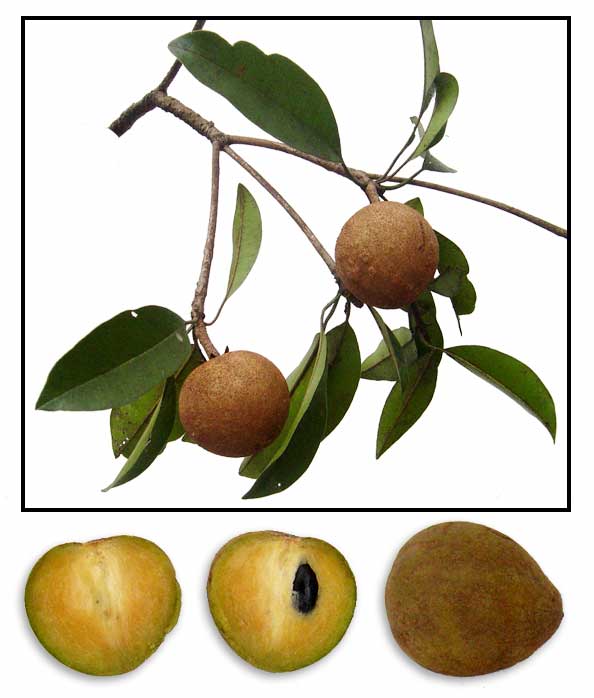
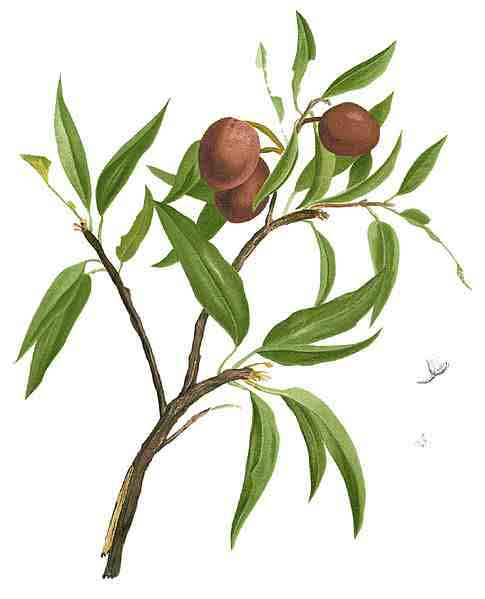
Chico is a much-branched tree growing to a
height of 8 meters. Leaves are oblong to narrowly oblong-obovate, 8
to 13 centimeters in length, pointed at both ends. Flowers are hairy outside,
6 to 8 millimeters long and 6-parted. Fruit is brown, fleshy, ovoid to round, 3 to 8
centimeters long, containing 5 or more shiny blackish-brown seeds. Fleshy is brown,
soft, slightly gritty, sweet, and very agreeable in flavor.
Distribution
- Cultivated in most parts of
the Philippines.
- Introduced from tropical America in the early colonial period.
- Cultivated in the tropics.
Constituents
- Leaves contain a bitter principle
alkaloid, sapotin 0.076%, fixed oil 1.45%, etc.
- Fruit also yields sapotin, 0.013%.
- Seeds yield sapotin, saponin, achrassaponin, an alkaloid,
fixed-oil 16-23%, the bitter principle, sapotinine 0.08%, etc.
- Bark contains sapotin, saponin, and tannin 11.8%.
- Gum chicle contains 75% resin, gum (arabin) 10%, calcium oxalate,
sugar, etc.
- Fruit flesh yields saccharose 7%, dextrose 3.7%, and levulose 3.4%.
- Chemical composition analysis of sapota juice showed it to be a rich
source of sugars, proteins, vitamin C, phenolics, carotenoids and minerals
(iron, copper, zinc, calcium and potassium).
- Phytochemical screening yielded terpenoids, glycosides, and flavonoid type compounds.
- Leaves studied for lipoidal matters yielded fatty acids, of which unsaturated fatty acids represented 32.32% of total FA, oleic acid (13.95%), linoleidic acid (10.18%), and linoleic acid (5.96%) were the major ones. Isolated compounds were lupeol acetate, oleanolic acid, apigenin-7-O-α-L-rhamnoside, myricetin-3-O-α-L-rhamnoside and caffeic acid. (12)
Properties
- Seeds are aperient, diuretic, tonic, and antipyretic.
- Sapotin considered a febrifuge.
Parts
utilized:
Bark, seeds, fruit.
 Uses Uses
Edibility
• Fruit is soft and gritty with a sweet agreeable flavor.
Folkloric
• Decoction of the bark used
for diarrhea and fever.
• Fruit soaked in melted butter overnight, is thought to be preventive
for biliousness and fevers.
• Seed kernel oil used as skin ointment and as dressing for falling
hair.
• In Mexico, used
for kidney stones and rheumatism.
• In West Indies, seeds considered aperient and diuretic; the bark as tonic and febrifuge.
• In Cuba, seed
infusion used as an eyewash.
• In Konkan, fruit soaked in melted butter overnight, considered an excellent preventive for biliousness and febrile attacks.
• In Antilles, astringent fruit used for dysentery.
• Leaf decoction used for fever, hemorrhage, wounds and ulcers.
• For neuralgia, leaf with tallow or oil, applied as compress
to the temples.
• Seeds used for fever; when ground with water, acts as diuretic.
• In Indonesia,
flowers are one of the ingredients in a powder rubbed on the woman's
body after childbirth.
• In Cambodia, tannin
from the bark used for diarrhea and fever.
• Malays
flowers
Others
• Bark: Used for tanning sails and making fish tackle.
• Gum
chicle: Derived from the bark juice, is used in the manufacture of chewing
gum. Gum chicle is also used for transmission belts, dental surgery,
and a substitute for gutta-percha.
• Lambanog flavoring: fruit is also a popularly used in the aging of the coconut
liquer, lambanog.
Related
additional
info
Latex is tapped only if the sapodilla is at least 20
to 25 years old. Each tapping yields only 21/2 pounds of gum over a
period of six hours; and trees are tapped only once in three or four
years. (The Story of Chewing
Gum)
Caution
!
Seeds contain hydrocyanic acid and should be removed
before eating the fruit.
Studies
• Phytochemical: Triterpenoids,
achras sapota, saponins, cotyledons, terpenes, terpenoids, non-polar
extracts: Study isolated 14 triterpenoids and five triterpenoidal
saponins.
• Triterpenoid saponin / Antibacterial:
Study isolated a new pentacyclic triterpenoids saponin along with one
known from the cotyledons of Achras sapota. Compound 2 showed antibacterial
activity against Gram positive and negative bacteria. (2)
• Antioxidant: Study
showed zapota juice to have multiple radical-scavenging potential due
to its nutraceutical components, viz., phenolics carotenoids and ascorbic
acid. (3)
• Antimicrobial: Study
of extracts of stem bark and leaves
showed activity against all pathogenic bacteria in the study, including Aspergillus flavus, Vasianfactum sp and Fusarium sp.
• Antibacterial: Study
showed the acetone extract of M. zapota seeds to be bactericidal.
(8)
• Antioxidant / Hepatoprotective: Study of cold ethanolic extract of M. zapota leaves
demonstrated significant dose-dependent antioxidant activity. In a carbon tetrachloride (CCl4)-induced liver damage model in rats, it exhibited hepatoprotective activity. (9)
• Anti-Tumor: Study of stem bark of M. zapota against Ehrlich ascites carcinoma in Swiss albino mice showed significant antitumour activity with increase in survival time and restored hematological parameters. (10)
• Antidiabetic / Roots: Study evaluated an alcohol extract of A. zapota roots for antidiabetic activity.
Results showed increasing dosages of the alcohol extract caused increase in antidiabetic activity. 80g/kbw of fresh material was almost as strong as 100 mg/kbw of tolbutamide. (11)
• Triterpenoid Acyl Derivatives / Fruits / Antioxidant / Antihyperglycemic / Hypocholesterolemic: Fruits yielded a new natural compound, β-amyrin-3-(3'-dimethyl) butyrate, together with lupeol-3-acetate and 4-caffeoylquinic acid (cryptochlorogenic acid). The alcoholic and aqueous extracts of unripe fruits, in addition to their aqueous homogenate showed antioxidant antihyperglycemic, and hypocholesterolemic activities.
(13)
• Antipyretic / Anti-Inflammatory / Leaves: Study evaluated extracts of leaves for anti-inflammatory and anti-pyretic activities in albino Wistar rats. Crude ethanolic and ethyl acetate extracts showed anti-inflammatory activity with significant inhibition of paw edema. Both petroleum and EA fractions exhibited significant anti-pyretic property.
(14)
• Analgesic / Leaves: Study of petroleum ether and ethanolic extracts of M. zapota, using a hot plate method, showed analgesic effect at doses of 200 mg/kg. (15)
• Triterpenes and Sterols / Fruits / Antifungal: Freeze-dried unripe fruit of Achras zapota yielded a mixture of ß-amyrin (1a) pentanoate and α-amyrin pentanoate (1b), a mixture of spinasterol and taraxerol, and a fatty acid ester of oleanolic acid.
Mixture of 1a and 2b showed moderate activity against Candida albicans Mixtures were inactive aginst bacteria. (16)
• Volatile Flavor Components of Fruit: Study evaluated the essence of fresh sapodilla fruit. Fruit yields a small quantity of aroma volatiles (about 5 µg/kg of fresh fruit), less than that obtained from other fruits, which partly explains the delicate flavor.
A group of benzyl-related compound comprise over 45% of the essence and includes a series of five alkyl benzoates. (17)
• Anti-Cancer / Apoptosis / Inhibtion of Tumor Progression: A methanolic extract of sapota fruit induces cytotoxicity in a dose dependent manner in cancer cell lines. Cell cycle analysis suggested activation of apoptosis, without arresting cell cycle progression. Treatment leads to significant inhibition of tumor growth and a 3-fold increase in life span of tumor bearing animals.
(18)
Availability
Cultivated. |