 Botany Botany
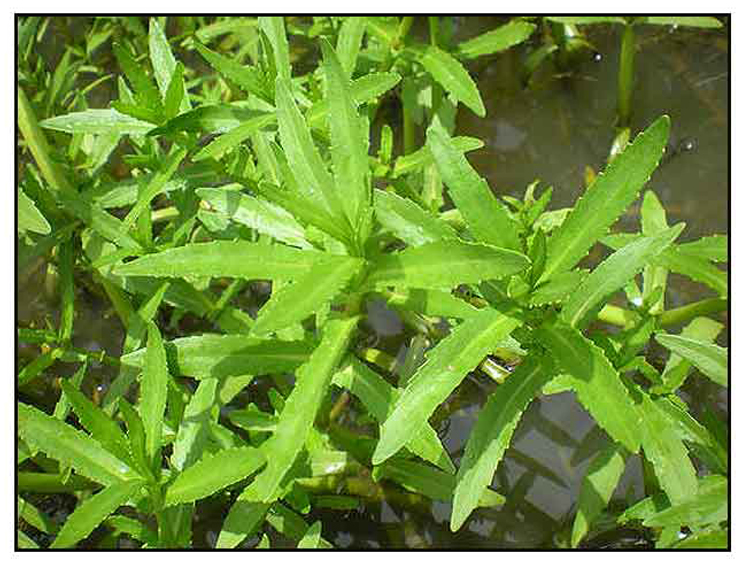
Kankong-kalabau is a prostrate, spreading, annual herb. Stems are somewhat fleshy, 30 centimeters or more in length, branched, rooting at the lower nodes, and somewhat hairy. Leaves are stalkless, linear-oblong, 3 to 5 centimeters in length, pointed or blunt at the tip, usually truncate at the base, and somewhat toothed at the margins. Flowering heads are without stalks, borne singly in the axils of the leaves, and excluding the bracts, are less than 1 centimeter in diameter. Outer pair of the involucral bracts is ovate and 1 to 1.2 centimeters long; the inner pair is somewhat smaller. Flowers are white or greenish-white. Fruits are achenes enclosed by rigid receptacle-scales. Pappus is absent.
Distribution
- In the Philippines, found only in Rizal Province in Luzon and occasional along the banks of small streams in and about Manila.
- Certainly introduced.
- Found in tropical Africa and Asia to Malaya.
Constituents
- Study yielded flavonoids, tannins and saponins.
- Leaf extract study yielded two new chlorine containing melampolids, in addition to three known sesquiterpene lactones.
- Phytochemical analysis yielded alkaloids, saponins flavonoids, triterpenoids/steroid, tannins, carbohydrates, and glycosides.
- Ethyl acetate fraction yielded two flavonoids: baicalein 7-O-glucoside and baicalein 7-O-diglucoside.
- Study showed low ash content and a good source of beta-carotene (3.7 to 4.2 mg/100g on fresh weight basis.
- Study of methanolic extract showed total phenol and total flavonoid contents of 153.08 ± 0.38 mg/mL and 172.04 ± 0.56 mg/mL, respectively. (see study below) (20)
Properties
- Leaves are antibilious.
- Demulcent, cooling, laxative.
- Study showed antimicrobial, analgesic, antidiarrheal, antioxidant, anti-cancer, CNS depressant, iron chelating, hepatoprotective, gastroprotective properties.
Parts used
Leaves, young plant parts.
Uses
Edibility
- In Malaya, young parts are used as salad.
- Sometimes steamed before they are eaten.
Folkloric
- In the Philippines, leaves are pressed and applied to the skin as a cure for herpetic eruptions.
- The Malays use the young parts and bitter leaves as laxative.
- Leaves used for diseases of the skin and nervous system.
- Leaf paste applied to inflamed breasts to reduce inflammation.
- In Calcutta, fresh juice of leaves used as adjunct to tonic medicines; used for neuralgia and other nervous diseases. In Indian medicine, also used for various skin diseases and as a laxative.
- In Assam, India, plant juices used for skin diseases, nervous disorders and high blood pressure.
- Expressed juice of leaves used as demulcent in cases of gonorrhea; mixed with cow's or goat's milk.
- As a cooling agent, leaves are pounded and made into paste and applied cold to the head.
- Plant used for torpidity of the liver. Infusion is prepared the previous evening, boiled with rice and taken with mustard oil and salt.
- Used by the tribal practitioners of the Marakh sect of the Garos for treatment of diabetes.
(19)
- In Ayurveda, used for liver disorders, skin and nervous disorders; also, as laxative.
Studies
• Antimicrobial: Study results showed extract variations, but the methanol extract of A. longifolia, I. aquatica and Enhydra fluctuans showed antimicrobial activity against pathogenic bacteria - S. aureus, P. aeruginosa, E coli and M. luteus. (1)
• Antioxidant: Study showed the crude extract to contain flavonoids, saponins and tannins. The ethyl acetate fractions showed the highest free radical scavenging activity
• Analgesic: Study evaluating the analgesic activity showed promising results in both acetic acid-induced writhing and the tail-flick methods. (6)
• Antidiarrheal: Study of the methanol and aqueous extracts of the whole plant showed antidiarrheal activity on castor-oil induced diarrhea. The methanolic extract moderately inhibited growth of S. dysenteriae, S. boydii and S. flexneri; the aqueous extract inhibited growth of S. aureus, S. dysenteriae and S. boydii. (7)
• Flavonoids / Anticancer: Study yielded two flavonoids: baicalein 7-O-glucoside and baicalein 7-O-diglucoside. They were screened for anticancer activity against Erlich/s ascites carcinoma bearing Swiss albino mice. Treatment caused a significant decrease in tumor cell volume and increase of life span. Treatment with the flavonoids was found to be cytotoxic in the in-vitro model. (8)
• CNS Depressant Activity: Neuropharmacological effects of three fractions of aerial parts were studied using mice models. Results showed significant spontaneous motility depressant, sedative, anticonvulsant and anti-stress activity. (10)
• Flavonoids / Analgesic Activity: Study of total flavonoids in Swiss albino mice showed analgesic and anti-inflammatory activity. The results may be attributed to high free radical scavenging and antioxidant potential of flavonoids in the ethyl acetate fraction of E. fluctuans. (11)
• Hepatoprotective / CCl4-Induced Damage: Study evaluated the hepatoprotective potential of EF against carbon-tetrachloride-induced oxidative damage in rats. Results showed the flavonoid rich ethyl acetate fraction to have significant hepatoprotective activity, probably due to the ability of the extract to inhibit lipid peroxidation and increase the anti-oxidant enzymatic activity. (12)
• Antimicrobial / Cytotoxicity: Study evaluated three medicinal plants (E. fluctuans, Clerodendrum viscozum and A. peniculata) for antimicrobial and cytotoxic activities against some pathogenic organisms and Artemia salina (brine shrimp nauplii). All three showed activity against brine shrimp nauplii. A methanol leaf extract of E. fluctuans showed significant efficacy against tested bacteria and fungi. (15)
• Iron-Chelating / Antioxidant: Chelation of free iron can prevent the formation of free radicals. An antioxidant prevents the activity of free radicals either by inhibition or scavenging of free radicals. Study showed E. fluctuans to have both iron chelating and antioxidant activity. (18)
• Anti-Diarrheal / In vitro Antimicrobial Activity: Study of extracts of E. fluctuans showed antidiarrheal activity. The methanolic extract showed moderate inhibitory activity on Shigella dysenteriae, S. boydii and S. flexneri; the aqueous extract inhibited Staphylococcus aureus, S. dysenteriae, and S. boydii. (13)
• Phagocytosis Effects / Leaves: Study evaluated the effect of aqueous extract of leaves on neutrophil phagocytic function. Results showed the extract stimulated chemotactic, phagocytic, and intracellular killing potency of human neutrophils at different concentration. probably through stimulation of cell-mediated immune system. (16)
• Natural Flavonoids / Anti-Inflammatory / Gastric Cytoprotective: Flavonoid isolated from the leaves of E. fluctuans showed anti-inflammatory activity by inhibiting COX-2 and 5-LOX. Its anti-ulcerogenic effect can be attributed to its action on mucosa defense factors. (17)
• Anthelmintic / Antioxidant / Thrombolytic: Methanolic extract was evaluated for anthelmintic and thrombolytic activities. Results showed significant antioxidant activity with IC50 of 135.20 ± 0.56 µg/mL, with reducing power increasing with concentration. Anthelmintic activity of crude extract against Pheretima posthuma showed concentration dependent effect and compared with albendazole. Clot lysis activity of crude extract was significant (31%) compared to standard streptokinase's clot lysis activity of 40.13%. (see constituents above) (20)
Availability
Wild-crafted.
|