|
 Botany Botany
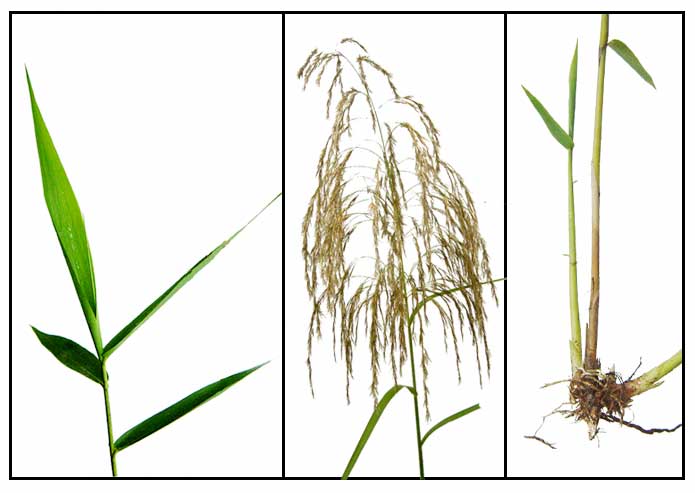
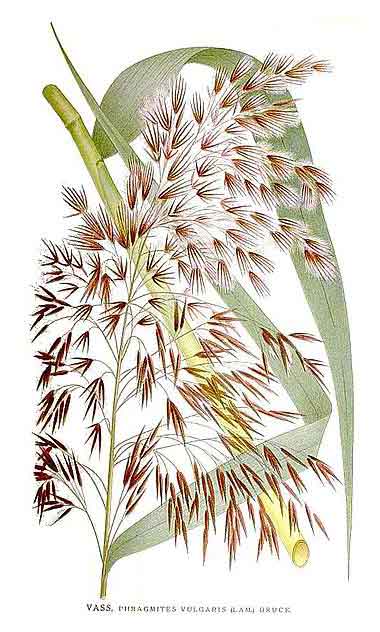
Tambo is a coarse, erect grass growing to a height of 1.5 to 3.5 meters. Stems
are cylindrical and hollow, about 1 centimeter in diameter. Leaves are flat and
linear, up to 50 centimeters long, 2.5 centimeters wide. Panicles are large, terminal,
plume-like, somewhat nodding, 30 to 50 centimeters long, brownish, dense, very many-flowered, with slender branches. Spikelets are linear, and about 1 centimeter long.
Distribution
- Widely distributed in the Philippines at low and medium altitudes.
- Locally abundant in shallow swamps and muddy streams.
- Often gregarious, occupying considerable areas.
- Cultivated for commercial use.
- Occurs in warm countries throughout the world.
 Constituents Constituents
- Root has 5% protein; 1%
fat;; 51% carbohydrate; 1.54% ash and 0.1% asparigin.
- Per 100 g, reed yields 415 calories, 20.6 g protein, 2.1 g fat, 72.7 g total carbohydrate, 31.9 g fiber, 14.6 g ash, 480 mg Ca, 70 mg P, and 130 mg Mg.
- Leaves yield 17.1 g protein, 63.7 g total carbohydrate, 27.4 g fiber, and 15.7 g sh.
- Stems yield 4.8 g protein, 0.8 g fat, 90.0 g total carbohydrate, 41.2 g fiber, and 4.4 g ash.
- Fresh herb reported to yield vitamin A, C, B1 and B2, triterpene ß-amyrin, taraxerol.
- Yields triterpenes, vitamins A and B, ascorbic acid.
- Secretes a phytotoxin, gallic acid, which on ultraviolet light photo-degradation, causes higher mortality of susceptible seedlings, that gives it a competitive edge in their habitats.
Properties
- Considered , antiasthmatic, antidote, antiemetic, diaphoretic, diuretic, lithotriptic, sialagogue, stomachic, sudorific.
- Roots considered cooling and diuretic.
- Studies have suggested phytoremediative properties.
Parts
utilized
Roots, leaves, flowers, stems.
 Uses Uses
Edibility / Nutrition
- Leaves, roots, seed, and stems are edible.
-
Young shoots may be eaten raw or cooked and eaten like labong
(bamboo sprouts).
- Young shoot and roots are foraged for its edibility. They can be eaten raw or steamed. Overnight, a sweet syrup oozes out of injured stems. (9)
- Unfolded leaves used as potherb.
- In Japan, young shoots are eaten, cooked like asparagus or bamboo sprouts. Also, grounded dry young leaves, mixed
with cereal flour in making dumplings.
- Sugary gum from the stem can be rolled into balls and eaten as sweets.
- Powder extracted from dried stems can be moistened and roasted like marshmallow.
- Stems can boiled.
Folkloric
- The roots and sprouts are cooling and diuretic.
- In China, tender sprouts and rhizomes used
medicinally. Reed rhizome used for cancer.
- Reported folk medicine for condylomata, indurated breast, breast cancer,
leukemia.
- Used for abscesses, arthritis, bronchitis, cough, cholera, gout fever,
hiccups, rheumatism.
- Ash of leaves used for foul sores.
- Leaves used in treatment of bronchitis and cholera.
- Root is used as antiasthmatic, antiemetic antitussive, febrifuge, sedative, sialagogue, and stomachic.
- Stems are antiemetic, antidotal,
antipyretic.
- Decoction of flowers used for cholera and food poisoning.
- Mixed with gypsum for halitosis and toothache.
- In Iran, boiled rhizomes used for treating infections. (12)
Others
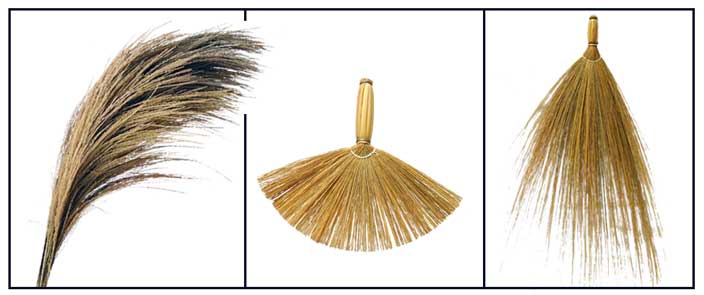
- Brooms: In the Philippines, dust
brooms are made from the panicles.
- Firewood: The hardy stems are used as firewood.
- Roofing: Where bamboo is not available, used for roofing ribs or thatched roofs. In Germany, the use of thatched roofs for vacation houses is a status symbol. In poor villages of Romania, thatched roofs may be the economical choice. (9)
- Fiber: Used for making strings and rope. (11)
- Dye: Flowers yield a light green dye. (11)
- Instrument parts: Culms used for pen handles. Pens for writing fashioned from thin stems of reeds. Stems used as measuring device. (11)
- Paper: Makes first-class paper, but difficult to bleach.
- Mouthpiece: Mouth pieces for musical instruments (clarinets, etc.)
- Plaster: Plant mixed with mud to make plaster for walls. (11)
Studies
• Pharmacologic Study:
Study of aerial parts of P. communis Trin. was done concerning free amino acids, fatty acids, sterols, tocopherols and polyphenols. Isolated polyphenols were investigated for antibacteriophage properties. (3)
• Phytotoxin / Gallic Acid:
Study on plant invasiveness behavior showed P. australis (common reed) secretes a phytotoxin, gallic acid, which on ultraviolet light photo-degradation, causes higher mortality of susceptible seedlings, that gives it a competitive edge in their habitats. (4)
• Phytoremediation / Ibuprofen Removal: Phytoremediation of selected pharmaceuticals (diclofenac, ibuprofen, and acetaminophen) using Armoracia rusticana and Linum usitatissimum cell cultures and by hydroponically cultivated Lupinus albus, Hordeum vulgaris, and Phragmites australis plants in laboratory conditions was done. Best effectiveness for ibuprofen removal was found with Phragmites. (5) Ibuprofen concentrations higher than 10 µg/ml can be embryotoxic to zebrafish and decrease hatching and growth rates. Study showed Phragmites australis degrades IBP from water and is a suitable species for use in constructed wetlands to clean wastewater effluents containing ibuprofen and possibly other pollutants. (10)
• Drug Interaction / Lithium: Moderate interactions reported with lithium. Reed herb may decrease the excretion of lithium, increase blood levels and cause serious side effects. (8)
Availability
Wild-crafted. |