General info
- Arcangelisia is a genus of flowering plants belonging to the family Menispermaceae. Its native range is Hainan to Indo-China and New Guinea.
- The genus Argangelisia comprises 3 species: A. flava, A. gusanlung, and A. typanopoda.
(46)
 Botany Botany
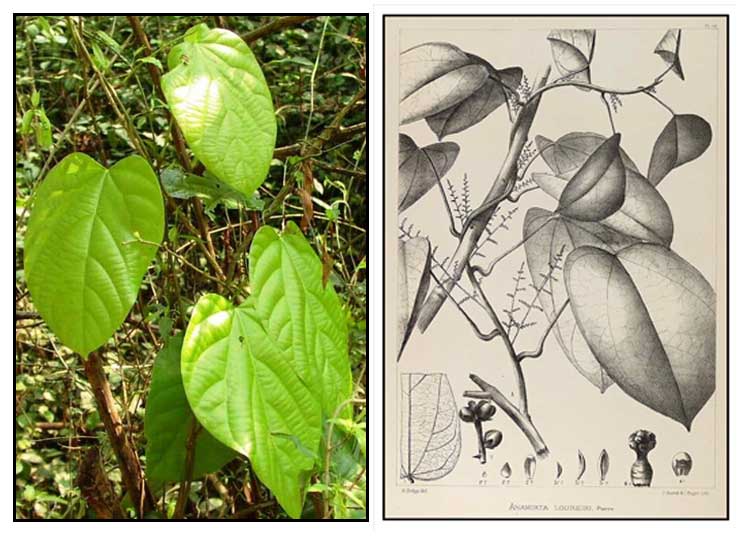
• Abutra is a woody,
perennial, climbing plant with a very long stem growing from the ground
level to the canopy of trees. Old stems are about 5 centimeters thick, with a
gray bark and yellow wood. Leaves are leathery, smooth, broadly ovate, 16 centimeters wide and 16 centimeters long, the tip abruptly
pointed, the base obtusely round or subtruncate, with 5 veins radiating
from the base, with one or two lateral nerves arising from the midvein above the middle. Inflorescence
is axillary, pendulous and spicately panicled, usually clustered along the stems.
Flowers are fragrant, yellowish, crowded and stalkless. Exterior perianth segments are 3, and small; interior ones are 6, oblong, much longer, and spreading. Fruit is nearly spherical, about 2 centimeters in diameter, green or yellowish green.
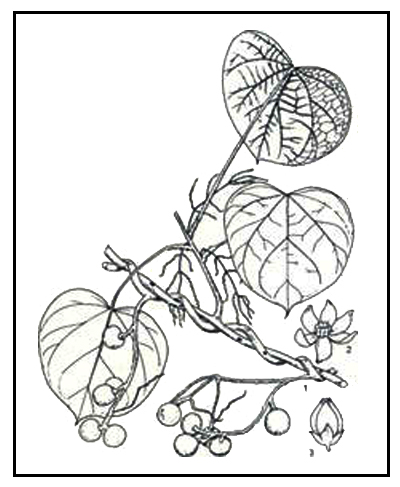
• Growth form: A liana with cup-like petiole scars and injured stem produce yellow sap. Foliage: Petiole is 4 – 20 cm long, swollen at both ends and bend like a knee at the base. Leaves are ovate to elliptic (10 – 25 cm long and 5.5 – 19 cm wide) with rounded or slightly cordate leaf base and acuminate leaf tip. Leaves are palmately veined at the base with 1–3 pairs of secondary veins usually arising from above halfway along the midrib. Veins are prominent on both surfaces and possess hollow domatia in the secondary veins axils on the lower surface. Leaves dry matte with inconspicuous veins pattern. Flowers: Inflorescence is a slender panicle (10 – 50 cm long) and occurs axillary or on stem. Male flower has 3 – 4 tiny outer sepals (less than 1 mm long), 3 + 3 larger inner sepals which are elliptic to ovate (1.5 – 2.5 mm long) and stamens about 0.5 – 1 mm long. Female flower has 6 sepals (2.5 – 4 mm long) which are narrowly oblong and become reflexed. The reduced male organs in the female flower are tiny and scale-like. Female flower also has 3 carpels and a broad stigma. Fruit: Fruits are borne in a branched cluster (5 – 45 cm long) at the axillary or on the stem. Within the branched cluster, fruits usually occur in group of 1 – 3, often forming a club-shape. Each fruit is yellow and appears slightly laterally compressed (2.2 – 3 cm long and 2.5 – 3.3 cm wide), smooth and drying wrinkled. Endocarp is woody and the surface is covered densely with fibers. (45)
Distribution
- Native to the Philippines.
-
Scattered in thickets and
forests at low and medium altitudes from the Batan Islands to Palawan and Mindanao.
- Also native to Borneo, Hainan, Jawa, Laos, Malaya, Maluku, New Guinea, Sulawesi, Sumatera, Thailand, Vietnam. (14)
 Constituents Constituents
- Stems yield a yellow
dye, berberine, the active principle in barberry.
- Study showed the stems contain approximately 4.8 percent pure alkaloid.
- The plant yields several alkaloids: berberine, the principal alkaloid, with jatrorhizine, columbamine
and shobakunine.
- A single plant has been reported to yield one kilo of berberine.
- Roots yielded a furanoditerpenoid, fibaruretin B.
- Study yielded 11 secondary metabolites including 2-dehydroarcangelisinol, 6-
hydroxyarcangelisin, fibleucin, fibraurin, 6-
hydroxyfibleucin, 6-hydroxyfibraurin,
berberine, columbamine, jatrorrhizine,
palmatine, and tinophyllol. (see study below) (23)
- Phytochemical screening yielded alkaloid, flavonoid, saponin, and terpenoid compounds, with the absence of tannin. (see study below) (24)
- Study isolated two furanoditerpenes, 2α,3α-epoxy-2,3,7,8α-tetrahydropenianthic acid methyl ester (1) and 2α,3α-epoxy-2,3-dihydropenianthic acid methyl ester (2) from the roots of A. flava. NMR and EI-MS studies also isolated fibraurin (3), fibleucin (4) 2ß, 3α-dihydroxy-2,3,7, 8α-tetrahydropenianthic acid-2.17-lactone (5), along with p-hydroxybenzaldehyde and vanillin. (see study below) (33)
- Thin-layer chromatography (TLOC) and phytochemical screening of hexane extract of A. flava stems revealed presence of organic acids, triterpenes, sterols, essential oils, phenols, and flavonoids. GC-MS analysis revealed 64 chemical compounds classified into hydrocarbon, ketone, alcohol, aromatic compounds, aldehyde, ester, organosilicon, and other chemicals. Most abundant was hexacosane (43.17%), followed by tetracosane (8.85%), o-xylene (8.09%), and hexatriacontane (5.72%). FTIR also revealed hydrocarbons such as alkanes and alkenes. (49)
Properties
Considered antimalarial, germicidal, tonic, stomachic, febrifuge, emmenagogue, abortive, antiperiodic, diaphoretic
(much of these due to the berberine).
- Studies have suggest anti-inflammatory, antioxidant, antibacterial, antifungal, antimalarial, anti-cancer, hepatoprotective, antibabesial, antidiarrheal, antidiabetic, neuraminidase inhibitory, hypocholesterolemic, anti-osteoarthritis, interleukin -1ß inhibitory properties.
Parts
used
Bark, roots, and
stems.
 Uses Uses
Edibility
• Fruits reportedly eaten and dispersed by orangutans, gibbons, and macaques in Eastern Borneo.
Folkloric
• Decoction of wood used for cleansing wounds; used as a cure for itches and tropical ulcers.
• Decoction or infusion of plant used as stomachic and febrifuge.
• Decoction of roots and stem used as febrifuge, tonic and emmenagogue. Also used
as abortive.
• In Zambales used as expectorant in bronchial affections.
• In Malaya, decoction taken internally for jaundice, indigestion and as vermifuge.
• Smoke used as inhalant for mucous membrane affections of the nose and mouth.
• In Indo-China used as antidiabetic drug.
• In East Asian traditional medicine, used as bitter tonic and
for jaundice, infectious diarrheal disease and skin abscess.
• Used for treatment of malaria and dysentery and as a tonic.
• Sap from cut stems drunk as treatment for fever and sprue. (16)
• Used for treatment of jaundice, sore eyes, aphtha, water flea; as stomachic and anthelmintic. (46)
Others
- Dye: Stems used for its yellow
dye (berberine), a single plant yielding as much as one kilo of berberine.
- Germicide: Popular in the Philippines as a germicide.
Studies
• Antioxidant
/ Cytotoxic / Anti-Breast Cancer: Study evaluated the antioxidant
and cytotoxic activities of A. flava, C. blumeanum and F. tinctoria:
A. flava showed antioxidant
activity and pronounced cytotoxic activity against human cancer cell
line MCF-7 (breast adenocarcinoma). Berberine, palmatine and jatrorrhizine
were isolated from A. flava. (1)
• Antimalarial / Cytotoxic: Study evaluated 49 plants and 228 extracts from plants traditionally use to treat malaria in south Vietnam for in-vitro activity against Plasmodium falcifarum and antitoxicity against human cancer cell lines HeLa and the embryonic lung MRC5 cell line. At concentration of 10 µg/ml, 82 extracts showed antiplasmodial activity. Six plants, including A. flava, showed antiplasmodial activity with IC50 ranging from 0.4 to 8.6 µg/ml with good selectivity. (2)
• Phytochemical / New Furanoditerpenes: Study
yielded four new furanoditerpenes plus fibraurin, fibleucin, and 6-hydroxyfibraurin. (3)
• Antibabesial Activity / Protoberberine Alkaloids: Study
isolated palmatine, berberine, jatrorrhizine, dihydroberberine and 20-hydroxyecdysone.
Four compounds caused significant inhibition of Babesia gibsoni, an
intraerythrocytic parasite that causes hemolytic anemia in wild and
domesticated dogs. The mechanism was possibly through prevention of
parasite invasion of erythrocytes and inhibition of growth. (4)
• Genotoxicity: In a study of 138 medicinal plant preparations used in the Philippines
were studied for genotoxicity. 12, including A. flava exhibited detectable
genotoxicity.
• Furanoditerpenoids / Fibaruretin: Furanoditerpenoids are secondary metabolites found in Menispermaceae plants, found to possess anti-inflammatory and antimalarial activities. Study of the roots of A. flava isolated a furanoditerpenoids compound, fibaruretin. (6)
• Protoberberine Alkaloids / Anti-Babesial:Stems yielded palmatine, berberine, jatrorrhizine, dihydroberberine and 20-hydroxyecdysone. Compounds 1-4 showed growth inhibiting effects on Babesia gibsoni in culture. (B. gibsoni is an emerging pathogen in dogs.) (7)
• Berberine: A. flava yields the plant alkaloid berberine. Review lists its physiological effects: anti-diarrheal, anti-malarial, anti-tumor, stimulates cardiac contractility and anti-arrhythmic, anti-inflammatory and antihepatotoxic.
• Anti-Babesial: Study evaluated the inhibitory effects of 45 selected plant extracts from Central Kalimantan, Indonesia in invitro and its acute toxicity to mice. Arcangelisia flava showed to have appreciable antibabesial activity without toxicity to mice. (9)
• Hepatoprotective: In vivo studies of secondary metabolites of abutra (akar kuning) saponin extracts without alkaloids showed hepatoprotective activity in paracetamol induced liver damage in Sprague Dawley rats. (10)
• Anti-Malarial / Anti-Telomerase: Berberine, extracted from Arcangelisia flava dose-dependently inhibited telomerase activity in erythrocytic cycle of Plasmodium flaciparum suggested P. falcifarum telomerase may be a potential target for future malarial chemotherapy. (12)
• Antihypertensive / Anti-Cancer: A study of twenty-two medicinal plants showed the pepsin hydrosylates of Arcangelisia flava bark to have antihypertensive (ACE inhibitory) and anticancer (≥50 % inhibition of human cancer cell lines) activities. (13)
• Natural Food Additive / Antimicrobial / Acidity-Stabilizing Effects in Palm Sugar: Study investigated the antimicrobial and acidity-stabilizing effects of yellow root extract. A water extract showed antimicrobial activity against Salmonella typhi, Staphylococcus aureus, and Trichophyton rubrum. The extract showed ability to stabilize the acidity of fresh palm sap due to fermentation mechanism. Toxicity testing using Brine shrimp lethality assay showed A. flava to be a natural product without toxicity. Results suggest A. flava can be used as a safe natural food additive, especially in the production of palm sugar. (15)
• Safety Study on Hepatotoxicity: Study sought to determine if A. flava is hepatotoxic to rats. A freeze-dried preparation was administered intraperitoneally to rats. Only an isolated case of SGPT elevation was noted; the majority were within normal range. (17)
• Pharmacologic Effects / Berberine: Study was done to determine whether the pharmacologic effects of A. flava extracts are attributable to the berberine content, the principal alkaloid content of the plant. The study did not settle the issue, but concluded the following: (1) IV doses of the extract to a dog caused hypotension, bradycardia, and increased myocardial contraction. (2) In isolated turtle heart, the extract caused a decreased in heart rate. (3) IV to dogs, the extract caused an initial stimulation of respiratory rate followed by depression without changes in tidal air. (4) Increase in ileal amplitude and tone. (5) Intraarterially, produced paralysis of the gastrocnemius-soleus contractions of the dog. (18)
• EGFR Inhibition / Potential Benefit in HER2-Positive Breast Cancer / Berberine: Cancer cell over-proliferation can be caused by abnormalities of EGFRs, a group of receptors that play a role in initiation of cell proliferation. EGFRs inhibition could inhibit cancer cell proliferation process. Study evaluated the potent secondary metabolites of akar kuning as EGFRs inhibitors. Over-expression activity of EGFR-2 often occurs in breast cancer. Study predicted that berberine has EGFR inhibitory activity, especially EGFR-2 and has potential for HER2-positive breast cancer therapy. (19)
• Selective Cytotoxicity Against Breast and Colon Cancer Cell Lines / Leaves: Study of an ethanolic extract of A. flava leaves is cytotoxic and selective against breast and colon cancer. Results suggest it has potential to be developed as a cancer co-chemotherapeutic agent especially for breast and colon cancer. (20)
• Antidepressant: Study evaluated the antidepressant activity of A. flava on immobility time of white male mice strain Balb-c by forced swim test method. Amitryptiline was used as positive control. Results showed best antidepressant effect at 312 mg/kbw, with minimum immobility time. (21)
• Potential for
α-Glucosidase Inhibition / Antidiabetic / Bark: Study evaluated the bark extract of yellow root plant for α-glucosidase enzyme. Results showed very weak inhibitory activity towards α-glucosidase enzyme. The supposed antidiabetic mechanism of yellow root-stem is via inhibition of α-glucosidase enzyme and stimulation of pancreatic ß-cells, thereby increasing insulin production or secretion. (22)
• Neuraminidase Inhibition / Fibleucin: Study evaluated the relationship between secondary metabolites of akar kuning and neuraminidase (NA) with molecular docking study and to determine the most potent NA inhibitor from metabolites from akar kuning. Study isolated a total of 11 secondary metabolites, including fibleucin. In silico molecular molecular docking and pharmacophore optimization indicated fibleucin could be considered as NA inhibitor, with a potential as anti-influenza particularly to H5N1 with oseltamivir resistance, (see constituents above) (23)
• Antibacterial Against Aeromonas hydrophila: Study evaluated the antibacterial activity of A. flava against Aeromonas hydrophila. The chloroform solvent exhibited the widest preventive zone (17.25 mm) on A. hydrophila. (24)
• Antibacterial / Molecular Docking Study / Berberine: Molecular docking study was done on several secondary metabolites of akar kuning against active site of several antibacterial receptors known for many antibiotics including cell wall protein, nucleic acid, synthesis inhibitors and antimetabolites. Findings showed that among 11 metabolites studied, 6-hydroxyfibraurin, berberine, and fibleucin showed lowest free energy of binding between 11 antibacterial receptors compared with natural substrates or inhibitors from each receptor. Results showed the for the selected secondary metabolites of akar kuning, the main mechanism of action was inhibition of protein synthesis which was shown by berberine. (25)
• Antidiabetic / Antioxidant / Leaves: Study evaluated the in-vitro antioxidant and antidiabetic activity of hexane, ethyl acetate, and methanol extract of Kaya kuning leaves. The methanol extract showed highest scavenging activity on superoxide and hydroxyl radical, while the ethyl acetate extract showed highest scavenging activity on DPPH radical. Compared to standard acarbose, the hexane and EA extracts showed potent potent antidiabtic activity, with the EA extract showing highest potency. Antidiabetic activity was evaluated using α-amylase and α-glucosidase assays. (26)
• Hypocholesterolemic / Stem / Root: A previous study showed a methanol extract of A. flava leaves reduced TC and LDL cholesterol, and reduced the atherogenic index value and number of foam cells. The antihyperlipidemic effect was attributed to berberine and flavonoid in the extract. In this study in hyperlipidemic rats, the stem extract reduced TG, TC, and LDL cholesterol levels. The hypo-cholesterolemic effect could also be attributed to berberine and flavonoid. (27) Study evaluated the anti-hypercholesterolemic extract of A. flava root extract in male mice induced by high fat diet of quail egg yolks. The A. flava extract at 9.5 mg, 10 mg, 38 mg / 20gBB decreased total cholesterol by 10%, 13%, and 17%, respectively. The effect was still different from simvastatin 10 mg. (40)
• Berberine and Jatrorrhizine / Src Inhibitor in Cancer Therapy: Proto-oncogene tyrosine protein kinase (Src) protein is one of the targets in various cancer therapies such as leukemia. Study evaluated the potential secondary metabolites of akar kuning as Src inhibitors Molecular docking was done using quercetin and dasatinib as reference ligands. Docking results showed berberine to have the highest affinity. Results showed the combination of berberine and and jatrorrhizine is predicted to be optimally used as an Src inhibitor to cancer therapy. (28)
• Antioxidant / Stems: Study evaluated the antioxidant activity of akar kuning stem extract using DPPH method. The ethanol extract from yellow root plant stem showed moderate antioxidant activity with IC50 values of 136.81 ppm. (29)
• Growth Inhibition of Candida albicans and Trichophyton mentagrophytes / Stems: Study evaluated the antifungal activity of stem extract of A. flava against C. albicans and T. mentagrophytes using agar diffusion and microdilution methods. The extract contained 1.55 ± 0.12& w/ alkaloid calculated as Berberine chloride. Inhibition zones were 16.65 ± 4.52 and 6.55 ± 0.05 mm for CA and TM, respectively. The MIC for both fungi was 10 mg/mL, and MBC was 40 mg/mL for Ca and 50 mg/mL for Tm. (30)
• Antibacterial against Pseudomonas fluorescens / Leaves: Study evaluated the antibacterial activity of A. flava leaf on Pseudomonas fluorescens infection in water culture. Phytochemical screening yielded secondary metabolites such as alkaloid, phenol, flavonoid, and saponin. Highest inhibitory activity was seen at concentration of 1.5% with mean inhibition zone of 7.18 mm. (31)
• Hepatoprotective / Modulation of Caspase-3 Expression in Acetaminophen Toxicity: Study evaluated the effect of A. flava extract on modulation of caspase-3 in acetaminophen-induced hepatotoxicity in Wistar male rats. A higher dose of A. flava extract showed hepatoprotective activity as evidenced by prevention of elevation of serum transaminase and transferase levels. Findings suggest modulation of expression of caspase-3 protein in a dose-dependent manner. (32)
• Furanoditerpenes / Antifungal / Roots: Study isolated two furanoditerpenes, 2a,3a-epoxy-2,3,7,8a-tetrahydropenianthic acid methyl ester (1) and 2a,3a-epoxy-2,3-dihydropenianthic acid methyl ester (2)from the roots of A. flava. NMR and EI-MS studies also isolated fibraurin (3), fibleucin (4) 2ß, 3a-dihydroxy-2,3,7, 8a-tetrahydropenianthic acid-2.17-lactone (5), along with p-hydroxybenzaldehyde and vanillin. Compound 5 showed the highest antifungal activity of the five isolated furanoditerpenes against white-rot fungus (Rametes versicolor) and a brown-rot fungus (Fomitopsis palustris. (33)
• Immunostimulant on Edwardsiella tarda Infection / Roots: Study evaluated the immunomodulator activity of yellow root in non-specific resistance of catfish Pangasionodon hypophthalmus infected with bacterium E. tarda. Results showed the yellow root extract at highest doses, 0.7 g/L was the most effective dose as immunostimulant in P. hypopthalmus. raising total leucocyte, hematocrit level, phagocytic activity, and survival rate that are beneficial for overcoming E. tarda infection. (34)
• Comparative Effects of Water and Brackish Water on Kidneys and Uterus of Rats: Study evaluated the effects of yellow root decoctions on biochemical and histopathological profile of kidney and uterus in Wistar rats after subchronic treatment of yellow root water decoctions and brackish water decoctions at doses of 1.25, 2.5, and 5 g/kbw of dried yellow root/ The groups[s treated with brackish water decoctions revealed no significant changes except at highest doses. With water decoction, results showed significant differences with the control group. Histopathological features in all doses of the water decoction group revealed organ damage manifested as hemorrhage, degeneration and necrosis of the kidneys, as well as epithelial damage and inflammatory infiltration of the uterus. (35)
• Anti-Inflammatory / Expression of COX-2 Enzyme in Induced Complete Freund's Adjuvant / Stem Bark: Study evaluated the anti-inflammatory effect of katola (A. flava) on cyclooxygenase-2 enzyme expression in Wistar rats inflamed with CFA induction. Results showed the infusa of katola stem bark, which contained Berberine Hcl 5.69 ± 0.18 at dose of 450 mg/kbw significantly decreased the expression of COX-2 by 95% (p<0.05).
(36)
• Suppression of Cancer Cell Lines / Non-Apoptotic Pathway / Leaves: Study evaluated an ethanolic leaf extract for mechanism of cytotoxicity. The EEAFL obtained from 16.1 g/100g of dried leaves yielded 16.1%. The EEAFL tends to trigger necrosis rather than apoptosis on HeLa, MCF-7 and WiDr. The higher the concentration, the more cells to undergo necrosis, except on HeLa cell line. (37)
• Antimalarial / Inhibition of Heme Polymerization: An earlier investigation showed A. flava can inhibit P. falcifarum growth. Study evaluated the antimalarial activity and IC50 based on inhibition of heme polymerization.
Results showed the water extract had an IC50 pf 601 ppm, and FTIR and GA-MS study identified the chemical constituent, stigmastan. (39)
• Anti-Inflammatory / Phytoconstituents against Nitric Oxide Synthase / Molecular Docking: Study sought to discover inducible nitric oxide synthase (iNOS) inhibitors from Morus sp. and A. flava for anti-inflammatory drug candidates. Molecular docking of phytoconstituents yielded 10 phytoconstituents in A. flava and eight compounds in Morus sp. interacting with Glu377, an important amino acid residue in the iNOS binding pocket. The phytoconstituents fit the pharmacophore features generated from AT2 or SEITU complex with iNOS with potential as iNOS inhibitors. (41)
• Effect on Estrous Cycle / Bark: Study evaluated the effects of A. flava bark decoction on the estrous cycle of female albino mice
with bark decoction administered orally for one month. Results showed a decrease in the number of estrous cycles in the treated groups. The proestrus stages of the group that received 3 mL of decoction showed prolonged mean duration. (42)
• EGFR Inhibitors / Breast Cancer Therapy: Akar kuning (A. flava) is known for anticancer activities. Several secondary metabolites have shown antiproliferative activity towards cancer cells. Study aimed to determine the most potent secondary metabolites of akar kuning as several EGFRs inhibitors. Molecular docking results showed berberine provided the most negative free energy of binding and lowest inhibition constant towards all EGFRs. Berberine showed activity as EGFR inhibitor, especially EGFR-2, with potential for development as HER2-positive breast cancer therapy.
(44)
• Anti-Osteoarthritis / Inhibition of Nitric Oxide / Stems: Study evaluated a 70% ethanol extract of A. flava stems on inhibition of NO production in RAW 264.7 cells induced with lipopolysaccharide (LPS) and IL-1ß in osteoarthritic rats induced with monosodium iodoacetate (MIA). The extract at 10, 30, and 90 mg/200gBW increased latency time, reduced joint swelling, reduced IL-1ß levels in the serum in osteoarthritis rat model. Results suggest potential of the 70% ethanol extract as anti-osteoarthritis drug. (47)
• Antifungal Against Candida Species: Study evaluated the fungicidal properties of secondary metabolites from A. flava, focusing on efficacy against Candida species. Biologically active constituents in the dichloromethane extract of A. flava, palmatine (1) and fibraurin (2) exhibited antifungal properties, with MICs ranging from 15.62 to 62.5 µg/mL against Candida species. Compound 1 showed minimum fungicidal concentration (MFC) of 62.5 µg/mL against Candida glabrata and C. krusei. Compound 2 showed MFC f 125 µg/mL against both Candida species. Results suggest the compounds can provide references for the next stage in antifungal drug design. (48)
• Interleukin 1ß Inhibitor / Stems: Study evaluated the phytochemical compounds in 70% ethanol extract of A. flava stems. Extract revealed alkaloids, flavonoids, furano-diterpene, hydroxyquinoline, phenylpropanoid, phenol, and fatty acids. Molecular docking study of 15 compounds analyzed by
LC-MS/MS showed compounds 3-hydroxy-3',4',5'-trimethoxyflavone (∆G=-7.72 kcal/mol), fisisaine (∆G=-6,91 kcal/mol), and demethyleneberberine (∆G=-6.85 kcal/mol) demonstrated high affinity for binding to target protein. Results suggest the phytochemical compounds from A. flava may serve as adjunctive therapy or source of structures in drug discovery for treatments targeting interleukin-1ß. (50)
• Anticancer / HepG2 Hepatocellular Cancer Cells / Roots: Study evaluated the anticancer activity and apoptosis induction of ethanolic extract of A. flava roots on HepG2 cancer cell lines. Results showed IC50 of 109.14 µg/ml against HepG2 cells. Apoptosis assay showed significant decrease in intact cells (80.10%) and a significant increase in early apoptosis (7.9%) and late apoptosis of HepG2 cancer cells (4.9%) compared to control. Proliferation of HepG2 cells declined significantly (75.9% in 48 and 72 hours after treatment with IC50s of 77.5 and 64.3%, respectively. Results suggest potential for hepatocarcinoma treatment. (51)
Availability
- Wild-crafted.
-
Capsules, supplements, tea bags in the hypermarket. |