 |

Family • Poaceae
Agusais
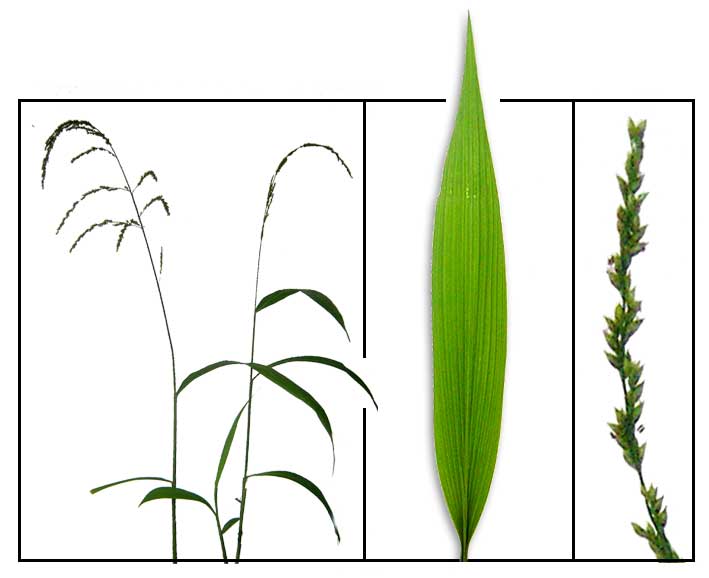
Setaria palmifolia (J. Koenig) Stapf.
PALM GRASS
Chu mao
|
| Scientific names | Common names |
| Agrostis plicata Lour. | Agusais (Bik.) |
| Chaetochloa effusa (E.Fourn.) Hitchc. | Asahas (C. Bis.) |
| Chaetochloa palmmifolia (J.Koenig) Hitchc. & Chase | Bañgas (Ig.) |
| Chamaeraphis effusa (E.Fourn.) Hitchc. | Dumbug (Sul.) |
| Chamaeraphis nepalensis (Spreng.) Kuntze | Hagusahis (Bik.) |
| Chamaeraphis neurodes (F.W.Schultz) Kuntze | Lalasa (Ig.) |
| Chamaeraphis palmifolia (K.D.Koenig) Kuntze | Liahon (If.) |
| Chamaeraphis paniculifera (Steud.) Kuntze | Lias (Bon.) |
| Panicum amplissimum Steud. | Pungag (Mindoro) |
| Panicum lene Steud. | Tadyawan (Tag.) |
| Panicum nervosum Roxb. | Yas (Ig.) |
| Panicum neurodes Schult. | Broadleaved bristlegrass (Engl.) |
| Panicum palmatum R. Schleich. | Highland pitpit (Engl.) |
| Panicum palmifolium J.Koenig | Palm grass (Engl.) |
| Panicum paniculiferum Steud. | |
| Panicum sulcatum Aubl. | |
| Setaria palmifolia (J.Koenig) Stapf | |
| Setaria paniculifera (Steud.) E.Fourn. ex Hemsl. | |
| Setaria sulcata (Aubl.) Desv. | |
| Setaria palmifolia (J.Koenig) Stapf is an accepted name The Plant List | |
| Other vernacular names |
| CHINESE: Zeng ye wei cao, Ruo ye fu, Ji mao, Ji ye cao, Chu mao. Zhu lou cao, Zhu ye cao. |
| JAPANESE: Sasa kibi. |
| MALAY: Rumput daun pisang, Lintabung (Indonesia). |
| THAI: Ya kap phai. |
|
Botany Distribution Constituents Studies |

 |
| Photos © Godofredo Stuart / StuartXchange |
| Additional
Sources and Suggested Readings (1) Evaluation of antioxidant polyphenols in Taiwan's medicinal plants / Shieh PoChuen et al / Asian Journal of Chemistry, 2009; Vol 21 No 7: pp. 5556-5562 (2) Setaria palmifolia (J. Konig) Stapf / Chinese names / Catalogue of Life, China (3) Sorting Setaria names / Maintained by: Michel H. Porcher / MULTILINGUAL MULTISCRIPT PLANT NAME DATABASE / A Work in Progress. School of Agriculture and Food Systems. Faculty of Land & Food Resources. The University of Melbourne. Australia / Copyright © 1997 - 2000 The University of Melbourne (4) Chemical composition and nutritive value of Aruna (Setaria palmifolia) grass for cattle / Bora, J.; Saikia, A.; Baruah, K. K., 1986: / Indian Journal of Animal Nutrition 3(4): 282-284 (5) Reite Plants: An Ethnobotanical Study in Tok Pisin and English / Porer Nombo and James Leach / Asia-Pacific Environment Monograph 4 / Australian National University E Press (6) THE ROLE OF MEDICAL ETHNOBOTANY IN ETHNOMEDICINE: A NEW GUINEA EXAMPLE / BORUT TELllAN / J, Elhnobio/, 8(2):149-169 Winter 1988 (7) Nutritive value of dhutesaro setaria palmifolia koenig stapf. for goats. / Gupta, H. K.; Balaraman, N. / Indian Journal of Animal Research 22(1): 47-48, 1988 (8) Setaria palmifolia / Synonyms / Kewscience / Plants of the World online (9) Medicinal Plants in Tao Dam Forest, Wangkrajae Village, Sai Yok District, Kanchanaburi Province / Urai Chiramongkolgarn and Yingyong Paisooksantivatana / Thai Journal of Phytopharmacy Vol. 9(2); Dec. 2002 (10) INFLUENCE OF CONSUMING LILIN VEGETABLE (Setaria Palmifolia) TO THE REDUCTION OF URIC ACID DEGREE AT GOUT ARTHRITIS SUFFERER / Imelda Kambey, Leady D. Lamidja, Dewi Mayangsari / International Journal of Health Medicine and Current Research Vol 1, Issue 2, pp.155-160, December 2016 (11) An ethnobotanical survey of medicinal plants used in the Siwai and Buin districts of the Autonomous Region of Bougainville / Julie Waruruai et al / J Ethnopharmacol., 2011 Nov 18; 138(2): pp 564–577 / doi: 10.1016/j.jep.2011.09.052 / PMID: 22004894 (12) Ethnopharmacologic Documentation of Selected Philippine Ethnolinguistic Groups: The Mangyan (Tadyawan) People of Mindoro Island / Prof. Rosario R. Rubite, Dr. Isidro C. Sia, r. Leonard Co, Mr. Larry Ylagan / 2002 |
| It is not uncommon for links on studies/sources to change. Copying and pasting the information on the search window or using the DOI (if available) will often redirect to the new link page. (Citing and Using a (DOI) Digital Object Identifier) |
• |
 |
|
