|  Gen info Gen info
- Flacourtia is a genus of flowering plant in the family Salicaceae. It was previously in the now defunct family Flacourtiaceae. It contains 23 species of shrubs and small trees.
-
Flacourtia rukam is a species of flowering plant in the family Salicaceae. Common names include rukam, governor's plum, Indian plum, and Indian prune.
- Etymology: The genus name Flacourtia honors Étienne de Flacourt (1607-1660), a governor of Madagascar, and director of the French East India Company. The specific epithet rukam is the Javanese vernacular name for the species.
 Botany Botany
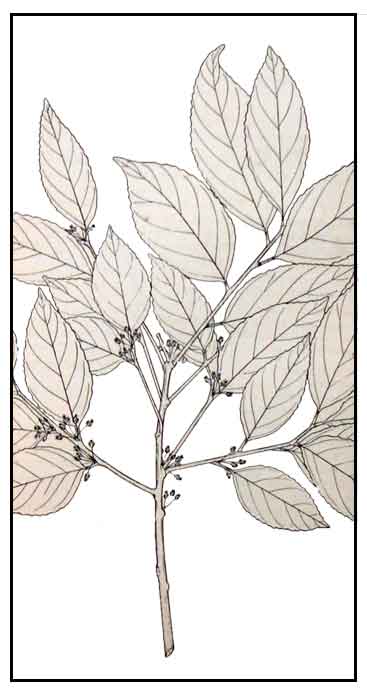
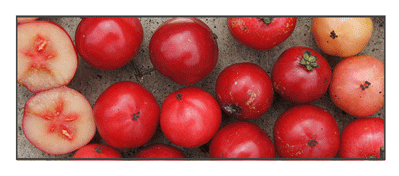
• Amaiit is an erect tree reaching a height of 20 meters. Leaves are oblong-ovate to elliptic, 5 to 18 centimeters long by 5 to 7 centimeters wide, pointed tips, pointed or rounded base, and toothed margins. Flowers are small and greenish, occurring in clusters in the axil of leaves. Fruit is somewhat rounded, 2 to 2.5 centimeters in diameter, light green to dark red, fleshy, subacid and pleasing in flavor. The wild forms are sour.
• Small tree, 5-15(-20) m tall; trunk and old branches usually crooked, furrowed, branched near the base; young stem and branches with strong, woody, simple or branched spines, up to 10 cm long, usually absent in clonally propagated trees. Leaves ovate-oblong or elliptic to oblong-lanceolate, (6.5-)10-15(-18) cm x (3-)4-7(-9) cm, glabrous or puberulous on midrib and nerves, often shiny dark green above, brownish-red and drooping when young, margins coarsely toothed; petiole 5-8 mm long. Inflorescences in few-flowered, short, axillary, finely pubescent racemes; pedicels 3-4 mm long; flowers greenish-yellow, usually unisexual; sepals 4, rarely 3-6, petals absent; male flowers with 8 orange or yellow-white fleshy disk-lobes and numerous stamens; female flowers usually without stamens, styles 4-6(-8), free, stigmas indistinctly bilobed. Fruit a globose, depressed-globose to obovate berry, 2-2.5 cm in diameter, light-green to pink or purplish-green to dark red with whitish, juicy, acid pulp, crowned by the 4-6(-8) small peg-like styles set in a circle. Seeds 4-7, flat. [PROSEA] (10)
 Distribution Distribution
- Native to the Philippines.
-
In forests at low and medium altitudes in the provinces of Benguet, Pangasinan, Zambales, Laguna, Quezon, Bataan, Rizal and Sorsogon; in Mindoro, Negros, Cebu and Mindanao.
- Also native to Borneo, Caroline Is., Fiji, Jawa, Lesser Sunda Is., Malaya, Maluku, New Guinea, Nicobar Is., Niue, Samoa, Solomon Is., Sulawesi, Sumatera, Tonga, Vanuatu, Wallis-Futuna Is. (4)
- In slightly disturbed mixed dipterocarp, keranga, peat-swamp and sub-montane forests up to 1200 m altitude. Common on alluvial swampy sites and riversides, dry hillsides, and ridges. On poor shallow sandy soils and limestone. (10)
 Constituents Constituents
- 100 g of edible flesh yield 94 kcal, 0.5 g protein, 0.6 g fat, 24.2 g carbohydrate, 1.2 g fiber, 33 mg calcium, 0.7 mg iron, 17 mg phosphorus, 171 mg potassium, 5 mg vitamin C, 0.01 mg thiamine (B1), 0.2 mg riboflavin (B2), 0.4 mg niacin (B3), and 30 IU vitamin A.
- Fruit yields secondary metabolites like saponins, flavonoids, polyphenols, and tannins.
- Study of dichlormethane extract isolated monogalactosyl diacylglycerols (1), ß-sitosteryl-3ß-glucopuranoside-6ß-O-fatty acid esters (2) ß-sitosterol (3), and triacylglycerols (4) from the pulp; compound 3 and chlorophyll -a (5) were isolated from the peel; and compound 4 from the seeds. (see study below) (7)
- Study of leaves and bark isolated 17 compounds, which included previously undescribed four phenolics: 2-[(benzoyloxy)methyl]-phenyl-O-β-xylosyl-(1→2)-β-glucopyranoside (1), 2-[(benzoyloxy)methyl]-4-hydroxyphenyl-O-β-xylosyl-(1→2)-β-D-glucopyranoside (2), 2-hydroxy-5-(2-hydroxyphenoxy)phenoxy-β-glucopyranoside (3) and biphenyl-1,1′,2,2′-tetraol (5). (see study below) (11)
- Study of chloroform extract of stems isolated a new compound, rukamtenol, together with four known compounds viz., chaulmooric acid, flacourtin, 3,4,5-trimethoxy-phenyl ß-D-glucopyranoside, and daucosterol. (15)
- Study of stem bark isolated three compounds: friedelin (1), poliothrysoside (2), and ß-sitosteryl-3ß-glucopyranoside (3). (see study below) (16)
- Phytochemical screening of leaves for secondary metabolites yielded phenolics, flavonoids, saponins, steroids, and alkaloids. (see study below) (19)
 Properties Properties
- Considered appetite stimulant, digestive, diuretic, depurative, refrigerant, alexipharmic.
- Studies have suggested cytotoxicity, anti-inflammatory, anti-trypanosomal, antihypertensive, angiotensin-converting enzyme inhibitory, antihypertensive, natural colorant, antibacterial properties.
Parts utilized
Roots, fruits, leaves.
 Uses Uses
Edibility
- Fruit of the cultivated form is edible; eaten raw.
- Used in making jams and pies; also pickled.
- Young leaves and red young shoots are eaten raw in salads and side dishes.
- Rolling the fruit between the palms before eating reduces the fruit's natural astringency.
Folkloric
- Decoction of roots taken internally by women after childbirth.
- Juice of the young fruit is astringent, used for diarrhea and dysentery.
- Fruit is also used for dysmenorrhea.
- Juice of the leaves is applied to inflamed eyelids.
- In Mindanao, Philippines, the Higaonon tribe of Rogongon, Iligan City, decoction of roots
is drunk three times daily for relief of muscle pains over fatigue of "bughat" in women, stomach ulcer, lung infection, to enhance menstruation in women after birth, and for anemia. (3)
- In Java, dried leaves are pounded and applied to wounds.
- In Sabah, roots used for abdominal colic; leaves used for headaches.
- The Musi Banyuas in south Sumatera, Indonesia, used the plant for treatment of hypertension. (13)
Others
- Wood: Wood, hard and strong, used in making household utensils such as pestles and small furniture.
Studies
• Chemical Constituents / Biological Activities / Fruit: Study of dichlormethane extract isolated monogalactosyl diacylglycerols (1), ß-sitosteryl-3ß-glucopuranoside-6ß-O-fatty acid esters (2) ß-sitosterol (3), and triacylglycerols (4) from the pulp; compound 3 and chlorophyll -a (5) were isolated from the peel; and compound 4 from the seeds. Compounds 1-5 exhibited diverse biological activities. Compound 1 has been reported to exhibited anti-inflammatory activity in human articular cartilage and inhibited the growth of human melanoma cells in a dose-dependent manner with IC50 of 114 µM. Compound 1 has also exhibited cytotoxicity against human stomach adenocarcinoma (AGS) cell line and has exhibited potent anti-complement activity. Compounds 2, 3, and 5 have also exhibited biologic activities. (7)
• Phenolics and Antiparasitic Secondary Metabolites / Anti-Inflammatory / Anti-Trypanosomal / Leaves and Bark: Study of leaves and bark isolated 17 compounds, which included previously undescribed four phenolics. Compound 5, Biphenyl-1,1,2,2'-tetrol (5) exhibited good activity against Trypanosma brucei trypomastigotes with IC50 6.66 µg/mL. Compounds 2, 5,9, 10, 11 and 12 showed good anti-inflammatory activity using proteinase inhibitory assay. (see constituents above) (11)
• Antihypertensive / ACE Inhibitory / Leaves: Study of leaves isolated two compounds, apigenin (1) and lupeol (2). The compounds showed effective antihypertensive effects using angiotensin converting enzyme (ACE) inhibitory method, showing IC50s of 656.51 µg/ml for apigenin and 15.12 µg/mL for lupeol. Results suggest potential as ACE inhibitor. (12)
• Antihypertensive / Anti-Cholesterol Activity / Stem Bark: Study investigated the anticholesterol and antihypertensive activity of stem bark extracts of F. rukam. The crude ethanol extract showed highest anti-cholesterol activity compared to the fractions with IC50 of 157.88 mg/L. The crude ethanol extract also showed highest phenolic and flavonoid content compared to fractions. The anticholesterol activity was equivalent to total phenolic and flavonoid content. In the anti-hypertensive study, the crude ethanol extract exhibited high percentage of ACE inhibitory activity with IC50 of 119.82 mg/L. Results suggest the stem bark extract can reduce blood pressure and cholesterol level. (13)
• Antihyperlipidemia / Stem Bark: Study evaluated the antihyperlipidemic activity of ethanol extract of stem bark on propylthiouracil-induced Wistar albino rats (Rattus noverticus). The extract showed highest anti-hyperlipidemia activity at 400 mg/kbw with decrease in total cholesterol percentage of 56.28%, triglycerides 57.34%, LDL 54.29%, and HDL increase of 58.77%. Effective dose (ED50) was 327.83 mg/kbw. (14)
• Rukamtenol / Stems: Study of chloroform extract of stems isolated a new compound, rukamtenol, together with four known compounds viz., chaulmooric acid, flacourtin, 3,4,5-trimethoxy-phenyl ß-D-glucopyranoside, and daucosterol. Rukamtenol, flacourtin, and 3,4,5-trimethoxyphenyl β-D-glucopyranoside failed to show cytotoxic activity towards MDA-MB-23a, HepG2, and RD cancer cell lines, with IC50s > 100 µM. (15)
• Weak Antioxidants / Stems: Study of stem bark isolated three compounds: friedelin (1), poliothrysoside (2), and ß-sitosteryl-3ß-glucopyranoside (3). Antioxidant testing using DPPH method showed weak antioxidant activity, with all compounds with IC50s of > 100 µg/mL. (16)
• Subchronic Toxicity Testing / Stem Bark: Study evaluated the subchronic toxicity of an ethanol extract of stem bark of F. rukam on Wistar albino rat, Rattus noverticus, using doses of 200, 400, 600, and 800 mg/kbw for 90 days. measuring physical symptoms, weight, hematological and biochemical parameters. Results showed no significant difference between control and treatment groups up to 600 mg/kg dose, but with significant difference at 899 mg/kg dose. The difference, however, was still in acceptable limits. Results suggest F. rukam stem bark is not significantly toxic in the test animals. (17)
• Natural Colorant Potential / Anthocyanin Content / Antioxidant / Fruit Extract Powder: Rukem (Flacourtia rukam) is a tropical fruit with purple peel indicating anthocyanin content, and is therefore a potential source of natural colorant. Study evaluated the most efficient concentration of maltodextrin to coat the anthocyanins in rukem fruit, the total anthocyanin and antioxidant activity. Results showed 5% citric acid and 40% maltodextrin (w/v) gave most efficient yield of extraction, and best effects on anthocyanin powder, with highest antioxidant activity (74.28%), total anthocyanins (3.96 mg/100g), encapsulation efficiency (19.26%), and color values of L*87.46; a*16.21, and b*-1.60. (18)
• Antibacterial / Leaves: Study evaluated the potential antibacterial activity of the rukam plant against Staphylococcus aureus and Escherichia coli. by disc diffusion method. The methanol solvent showed highest zone of inhibition at 60% concentration, with average of 8.95 mm in S. aureus isolates and 9.03 mm for E. coli. With ethanol solvent, highest inhibition zones with as 20%, 7.73mm for S. aureus, and 6.61mm for E coli isolates. (19)
Availability
Wild-crafted.
|