| 
Gen info
- Crossostephium is a monotypic genus of flowering plants in the daisy family. The only species is Crossostephium chinense. (17)
- Etymology: The genus name "Crossostephium" derives from 2 Greek words, "krossoi", meaning 'tassels" and "stephos", meaning crown, referring to the crown-like appendage found on the fruits of some species. The species epithet "chinense" refers to its Chinese origin.
(18)
 Botany Botany
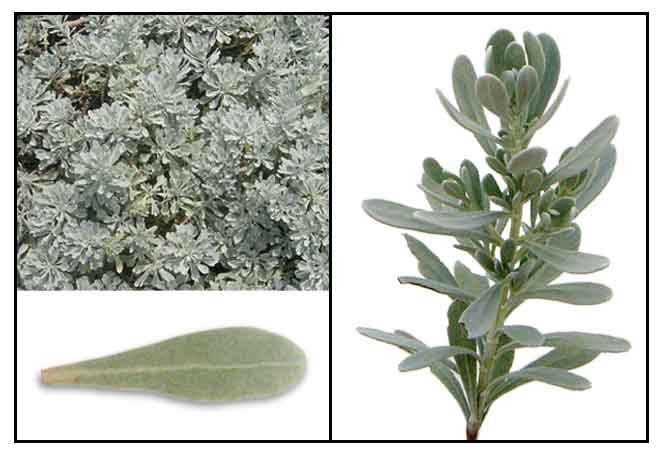
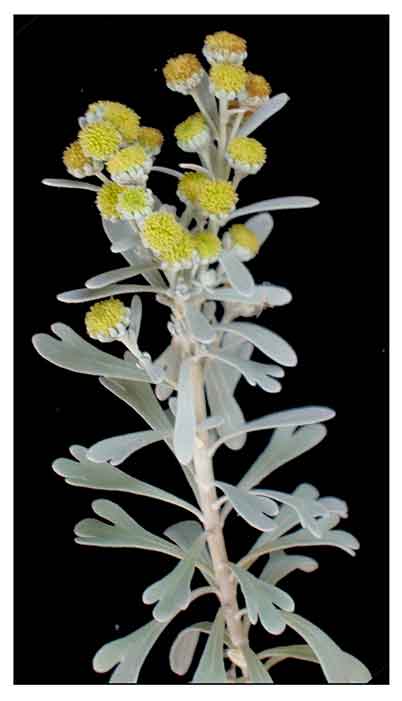
Anjenjo is a low, erect or spreading, branching
perennial under-shrub, growing to 50 centimeters high. Leaves are alternate, crowded toward the ends of the branches, narrowly obovate-cuneate, 2 to 3 centimeters long, densely and softly covered with short, grayish-white hairs; the base long and narrow, the apex prominently 3- to 5-toothed or lobed, and the lobes are ovate to narrowly oblong. Flowering heads are borne in the upper axils of the leaves, peduncled from the terminal leafy racemes, somewhat rounded, about 4 to 5 millimeters in diameter.
Distribution
- Native to the Philippines.
- Possibly introduced to the Philippines in the early Spanish times.
-
In open slopes near the sea.
- Ornamental cultivation.
- Also native to Cambodia, China, Japan, Jawa, Kazan-retto, Laos, Nansei-shoto, Taiwan, Vietnam.
Constituents
- Whole herbs yielded scopoletin (1), scopolin (2), tanacetin (3), quercetagetin-3,6,7-trimethylether (4) and 5-O-methyl-myo-inositol (5).
- Study isolated eight compounds from the whole plant of C. chinense: taraxeryl acetate (1), taraxerol (2), alpha-amyrin acetate (3), beta-amyrin acetate (4), beta-sitosterol (5), 3-beta-acetoxy-12ursen-11-one (6), uracil (7), and 5-O-methyl-myo-inositol (8). Compounds 3-8 were isolated for the first time. (2)
- Extracts of dried whole plants yielded tricetin 3′,4′,5′-trimethylether (1), scopoletin (2), tanacetin, hispidulin (3), apometzgerin (4), chrysoeriol (5), quercetagetin 3,6,7-trimethylether (6), selagin (7), scopolin (8), and quercetagetin-3,6-dimethylether (9).
- A 70% ethanolic extract of whole plant yielded a novel sesquiterpene, crossostephin (1), a coumarin, biscopoletin (2)
and four known compounds, artesin, tanacetin, scopoletin, and scopolin. (4)
- GC-MS study of essential oil extracted from whole herbs of C. chinensis yielded 56 compounds comprising 62.59% of total essential oil identified. The major compound, isocaryophillene, reached up to 14.94% of the total oil. (14)
- The crude methanol extract of stems yielded lupeol, ß-sitostenone, octadecyl (E)-p-coumarate, cycloeucalenol, oleanolilc acid, ursolic acid, stigmastan-3-one, betulin, and ergon. (see study below)
(19)
Properties
- Leaves and tops considered carminative and emmenagogue.
- Studies have suggested antioxidant, antiproliferative, anti-inflammatory, anti-diabetic, nephroprotective, antigout, reprellent, hepatoprotective properties.
Parts used
Leaves, tops, stems.
Uses
Folkloric
- In the Philippines, infusion of leaves and branch tips considered carminative and used as emmenagogue.
- In the some parts of rural Quezon, used for hepatitis and arthritis.
- Infused leaves and tops are carminative and emmenagogue.
- Leaves and stems used in making moxa (burning herbs).
- In Taiwan, a folkloric medicine for common colds, rheumatoid arthritis, hepatitis, bladder and kidney stones, prostate problems, gastritis.
- In Vietnam and China, leaf infusion--usually sweetened--
used to treat congestions, cough, and irregular menstrual cycles.
- In China, leaves and stems used in making moxa. Also used for diabetes.
- In China, leaves are boiled and the patient's whole body is dipped into the warm soup to treat rheumatic pains.
Others
- Superstition / Rituals: In China, the Chinese wormwood leaves are hung in windows and main doors during dragon boat festivals to drive away evil. Having the plant in-house is believed to prevent ghosts from entering the house. (21)
Studies
• Antioxidant / Antiproliferative: Study evaluated water and methanol extracts of C. chinensis for antioxidant and antiproliferative activities. Antioxidant activity was evaluated using ABTS, DPPH, nitric oxide and superoxide scavenging methods. Both water and methanol extract showed ability to dose-dependently scavenge free radicals. The water extract showed higher antioxidant and antiproliferative activities than the methanol extract. Antiproliferative activity was studied in vitro by using human hepatoma HepG2 cells. The CCW exhibited good antiproliferative activity. Results showed the water extract of Crossostephium chinensis might be used as a potential source of natural antioxidants and as anti-tumor agent. (1)
• Insulin Secretion Effects: Chemical constituents isolated from the whole herb were tested on its effects on insulin secretion in rat islets. Quercetagetin-3,6,7-trimethylether and 5-O-methyl-myo-inositol showed to enhance rat islet insulin secretion while scopletin suppressed rat islet insulin secretion. (3)
• Sesquiterpenes / Coumarins: Study of ethanolic extract yielded crossostephin and coumarin, biscopoletin, with four other known compounds, artesin, tanacetin, scopoletin and scopolin. (4)
• Membrane Transport of Flavonoids: Study yielded six flavonoids: selagin, apometzgerin, tricetin-3',4',5'-trimethylether, quercetagetin-3,6,7-trimethylether, hispidulin and quercetagetin. Results showed a structure-permeation relationship and role of MRPs in mediating efflux of flavonoids. Experimental results suggest pharmacological applications of the C. chinense flavonoids. (6)
• Sequoyitol / Anti-diabetic: Study in STZ-induced diabetic mice showed sequoyitol (5-O-methyl-myo-inositol) treatments decreased hyperglycemia and glucose intolerance by increasing both insulin sensitivity and insulin secretion.. Sequoyitol directly targets hepatocytes, adipocytes, and ß-cells. (7)
• Scopoletin / Anti-Inflammatory: Study of scopoletin (6-methoxy-7-hydroxycoumarin) from C. chinensis showed anti-inflammatory effects in mice probably related to a decrease in the level of MDA (malondialdehyde) via increased activities of SOD, CAT, and GPx in the edema paw and effects on the production of NO, TNF-α, and PGE2. (8)
• Alpha-Glusosidase Inhibition/ Anti-Inflammatory: Extracts of dried whole plants yielded compounds that showed inhibitory activity against alpha-glucosidase suggesting a potential use for the treatment of diabetes in humans. (9)
• Hepatoprotective: Study evaluated the hepatoprotective potential of CC water extract on carbon tetrachloride-induced liver damage in preventive and curative rat models. Results showed protection against acute liver damage through its radical scavenging ability. It also inhibited the expression of MMP-9 protein, indicating MMP-9 role in CCl4-induced chronic liver damage in rats. Scopoletin may be an important compound in CCW. (10)
• Sequoyitol Ameliorates Diabetic Nephropathy: Sequoyitol has been shown to decrease blood glucose, improve glucose tolerance and enhance insulin signaling in ob/ob mice. Study evaluated the effect of sequoyitol on diabetic nephropathy in rats with diabetes induced by a high-fat diet and low dose streptozotocin. Results showed sequotiyol ameliorates progression of diabetic nephropathy through its glucose lowering effects, antioxidant activity, and regulation of TGF-ß1 expression. (11)
• Potential for Treatment of Tophaceous Gout / Osteoclast Inhibition: Study investigated the effects of CC extract on the formation of RANKL-activating osteoclasts from RAW264.7 macrophages cells and from PBMCs in patients with tophaceous gout. Results suggest CC extract has the potential to treat gouty erosions through inhibiting differentiation, formation, and bone resorptive ability of osteoclasts. (13)
• Preventive for Balloon Angioplasty-Induced Neointimal Hyperplasia: Balloon angioplasty-induced neointimal hyperplasia is a clinical problem. Crossostephium chinense extract (CCE) has demonstrated potential in preventing progression of restenosis. Study investigated whether CCE can suppress balloon angioplasty-induced neointimal formation using a rat model of carotid arterial balloon angioplasty. Results showed CCE3 exerted strongest growth inhibitory and antimigratory effects on vascular smooth muscle cells (VSMCs). The in vivo study results indicated balloon-injury-induced neointimal hyperplasia was inhibited by CCE3. CCE3 could reduce neointimal formation in balloon-injured arteries, and the effect may be partially attributed to the CCE3-induced suppression of PDGFRB (platelet-derived growth factor receptor-ß)-mediated downstream pathways and inflammation-related molecules. (15)
• Volatiles / Repellent against Aphids in Chrysanthemum lavandulifolium / Leaves: Chrysanthemum aphids (Macrosiphoniella sanborni) seriously restrict the development of C. lanvandulifoium industry. Study introduced a potential aphid resistant germplasm C. chinense and the role of volatiles on the aphid resistance and behavioral effects. Forty seven major volatiles were detected in the parent and hybrid leaves. Methacrotein was demonstrated to be a repellent compound to aphids. Results suggest potential for novel control strategies against M. sanborni of C. lavandulifolium and its relative species. (16)
• Antimicrobial / Antioxidant / Antihypertensive / Stems: Study evaluated crude extracts of air-dried stems of Crossostephium chinense for antimicrobial, antioxidant, and antihypertensive activities using DPPH, FTC, TBA assays and ACE inhibitory assays. (see constituents above) (19)
Availability
Wild-crafted.
|