|  Gen info Gen info
- Acanthaceae is a family of dicotyledonous flowering plants containing almost 250 genera and about 2500 species.
- The fruit is a two-celled capsule, dehiscing somewhat explosively. In most species, the seeds are attached to a small, hooked stalk (a modified funiculus called jaculator or a retinaculum) that ejects the capsule - a trait shared by all members of the clade Acanthoideae.
-
The genus Asystasia comprises about 70 species found in the tropics.
-
Etymology: The genus Asystasia means inconsistency, referring to radially symmetrical flowers in the genus, which is uncommon in the family Acanthaceae. The species epithet gangetica refers to the Ganges River in India, where the species was likely observed from. (39)
 Botany Botany
• Asistasia is a procumbent herb, growing up to 1
meter or more in height. Leaves are ovate, 2.5 to 3 centimeters wide, with pointed
tips and rounded or narrowed base. Flowers are borne on one side of
lax racemes 5 to 12 centimeters in length. Sepals are linear-lanceolate, about
5 millimeters long and hairy on the back. Corolla is hairy, 2 to 3 centimeters long, with
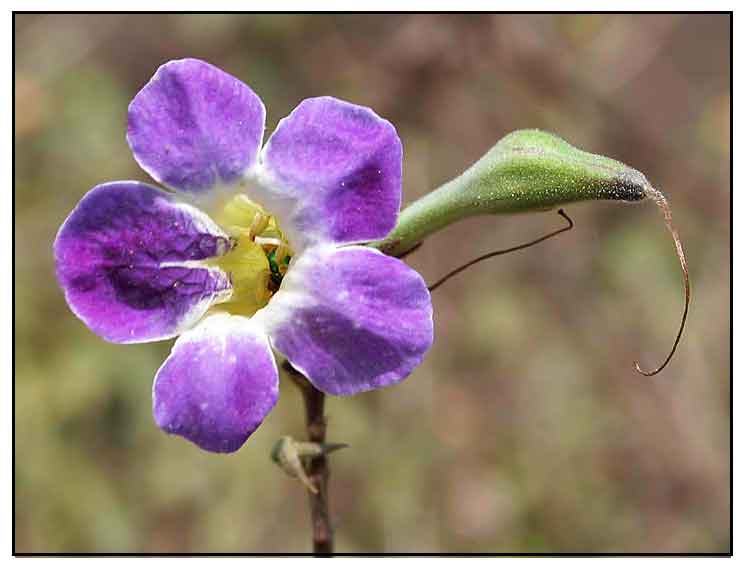
a yellow and inflated tube, limb is pink or pale purple, usually dull or lurid, sometimes yellow altogether. Capsule is cylindric-compressed,
about 2.5 centimeters long and hairy. Seeds are smooth, compressed, ovoid, angular,
wrinkled or subtubercular, less than 5 millimeters in diameter.
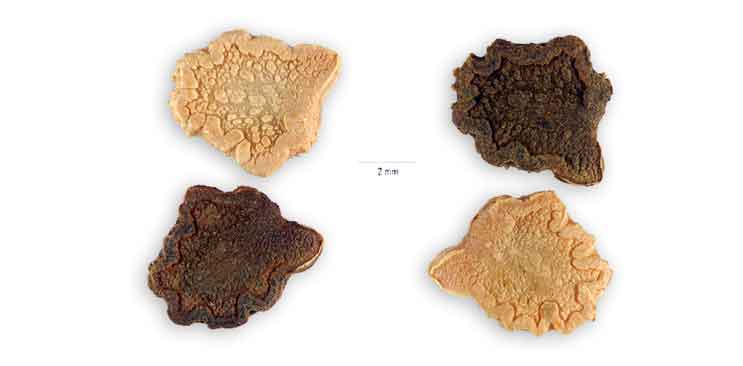
• The fruit is an explosive capsule that starts out green in color, but dries to brown after opening.
• Growth form: Evergreen herbaceous perennial with a creeping growth habit. Foliage: Opposite leaves are ovate with entire leaf margin (8 cm long, 4 cm wide). Flowers: Trumpet-shaped flowers have 5 purple, round to obovate lobes (3 - 4 cm long, 2.5 - 3.8 cm wide). The lower lobe (known as a palate) is dark purple in the center. The inflorescence is known as a terminal raceme, consisting of stalked flowers arranged along 1 axis and located at the branch tips. This species is free-flowering. Fruit: Explosively dehiscent fruits known as capsules are initially green, but becomes brown and dry after dehiscence (1.9 - 2.5 cm long). The fruit resembles an upside down cello and contains 4 whitish to brownish black, circular seeds which are flattened and beaked (5 mm long, 1 mm thick). (Flora & Fauna Web)
• Flowers come in various shades: white, light violet, pale mauve, often with distinctive purple or dark purple markings/veins on the lower lip (palate).
Distribution
- Introduced; naturalized.
-
In thickets near towns at low altitude. Often cultivated in Manila and Los Baños.
- Native to Andaman Is., Australia, Bangladesh, Cambodia, India, Lesser Sunda Is., Myanmar, New Guinea, Northern Territory, Queensland, Sri Lanka, Thailand, Vietnam. (22)
- In Australia, the species is considered invasive and a threat to native ecosystems. (39)
Constituents
- Phytochemical analysis yielded carbohydrates, proteins, alkaloids, tannins, steroidal aglycans, saponins, flavonoids, and triterpenoids.
Also yields, minerals: calcium, phosphorus, sodium, manganese, copper, zinc, magnesium, iron. (10)
- Flowers yielded a biflavon glycoside - apigenin 7-O-glucosyl (3'-6") luteolin 7"-O-glucoside.
- Aerial parts yielded a 5,11-epoxymegastigmane glucoside (asysgangoside).
 - Preliminary phytochemical analysis of hexane, EA, and methanol extracts yielded saponins, reducing sugar, steroids, glycosides, flavonoids and anthraquinones. (17) - Preliminary phytochemical analysis of hexane, EA, and methanol extracts yielded saponins, reducing sugar, steroids, glycosides, flavonoids and anthraquinones. (17)
- GCMS analysis of leaves for essential oil yielded hexadecanoic acid, n-hexadecanoic acid, phytol, and 9,12,15-octadecatrienoic acid. (28)
- Phytochemical screening of leaves yielded triterpenoids, flavonoids, steroids, alkaloids, saponins, tannins, carbohydrates, and proteins. (see study below ) (30)
 - Proximate analysis per 100g fresh weight
of leafy vegetable yielded energy 50 kcal, moisture 85 g, protein 3g, fat 0.5g, fiber 1.63g, ash 2.84g, and carbohydrate 8.27g. Mineral content (g/100g dry weight) yielded 2566 mg, phosphorus 814 mg, sodium 933 mg, manganese 18 mg, copper 4 mg, zinc 7 mg, magnesium 961 mg, and iron 21 mg. (100 g of leafy vegetables equals 3 cups) (32) - Proximate analysis per 100g fresh weight
of leafy vegetable yielded energy 50 kcal, moisture 85 g, protein 3g, fat 0.5g, fiber 1.63g, ash 2.84g, and carbohydrate 8.27g. Mineral content (g/100g dry weight) yielded 2566 mg, phosphorus 814 mg, sodium 933 mg, manganese 18 mg, copper 4 mg, zinc 7 mg, magnesium 961 mg, and iron 21 mg. (100 g of leafy vegetables equals 3 cups) (32)
- Phytochemical screening of methanolic extract of leaves yielded carbohydrates, proteins, alkaloids, tannins, steroidal aglycones, saponins, flavonoids, reducing sugars, and triterpenoids. (see study below) (1)
- Study of 100g edible portion yielded vitamin C 48.51 (0.91) mg and ß-carotene 5937.21 (1.50)
µg. (34)
- Nutrient analysis of 70g serving size yielded (% daily value) 4.45 protein, vitamin C 5.14, fiber 20.12, Fe 25.43, and Ca 25.42.
(42)
- Proximate composition of edible parts (100 g dry weight) yielded
21.94g protein, 29.38 mg vitamin C, 494.00 mg carotene, 47.90g fiber, 43.59mg iron, 2420.88mg calcium. (42)
- Phytochemical screening of bark extracts of A. gangetica and Euphorbia cyathophora showed rich presence of bioactive compounds such as flavonoids, tannins, triterpenoids, and carbohydrates, known contributors to tissue regeneration. Quantitative analysis showed A. gangetica contained higher total phenolic content (92 mg/g gallic acid equivalent) compared to E. cyathophora (60 mg/g) with both showing comparable flavonoid contents (~29 mg/g rutin equivalent). (see study below) (48)
Properties
•
Considered astringent, anthelmintic, antidiabetic, anti-asthma, anti-inflammatory, vermifuge.
• Studies have shown antiasthmatic, antihypertensive, antioxidant, anti-inflammatory, antidiabetic, analgesic, hypolipidemic, antibacterial, antifungal, anticonvulsant, sedative, anxiolytic, anticancer, phytoremediation, antiulcer, anti-venom, wound healing properties.
Parts utilized
Leaves, flowers, whole plant.
 Uses Uses
Edibility / Culinary
- In the Philippines the leaves and flowers eaten
as pot herb.
- In Uganda and Kenya, consumed as a popular vegetable mixed with beans,
groundnut or sesame paste.
- Used as famine food in the Kwa-Zulu Natal area of South Africa. (27)
- Leaves and flowers used as intestinal
astringent.
- Leaves consumed as spinach.
- In Tamil Nadu, dish is prepared from fresh leaves cooked with cumin seeds and onion bulbs. (38)
- In China, leaves and young shoots are blanched, then stir-fried. (42)
- In Myanmar, used for treatment of asthma and renal stones.
Folkloric
- In the Philippines, leaves and flowers used as intestinal astringent.
- In the Gold Coast the plant is commonly used as woman's medicine. Infusion
of plant used to ease pain during childbirth. infusion or decoction of plant mixed
with peppers used as an enema in the later months of pregnancy.
- In Nigeria, leaves used
as astringent and for treatment of asthma and piles.
- In South Africa,used for anthelmintic activity, swelling, rheumatism, gonorrhea, and ear disease. (10)
- In India, sap is applied
to swellings; also used for rheumatism and as vermifuge. In Tamil Nadu, root paste used for skin allergies. Plant also used as antiasthmatic, anthelmintic and antidiabetic. (10)
- In West Africa used for epilepsy. (26)
- In Kenya, used as anthelmintic: leaves are crushed, boiled in water, and decoction drunk as cure for intestinal worms.
- In China, aerial parts applied on swelling or bruises; used for treatment of metroptosis or rectocoele. (42)
Others
- Forage: In Kenya and Uganda,
used as forage for cattle. In Indonesia, for goats.
- Ethnoveterinary: In Tanzania, plants pounded
in water and used to wash flea-infested young animals.
- Ground cover: In Africa, commonly used as
ornamental ground cover.
- Leaf meal: Study showed replacing 66% of wheat offal in the diet of werner rabbits with with ALM (Asystasia gangetica leaf meal) can reduce the cost of rabbit production without adverse effects on growth performance and hematological indices. (38)

Studies
• Antiasthmatic / Leaves:
Study evaluated various leaves extracts for antiasthmatic activity. The extracts
relaxed histamine-precontracted tracheal strips, with the ethyl acetate extract showing highest activity. Extract also exhibited anti-inflammatory
activity with the methanol extract showing highest activity. Acute toxicity study estimated an i.p. LD50 of 2150 mg/kg in mice for the methanol extract. Study justified its use in Nigerian folk medicine for asthma
treatment. (see constituents above) (1)
• Bronchospasmolytic activity / Leaves:
Another Nigerian study suggests that the leaves of A gangetica provides
benefit through a bronchospasmolytic effect of the terpenoid compounds. (3)
• Antihypertensive:
In a South African study of 16 plants on the ACE Inhibitor Activity
of Nutritive Plants, Asystasia gangetica was one of eight that showed
significant ACE inhibition activity. (4)
• Antioxidant / Anti-Inflammatory:
Asystasia gangetica was one of 18 plants investigated for free radical
scavenging activity, total phenolic content and anti-inflammatory properties.
• Asysgangoside / Phytochemicals:
Study isolated a 5,11-epoxymegastigman glucoside (asysgangoside) together with known compounds. (6)
• Anti-Diabetic / Antioxidant:
Results showed significant antidiabetic and antioxidant potential for A gangetica and M indica, individually or in combination. (7)
• Anti-Diabetic / Antioxidant Study results suggest the potential of A. gangetica as antioxidant in protecting the tissue defense system against oxidative damage in streptozotocin-induced diabetes. (9)
• Angiotensin Converting Enzyme Inhibition / Antihypertensive:
Study showed A gangetica as one of eight plants that showed significant ACEI activity. (8)
• Analgesic / Anti-Inflammatory:
A methanolic extract of A. gangetica, evaluated for anti-inflammatory activity in albino wistar rats, showed significant decreased paw edema in the carrageenan model. (10)
• Antimicrobial / Antifungal:
Study of hexane, ethyl acetate, and methanol extracts was studied for in vitro inhibition of human pathogenic organisms. Crude extracts showed concentration-dependent inhibition of the growth of the 12 test organisms. The extracts showed higher antifungal properties on C. albicans, P notatum, T. rubrum, and E. flocossum comparable to Tioconazole, the reference drug. (10)
• Antimicrobial:
Extracts of leaves, stems, and roots were studied for antimicrobial activity. Methanol extracts showed the highest activity; the water extracts, the least. The methanol extract also showed potent antifungal activity against C. albicans.
• Antidiabetic / Hypolipidemic / Morus indica and A. gangetica Leaves:
Study of M. indica and Asystaia gangetica in alloxan-induced diabetes in rats showed the ethanolic extract of leaves to have good hypoglycemic and hypolipidemic effect. (13)
• Antihypertensive / Angiotensin Effects:
Study evaluated the in-vivo effects of an aqueous leaf extract on blood pressure and heart rate in anesthetized hypertensive male rats. Results showed significant and dose-dependent reduction of systolic, diastolic, and mean arterial BP. The effect may be due to actions of the ALE on ACE (angiotensin 1 converting enzyme), ANG II (angiotensin II) receptors and heart rate. (15)
• Antibacterial:
Study evaluated the antibacterial activity of various cold organic solvent extracts of A. precatorius and A. gangetica. In Asystasia gangetica, the benzene extracts showed the broadest spectrum of inhibition against B. subtilis followed by an ethanolic extract against Salmonella typhi. (16)
• Antimicrobial:
Study evaluated hexane, ethyl acetate and methanol extracts of whole plant of A. gangetica to determine inhibition of human pathogenic microorganisms. All the bacterial strains showed concentration sensitivity to all the extracts. The extracts showed higher antifungal properties on C. albicans, P. notatum, T. rubrum, and E. floccosum with activity comparable to reference drug, Tioconazole.(17)
• Antidiabetic / Anthocyanin / Flowers:
Study evaluated the alpha amylase and alpha glucosidase inhibitory effects of extracted anthocyanins from A. gangetica flower. The anthocyanin extraction showed significant inhibition and appreciable alpha amylase and alpha glucosidase inhibitory activity. The activity may be due to the presence of anthocyanin phenolic compounds; and presents a potential source of a natural antidiabetic agent. (18)
• Antidiabetic / α-glucosidase and α-amylase inhibitory activity / Antioxidant / Leaves:
Study evaluated the in vitro antioxidant and antidiabetic activity of a methanolic extract of leaves of A. gangetica in various models. The methanolic extract showed concentration dependent α-glucosidase and α-amylase inhibitory activity. The reducing power of the extract was concentration dependent. Results suggest a potential candidate for the management of T2DM. (19)
• Antidiabetic / Hypolipidemic / Antioxidant:
Study evaluated A. gangetica using streptozotocin-nicotinamide-induced type 2 diabetes model in rats. Antioxidant activity was observed in various models. Treatment significantly lowered blood glucose, HbA1C, total cholesterol, triglycerides, LDL, VLDL, with elevation of Hb and HDL. The antihyperglycemic effect may be due to peripheral glucose utilization and the hypolipidemic effect may lower cardiovascular complications and offer protection against oxidative damage in STZ-induced diabetes. (20)
• Anti-Inflammatory / Leaves:
Study for the anti-inflammatory activity of a methanolic extract of A. gangetica leaves in albino Wistar rats showed dose-dependent decrease of paw edema in the Carrageenan model and significant decrease in granuloma formation in the Cotton Pellet model. The anti-inflammatory activity may be due to inhibition of prostaglandin synthesis. (21)
• Gastroprotective / Anti-Ulcer / Stems:
Study evaluated the gastroprotective activity of A. gangetica on gastric ulcer induced by pyloric ligation in a rat model. Results showed ulcer protection as evidenced by significant reduction in total acidity and marked reduction in ulcer index, volume of gastric juice with an effect comparable to omeprazole. (23)
• Antioxidant / Induced Callus from Leaves:
Study evaluated the bioactive molecules and antioxidant potential of callus induced from leaves of Asystasia gangetica. The callus showed FRAP values of 17.67 ±0.0, 17.30 ± 1.830, and 23.81 ± 0.945 µg AAE/mg extract for methanolic, ethanolic, and aqueous extract, respectively. Methanolic extract showed the highest DPPH scavenging activity and reducing ability. (24)
• Hypoglycemic / Synergistic Antidiabetic Effect with Other Herbs:
Study evaluated the ability of Asystasia gangetica, Acanthus montanus, Emilia coccinea and Hibiscus rosa-sinensis, as well as a combination of formulations to ameliorate hyperglycemia in type 1 alloxan induced diabetic rats. Results showed the ethanolic extracts of the samples were more potent than aqueous extracts for management of hyperglycemia. Also, the combination of the herbal extracts synergistically improved the therapeutic action of the individual herbal extracts. (25)
• Antioxidant / Anti-Inflammatory: Study for antioxidant values showed a methanolic extract with 84.7 ±0.38 % scavenging activity; an aqueous extract, 36.2 ±0.18. Anti-inflammatory activity of a methanolic extract by 5-lipoxygenase inhibition showed a 5-Lox IC50 of 55.0 µg/ml. (27)
• Antidiabetic / Hypolipidemic / Flowers: Study evaluated the antidiabetic activity of A. gangetica ethanol extract of flowers in streptozotocin induced diabetic rats. Results showed significant reduction in blood glucose level and increase in insulin level. There was also a reduction in total cholesterol, triglycerides, LDL and increase in HDL with significant obliteration of the the increase in GPx, SOD and CAT activities in both liver and kidney. (29) Study evaluated glucose lowering effect of A. gangetica flowers in doses of 125, 250, and 500 mg/kbw in normal and STZ-induced diabetic rats. The LD50 was higher than 2000 mg/kbw and showed no significant changes in serum parameters. All doses showed significant lowering of glucose levels. The 250 mg/kbw dose of flower ethanol extract showed maximum activity. (41)
• Antioxidant / Leaves: Study of leaf extract showed in vitro antioxidant activity against DPPH, NO, H2O2, and free radicals. (see constituents above) (30)
• Persistence of Acidosis in Diabetic Rats Treated with Leaf Juice: Study evaluated the influence of A. gangetica leaf juice on alloxan-induced diabetic rats. Results showed significant reduction of elevated plasma glucose not significantly different from glibenclamide. However, there was a significant rise (p<0.05) in the level of bicarbonate as a result of juice treatment. (31)
• Anthelmintic / Leaves: Nigerian study screened three plants (A. gangetica leaves, Urtica dioica roots, and Spigelia anthelmia whole plant) for anthelmintic activity using local earthworm Nsukkadrilus mbae. Results showed significant anthelmintic effect: S. anthelmia > A. gangetica > U. dioica. (33) Study evaluated a methanolic extract of leaves against earthworms Pheretima posthuma and roundworms Ascaridia galli. Results showed significant anthelmintic activity at highest concentration of 100 mg/ml with piperazine citrate (10mg/ml) as standard reference. (35)
• Potential as Nutrient Cover Crop: Study evaluated the potential of Asystasia gangetica as cover crop for oil palm plantations. It can grow well in soil with low fertility rate and under shaded condition. Study showed A. gangetica can be utilized as a cover crop under mature oil palm plantations, increasing soil and physical properties, increasing soil moisture and nutrient bioavailability through rapid litter decomposition (within 30 days) and release of litter nutrients (nearly 100% within 3o days). (36)
• Anti-Snake Venom Activity / Leaves: Study evaluated the leaf extracts of Asystasia gangetica and Newbouldia leavis for anti-venom activity using mice. The methanolic extracts of the two plants significantly (p<0.05) neutralized the Naja melanoleuca venom. The polyphenols (flavonoid, tannin, and saponin) also showed significant anti-venom (p<0.05) protection compared to control. (37)
• Antiulcer / Leaves: Study evaluated the antiulcer potential of dried leaves 50% methanol extract on indomethacin-, ethanol-, and stress induced ulcer models in Wistar rats. Oral LD50 was estimated to be greater than 5000 mg/kg. Extract treated groups showed significantly lower (p<0.01) ulcer indices than distilled water-treated groups. In stress-induced ulcer model, 400 mg/kg caused significantly lower (p<0.01) ulcer index compared to 20 mg/kg omeprazole. Results suggest the leaf extract is safe in acute doses and possesses antiulcer properties. (40)
• Anticonvulsant / Sedative / Anxiolytic / Leaf and Stem: Study evaluated the anticonvulsant, sedative, and anxiolytic activities of aqueous leaf and stem extract of A. gangetica. The extract at 400 mg/kg significantly (p<0.05) delayed onset of strychnine- and picrotoxin-induced convulsions and reduced mortality by 80%. At 400 mg/kg, it significantly (p<0.05) and dose-dependently reduced sleep onset time and increased sleep duration in the hexobarbitone-induced sleep test. It also significantly (p<0.05) and dose-dependently reduced number of head dips by mice in the hold board model; and significantly increased time spent in open arms of elevated plus maze (EPM) and elevated Y-maze (EYM). Phytochemical screening of extracts yielded tannins, alkaloids, flavonoids, and cardiac glycosides. (44)
• Anticancer / A549 Human Lung Cancer Cell Line / Leaves: Study evaluated the in vitro anticancer activity of methanolic leaf extract of A. gangetica against A549 human lung cancer cell lines. The extract showed IC50 value of 122.85 µg/mL. The cytotoxic value was concentration dependent. (45)
• Potential Biomonitor and Phytoremediator of Toxic Metals: Study evaluated different plant parts of the invasive weed A. gangetica for its potential as biomonitor and phytoremediator of potentially toxic metals (PTMs) Ca, Cu, Ni, Pb, and Zn. Phytoremediation potential of five metals was estimated based on bioconcentration factor (BCF) and translocation factor (TF) values. Correlation analysis revealed roots and stems could be used as biomonitors of Cu, stems for Ni, and roots and leaves for Pb, and all three plant parts for Zn. BCF and TF showed A. gangetica was a good phytoextractor for Cd and Ni, a good phytostabilizer for Cu, Pb, and Zn. Results suggest A. gangetica is a good candidate as biomonitor and phytoremediator of Ni, Pb, and Zn for sustainable remediation strategies. (46)
• Antiulcer / Whole Plant: Study evaluated whole plant extract of A. gangetica for chemical constituents and anti-ulcer activity in albino Wistar rats. On acute toxicity testing, a methanol extract showed no death or observable sign of toxicity at dosage of 4000 mg/kg per os after 24 hours and 14 days. Doses of 125, 250, and 500 mg/kg extract in the ethanol induced ulcer model gave an ulcer index and % ulcer inhibition of 220 and 42.61%, 1.60 and64.35%, and 0.20 and 89.56%, respectively, compared to 20 mg/kg omeprazole with 4.0 and 29.56%. Results showed dose dependent activity. (47)
• Wound Healing / Synergism with Euphorbia cyathophora / Polyherbal Gel: Study evaluated the wound healing potential of methanolic bark extracts of Asistasia gangetic and Euphorbia cyathophora. Phytochemical screening showed rich presence of bioactive compounds such as flavonoids, tannins, triterpenoids, and carbohydrates, known contributors to tissue regeneration. Quantitative analysis showed A. gangetic contained higher total phenolic content (92 mg/g gallic acid equivalent) compared to E. cyathophora (60 mg/g) with both showing comparable flavonoid contents (~29 mg/g rutin equivalent). Herbal gell formulations showed acceptable application parameters re organoleptic properties, pH, viscosity, and spreadability.The polyherbal gel formulation exhibited superior antimicrobial activity with ZOI of 3mm with significant enhancement of wound contraction, approaching the efficacy of standard Gentamycin gell (04.74%). Results suggest synergism between the two plant extracts. (48)
• Antioxidant / Anticancer / Polyphenol Enriched Leaf Extract: Polyphenols are natural biomolecules known for circumventing several diseases, including cancer, with little adverse effects. Study evaluated the polyphenol enriched fractions of leaf extracts for composition, antioxidant activity, hemolytic effects and invitro cytotoxicity against cancer cell lines. LC-MS/MS analysis of enriched fractions identified 35 polyphenols with caffeic acid, luteolin, apigenin, and protocatechuic acid at higher concentrations. Fractions AG-3 and AG-4 exhibited higher total antioxidant activity with higher concentrations of phenolics and flavonoids. Thje AG-4 fraction showed highest DPPH radical scavenging (IC50 32.74 µg/mL) and ABTS radical scavenging (IC50 29.45 µg/m:L), along with modest iron chelating activity and reducing power. Fractions showed least hemolytic activity. On cytotoxicity testing, while the extracts showed no inhibitory effect on normal HDFa cells, the fractions showed varied cytotoxic activity on varied cell lines, with highest anticancer activity against HCT-116 cells with IC50 of 43.82 µg/mL. Fractions also induced apoptotic activity in HCT-117 cells, with cell cycle arrest at the G2M phase and increase in sub-G0/G1 cells, with IC50 13.54 µg/m:L. Results highlights the enhanced biological and antiproliferative activities of polyphenols from AG ;leaf extract, and its potential as cancer treatment strategy. (49)
• Palustrol / Anti-Asthma: Asthma is a chronic respiratory condition that affects the immune pathways via helper T-cells. Computational studies assessed the role of several phytoconstituent compounds in relieving symptomatology. Asthma-related proteins viz., IL-5, TRPA1 and IL1RL1, were selected. The phytocompound, Palustrol, (1aR,4S,4aS,7R,7aS,7bR)-1,1,4,7-tetramethyl-2,3,4,5,6,7,7a,7b-octahydro-1aH-cyclopropa[h]azulen-4a-ol was discovered to dock with the best binding affinity to all three proteins. In-silico pharmacological studies confirmed its drug-likeness. Study suggests the ligand should be further studies to understand its mode of action, ease of use and effectiveness against asthma symptoms. (50)
Availability
Cultivated.
|