|
Gen info
- Licuala is a genus of palms, in the tribe Tracycarpeae and farmily Arecaceae.
- Plants of the World Online currently lis(2021) ts 167 species.
-
Licuala spinosa is a species of palm in the genus Licuala.
Botany
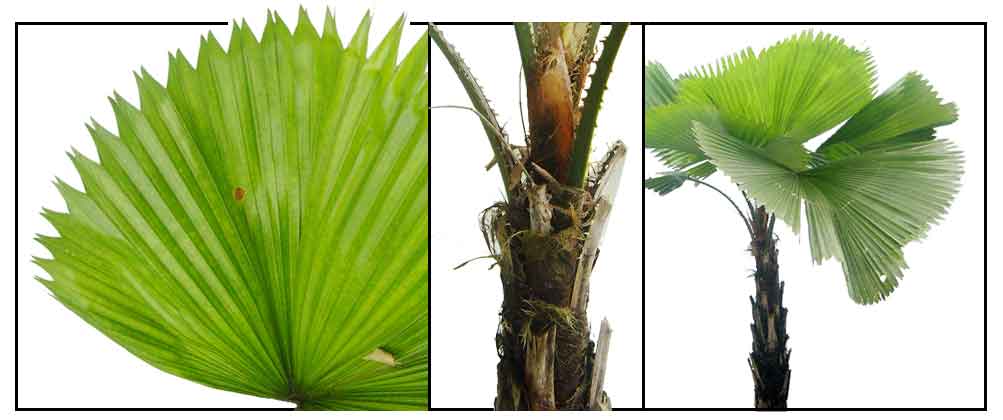
Licuala is a small clustering palm. Stems are stout,
roughened with fallen leaf scars, clustered, 2 to 3 meters high, 5 to
10 centimeters in diameter. Leaves are about 1 meter across, glossy and fan-shaped,
deeply divided 9- to 13-partite and horizontally spreading, with toothed
edges. Spadix is axillary, elongated, with the branches adnate to the rachis up to the orifice of the spathes, ultimately with many fine pubescent, densely flowered spikes. Flowers are sessile, in 2 or 3 rows, small and nearly oval in shape. Corolla
is a little longer than the calyx, divided below the middle in three, broad,
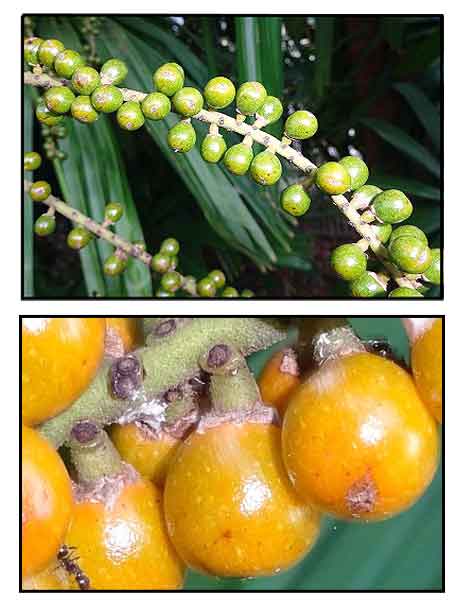
lanceolate segments. Fruit is obovoid, 5 to 8 millimeters long, pedicelled by
the calyx tube, red when mature, and one seeded. Seed is ovoid, with horny albumen, and horseshoe-shaped.
 Distribution Distribution
- Native to the Philippines.
-
In seashores, back of
mangroves in brackish mud. Grows wild in thickets at low altitudes.
- Cultivated for ornamental purposes.
- Also native to Andaman Is., Bangladesh, Borneo, Cambodia, Jawa, Malaya, Myanmar, Nicobar Is., Sumatera, Thailand, Vietnam. (4)
Constituents
- Study of leaves yielded vitexin and methyl (25S)-proto-dioscin.
- Study evaluated crude extract of leaves extracted successively with organic solvents (hexane, chloroform, and ethyl acetate) for antioxidant activity, total phenolic and flavonoid content. A chloroform crude extract showed the highest total phenolic content (9.42 ± 0.06 mg GAE/g), followed by EA crude extract (8.91 ± 0.06 mg GAE/g) and hexane crude extact (6,78 ± 0.26 mg GAE/g). The chloroform crude extract showed highest total flavonoid content (8.96 ± 0.21 mg EQ/g). By DPPH assay, among the extracts, the chloroform extracts exhibited higher radical scavenging activity with IC50 of 0.032 mg/ml, compared to BHT as positive control with IC50 of 0.089 mg/mL. (11)
Parts used
Bark, stems, leaves.
Uses
Edibility
- Young shoots reportedly edible, raw or cooked. Eaten with Thai shrimp paste and chili sauce. (4)
Folkloric
- In Cambodia, bark used in combination with other plants
for treatment of tuberculosis. Roots for treatment of fever and for preparation of health of the foetus.
- In Malaysia, leaves used for tuberculosis (5), meristem infusion is taken orally as antidote to poisoning. Also used for dehydration. (2)
- In Thailand, used to treat centipede bites.
- In Khmer, root decoction with pdao used for malaria. Pounded young leaves with tiger balm applied to centipede bite. Poultice of bulb applied to wounds. Roots used for treating fever. Roots and wood chips used for postpartum care. (8)
- In Nagaland, India, seeds used for the treatment of cough, asthma, and fever. (10)
Others
- Poison Preparation: In Borneo, the leaf's fireproof durability is of critical
utility in preparing blowpipe dart poison – the latex of Antiaris
toxicaria tree is held on a folded boat-shaped young leaf of L.
spinosa, and held over a small flame for about a week. The use of the young leaf is considered critical to the poison processing.
- Roofing: Leaves used for roofing.
- Food wrapping: Used as wrapping for glutinoid rice desserts.
- Tools: Stems used to make tool handles. (7)
- Clothing: In Cambodia, leaves used to make hats. (•) In the Andaman Islands, leaves used for clothing.
(7)
- Ritual object: Ritual object, dung-dung, made from leaves of silad (L. spinosa), frayed and tightened together. (9)
Studies
• Constituents: Study of leaves yielded vitexin and methyl (25S)-proto-dioscin. (3)
• Antioxidant / Phenolic and Flavonoid Content / Leaves: Study evaluated crude extract of leaves extracted successively swith organic solvents for antioxidant activity, total phenolic and flavonoid content. A chloroform crude extract showed the highest total phenolic content (9.42 ± 0.06 mg GAE/g) and highest total flavonoid content (8.96 ± 0.21 mg EQ/g). By DPPH assay, among the extracts, the chloroform extracts exhibited higher radical scavenging activity with IC50 of 0.032 mg/ml, compared to BHT as positive control with IC50 of 0.089 mg/mL. (11)
• Toxicity Study by Brine Shrimp Lethality Assay / Stems: Study evaluated methanol extract of L. spinosa dried powdered stems for antibacterial activity against four bacterial strains: E. coli, P. aeruginosa, B. subtilis, and Micrococcus luteus using disc diffusion method. The methanol extract of stems did not demonstrate any significant antibacterial activity against bacterial test strains. By brine shrimp lethality assay, the methanol extract showed significant toxicity to brine shrimp with LC50 of 38.9 µg/ml. (12)
Availability
- Wildcrafted.
- Ornamental
cultivation.
- Seeds in the cybermarket.
|