|
Gen info
- Mallotus is a genus is of the spurge family Euphorbiaceae first described as a genus in 1790. It contains about 150 species of dioecious trees or shrubs. (35)
- Mallotus philippensis is a plant in the spurge family, known as red kamala tree, due to the fruit covering that produces a red dye.
- Etymology: The genus name Mallotus derives from the Greek word mallotos, meaning "wooly" or "lined with wool", referring to the hairy appearance of some species. The specific epithet philippensis is Latin, referring specifically to the Philippines where the plant was first collected.
- Mallotus macrofossils have been recovered from the late Zanclean stage of Pliocene sites in Pocapaglia, Italy.
(45)
- Kamala as common name may be confused with kamala meaning 'lotus' in many Indian languages, an unrelated plant, flower, and sometimes, metonymic spiritual or artistic concept. (43)
 Botany Botany
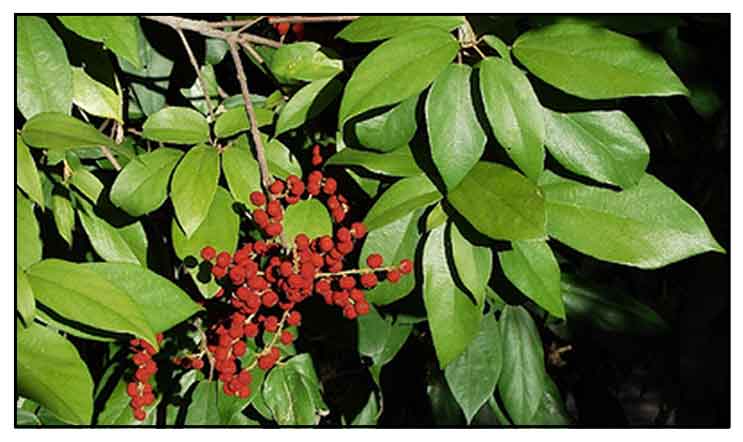
• Banato is a tree growing to
a height of 4 to 10 meters, with the branchlets, young leaves and inflorescence
covered with brown hairs. Leaves are alternate, oblong-ovate, with a
pointed tip and rounded base, 7 to 16 centimeters long, with toothed or entire
margins, the apex pointed, and the base rounded. Upper surface of the leaf has two smooth glands; the lower
surface, glaucous and hairy with numerous, scattered crimson glands.
Male flowers are numerous, 3 millimeters in diameter, axillary, solitary or fascicled
spikes, 5 to 8 centimeters long. Female flowers are in solitary racemes, 3 to 7 centimeters long, and three-cornered. Fruit
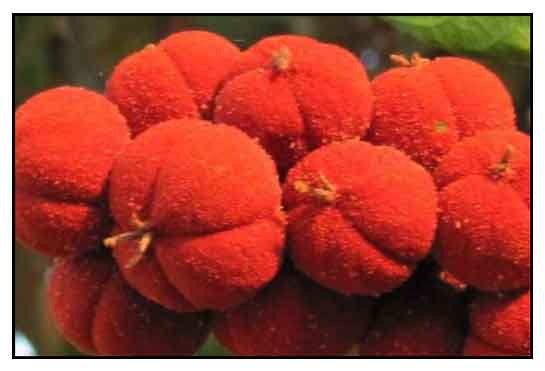
is somewhat spherical, 6 to 8 millimeters in diameter, unarmed but densely covered with red or crimson
powder, with three cells, each containing a dark grey, rounded seed
that is flattened on one side.
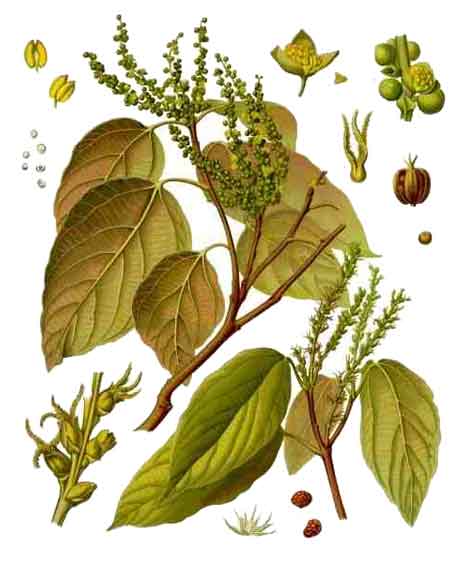 • A shrub or small evergreen tree 3-6 m high in Pakistan, elsewhere up to 20 m. Stems fluted in age. Bark rough, dark grey, thin. Wood white. Young shoots, petioles, leaves and inflorescences fulvous- to ferruginous-pubescent. Leaves alternate or subopposite. Petioles 1-4 (-7) cm long. Leaf-blades ovate to ovate-lanceolate, 5-15 x 2-9 cm, acute or subacutely shortly acuminate, subentire, cuneate, rounded or subtruncate at the base, triplinerved from the base, lateral nerves 3-8 pairs, tertiary nerves ± parallel, glabrous above, with a pair of large glands at the base, sparingly pubescent and minutely reddish-gland-dotted beneath, glaucous. Stipules minute, fugacious. Male inflorescences terminal, spicate or racemose, often clustered and appearing as if paniculate, up to 7 cm long, dense-flowered; bracts triangular, 1 mm long, persistent. Male flowers subsessile, or with pedicels 1 mm long; calyx-lobes ovate-lanceolate to lanceolate, 3 x 1-1.5 mm, acute, pubescent, glandular; stamens c. 30, 3 mm long, anthers 1 mm long, with a few apical glands; disc minute, central. Female inflorescences ± as in the ♂, but shorter and less crowded. Female flowers sessile or subsessile; calyx-lobes 3-5, triangular-ovate, 1.5 mm long, closely adpressed to the ovary, subpersistent, otherwise as in the ♂; ovary subglobose, c. 1 mm diam., pubescent and densely red-glandular; styles 2-3 mm long, plumose, green. Fruit trilobite-subglobose, occasionally quadrilobate, 8-10 x 6-7 mm, ± smooth, densely covered with crimson granular glands, which rub off, loculicidally dehiscent. Seeds subglobose, c. 4 mm diam., ± smooth, black.(Flora of Pakistan) • A shrub or small evergreen tree 3-6 m high in Pakistan, elsewhere up to 20 m. Stems fluted in age. Bark rough, dark grey, thin. Wood white. Young shoots, petioles, leaves and inflorescences fulvous- to ferruginous-pubescent. Leaves alternate or subopposite. Petioles 1-4 (-7) cm long. Leaf-blades ovate to ovate-lanceolate, 5-15 x 2-9 cm, acute or subacutely shortly acuminate, subentire, cuneate, rounded or subtruncate at the base, triplinerved from the base, lateral nerves 3-8 pairs, tertiary nerves ± parallel, glabrous above, with a pair of large glands at the base, sparingly pubescent and minutely reddish-gland-dotted beneath, glaucous. Stipules minute, fugacious. Male inflorescences terminal, spicate or racemose, often clustered and appearing as if paniculate, up to 7 cm long, dense-flowered; bracts triangular, 1 mm long, persistent. Male flowers subsessile, or with pedicels 1 mm long; calyx-lobes ovate-lanceolate to lanceolate, 3 x 1-1.5 mm, acute, pubescent, glandular; stamens c. 30, 3 mm long, anthers 1 mm long, with a few apical glands; disc minute, central. Female inflorescences ± as in the ♂, but shorter and less crowded. Female flowers sessile or subsessile; calyx-lobes 3-5, triangular-ovate, 1.5 mm long, closely adpressed to the ovary, subpersistent, otherwise as in the ♂; ovary subglobose, c. 1 mm diam., pubescent and densely red-glandular; styles 2-3 mm long, plumose, green. Fruit trilobite-subglobose, occasionally quadrilobate, 8-10 x 6-7 mm, ± smooth, densely covered with crimson granular glands, which rub off, loculicidally dehiscent. Seeds subglobose, c. 4 mm diam., ± smooth, black.(Flora of Pakistan)
Distribution
- Native to the Philippines.
- Common in thickets and
secondary forests at low altitudes.
- Also native to Andaman Is., Assam, Bangladesh, Bismarck Archipelago, Borneo, Cambodia, China South-Central, China Southeast, East Himalaya, Hainan, India, Jawa, Laos, Lesser Sunda Is., Malaya, Maluku, Myanmar, Nansei-shoto, Nepal, New Guinea, New South Wales, Nicobar Is., Northern Territory, Pakistan, Queensland, Solomon Is., Sri Lanka, Sulawesi, Sumatera, Taiwan, Thailand, Tibet, Vietnam, West Himalaya.
Constituents
- Phytochemical screening of stems yielded carbohydrates, amino acids, flavonoids, gum, oil and resins, proteins, phenolic groups, saponins, steroids, tannins and terpenoids.
(see study below) (12)
- Phytochemical screening of fruits yielded carbohydrate, protein, phenolic compounds, tannins, flavonoids, alkaloids, saponins, and steroids. (29)
-Early study yielded the following constituents: water, 3.4%; resinous coloring matter, 78.18%; albuminous matter, 7.34%; and ash, 3.84%.
 - An ethereal extract yielded three substances: a crystalline compound rottlerin, a wax, and a resin. - An ethereal extract yielded three substances: a crystalline compound rottlerin, a wax, and a resin.
- Perkin's ethereal extract yielded a dark, brownish, resinous product which yielded six distinct substances. Five of these are:
rottlerin, isorottlerin, a wax, and two resins.
- Extract of kamala from the
glands and hairs yielded a resin, a wax, and the crystalline compound
rottlerin.
- Kamala also contains a minute amount of essential oil, which when gently
warmed emits a peculiar odor.
- The kamala resin yields the yellow rottlerin, the principle constituent, and also mallotoin and kamalin.
- Study yielded rottlerin (reddish-yellow resin), 47-80%; fixed oil, 5.83-24%; citric
acid; mallotoxin; kamalin.
- The seed contains a fixed oil, camul oil and a bitter glucoside.
- Bark yields 6.5% tannin.
- Phytochemical screening of fruit yielded flavonoids, glycosides, phenolic compounds,
tannins, proteins, and amino acids. (see study below) (30)
- Bioassay-directed fractionation of organic extract of M. philippinensis yielded five compounds: 8-cinnamoyl-5,7-dihydroxy-2,2-dimethyl-6- geranylchromene (mallotophilippen F) (1), 8-cinnamoyl-2,2-dimethyl-7- hydroxy-5-methoxychromene (2), rottlerin (3), isoallorottlerin=isorottlerin (4) and the so-called “red compound,” 8-cinnamoyl-5,7-dihydroxy-2,2,6- trimethylchromene (5). (see study below) (38)
- Bioassay-directed fractionation of organic extract of M. philippinensis yielded five compounds (1-5): 8-cinnamoyl-5,7-dihydroxy-2,2-dimethyl-6- geranylchromene (mallotophilippen F) (1) 8-cinnamoyl-2,2-dimethyl-7- hydroxy-5-methoxychromene, isolated from a natural source for the first time (2), rottlerin (3), isoallorottlerin=isorottlerin (4) and the so-called “red compound,” 8-cinnamoyl-5,7-dihydroxy-2,2,6- trimethylchromene (5). (see study below) (40)
- Study of red colored extract from acetone extract of fresh whole uncrushed fruits of M. philippinensis yielded one new dimeric chalcone, kamalachalcone E (1) along with three known compounds 1-(5,7-dihydroxy-2,2,6-trimethyl-2H-1-benzopyran-8-yl)-3-phenyl-2-propen-1-one (2), rottlerin (3) and 4′-hydroxyrottlerin (4).
(see study below) (45)
- Study of leaves of M. philippensis isolated a new lignan dimer, bilariciresinol (1), along with platanoside (2), isovitexin (3), bergenin (4), 4-O-galloxyl bergenin (5). and pachysandiol A (7).
(47)
- Methanolic extract of fruits yielded alkaloids, carbohydrates, glycosides, fixed oils and fats, proteins and amino acids, saponins, tannins, flavonoids, with absence of phytosterols. (see study below)
(48)
- Study of acetone extract of M. philippensis fruits yielded five new phenolic compounds including two chalcones (1,3), a functionalized phloroglucinol (2), two flavanones (4,5) and six known compounds. (see study below)
(54)
Properties
- According to Ayurveda, leaves are bitters, cooling and appetizer.
- Fruit is anthelminthic, vulnerary, detergent, maturant, carminative.
- Studies have suggested antibacterial,
anticancer, anthelmintic, antifertility, anti-inflammatory, anti-cancer, antispasmodic, astringent,
contraceptive, laxative, immunomodulatory, vermifuge, and purgative and vulnerary properties.
Parts used
Leaves, powder, bark, fruits, seeds.
 Uses Uses
Edibility
- Kamala powder obtained from skin of fruits used as preservative for vegetable oils and dairy products. Young leaves reportedly eaten; also used as fodder.
Folkloric
- In the Philippines, glands mixed with charred bark and flowers of Pterospermum diversifolium was used in small pox to cause suppuration.
-
Fungal skin infections:
Pound leaves or seeds and apply on affected areas.
- The red glands of the fruit is antiherpetic and anthelmintic.
- Powder taken with milk for tapeworms, repeated as necessary.
- In India, used for bronchitis, abdominal
diseases, spleen enlargement. Leaves and bark are used for poulticing cutaneous diseases and pounded seeds are applied to wounds. Fruit powder used to treat skin conditions.
- Bark used for typhoid and meningitis. The gland and hairs of the fruits used for treatment of intestinal worms, and also as purgative. Oil use for skin problems and non-healing wounds. The glands/hairs of fruit mixed with coconut oil are used to dress wounds and burns.
(36)
- In India, bark decoction used for abdominal pain. Kernels are used as anthelmintic. Used in treatment of rheumatic diseases: Among the tribe of Chhota Nagpur, root is grounded and applied to painful articular rheumatism. In Burma, seeds are ground to a paste and applied to wounds and cuts. (18)
- In India, roots used as tonic by pregnant women.
- Used as external application in Herpes circinnatus.
- Used as contraceptive.
- Taken internally to remove leprous eruptions.
- Elsewhere, used for constipation, anorexia, cancers, dermatosis, cramps,
dysmenorrhea.
- In Pakistan, dried seed powder mixed with half cup of curd is given three times daily for 1 to 2 days for constipation and to kill intestinal worms. (28)
- In Manipur India, bark decoction with sugar given in urinary tract stone problem. (33)
- In Ayurveda, it is one of the most widely and readily available herb, used as purgative, vulnerary, febrifugal, cathartic, lithotriptic, antiallergic, anthelmintic, antimicrobial, antifungal, antioxidant, anti-inflammatory, and digestant. (41)
- In Myanmar, seeds ground to a paste are applied to wounds and cuts. Powdered seeds mixed with sulphur sandalwood oil is applied externally in rheumatic joints and dermatitis. (44) Fruits used as anthelmintic and laxative.
Others
- Dye: Glands of ripened fruits yield a yellow to orange-red colored dye, called Kamala dye. Fresh fruits yield about 1.4%-3.7% red powder containing pigment Rottlerin. Red dye used for preparing traditional Bhutanese fabrics and coloring silk clothes. The dye along with a mordant (alum) used for dyeing silk and wool. The dye is considered superior for woolen and silk fabrics. Besides textile, the powdered dye is used in perfume and leather. It also finds use in paintings and decoration of wooden crafts, especially by the Bokshas of the Himalayas. (37) To dye silk and wool, 4 parts of kamala, 1 part of alum, and 2 parts sodium bicarbonate are mixed in powder state, with small amount of sesamum oil, and boiled. The bright orange to red color is fairly fast to soap, acids and alkalies, fading somewhat on much exposure to sunlight. (44) Powder obtained
from the glands and hairs, besides its medicinal properties, was once valued
as a dye; used for coloring silk and wool. Today, kamala is rarely used as a dye because of expense and competition of less expensive synthetic dyes. (18)
- Food coloring: Rottlerin and its derivatives are used for coloring foodstuffs, lemonades, lime juice, and other beverages. (18)
- Oil: Oil derived from the seeds is used in paints and varnishes, as hair-fixer,
and ointment additive. Oil used as fixative in cosmetic preparations.
- Bark: Occasionally used for tanning.
- Wood: Wood pulp used for making writing and printing paper. Wood sometimes used as timber for implements. Bark used to make rope. Wood often used as fuel wood. (18)
- Paper: Wood is suitable for making paper pulp.
- Fodder: Leaves are used as fodder.
- Kamala powder: Yield of kamala powder is only 1.5-4% of the weight of the fruit, which makes the product expensive. It is often adulterated with other vegetable dyes or minerals. (44)
- Veterinary: In the Philippines, extract of Kamala powder, the active principle of rottlerin and hexachlorethane showed encouraging results in treating fascioliasis (liver fluke infestation) in cattle and Indian buffaloes (Perry 1980). (55)
Studies
• Antifilarial Activity / Leaves: The
effect of aqueous and alcoholic extracts of the leaves of Mallotus philippensis
was studied on the spontaneous movements of the whole worm and nerve-muscle
preparation of Setaria cervi and on the survival of microfilariae in
vitro. (3)
• Antimicrobial / Bark: In an ethnopharmacological screening in Nepal, the bark from
Mallotus philippensis was found to be active against gram-positive and
gram-negative bacteria.
* Anti-allergic: Two new phloroglucinol derivatives
were isolated from the fruits of Mallotus philippensis. They inhibited
histamine release from rat peritoneal mast cells suggesting the new
phloroglucinol derivatives have anti-allergic effects. (5)
• Antibacterial / Phytochemical / Stem Bark:
(1) Study showed excellent inhibition with chloroform and methanol
extracts of the stem bark on testing with E coli, K pneumonia, P aeruginosa,
S typhi and B subtilis, (2) Mallotus philippinensis was one of plants
in a study of 61 Indian medicinal plants that exhibited antimicrobial
properties, supporting its folkloric use as antimicrobial treatment
for some diseases.
• Antifertility / Seeds: Study showed when females treated with Kamala seed extract were mated with non-treated males, rate of infertile mating increased in a dose-dependent manner with reduced pregnancy rate and number of implantation sites. Data indicate, Kamala reduced levels of FSH and LH and affected various reproductive parameters of female rats. (1)
• Antioxidant / Bark: Study extracted six phenolic compounds from the bark of MP. Results showed the fractions separated possess strong antioxidant and antiradical properties. Results suggest a potential as antioxidant for food, functional foods, or nutraceuticals. (10)
• Hepatoprotective / Leaves: Study of methanol extract of leaves in carbon tetrachloride-induced hepatotoxicity showed increased antioxidant enzyme activity with associated histopathological evidence of protection. (9)
• Antineoplastic / Roots: Hexane extract of roots of MP showed good anti-proliferation activity against HL-60 lines. The antineoplastic effect was believed to have been triggered by induction apoptosis through caspase-2 activation. (11)
• Antibacterial / Free Radical Scavenging Activity / Leaves: Kamala extract showed activity against Gram positive bacteria, B. subtilis and S. aureus. Leaf extract was more active than Kamala powder in scavenging free radicals. Flavanoids finger printing of leaves showed vitexin, isovitexin and rutin.
• Antimicrobial: Phytochemical screening yielded carbohydrates, amino acids, flavonoids, gum, oil and resins, proteins, phenolic groups, saponins, steroids, tannins and terpenoids. Extracts showed significant activity against human pathogens such as Strep pneumonia, Proteus vulgaris, P. aeruginosa, Salmonella typhi, Vibrio spp and Candida albicans. (see constituents above) (12) Study evaluated various fractions for antimicrobial activity against nine human pathogens. The ethyl acetate and butanol fraction exhibited strong antibacterial (P. vulgaris, S. typhi, B. subtilis, S. pneumonia) and antifungal (A. flavus, A. niger) activities. (22)
• Bioactive Root Alkaloid / Antibacterial: Study isolated a potent bioactive alkaloid (MMH-1) from the root of M. philippensis. On antimicrobial testing, it was found to have medium activities on all six types of microorganisms. (14)
• Anthelmintic / Kampillaka: Study evaluated the anthelmintic activity of Kampillaka Churna (powder of fruit hairs). Results showed anthelmintic efficacy in 42/50 patients with Gandupada krimi (Ascaris lumbricoides). (15) Kampillaka is one of the best drugs mentioned in Ayurveda for worm infestation (Krimighana). Kampillaka is Katu (pungent) in Rasa and Ushna (hot potency). It reduces Kapha, Pitta, and Rakta diseases, destroys worms, and pacifies intestinal tumors, abdominal diseases, wounds and ulcers. It consists of M. philippensis, rottlerin, iso-rottlerin, and bergenin, among others. (57)
• Rottlerin / Toxicity / Anthelmintic Activity: Approximate lethal dose of rottlerin in rat was 750 mg/kg. Extract was found lethal to trematodes; the alcoholic extract most effective in vitro and in vivo. (18)
• Wound Healing / Fruit Hair: Study evaluated the healing potential of fruit glandular hair extract in rat using incision and dead space wound models. The MPE was found safe in rats given up to 10 times of optimal dose. Results showed wound healing effects probably due to decrease in free radical generated tissue damage, promoting effects on antioxidant status and faster collagen deposition as evidenced biochemically and histologically. (19) Study of acetone extract of fruits for wound healing activity by excision model in experimental rats showed significant reduction in wound area with a high percentage of wound healing in a 10% (w/w) extract ointment treated animals. (24)
• Scolicidal Activity / Hydatid Cyst Echinococcus glanulosus / Fruit: Study evaluated evaluated the scolicidal potential of a methanolic fruit powder extract against Echinococcus granulosus. Results showed significant solicidal activity compared with standard anti-parasitic drug Praziquantel, with almost no associated side effects. (20)
• Anti-Leukemic / Root: Study evaluated root extracts from M. philippensis on human promyelocytic leukemia HL-60 cell proliferation, cell cycle regulators and apoptosis. The hexane contract showed highest toxicity against p53-deficient HL-60 cells. The polyphenols were the main compounds of the hexane extract that inhibited proliferation and induced apoptosis. (21)
• Anti-Diabetic / Bark: Study of hydroalcoholic bark extract showed antidiabetic activity in STZ induced diabetic rats. Results showed a significant increase in body weight and significant decrease in blood glucose and glycosylated hemoglobin. Effect may be due to the phenolics in the bark extract. (23)
• Comparative Study on Intestinal Parasites: In an open comparative randomized clinical study of Embelia robusta and Mallotus philippensis on 40 patients exhibiting symptoms of intestinal parasitic infection confirmed by stool tests (Ascaris, E. histolytica, Giardia lamblia and H. nana), Mallotus philippensis showed better efficacy than Embelia robusta, with a cure rate of 70% and 40% respectively. (25)
• Anti-Tuberculosis: Study screened 15 plants for antituberculosis activity. Seven plants, including M. philippensis, were active against M. smegmatis in primary screening. The ethanolic extract and ethyl acetate fraction of M. philippensis exhibited significant anti-mycobacterial activity against M. tuberculosis. (26)
• Mallotus B from Rottlerin / Tuberculosis: Mallotus B is a prenylated dimeric phloroglucinol compound isolated from Mallotus philippensis, together with rottlerone, via intramolecular rearrangement of rottlerin. Mallotus B exhibited cytotoxicity for MIAPaCa-2 and HL-60 cells, and induced cell cycle arrest at the G1 phase and causes defective cell division, and induces apoptosis as evidenced by cell morphology. (27)
• Antimicrobial / Fruits: Antimicrobial testing of ethanolic and aqueous extracts of fruits showed antibacterial activity against selected gram positive and gram negative bacteria. There was strong activity against Pseudomonas aeruginosa, Escherichia coli and Staphylococcus aureus, without any response against S. dysenteriae, Streptococcus sp. and Bacillus subtilis. (30)
• Anticestodal / Fruits: Study evaluated the anticestodal efficacy of M. philippinensis fruit extract in a rat cestodal (Hymenolepis diminuta) intestinal infection model.
The extract at 800 mg/kg twice daily showed curative effect against mature adult worms, with dose-dependent decline in EPG (eggs per gram) count in the feces. The effect was may be attributed to the presence of phloroglucinol derivatives, chalcone derivatives and some glycosides. (31)
• Anthelmintic / Vidangadi Churna: Study evaluated the anthelmintic activity of Vidangadi churna, an Ayurvedic formulation containing Embella ribes, Hordeum vulgare, Mallotus philippinensis, Terminalia chebula. The formulation showed potent anthelmintic activity against Indian earthworm Pheretima posthuma. (32)
• Antibacterial / Multidrug Resistant Bacteria: Study evaluated the antibacterial activity of three different plant extracts viz., Mallotus philippensis, Silybum marianum, and Stachys parviflora in four different solvent extracts against 8 pathogenic MDR bacterial strains (Brucella abortus, Escherichia coli, Enterobacter sakazakii, Proteus vulgaris, Klebsiella pneumoniae, Providencia stuartii, Pseudomonas aeruginosa and Staphylococcus aureus). The extracts of selected plants showed maximum activity against all bacterial strains. (34)
• Rottlerin / Pharmacokinetic Assessment: Study assessed selective in vitro ADME properties and in vivo pharmacokinetics of isolated and characterized rottlerin using a newly developed and validated liquid chromatography-tandem mass spectrometry-based highly sensitive bioanalytical method. The method was simple, sensitive, and rapid. Rottlerin showed a number of drug-like pharmacokinetic properties (in vitro), moderate lipophilicity, considerable plasma stability, high plasma protein binding, displayed excellent half-life (>2 h), oral bioavailability (>35%) compared to other natural phenolics. (38)
• Anti-Tuberculosis Compounds: Bioassay-directed fractionation of organic extract of M. philippinensis yielded five compounds (1-5). The most active of which against Mycobacterium tuberculosis was 8-cinnamoyl-5,7-dihydroxy-2,2-dimethyl-6- geranylchromene (mallotophilippen F) (1). 8-cinnamoyl-2,2-dimethyl-7- hydroxy-5-methoxychromene, isolated from a natural source for the first time (2), rottlerin (3), isoallorottlerin=isorottlerin (4) and the so-called “red compound,” 8-cinnamoyl-5,7-dihydroxy-2,2,6- trimethylchromene (5). Mallotophilippen F showed an IC50 of 16 µg/mL. (see constituents above) (39)
• Anticancer / GAPDH / Apoptotic and Antiproliferative Potential / Human Lung Carcinoma: Study evaluated the anticancer potential of a purified seed protein from M. philippensis. The protein was identified using LC-MS/MS method and analyzed in vitro (A549 cell lines) in vivo (B16-F10 cells from melanoma cancer-induced Wistar rats) to estimate anticancer activity. MTT assay of GAPDH-treated A549 cells exhibited an IC50 of 3.03±0.39 µg/24h and 1.93±0.19/48h. AO/EtBr staining showed early and late apoptotic characteristics such as cell membrane blebbing, chromatin condensation, and formation of apoptotic bodies GAPDH treatment also significantly increased levels of SOD, CAT, and GPx and reduced GST and GSH. Histopathology analysis confirmed nuclear alteration in lung tissue of treated groups. Results confirmed the apoptotic potential of GAPDH against lung carcinoma. (40)
• Cytotoxic and Antiproliferative / MCF-7 Cell Line / Leaves: Study evaluated a methanolic extract of Mallotus philippensis leaves for cytotoxic and apoptotic potential in MCF-7 breast cancer cell lines. The leaf extract reduced cell viability in a dose dependent manner. Results showed invitro cytotoxic potential and induced apoptotic cell death in human breast cancer MCF-7 cell lines. (42)
• Antifungal / Antiproliferative / Fruits: Study of red colored extract from acetone extract of fresh whole uncrushed fruits of M. philippinensis yielded one new dimeric chalcone, kamalachalcone E (1) along with three known compounds 1-(5,7-dihydroxy-2,2,6-trimethyl-2H-1-benzopyran-8-yl)-3-phenyl-2-propen-1-one (2), rottlerin (3) and 4′-hydroxyrottlerin (4). Compounds 1-4 were evaluated for antifungal activity against different human pathogenic yeasts and filamentous fungi and antiproliferative activity against Thp-1 cell lines. Compounds 1 and 2 exhibited IC50s of 8, 4, and 16 µg/mL against Cryptococcus neoformans PRL518, C. neoformans ATCC32045 and Aspergiillus fumigatus, respectively. Compound 4 at 100 µg/mL showed 54% growth inhibition of Thp-1 cell lines. (45)
and induced apoptotic cell death in human breast cancer MCF-7 cell lines. (42)
• Antimicrobial / Toxicological Study/ Fruit Hairs and Glands: Study evaluated a methanolic extract of hairs and glands covering the fruits of M. philippinensis for antimicrobial and toxicological screening. The extract was effective against all gram-positive cocci and bacilli used in the study. Gram negative bacilli Salmonella typhi, S. paratyphi A and P. aeruginosa and Candid albicans showed sensitivity. No mortality was observed at high dose of 1000 mg/kbw; however, male mice showed a significant decrease in weight. Histopathological studies indicated minor pathological changes in the kidney and liver of test animals. (46)
• Antidiabetic / Fruits: Study of methanolic extract of fruits exhibited potential antidiabetic activity, which was suggested by lowering of serum glucose level and significantly increased glucose tolerance. It also showed significant antihyperlipidemic activity, evidenced by lower serum cholesterol , LDL, and triglyceride levels and increased HDL cholesterol level. (see constituents above) (48)
• Protective in Aniline Induced Spleen Toxicity / Fruits: Study evaluated the protective effect of Mallotus philippensis on aniline induced spleen toxicity in Wistar albino rats. Aniline treated rats showed significant alterations in body weight and spleen weighty, hematological and tissue parameters. Treatment with EEMP showed attenuation of splenic toxicity induced by aniline, which may be due to its inhibitory potential of reactive oxygen species and potent free radical scavenging activity. (49)
• Silver Nanoparticles / Fruits: Study reports on the green and cost-effective, eco-friendly synthesis of silver nanoparticles using ethanolic extract of fruits of M. philippensis. FTIR showed the presence of halides group, aliphatic amines group, alkynes, alcohols, and phenol groups. The AgNPs have potential applications in the biomedical field. (50)
• Cytotoxic Potential against Cancer Cell Lines / Bioactive Seed Proteins: Study evaluated the antiproliferative activity of seed crude proteins from M. philippensis against A5409, SW480, and MCF-7 cells lines. MTT assay showed decrease cell viability with IC50s of 4.18 µg to A549, 4.21 µg to SW480, and 8.99 µg to MCF-7 cells. The seed crude proteins did not exhibit toxicity in PBMC (peripheral blood mononuclear cells) but exhibited notable toxic effects against colon and lung cancer cells compared to breast cancer cells. (51)
• Cytokine Attenuation and Free Radical Scavenging / Anti-Inflammatory: Study evaluated the anti-inflammatory activity of M. philippensis and a new flavanone isolated sing albino Wistar rats. Results showed the ME, EA fraction, and flavanone demonstrated significant reduction in carrageenan induced paw edema and diminished TNF-α, IL-6, and IL-1 levels. There was significant attenuation of malondialdehyde levels and increased activities of catalase and glutathione peroxidase in paw tissue. There was significant decrease in granulo9oma formation in cotton pellet induced granuloma method. Results showed anti-inflammatory activity attributed to inhibition of various cytokines and increased free radical scavenging activity. (52)
• Antiurolithiatic Activity / Leaves: Study evaluated the antiurolithiatic activity of alcoholic leaf extract of M. philippensis against ethylene glycol-induced urolithiasis in Wistar rats. Treatment with doses of 250 and 500 mg/kg significantly reduced calcium, oxalate, and phosphate concentration in urine compared to control. Results showed antiurolithiatic effect evidenced by reduction and inhibition of growth of urinary stones. (53)
• Mallopenins / Antibacterial Phenolic Derivatives / Fruits: Study of acetone extract of M. philippensis fruits yielded five new phenolic compounds including two chalcones (1,3), a functionalized phloroglucinol (2), two flavanones (4,5) and six known compounds. Compounds 6 and 7 exhibited significant antibacterial activities against M. luteus, S. mutans, B. cereus, S. aureus, and E. coli with MIC values ranging from 3.8 to 15.5 µM. (54)
• Hepatoprotective / A4 Flavanone / Fruits: Study evaluated the protective property of MP and a flavanone i.e. 7,4'-dihydroxy-3",3"-dimethyl-(5,6-pyrano-2"-one)-8"'-(3''',3'''-dimethylallyl)-flavanone (A4) on CCl4-induced liver injury in animal models. Silymarin was used as standard drug. Results showed the EA and methanol fractions of MP fruit and isolated A4 flavanone compound exhibited strong hepatoprotective effects, evidenced by ability to impede rise in serum transaminases, along with decrease in serum IL-1, IL-6, and TNF-α, and significant antioxidant potential. Results may be attributable to antioxidant and cytokine-inhibitory properties. (56)
Availability
- Wild-crafted.
- Supplement formulations and seeds in the cybermarket. |