|
 Etymology Etymology
Ageratum is derived from Greek "a geras," meaning non-aging, referring to the plant's longevity. Conizoides is derived from "kontz," the Greek name of Inula helenium, which it resembles (Kissmann and Groth, 1993). (45)
Botany
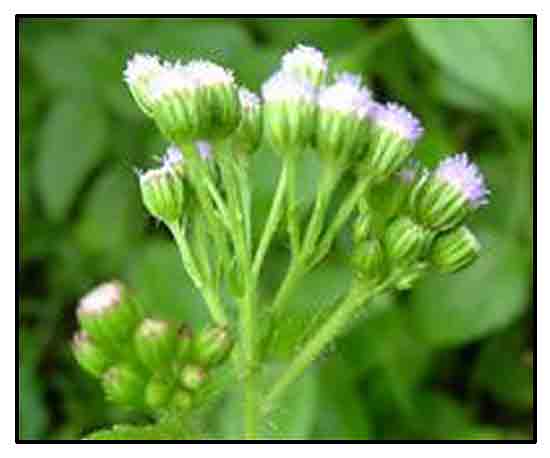
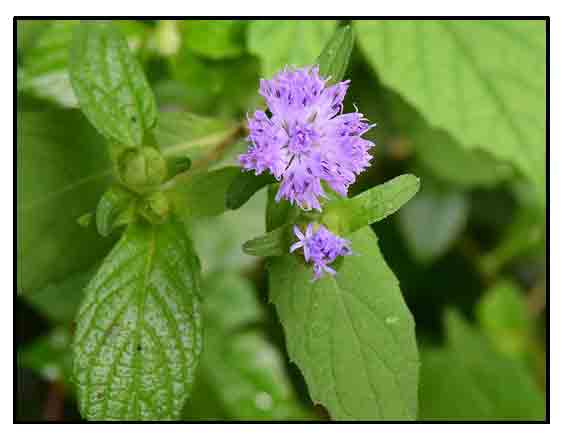
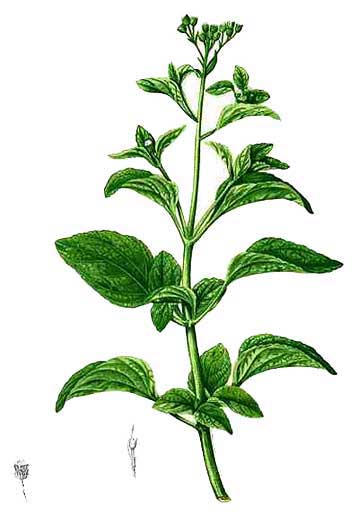
Bulak-manok is an erect, slender, branched
perennial, hairy and aromatic herb, 15 to 60 centimeters in height. Leaves are stalked, alternate, ovate, 4 to 11 centimeters long, and 1 to 5
centimeters wide, with the tip and base somewhat pointed, and with round toothed
margins, hispidly hairy. Flowering heads are numerous, small, about 5 millimeters across,
and borne in dense terminal corymbs. Ray flowers are many, pale blue, purple
or white. Disk flowers absent. Fruits (achenes) are black, with 5 pappus scales which are awned
and often toothed or serrate below.
 Distribution Distribution
- A common weed flowering year-round throughout the Philippines from sea level to an altitude of
2,000 meters. The seeds are light, easily dispersed and disseminated by wind.
- Of American origin.
- Now pantropic.
Constituents
• Leaves yield a volatile oil, 0.00054 percent, which contains sesquiterpene.
• Plant yields a vegetable proximate principle known as "coumarin," also found in the allied genus, Eupatorium.
• Yields mono and sesquiterpenes, chromene, chromone benzofuran
and coumarin, flavonoids, triterpene and sterols, and alkaloids.
• Essential oil from leaves and flowers yielded ageratochromene (precocene II, 25.89%), the sesquiterpene beta-caryophyllene (23.79%); demethoxyageratochromene (precocene I, 14.76%), and some monoterpene hydrocarbons (2-5.5%).
• Chemical profile analyses of leaf, stem, root and flower yielded phytochemicals: alkaloids, flavonoids, saponins, tannins, glycosides, resins, phenols; nutrients were proteins, carbohydrates, and essential and non-essential amino acids.
• Evaluation of leaf, stem, root, and flowers for chemical profile yielded alkaloids, flavonoids and some constituents of flavonoids, tannins, saponins, glycosides, resins, phenols while proteins, carbohydrate and its reducing forms were present as nutrients. (28)
• Phytochemical composition of leaves and roots yielded alkaloids, flavonoids, saponins, tannins, cardiac glycosides, and anthraquinones. Phytochemicals in the leaves were slightly higher than the roots. (40)
• Proximate analysis of dried leaves yielded crude carbohydrate 36.84%, protein 14.73%, fiber 23.50%, fat 2.27%, ash 12.64%, moisture 109.02%. Na, K, Ca, Mg, P, Zn, Mn, and Fe were present in both leaves and roots, with the concentration slightly higher (p,0.05) in the leaves. (40)
• Study of flowers yielded 0.25% v/w of essential oil. GC-MS analysis showed the predominance of demothoxyageratochromene. Other principal constituents were β-caryophyllene (19.5%), β- cubebene (5.2%), germacrene D (3.9%), α-caryophyllene (2.9%) and trans-β-farnesene (2.4%). (41)
 Properties Properties
• Plant has a characteristic aromatic odor when crushed.
• Considered analgesic, antispasmodic, febrifuge, tonic, laxative, vulnerary.
• Considered antioxidant, anthelmintic, antibacterial, anti-inflammatory.
Parts utilized
Leaves, young stems and flowering tops.
Uses
Edibility
- See study on toxicity of medicinal tea. (29)
Folkloric
- In the Philippines, juice of fresh leaves is widely used as a vulnerary, pounded and mixed with salt.
- Stem, roots, and flowers of the plant are boiled, the resulting decoction used for stomach troubles.
- The whole plant has been used as a decoction for cough, colds, fever,
skin disease, and high blood pressure. Also for bleeding due to external wounds; furuncle, eczema, carbuncle.
-
Poultices for headaches.
- Squeezed juice from fresh
material when dropped inside the ears treats otitis media.
- Leaves sometimes cooked in coconut oil, and the medicated oil applied to wounds.
- Used for fever, cough and colds; hepatitis, dysentery; neurasthenia,
snake bites, dizziness.
-In Brazil, used as stimulant, tonic, emmenagogue, diuretic and carminative. Leaf infusion used for colic,
fever, diarrhea, rheumatism, spasms.
- In Africa, used for fever, headache, rheumatism,
pneumonia, and healing of burn wounds.
- In India, used for leprosy and oil lotion
for purulent ophthalmia.
- In Vietnam, used for gynecologic disease.
- In Congo and Cameroon,
used for fever, rheumatism, headache and colic.
- In Togoland, used for fevers.
- Among Hindus, popular as an external application for agues.
- In Java, paste of roots rubbed on the body for fever.
- Juice applied as remedy for anal prolapse.
- In the Gold Coast Colony, juice from squeezed leaves used as lotion for the eyes.
- In Sierra Leone, leaves used as remedy for craw-craw; also used for chronic ulcers, and intravaginally, for uterine troubles. Also, crushed in water and given as an emetic.
- In Trinidad used as abortifacient, depurative, decoagulant; for cough, cystitis, diabetes flu.
- In Siberia, extract of leaves are rubbed on the chest for pneumonia in children.
- In Java, paste of leaves, mixed with chalk, used for wounds.
- In Nigeria leaf decoction used for STDs. In North Africa, root decoction used for STDs such as syphilis; also used for cystitis, urethral pain, leucorrhea. In Togo, leaves used for the same. Leaves used to treat malaria.
- Poultice of leaves applied to boils; also, applied to wounds to prevent tetanus.
- In Cameroon, leaves are pounded with Ocimum and macerated in water with "bush pepper" as a purgative enema preparation.
- In Cameroon and Congo, used to treat fever, rheumatism, headache, and colic.
- In Nigeria and other African countries, plant has been used in the treatment of scabies, craw-craw, ringworm, and ulcers.
Studies
• Antibacterial / Phytochemicals:
Phytochemical testing of dried leaves yielded resins, alkaloids, saponins, tannins, glycosides and flavonoids while dried stems showed resins, saponins, tannins, glycosides and flavonoids. In vitro studies of AC extracts activity against
S aureus, Y enterocolitica, S gallinarum, and E coli, suggesting a potential
source for development of new antibacterials. (1)
• Antiulcerogenic / Gastroprotective:
Study documents the beneficial cytoprotective effects of the plant extract
against ethanol-induced gastric ulcers in rats. (3)
• Analgesic / Anti-Inflammatory:
Study evaluated a water soluble fraction (WSF) from a hydroalcoholic extract for analgesic and anti-inflammatory activities. Results showed reduction of articular incapacitation induced by carrageenan in rats. The WSF also inhibited the carrageenan induced paw edema. Results suggested that WFC can inhibit inflammatory reactions induced by neutrophil mobilizing stimuli. (4)
• Antimicrobial:
Crude extract studies demonstrated antimicrobial properties on S aureus
and Methicillin-resistant S aureus and possible usefulness in skin and
wound infections. (5) Study evaluated ether and methanolic extracts for antimicrobial potential against strains of gram negative and gram positive bacteria, yeast and mould strains belonging to 49 genera and more than 155 species. Results suggest A. conyzoides contain useful antimicrobial components more active against oxidase positive potentially pathogenic strains associated with systemic and deadly infections in humans and animals. (52)
• Hemostatic:
Study yielded tannins, saponins and flavonoids and confirmed the hemostatic
activity of the leaf extract through vasoconstriction and formation
of an "artificial clot" to arrest the small vessel bleeding. (6)
• Radioprotective:
Study of AC extract showed it to be non-toxic at its highest dose and
exhibiting a radioprotective activity in part attributed to the scavenging
of reactive oxygen species induced by ionizing radiation. (7)
• Wound Healing:
Extract study showed wound healing effect better than normal saline
treated controls, an effect attributed to the antimicrobial properties
of AC. (8)
• Blood Glucose Lowering / Leaves:
Study
of aqueous extracts of leaves of Ageratum conyzoides in normoglycemic and STZ-induced diabetic rats showed significant reduction of blood glucose levels. (9)
Study of aqueous extracts of leaves of Ageratum conyzoides in normoglycemic and STZ-induced diabetic rats confirmed the hypoglycemic properties of the leaves of A conyzoides. (13)
• Anti-Inflammatory / Toxicity Study:
A hydroalcoholic extract of leaves was studies for anti-inflammatory effect on sub-acute (cotton pellet-induced granuloma) and chronic (formaldehyde-induced arthritis models of inflammation in rats. Study confirmed the anti-inflammatory properties of A conyzoides with no apparent hepatotoxicity. (11)
• Anti-Cancer / Radical Scavenging Activity:
Various extracts of A conyzoides were screened in some cancer lines including Human non-small cell lung CA, human colon adenocarcinoma, human gastric CA, and human breast CA among others.
Results showed A conyzoides possessed anticancer and antiradical properties. (12)
• Toxicity Study / Leaves:
A 28-day study evaluated the acute and sub-chronic toxicity of A. conyzoides leaves in Wistar rats.
Results showed the hydroalcoholic extract is relatively safe when administered orally to rats.
• Comparative Study / Wound Healing / Polyherbal Formulation / Roots: Study in rats of root extract showed wound healing activity, with accelerated healing processes and increased breaking strength. The wound healing of a polyherbal formulation, Ageratum conyzoides with Ficus religiosa, C. longa and T. indica showed better results, attributed to the synergistic action of the plant constituents.
(18)
• Chemical Profiles of Leaf, Stem, Root, and Flower: In a study evaluating the chemical profile of plant parts, the leaf showed the most concentration of chemicals, followed by the flower.
• Antioxidant / Leaf / Improved Glycemia: The antioxidant activity of aqueous extract of leaves of Ac
in the serum of male diabetic rats was evaluated. Results showed lowering of lipid hydroperoxides. Ac had a positive effect on the oxidation-reduction system on STZ-induced diabetic rats, together with improved glycemia. (19)
• Wound Healing Comparative Study Vs Honey: Study in Wistar rats investigated the wound healing properties of methanolic extracts of Ac compared to honey. Histologically, the day-10 Ageratum sections showed fewer inflammatory cells compared with honey and controls. Also, healed scar sections of wounds dressed with herb extract showed more fibrosis. Healed wounds from Ac group showed significantly fewer fibroblasts. (20)
• Diuretic Activity: Study of aqueous extract of leaves of Ac in albino Wistar rats showed significant diuretic activity. similar to Acetzolamide. at 600 mg/KBW, there was significant increase in concentrations of Na, K, and Cl ions suggesting benefits for hypertension and cardiovascular diseases.
• Lactation Effect: Study evaluated the effect of Ac leaf extract on the histological structures of non-lactating mammary gland of wistar white female albino rats.
After 14 days of treatment, female rat mammary gland showed more secretory activity indicating lactation.
• Methoxylated Flavonoids / Antiprotozoal: The dichlormethane extract from aerial parts have shown prominent activity against bloodstream forms of Trypanosoma brucei rhodesiense, the etiologic agent of East African Sleeping Sickness. Study isolated five highly methoxylated flavonoids along with the chromene derivative encecalol methyl ether. The flavonoids showed activity against protozoan pathogens. (24)
• Haemostatic Effects: Study of methanolic leaf extract
in albino rats exhibited haemostatic effects. Results showed significant dose-dependent decreases in the bleeding time, prothrombin time, and clotting time, with a significant increase in plasma fibrinogen concentration. Results suggest haemostatic activity in both intrinsic and extrinsic pathways. (25)
• Psychopharmacologic Effects / Memory / Ach: In a study in mice, Ac produced dose-dependent improvement in learning capacity and retention memory of both young and aged mice. It also reversed scopolamine and natural ageing-induced amnesia in young and old mice, while also indirectly increasing the acetylcholine
by reducing the whole brain anticholinesterase activity. (26)
• Inflammatory Bowel Disease / Protective Effects: In a study of acetic acid-induced colitis and indomethacin-induced enterocolitis models in rats, pretreatment with an ethanolic extract produced significant attenuation in biochemical and histopath parameters. Results suggest a possible benefit for use in inflammatory bowel disease. (27)
• Pyrrolizidine Alkaloids in Medicinal Tea: Asteraceae is described as containing toxic pyrrolizidine alkaloids. Evaluation of aqueous extracts of Ageratum conyzoides detected pyrrozilidine alkaloids lycopsamine, dihydrolycopsamine, and acetyl-lycopsamine and their N-oxides. Lycopsamine and its N-oxide are known hepatotoxins and tumorigens. At the time of the report, there are no established safety guidelines on pyrrozilidine alkaloids-containing plants, and their use in Brazil.
(29)
• Toxicity Study / Safety with High LD50: Study evaluated the mean lethal dose of an ethanolic extract of Ageratum conyzoides at a daily dose of 500 and 1000 mg kg of extract for 28 days. Results showed no toxic effects in rates, with an LD50 of 10,000 mg kg. However, the extract significantly reduced the level of cholesterol and HDL. At 1000 mg/kg, the extract enhanced the growth and weight of rats. Results suggest AC is safe for use in ethnomedicine. (30)
• Antihyperglycemic: Study of crude extracts of leaves and fractions of A. conyzoides in rats showed important antihyperglycemic potential. Result suggest more than one antihyperglycemic compound with different chemical characteristics and mechanisms of action.
(31)
• Antioxidant / Cytotoxic: Study evaluating a methanolic extract of A. conyzoides stems for antioxidant activity using a DPPH scavenging assay showed dose dependent scavenging of free radicals. Cytotoxicity evaluation using brine shrimp lethality assay exhibited promising cytotoxicity, comparing with LC50 values of vincristine sulphate. (32)
• Hepatoprotective / Acetaminophen Toxicity: Study evaluated the hepatoprotective effect of acetone and n-hexane extracts of A. conyzoides in wistar rats following acetaminophen induced hepatotoxicity. Results showed restoration of enzyme levels as indication of stabilization of plasma membrane as well as repair of hepatic tissue damages induced by APAP. (33)
• Ovicidal / Larvicidal / Parasitic Nematode Heligmosomoides Bakeri: Study showed aqueous and ethanolic extracts of A. conyzoides have potent anthelmintic activity. The ovicidal activity could be due to penetration of egg shells, segmentation of blastomeres, or paralyses of larvae inside embryonated eggs. (34)
• Anthelmintic / Schistosomicidal / Essential Oil: Study evaluated the schistosomicidal effects of the essential oil of A. conyzoides against adult worms of Schistosoma mansoni. Ac-EO showed activity, although less effective than the positive control, praziquantel (PZQ). Ac-EO caused dose-dependent reduction in the number of eggs. Precocene I and (E)-caryophyllene were identified as two major constituents. (35)
• Toxicity Study / Leaf Extract: Study evaluated the safety potential of the leaf extract of Ageratum conyzoides in Sprague Dawley rats using biochemical, hematological, and histopathological indices of toxicity.
Histopathological studies indicated various degrees of hepatocellular necrosis accompanied by significant increases in liver and spleen weights. Results suggest the leaf extract significantly alters biomarkers of cardiac and skeletal muscle disorders, and higher doses could induce liver injury. (37)
• Antioxidative Potential: Comparative study evaluated the in vivo effects of two common African herbs: Ageratum conyzoides stem bark and Zanthoxylum zanthoxyloides leaves on antioxidant status in the brain, kidney, and liver of wistar albino rats intoxicated with sublethal concentration of cadmium chlorides. Results suggest both possessed antioxidant properties which could provide protection against oxidative organ damage. (38)
• Antimalarial Activity / LD50 / Leaves: Study evaluated fractions of crude methanolic extract of leaves in an in vivo model of mice infected with Plasmodium berghei. The aqueous extract showed significant (p,0.05) and dose dependent antiplasmodial activity. All fractions yielded alkaloids, glycosides, flavonoids, saponins, tannins, reducing sugar, proteins, carbohydrates, and resins. LD50 was estimated to be greater than 5000 mg/kg p.o. in mice. (39)
• Larvicidal / Aerial Parts / Aedes albopictus: Study showed the essential oil of A. conyzoides aerial parts and two major constituents, precocene I and precocene II, have potential for use in control of Ae. albopictus larvae. (42)
• Acute and Subacute Toxicity Studies / Hepatorenal Changes: Study evaluated acute and subchronic toxicity potential of Ageratum conyzoides total extract in rats. An aqueous extract yielded pyrrolizidines alkaloids, tannins, saponins, flavonoids, and polyphenols. The aqueous extract showed d dose dependent sedative and analgesic effects. Subchronic toxicity testing the LD50 of the aqueous extract was more than 13 g/kbw. Although there was no effect on body weight, food consumption and water intake, histological studies showed dose-dependent lesions with hepatorenal changes associated with high levels of transaminases and hyperleukocytosis at 800 mg/kg dose. (43)
• Antioxidant / Leaves: Study of an alcoholic extract of leaves by DPPH assay showed better antioxidant potential compared to reference standard ascorbic acid. It exhibited strong antioxidant DPPH radical scavenging activity with !C50 of 24.8 µg/ml compared to ascorbic acid of 9.3. The strong antioxidant activity was attributed to flavonoids and phenols. (44)
• Antibacterial / Leaves: AC-1, a compound isolated from leaves, was evaluated for antibacterial activity against four gram-negative bacteria (E. coli, S. dysenteriae, P. aeruginosa, and S. typhi) and four gram-positive bacteria (B. subtilis, B. megaterium, S. aureus, and S. pyogenes). Results showed large zone of inhibition against test bacteria, with activity greater in gram positive than in gram negative bacteria, and highest against Staphylococcus aureus. (46)
• Wound Healing Effect / Leaves: Study evaluated various extracts of leaves of A. conyzoides for wound healing activity in rats using excision, incision, and dead space wound models. Results showed animals treated with methanol and aqueous extracts exhibited faster rate of wound healing compared to other extracts. (47) Study evaluated the effect of a leaf extract of A. conyzoides for wound healing activity on an excision wound model. Results showed wound healing activity attributed to phytoconstituents like alkaloids, saponins, and triterpenoids. (58)
• Antidiabetic Property / Lipid Profile Benefits / Leaves: Study evaluated the antidiabetic activity of aqueous extract of leaves of AC in STZ-induced hyperglycemic male adult albino rats. Results showed significant antidiabetic activity. There was a significant reduction in serum glucose along with increase in serum insulin and protein levels, improvement in lipid profile as evidenced by decreased LDL and triglycerides and an increase in HDL. (48)
• Treatment of BPH (Benign Prostatic Hypertrophy): A double-blind, randomized, placebo-controlled clinical trial evaluated the efficacy and safety of A. conyzoides in treating benign prostatic hypertrophy in men with medically diagnosed BPH, aged 41-76. Study showed a significant reduction in total IPSS score (p<0.01) and day- and night-time urinary frequency (p<0.01). Results suggest a potential treatment for reducing symptoms of BPH in healthy men. The activity, in part, was attributed to inhibition of 5-alpha reductase enzyme activity. (49)
• Anti-Inflammatory / Antioxidant
/ Aerial Parts: Study evaluated the effect of methanol extract and flavonoid fraction of aerial parts on carrageenan induced edema in rat. The flavonoids showed strong inhibitory activity on DPPH radical. Anti-inflammatory effect was attributed to the flavonoid fraction through protective action against free radical mediated damage in cells and tissue. Study hypothesizes that flavonoids influence inflammatory gene protein expression. (50)
• Antidiabetic / Hypolipidemic / Antiatherogenic / Leaves: Study evaluated the antidiabetic, antilipidemic, and antiatherogenic effects of leaf extracts of A. conyzoides in STZ-induced diabetic rats. Results significant reduction (p<0.05) in glucose, total cholesterol, triglycerides and LDL concentrations, along with significantly increased (p<0.05) HDL in treated groups. The effect was linearly dose-dependent. (51)
• Haemostatic Effect: Study evaluated the hemostatic effect of A. conyzoides on bleeding in mice induced by the combined use of anticoagulant agents and antiaggregants. Results showed reversal of clotting time to normal baseline. The ethanol extract showed a hemostatic effect and a potential reversing agent for bleeding induced by combination of acetosal, clopidogrel and enoxaparin. (53)
• Treatment of Breast Myiasis Sores in Women: Study reports on the use of ethanolic extract of leaves, stems, and flowers of Ageratum conyzoides in women with breast myiasis. Diifferent numbers of maggots were extracted from the breasts and 92% of nursing mothers had their sores healed after application of the ethanolic leaf extracts. Bacteria identified included B. subtilis, S. aureus, P. aeruginosa, and E. coli. (54)
• Anti-Urolithiatic: Study evaluated various extracts of whole plant of A. conyzoides for anti-urolithiatic effect in wistar albino rats with urolithiasis induced by 5% ethylene glycol. Results showed significant reduction in calcium and oxalate concentrations in excreted urine and deposition in the kidney. The highest reduction in calcium and oxalate in the urine and kidney was seen with the ethanol extract. (55)
• Anxiolytic: Study evaluated methanol extract and fractions of A. conyzoides for anxiolytic activity in mice using elevated plus maze (EPM) model. Results showed significant anxiolytic effect which was attributed to the ethyl acetate fraction and its flavonoid quercetin content. (56)
• Topical Anti-Inflammatory Effect of Ointment: Study evaluated an ointment formulation of an aqueous extract for anti-inflammatory effect in carrageenan induced hind paw edema. Results showed anti-inflammatory activity as evidenced by an antiedematogenic effect, reduction of exudate volume, and leukocyte mobilization. In oral toxicity study, no mortality was observed at doses up to 5000 mg/kg. (57)
Availability
- Wild-crafted.
- Seeds, tinctures and extracts in the cybermarket. |