| Botany
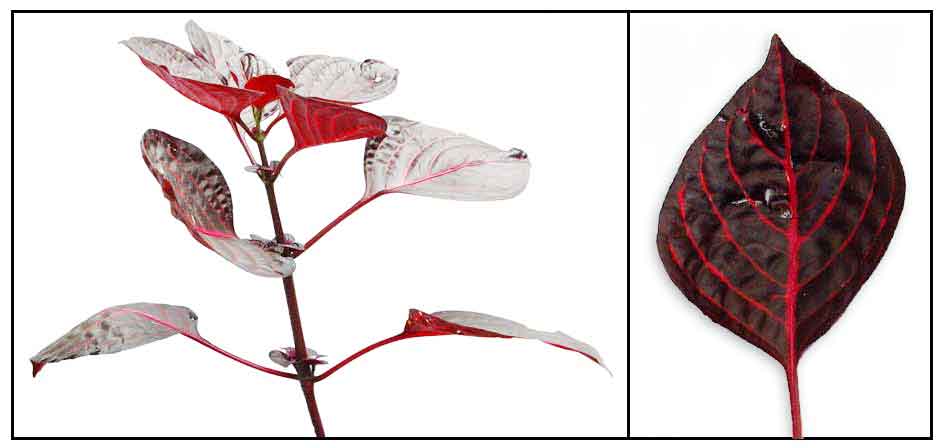
Iresine herbstii is a low annual herb. Leaves are broadly
ovate or orbicular, purple-red with lighter colored prominent arched
veins. A common variety has green or reddish-green leaves with yellow
veins. Flowers are small. Petals are greenish white or yellowish-white, with dry membranous bracts.
Distribution
- Native to tropical America.
- Cultivated throughout the Philippines.
Constituents
- Ethanolic extract yielded waxes, ß-sitosterol, campesterol and 3'4'7-tri-hydroxy-6-metoxyflavone from the aerial parts. (see study below) (9)
- Aerial parts yielded a new isoflavone 2,2,5-trimethoxy-6,7-methylenedioxyisoflavanone, together with isoflavone tlatlancuayin (2,5-dimethoxy-6,7-methylenedioxyisoflavone).
(see study below) (10)
- Phytochemical screening of leaf and stem yielded alkaloids, carbohydrates, flavonoids, glycosides, phenols, phytosterols, proteins, resins, saponins, tannins, and thiols. (see study below) (14)
- Phytochemical screening of Iresine herbstii leaves for secondary metabolites by GC-MS analysis yielded
10 phytocompounds, namely: Furan-2-carboxylic acid (1), 2-Ethyl-2-hexen-1-al (2), Diethylene glycol monomethyl ether (3), Methyl 14-methylpentadecanoate (4), Hexadecanoic acid also known as Palmitic acid (5), Methyl linolelaidate (6), Linolenic acid methyl ester (7), 2,5-dihydroxycyclohexa-2,5-diene-1,4-dione (8), 5-chloropyridin-2-ol (9), and 17-Carboxyoctadeca-2,4-dien-1-ylium (10). (18)
Uses
Folkloric
• No folkloric medicinal
use in the Philippines.
• In southern Brazil, used for wound healing. Leaves used in treatment of cancer.
• In Africa, leaves and stems used for wound healing. (12)
• In the northern Peruvian Andes,
used for magic-therapeutical purposes where traditional healers use
it to expel evil spirits from the body. (2)
• Used in association with other plants, such as Trichocereus
pachanos, for divination, for diagnosing diseases, to take possession
of another identity or for other ritualistic healing uses.
• Leave used externally against skin depurative such as eczemas, sores, and pimples. (De Feo, 2003) Leaves and flowers used in decoction, fever, relaxant, and kidney problems. (Vicente et al., 2007) (12)
Studies
• CNS Effects / Affinity for Cerebral Receptors / Ritual Use:
Studied to evaluate if the central effects of Iresine herbstii with
Brugmansia arborea could be associated with interaction with SNC receptors.
The results of the experiments indicate that Iresine herbstii methanolic
extract was able to interact with the central 5-HT2C and D1 receptors
and Iresine herbstii aqueous extract showed affinity for D2 receptors,
thus confirming their ritual use. (1)
• CNS Effects: Paper reports on some pharmacological tests performed on V. adscendens, I. herbstii, and B. arborea. Animal
experiments indicate the plants were able to significantly reduce the
central nervous system activity. The reduction of motor coordination
and stereotyped behavior together with induced locomotor activity support
the possibility that all the studied plants act as psychotropic agents,
thus confirming their ritual use. (2) Study evaluated the CNS effects of methanolic extract of I. herbstii. Results showed interaction with central 5-HT (2G) and D1 receptors, while aqueous extract showed affinity for D2 receptors. (12)
• In Vitro Binding Receptors: Study evaluated the affinity and selectivity of V. adscendens, Irsine herbstii, and Brugmansia arborea towards %-HT(1A), 5HT(2A), 5HT(2C) serotonergic, D(1) and D(2) dopaminergic, alpha 1 and alpha 2 adrenergic receptors. Results showed Iresine herbstii interacted with the central 5-HT receptors thus confirming their ritual use. (3)
• CNS Pharmacological Effects: Study investigated a purified aqueous extract
for CNS pharmacological profile. Results showed significant reduction of locomotor activity, motor coordination
and stereotyped behavior of mice. Results suggest that I. herbstii induces
significant effects on selected aspects of the CNS. (4)
• Betacyanins / Natural Colorants: Red-colored plants in the family Amaranthaceae are a rich source of unique betacyanins. A study of 37 species of 8 genera in Amaranthaceae isolated 6 simple betacyanins and 10 acylated betacyanins. The highest proportion of acylated betacyanins occurred in Iresine herbstii. Compared to wild species, cultivated species contain more acylated betacyanins, a potential source of pigments as natural colorants. (5)
• Effects on Biochemical Profile: Study evaluated Iresine herbstii leaf extract and powder on the biochemical profile of adult male albino Wistar rats. Results showed considerable alterations in enzyme activities and is likely to induce tissue damage and lipid profile abnormalities. Caution is advised on the consumption of extracts or powder for treatment of various ailments. (7)
• Anthocyanin Content / Antioxidant / Flowers: Study evaluated the effects of vacuum drying, storage and freezing on anthocyanin content and antioxidant properties. Results showed fresh samples had the highest total anthocyanin content. The anthocyanins from flowers exhibited dose dependent antioxidant activity against lipid peroxidation and showed remarkable scavenging activity on various assays. Results showed a potential source of natural antioxidants and potential application in both pharmacy and food industry. (8)
• Antioxidant / Aerial Parts: Study on ethanolic extracts from Iresine herbstii showed antioxidant activity attributed to constituents isolated from aerial parts. (see constituents above) (9)
• Isoflavones / Alpha-Glucosidase Inhibitory Activity: Study on aerial parts yielded a new isoflavone 2,2,5-trimethoxy-6,7-methylenedioxyisoflavanone, together with isoflavone tlatlancuayin. Both compounds showed a low effect for alpha-glucosidase inhibitory activity compared to hyperoside. (see constituents above) (10)
• Silver Nanoparticles / Leaves / Bioactivity: Study reports on the synthesis and characterization of silver nanoparticles. Biosynthesized nanoparticles exhibited strong antioxidant activity, cytotoxicity against HeLa cervical cell lines, and potent antibacterial activity against human pathogenic bacteria. (11)
• Antioxidant / Anticancer: Various extracts of Iresine herbstii leaf and stem powders were investigated by GCMS for therapeutic potential and antioxidant activity Total phenolic content by Folin-Ciocalteau reagent varied from 34.67±0.58 to 103.33±1.53 mg/g dry weight GAE. The DPPH radical scavenging activity was increased in a dose dependent manner, with the acetone extract of stem showing the highest activity compared to standard ascorbic acid. In vitro cytotoxic effect of ethanolic extract of leaf in HeLa cervical cancer cell line showed over 85% reduction in live cells. (13)
• Antibacterial / Leaf and Stem: Study evaluated leaf and stem extracts for phytochemicals and antibacterial activity against pathogenic bacteria. An ethanolic leaf extract showed to be most effective against pathogenic bacteria at varying zone of inhibition (10.20±0.50 to 15.13±0.33 mm). (see constituents above) (14)
• CNS Depressant Effect: Study investigated a purified aqueous extract of I. herbstii for CNS pharmacological effects. The extract significantly reduced locomotor activity, motor coordination and sterotyped behavior of mice. There was no effect on the nociceptive threshold in hot plate and tail flick test. Results showed significant selected CNS effects. (15)
• Haematological Effects / Antianemic: Study evaluated a methanolic extract of I. herbstii on some blood parameters of experimentally induced anemic albino rats. Acute toxicity study showed n LD50>5000 mg/kg. The extract showed significant improved of red blood cell count of rats at dose of 400 mg/kbw and body weights of anemic rats at all treatment doses. (16)
• Soil pH Indicator: Study of aqueous extract of blood leaf (I. herbstii) showed it can be used as soil pH indicator. (17)
• Isoflavonoids: Study yielded two isoflavonoids:
Study of forage plants have yielded active toxic compounds that may cause outbreaks of biliary atresia in livestock. Two similar isoflavonoids were extracted from I. herbstii: 2′,2,5-trimethoxy-6,7-methylenedioxyisoflavanone (1) and 2′,5-dimethoxy-6,7-methylenedioxy-isoflavone (2). (18)
Availability
Cultivated.
|