 Gen info Gen info
- Erythrina is a genus of plants in the pea family, Fabaceae. It contains about 130 species distributed in tropical and subtropical regions worldwide. The species are known for their large flowers with long and bright red or orange petals. (12)
- In horticulture, "coral tree" is the collective name for the plants.
- Collective names for the genus plants are coral tree and flame tree.
- Etymology: The genus name Erythrina derives from the Greek erythros, meaning "red", referring to the flower color of certain species. (Not all species have bright red flowers.)
(12)
Botany
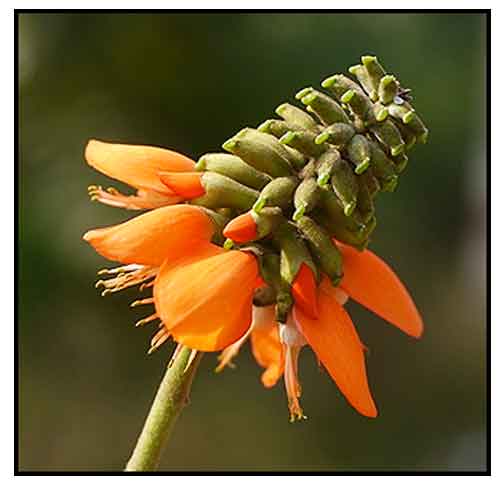
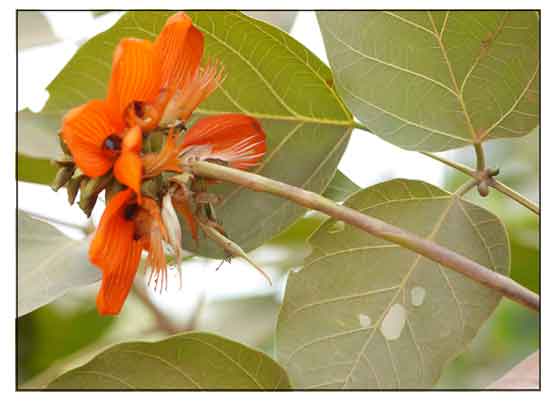
• Erythrina subumbrans is a tree, 12-15 m tall. Trunk up to 60 cm d.b.h., with robust prickles. Leaves pinnately 3-foliolate; stipules ovate, deciduous; petiole 10-12 cm, without prickles; petiolules ca. 7 mm; leaflets ovate-triangular, 10-15 cm × 7-10 mm, membranous, both surfaces glabrous, lateral veins 7 on each side, obviously convex abaxially, base rounded or broadly cuneate, margin entire, apex acuminate. Raceme 7-10 cm. Flowers ca. 4 cm. Calyx campanulate, 2-lobed, silky hairy. Standard scarlet, elliptic, 5-6 cm, apex obtuse, shortly clawed; wings obovate; keels subequal to wings. Ovary glabrous. Legume ca. 15 × 2.5 cm, with seeds restricted to apical part, indehiscent. Seeds 1-3, black. (Flora of China)
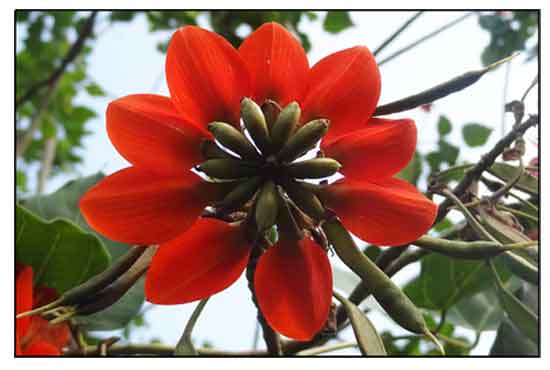 Erythrina subumbrans is a deciduous, medium-sized tree, 5-25 m tall, crown spreading, trunk reaching 60 cm in diameter, armed with stout prickles, under cultivation mostly unarmed. Petiole 8-16 cm long, thickened at the base; stipules orbicular, small, rachis 2-5 cm long, leaflets ovate-triangular-rhomboid, terminal one largest and 8-16 cm × 6-14 cm, base rounded or cordate, apex acuminate, glabrous, petiolule up to 7 mm long; stipels stipitate, cup-like, glandular. Inflorescence racemose, in the upper leaf axils, 5-23 cm long, brownish-tomentose, peduncle 3-15 cm long. Flowers many, arranged in groups of 3, pedicel 2- 3 mm long, in fruit up to 6 mm long, calyx campanulate, 1-1.5 cm long, splitting open up to halfway down, tomentose, yellow-green; standard broadly elliptical, 2.5-4 cm × 2-3 cm, shortly clawed, scarlet, at base inside with numerous white stripes, wings as long as the keel or slightly longer, about 1.5 cm long, pale red with a blackish upper margin; stamens 3-3.5 cm long, monadelphous but vexillary stamen slightly shorter than other ones and only connate for the lower 0.5-1 cm, pinkish red. Fruit a flat, curved pod, 10-15 cm long, on a slender stalk 3-4.5 cm long, lower part seedless and 2-2.5 cm wide, upper part thicker, 1-1.5 cm wide and 1-5-seeded, septate between the seeds, dehiscent. Seed ellipsoid, 7-18 mm × 5-11 mm, smooth, dull black. (2) Erythrina subumbrans is a deciduous, medium-sized tree, 5-25 m tall, crown spreading, trunk reaching 60 cm in diameter, armed with stout prickles, under cultivation mostly unarmed. Petiole 8-16 cm long, thickened at the base; stipules orbicular, small, rachis 2-5 cm long, leaflets ovate-triangular-rhomboid, terminal one largest and 8-16 cm × 6-14 cm, base rounded or cordate, apex acuminate, glabrous, petiolule up to 7 mm long; stipels stipitate, cup-like, glandular. Inflorescence racemose, in the upper leaf axils, 5-23 cm long, brownish-tomentose, peduncle 3-15 cm long. Flowers many, arranged in groups of 3, pedicel 2- 3 mm long, in fruit up to 6 mm long, calyx campanulate, 1-1.5 cm long, splitting open up to halfway down, tomentose, yellow-green; standard broadly elliptical, 2.5-4 cm × 2-3 cm, shortly clawed, scarlet, at base inside with numerous white stripes, wings as long as the keel or slightly longer, about 1.5 cm long, pale red with a blackish upper margin; stamens 3-3.5 cm long, monadelphous but vexillary stamen slightly shorter than other ones and only connate for the lower 0.5-1 cm, pinkish red. Fruit a flat, curved pod, 10-15 cm long, on a slender stalk 3-4.5 cm long, lower part seedless and 2-2.5 cm wide, upper part thicker, 1-1.5 cm wide and 1-5-seeded, septate between the seeds, dehiscent. Seed ellipsoid, 7-18 mm × 5-11 mm, smooth, dull black. (2)
Distribution
- Native to the Philippines.
- Also native to Andaman Is., Assam, Borneo, China, Fiji, India, Jawa, Laos, Lesser Sunda Is., Malaya,, Maluku, Myanmar, Samoa, Sri Lanka, Sulawesi, Sumatera, Thailand, Vietnam.
(1)
- Grows primarily in the wet tropical biome.
- Low and medium elevation thickets, open locations and secondary forests, etc.
 Constituents Constituents
- Study of twig and root extracts of Erythrina subumbrans isolated a new pterocarpan, erythinocarpan (1), along with 27 known compounds. (see study below) (3)
- Study of bark isolated three new erythrina alkaloids: (+)-10,11-dioxoerythratine (1), (+)-10,11-dioxoepierythratidine (2), and (+)-10,11-dioxoerythratidinone (3), and a new pterocarpan, 1-methoxyerythrabyssin II (4), together with seven known pterocarpans, erythrabyssin II, erybraedin A, erystagallin A, erycristagallin, erythrabissin-1, eryvarin A, and hydroxycristacarpone, three flavanones, 5-hydroxysophoranone, abyssinone V, and lespedezaflavanone B, three triterpenes, sophoradiol, soyasapogenol B, and lupeol, and one isoflavanone, vogelin C. (4)
-Study of stems led to isolation of one triterpene, soyasapogenol B, two pterocarpans, erybraedin A and erystagallin A, and one flavanone, 5-hydroxysophoranone. Study of bark isolated vogelin C and lespedezaflavanone B. (see study below) (8)
- Study of hexane and Ch2Cl2 extracts of Erythrina subumbrans stems and E. stricta roots isolated six pterocarpans, one flavanone, one isoflavone, two alkaloids, five triterpenes, six steroids and alkyl trans-ferulates. Sophoradiol (15), a mixture of stigmast-4-en-3-one (19) and stigmasta-4,22-dien-3-one (20), lupeol (21), cycloeucalenol (22), a mixture of 3β-hydroxystigmast-5-en-7-one (23) and 3β-hydroxystigmast-5,22-dien-7-one (24) and melilotigenin C (25) were first isolated from the genus Erythrina. (see study below) (10)
- Study of twigs and leaves isolated three coumaronochromones, erythrinasubumbrin A and (±)-erythrinasubumbrin B, five prenylated flavanones, (±)-erythrinasubumbrin C and erythrinasubumbrins D–F, and two prenylated isoflavones, (±)-5,4ʹ-dihydroxy-[4,5-cis-4-ethoxy-5-hydroxy-6,6-dimethyl-4,5-dihydropyrano (2,3:7,6)]-isoflavone, in addition to 18 known analogues. (see study below) (21)
Properties
- Studies have suggest antibacterial, antifungal, anti-inflammatory, antidiabetic, antiplasmodial, antimycobacterial, cytotoxicity, insulin-resistance decreasing, antioxidant, anti-acne, anti-obesity, sun protective, antipyretic properties.
Parts used
Leaves, bark, roots.
 Uses Uses
Edibility
- In Java, steamed young leaves eaten in salads.
Folkloric
- In the Philippines, bark decoction drunk for afflictions of the spleen.
- In Indonesia, poultice of pounded bark applied for fever. Poultice of pounded young leaves used for post partum hemorrhage, menorrhagia and for relief of jaundice. Leaf juice used as eye wash. Decoction of leaves used for cough. In Malaysia, bark juice drunk to relieve cough, and bark poultice applied simultaneously. Vinegar infusion of bark rubbed on the body for vomiting after childbirth. (2)
- In Indonesia, leaves used for treatment of rheumatism, stomach aches, asthma, dysentery, contact dermatitis, eczema, and skin infections.
(5)
- In West Java, Indonesia, dadap serep leaves are used as poultice or drunk as herbal tea to reduce blood glucose, fever, and edema. (14)
- Poultice of bark and leaves used after childbirth.
- In Usada, Bali, dadap serap leaves are used for wound healing. (9)
Others
- Fodder / Meal: Used as fodder but may cause sterility and death when consumed by rabbits. In western Samoa, a 5% leucana meal and 5% dried and ground dapdap leaves used as starter diets in chickens, with resultant weight gains.
- Ritual / Ornamental: In Papua New Guinea, used in ritual ceremonies.
- Wood: Used for canoe and raft building.
- Agroforestry: Used as shade tree. In Indonesia, used as live support for betel, pepper, and vanilla vines. In Malaysia, used as live support for yams; in Myanmar and India, for betel and pepper vines.
Studies
• Antidiabetic / Antimicrobial / Flavonoids / Twigs and Roots: Study of twig and root extracts of Erythrina subumbrans isolated a new pterocarpan, erythinocarpan (1), along with 27 known compounds. The compounds were evaluated for antidiabetic, antimicrobial, and anti-inflammatory properties. Compounds 3, 8, 8, and 22 showed α-glucosidase inhibitory activity with IC50 of 13.4, 24.5, 29.0, and 12.8 µM, respectively. Compound 2 showed α-amylase inhibitory activity with IC50 of 67.6 µM. Compounds 22 and 24 inhibited glycation activity with IC50s of 36.9 and 40.5 µM, respectively. From cell based assays, compound 27 showed highest ability to induce glucose consumption (IC50 29.1 µM) and glucose uptake (2.8-fold) and to inhibit NO production (IC50 52.5 µM) without cell toxicity. Compound 9 showed antimicrobial activities against Gram-positive bacteria and fungi with MIC range of 2-4 µg/mL. (3)
• Antimicrobial / Leaves: Study evaluated the antimicrobial activity of ethanol extracts of leaves of E. subumbrans and its topical use in the treatment of skin infections using disc diffusion agar assays. The EE of leaves showed most significant activity against Staphylococcus epidermis with MIC of 0.5 µg/mL. Extract concentrations of0.5, 1 mg, 5 mg, and 10 mg/mL showed inhibition zones of 1.83, 3.42, 5.17 and 8.00 mm. The EE of leaves also showed significant activity against Candida albicans with MIC of 0.5 µg/mL. The extract yielded alkaloids, flavonoid, saponin, and triterpenoids. (5)
• Effect on Nicotine Withdrawal / Leaves: Study evaluated the effect of leaves extract of Erythrina subumbrans on nicotine withdrawal syndrome and ß2 nAChRs expression in rats' ventral tegmental area (VTA). Results showed E. subumbrans at dosage of 100 mg/kbw may decrease some somatic sings (rearing, body scratching, front paws licking, and penile licking) of nicotine withdrawal syndrome. (6)
• Antidiabetic / Reduction of MDA and 8-OHDG / Leaves: Study evaluated the effect of Erythrina subumbrans extract on blood glucose and MDA levels in diabetic Wistar rats induced by high-fat diet and combination of nicotinamide (100 mg/kbw) and streptozotocin (40 mg/kbw). Metformin was used as reference drug. The leaf extract at 200mg/200gBW orally significantly lowered and normalized blood glucose levels and decreased serum MDA and 8-OHdG levels. Results suggest promising hypoglycemic action and antioxidant effects starting at 200mg/200gBW dose. (7)
• Antimalarial / Bark and Stems: Study of stems led to isolation of one triterpene, soyasapogenol B, which exhibited moderate antiplasmodial activity (10.0µM) against K1 strains of Plasmodium falciparum. Study of bark isolated vogelin C and lespedezaflavanone B which possessed antiplasmodial activity against K1 with IC50s of 6.6 and 9.1 µM, respectively. Study of stems isolated two pterocarpans, erybraedin A and erystagallin A, and one flavanone, 5-hydroxysophoranone, which exhibited antiplasmodial activity against K1 with IC50s of 8.7, 9.0 and 5.3 µM, respectively. (8)
• Anti-Inflammatory / Cream Formulation / Leaves: Study evaluated the anti-inflammatory effect of cream formulation of dadap serap leaves in rats. Results showed a 20% cream formulation of ethanol extract of leaves showed anti-inflammatory effect in carrageenan-induced rat model. (9)
• Antiplasmodial / Antimycobacterial / Cytotoxicity / Stems: Study of hexane and Ch2Cl2 extracts of Erythrina subumbrans stems and E. stricta roots isolated six pterocarpans, one flavanone, one isoflavone, two alkaloids, five triterpenes, six steroids and alkyl trans-ferulates. Compound 8 (hydroxysophoranone) exhibited highest antiplasmodial activity against Plasmodium falciparum (IC50 2.5 µg/mL). Compound 8, 5 (erystagalliin A), 7 (erycristagallin) and 10 (erysubin F) showed antimycobacterial activity against M. tuberculosis (MIC 12.5 µg/mL). For cytotoxicity, erybraedin A (2) showed highest activity against NCI-H187 and BC cells (IC50 2.1 and 2.9 µg/mL, respectively, while compound 10 exhibited highest activity against KB cells (IC50 4.5 µg/mL.) (10)
• Anti-Inflammatory / Leaves: Study evaluated Dadap leaves macerated in 96% ethanol for in vivo anti-inflammatory assay with paw edema method in doses of 200, 300, and 400 mg/kbw in Wistar rats. All extract doses produced similar anti-inflammatory activity as compared to diclofenac sodium as positive control. The 200 mg/kbw dose was most efficient. (11)
• Anti-Inflammatory / Effect on Membrane Stability: Study evaluated the effects of E. subumbrans leaves extract (ESE) on membrane stability of human red blood cells (HRBC) and in egg-white induced edema in male Wistar rats. Phytochemical screening showed presence of flavonoids, alkaloids, and tannins. Invitro study confirmed ESE inhibits hemolysis in HRBC with IC50 of 75.61 µg/ml, compared to diclofenac at 49.97 µg/ml. Invivo study showed all doses of ESE and sodium diclofenac significantly reduced rat paw edema at 180 mins. Results suggest potential of ESE as anti-inflammatory drug. (15)
• Inhibition of Insulin Resistance / Leaves: Twigs and roots were reported to possess antidiabetic activity by reducing activity of α-glucosidase and α-amylase. Study evaluated the effect of E. subumbrans leaves extract (EES) in improving insulin resistance conditions. The EES significantly reduced % weight gain, TNFα levels, and increased adiponectin levels in fructose-induced Wistar rats. The extract also significantly reduced FFA levels and significantly affected the formation of BAT similar to metformin. All rats in EES and metformin groups improved insulin resistance as shown by higher ITT levels. EES contained polyphenol compounds (2.76 mg GAE/g extract), flavonoids (1.96 mg QE/g extract), and quercetin (0.246 µg/mL at m/z 301.47). (16)
• Prevention of Acne / Antioxidant / Leaves: Acne is an inflammatory disease of the skin caused by increased sebum production which contains free radicals called ROS (reactive oxygen species). ROS may lead to inflammation and be a significant pathogenic factor in acne. Study evaluated the potential of dadap serep leaves as a natural source of antioxidants in preventing acne. Study showed several flavonoids from dadap serep (5-Hydroxysophoranone, Abyssinone V, and Eribraedin B) have Pa value of more than 0.7. DPPH assay showed strong antioxidant activity with IC50 of 8.32 ppm. Results suggest serep leaves extract has potency to be an antioxidant source to prevent acne. (17)
• Balm Formulation / Leaves: Erythrina subumbrans is one of those plants possessing many natural constituents with varied medicinal use. Extraction of leaves used 96% ethanol using maceration method. Balm formula was made with 3 variations of liquid paraffin concentration: F1 (10%), F2 (40%), and F3 (50%) in parameters of semi-solid texture, moss green with characteristic dadap serep odor, homogeneity, pH, spreadability, and adhesion quality. All three showed good balm products, with preference to F1 with 10% liquid paraffin concentration. (18)
• Anti-Obesity / Leaves: Study evaluated the anti-obesity activity of ethanol extract of E. subumbrans leaves (EES) in obese Wistar albino rats. Phytochemical screening for secondary metabolites yielded flavonoids, alkaloids, saponins, polyphenols, and tannins. EES decreased the percentage of BW gain, appetite, organ index (spleen), total fat, triglycerides, and leucocyte profile of rats. Results suggest potential for EES as an anti-obesity agent, although the molecular mechanism of its pathway of modulation is still unknown. (19)
• Sun-Protective / Flavonoids / Leaves: Flavonoid compounds are considered to have sunscreen effect. Study evaluated the Sun Protective Factor (SPF) of E. subumbrans leaf extracts using spectrophotometry method with variations in extract concentrations of 500, 750, and 1000 ppm. Results showed SPF values for each concentration of 11.47, 17.05, and 21.93, respectively. Results suggest potential for the ethanol extract of dadap serap as sunscreen in the maximal and ultra category. (20)
• PTP1B and Nitric Oxide Production Inhibitory / Isoflavones / Twigs and Leaves: Study of twigs and leaves isolated three undescribed coumaronochromones, five undescribed prenylated flavanones, and two undescribed prenylated isoflavones, in addition to 18 known analogues. All the isolates were evaluated for inhibitory activities on protein tyrosine phosphatase 1B (PTP1B) and nitric oxide (NO) production in lipopolysaccharide (LPS)- BV-2 microglial cells and cytotoxicity against HCT116 cell line. Nine compounds showed significant inhibitory activities on NO production. Thirteen compounds exhibited considerable inhibition of PTP1B. (see constituents above) (21)
• Leaf Compress for Fever: Contents of leaves considered to function as antipyretics are alkaloids and ethanol. Study evaluated the effect of spare dadap leaves on reducing body temperature in children with hyperthermy. Statistical tests obtained p values of 0.001 <0.05, meaning there is an effect of spare dadap leaf compress on reducing temperatures of children with hyperthermy. (22)
• Febrifuge Plaster / Leaves: Study evaluate the effectiveness of an innovation of febrifuge plaster made dadap serep leaves (Plesadep) in reducing fever. Effectiveness test was conducted applying warm water compresses. Dadap serep leaves were chosen for its ingredients: alkaloid compounds, flavonoids, and saponins that can reduce body temperature and are easily available in the surrounding environment. Results may provide a safe, cheap, and easily accesible alternative first aid for fever. (Results pending). (23)
Availability
- Wild-crafted.
- Ornamental cultivation.
|


_Merr.jpg)
_Merr._inflorescence.jpg)
_Merr._(30910819490).jpg)



_Merr.jpg)