 Botany Botany
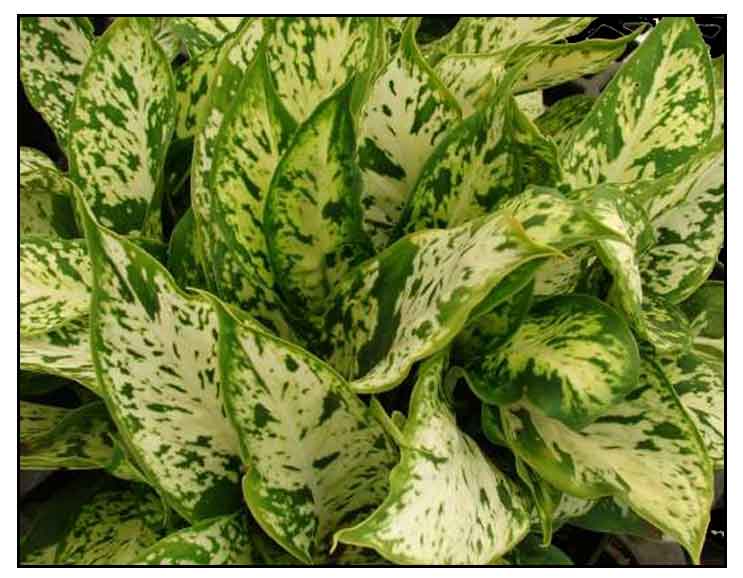
Dieffenbachia is a long-lived, evergreen, perennial herb growing to height of 1 to 1.5 meters. Stem is branchless, about 2.5 centimeters thick, cylindrical, tinged with leaf scars, and erect with the base usually reclining. Leaves concentrated towards the apical part of the stem, the stalk elongated, broadly grooved, the lower part forming a sheath around the stem. Leaves are 20 to 40 centimeters long, 10 to 20 centimeters wide, oblong to broadly lanced-shaped, dark to glossy green on both sides, with numerous white or yellowish spots or streaks, the base rounded to acute, the tip narrow. Flower cluster is white, erect, subtended and partly enclosed by a leaflike spathe. Flowers are stalkless, the males crowded on the upper part of the cluster, the females on the lower, the latter enclosed the spathe's tubular base. Fruits are berries, orange when ripe.
Distribution
- The most common cultivated Dieffenbachia species of the Philippines.
- Usually grown as a potted plant for its handsome foliage.
-
Native to Brazil.
- In some places in Nigeria, considered an invasive species, forming extensive mats and displaced native flora. (11)
Constituents
- Leaf oil yielded major constituents of pyrimidine-5-carboxylic acid, 4-(1,3-dimethyl-1H-pyrazol-4-yl)-6-methyl-2- thioxo-1,2,3,4-tetrahydro-methyl ester (5.814%), 5-methyl-2-phenylindolizine (2.957%), 1- (3-methylbutyl)-4-(4,4,5,5-tetramethyl-1,3,2-dioxaborolan-2-yl)-1H-Pyrazole (2.764%),
Dichotine, 19-hydroxy-11methoxytriacetate methylpiperazin-1-yl)benzo[1,2,5]diazol-1-oxide methoxycarbonyl-1H-2-benzopyran-3-one ethanediylbis[diphenylphosphine]-p-p']hydro[(1,2,3,4,5-β)-1-methyl-2,4-cyclopentadien-1- yl] Iron (2.067%) and 9,10-dihyro-9,10,11-trimethyl-9,10-methano anthracen-11-ol (1.011%).
Properties
- The common name dumb-cane derives from the acrid and poisonous juice numbs the tongue.
- Considered analgesic, aphrodisiac, caustic, contraceptive, cyanogenic, insecticidal, rodenticide, vesicant.
- Studies have suggested antimicrobial, antiproliferative, antioxidant, rodenticidal, amylase inhibitory properties.
Uses
Folkloric
- No reported folkloric medicinal use in the Philippines.
- In Brazil, reported use of leaf decoction as gargle for angina. Root tincture used for genital pruritus and gout. (7)
- Natives of the
West Indies and Carribean Islands chew D. seguine to bring about temporary male sterility which lasts 24-48 hours. (12)
- In French Guiana, stems use to treat ulcers of leishmaniasis. Used as ingredient in curare by the Amerindians. (15)
Others
- Poison: Used by West Indians as arrow poison. (11) Used by Brazilian Indians to sterilize enemies by administration in food or as arrow poison. (12) Diffenbachia poisoning has also been reported in chew-all dogs.
Toxicity / Concerns
• All plant parts are believed to contain lots of needle-shaped calcium oxalate crystals, which when chewed can cause painful swelling or blistering of the mouth. When the mouth swelling is severe, talking might be difficult or unintelligible, hence the name "Dumb Cane." The sap can also cause irritation of the eyes, of other unfortunately scratched body parts. In the past, the plants were also used as a means of torture. Plant juices/sap also reported to cause contact dermatitis.(5) (6)
• Toxic principles in Dieffenbachia have been attributed to an insoluble oxalate, calcium oxalate raphides (bundles of long slender needles), and to a proteolytic enzyme, "dumbain" (Walter, 1967). (11) (13)
• Wash hand thoroughly after cuttings or removing leaves.
Studies
• Toxicity: Toxicity results from brine shrimp lethality test showed a higher level of toxicity in the leaf than the stem essential oils.
• Antimicrobial: Essential oil exhibited appreciable antimicrobial activity against E. coli, S. aureus, B. subtilis, P. aeruginosa, K. pneumonia, S. typhii, Candida albicans, C. krusei, A. niger and Penicillum aotatum.
• Antioxidant: Tests using a DPPH assay showed the essential oils with higher activity than a-tocopherol. Results showed Dp with promising antioxidant activity as a free radical scavenger.
• Eugenol / Toxicity: When chewed, the juice from the leaves causes a painful edema of the oral mucous membrane, buccal ulcerations and tongue hypertrophy - severe enough to possibly cause glottis obstruction, respiratory compromise and death. Topical application of essential oil extracted from Caryophyllus aromaticus provides about 70% reduction of edema. (3)
• Antiproliferative / Leaves: Study evaluated alcoholic extracts of four Gabonese medicinal plants for antiproliferative activity against human colon cancer cell line (Ca-Co-2). While roots of P. africanum and leaves of P macrocarpus and stem of C. debilis showed strong antiproliferative activity, only the leaf extract of Dieffenbachia seguine exhibited weak antiproliferative activity with 50% inhibition concentration (IC50) higher than 50 µg/ml. (8)
• Amylase Inhibitors / Leaves: Study of leaves, petoles, and stems of Dieffenbachia maculata all showed amylase inhibitor activity, highest for the mid-section of stems; water was the best extractant. The inhibitor is of non-competitive type and active against human salivary amylase, porcine pancreatic α-amylase, Bacillus subtilis α-amylase and sweet potato ß-amylase. (9)
• Rodenticide / Stem: Study evaluated the ability of dumb cane stem extract in killing black rats. (Black rats are famous for its role in spreading the dreaded bubonic plague in the Middle Ages). Results showed rodenticide activity. The commercial rodenticide Raccumin took earlier effect compared to dumb cane stem extract. (10)
• Acute Oral Toxicity Study / Leaves:Study evaluated the toxicological effect of ethanol leaf extract of Dieffenbachia seguine. Single oral doses of 0, 4000, 6000, and 8000 mg/kbw were administered to albino rats. Results suggest an LD50 slightly higher than 8000 mg/kg. Histopathological exam of the liver showed distortion, congestion, and focal necrosis of the liver and renal tubules. Caution is advised in the use of this plant for ornamental purposes in homes. (14)
Availability
Ornamental cultivation.
|