Botany
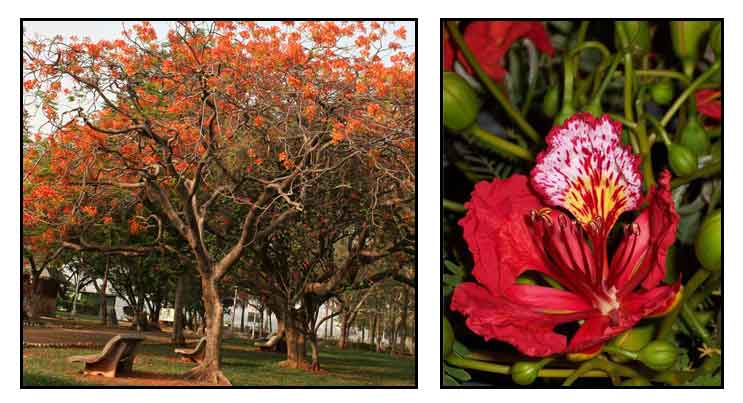
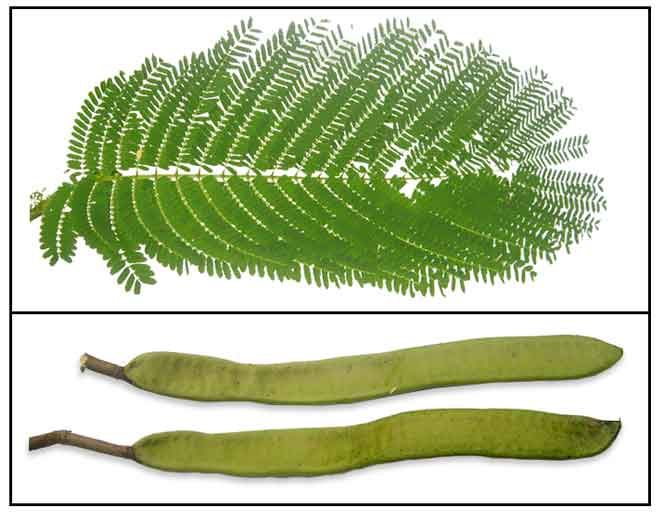
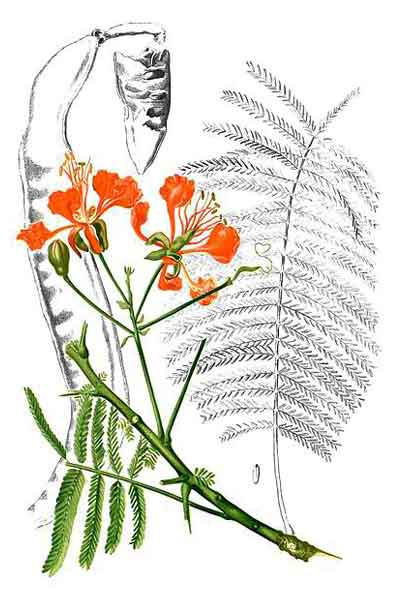
Delonix regia is a large, deciduous tree with fern-like leaves. Leaves are bipinnate, slightly hairy, about 30 centimeters long. Leaflets are oblong, in 18 to 30 pairs, about 1.5 centimeters long. Flowers are large, showy, red or red and yellow, up to 12 centimeters across. Fruit is green and flaccid when young, turning to dark, pendulous pods, elongate, woody, compressed, and up to 50 centimeters long, ending in a short beak upon maturity. Seed are olive brown or smooth, hard, glossy, oblong, shaped like date seeds, about 2 centimeters long.
Distribution
- Introduced to the Philippines during the early Spanish period.
- Planted along roadsides and gardens.
- Native to Madagascar.
- IUCN Red lits of Threatened Species: classified as "vulnerable"-1960.
 Constituents Constituents
- Phytochemical screening yielded sterols, triterpenoids, phenolic compounds, and flavonoids.
- Bark yields ß-sitosterol, saponins, alkaloids, carotene, hydrocarbons phytotoxins, and flavonoids.
- Flowers yielded carotenoides, tannins, saponins, flavonoids, steroids, alkaloids, and ß-sitosterol.
- Leaves yield lupeol and ß-sitosterol.
- Stem bark yielded four triterpenes: lupeol, epilupeol, ß-sitosterol, stigmasterol, and an aromatic compound p-methoxybenzaldehyde.
- Study isolated seven flavonoid glycosides: Kaempferol 3-rhamnoside 1, Quercetin 3-rhamnoside 2, Kaempferol 3-glucoide 3, Kaempferol 3-rutinoside 4, Kaempferol 3-neohesperidoside 5, Quercetin 3-rutinoside 6 and Quercetin 3-glucoside 7. (see study below) (11)
- A hydroalcoholic extract of flowers yielded sugars, flavonoid, tannins, phenolic compounds, steroids, and saponins.
(see study below) (12)
- Root bark extract yielded secondary metabolites like tannins, phenols, alkaloids, terpenoids, sterols, cardiac glycosides.
(see study below) (14)
- Study of water extracts characterized three major anthocyanins: cyanidin 3-O-glucoside, cyanidin 3-O-rutinoside, and pelargonidin 3-O-rutinoside. (19)
- Fractionation of 95% ethanolic extract of leaves isolated three sterols and its glucoside namely, stigmasten-diol-3-o-glucoside, 12,15-Dihydroxy-chol-8-en-24-oic-acid-3-oxy-6’-acetyl-glucoside and sodium, potassium adduct of 12,15- Dihydroxy-5-chol-9-en-24-oic-acid-3-oxy-rhamnosyl-rhamnoside, one flavonol, namely, kaempferol. (27)
- Chloroform extract of leaves yielded terpenoids, steroids, flavonoids, and tannins. (see study below) (35)
- Total concentration of fatty acids in the wood and bark were o.17% and 0.386%, respectively.
Major fatty acids in stem wood were myristic acid (10.77%), erucic acid (8.532%), tridecanoic acid (6.48%), 14-pentadecenooic acid (5.55%), tetradecanoic acid (4.98%), pentadecanoic acid (4.26%) and palmitic acid (4.26%). Major fatty acid constituents in bark were myristic acid (9.63%), palmitic acid (7.75%), tridecanoic acid (6.08%), erucic acid (5.93%), tetradecanoic acid (4.91%), 14-pentadecenooic acid (3.66%), and pentadecanoic acid (3.58%). (see study below) (38)
- Study of aqueous (W), petroleum ether (PE), chloroform (C) ethanol (E) and acetone A (A) extracts of flowers for secondary metabolites yielded phenolic compounds (W+++, PE+, C+, E+++, A+++), flavonoids (PE++, C+, A+), saponins (W+, PE+++, E++, A+++), glycosides (W+++, E++), terpenoids (W+++, PE+++, C+, E+++, A+++), steroids (W++, C+++, E+), coumarins (PE++, C+++, A+++), quinones (W++, PE+, E++), phytosterols (PE++, C++), proteins (PE++, C+++, E+), carbohydrates (W++, PE++, C+++, E+, A+).
(43)
- Study of seeds for proximate composition yielded: moisture 10.12%, crude fiber 14.60%,
fat 17.16%, ash 1.03%, crude protein 8.75%, carbohydrate48.34%. (Minerals in mg/100 g) potassium 9.10, magnesium 4.00, calcium 1.5, phosphorus 4.1, sodium 1604.0, iron 1144.0, zinc 920.0, manganese 286.0, copper 114.0; (Antinutrient, mg/g) tannin 1.28, oxalate 2.52, saponin 2.89. (see study below)
(45)
- Amino acid composition of seeds yielded essential amino acids (isoleucine, leucine, lysine, methionine, cystine, phenylalanine, tyrosine, threonine, valine) and non-essential amino acids ( glycine, alanine, serine, proline, aspartic acid, glutamic acid, histidine and arginine). (see study below)
(45)
Properties
- Antispasmodic, antirheumatic.
-
Studies suggest antimicrobial, antioxidant, hepatoprotective, anti-inflammatory, anti-diabetic, wound healing, diuretic, antidiarrheal, cytotoxic, antiulcer, anthelmintic, phytoremediative properties.
Parts used
Flowers, leaves, stem, bark.
 Uses Uses
Edibility
- Study has shown the seeds to be edible. It is a good source of oil, energy-rich, and can be used as protein supplement, but may pose cardiovascular risk because of high sodium-to-potassium ration. (see constituents above and study below) (45)
Folkloric
- No reported folkloric medicinal use in the Philippines.
- Elsewhere, traditionally used for constipation, arthritis, diabetes, earaches, constipation.
- In Bangladesh folk medicine, leaves used for the treatment of diabetes.
- The Shaiji community in southwestern Bangladesh drink decoction of flowers for treatment of chronic fever. In the Pirojpur district, leaves and fruits used to treat hemorrhoids and helminthiasis. Fruits eaten for piles and crushed leaves and fruits applied to boils. In Assam, plant used for wound healing: leaves are crushed and applied on wounds. In Tamil Nadu, India, leaves used to treat constipation, inflammation, arthritis, and hemiplegia. (40)
- In Madhya Pradesh, India, seeds used for pyorrhea; roasted and crushed leaves wrapped in cloth inhaled just aster a scorpion bite; infusion of flowers used for bronchitis, asthma and malarial fever. Leaves used for rheumatism and as purgative. Bark used for fever and ethanol extract of flowers used for treatment of round worms. In Andhra Pradesh, flowers used for the treatment of dysmenorrhea. (40)
Others
- Mucilage: Tree yields a gum in warty tears. Gum from seed used in textile and food industries. (41)
- Wood: Durable; used for small scale projects. Used for making agricultural tools, handles combs.
- Agrofrestry: Tree planted as live fence posts. (41)
- Crafts: Hard seeds used as beads for making necklaces..(41)
- Fuel: Wood and large pods used as fuel. Wood used for making charcoal. (41)
- Oil: Seeds yield 18 to 27.5% fatty oil--the pongam or karanga oil of commerce, used mainly in the tannin industry. The oil has insecticidal properties and also used in soap making, as illuminant, and for pharmaceutical preparations. (42)
Studies
• Antibacterial: Delonix regia was one of 12 medicinal plants studied for antibacterial activity. The methanol extracts showed more activity than the aqueous extracts for all 12 plants studied. The most susceptible bacterial were S. subtilis, followed by S. epidermis. (2)
• Anti-Inflammatory: Study evaluated the anti-inflammatory activity of leaves using a carrageenan-induced rat paw edema and cotton pellet granuloma models. Results showed significant anti-inflammatory activity in both models. (3)
• Flowers Constituents / Phenols and Flavonoids: Study was done to estimate the total phenolic and flavonoidal content of the flowers. Results showed the flowers to contain significant amounts of phenols and flavonoids, with the total phenolic content to be much higher than the flavonoidal content. (4)
• Hepatoprotective / Cytotoxic: Study of an ethanolic extract isolated three sterols (stigmasterol, ß-sitosterol, and its 3-O-gucoside), a triterpene (ursolic acid) and four flavonoids (quercetin, quercitrin, isoquercitrin, and rutin), plus an amino acid. Results showed cytotoxic activity against human liver cancer cell line (HEPG2). It also showed hepatoprotective activity against CCl4-induced hepatic damage, attributed to the free radical scavenging property of the flavonoids. (5)
• Antimicrobial: In antimicrobial screening, a dichloromethane soluble fraction of a methanolic extract showed strong inhibition of S. paratyphi growth, with moderate inhibition of S. typhi, S. aureus and S. dysenteriae. Other fractions showed inhibition of C. albicans, S. cerevisiae.
• Antidiarrheal: Evaluation of ethanolic extract of D. regia for in vivo anti-diarrheal activity in experimentally induced diarrhea, prostaglandin E2-induced enteropooling and charcoal-induced motility test in rats showed dose-dependent antidiarrheal properties. (7)
• Seed Mucilage / Tablet Binder: Seeds of plant contain glucomannose. Mucilage obtained from the seeds were used in the preparation of calcium carbonate tablets. Results showed the endospermic mucilage obtained from the seeds possesses comparable binding properties. (8)
• Wound Healing / Flowers: Study investigated the wound healing properties of Delonix regia in experimental models in albino rats using incision and excision wound models. Results showed ethanolic and aqueous extracts of flowers significant promoted the healing process, as evidenced by increase in wound breaking strength, percentage of wound contractions, increased hydroxyproline content and decreased epithelialisation period. (9)
• Antidiabetic / Leaves: Study evaluated a methanol extract of leaf for glucose tolerance efficacy in glucose-induced hyperglycemic mice. Results showed significant hypoglycemic effect on glucose-loaded mice at every dose. (10) Study evaluated the effect of gulmohar leaves extract on alloxan induced diabetic rat model. Results showed significant (p<0.001) reduction of blood glucose, with significant (p<0.001) reduction in total cholesterol and triglyceride levels. (28)
• Hepatoprotective / Anticancer / Antioxidant: On cytotoxicity testing, D. regia extract showed potent anticancer effect against HepG2 cell line. It also showed dose-dependent hepatoprotective and antioxidant activities attributed to the flavonoids content. (See constituents above) (11)
• Mercury Adsorption/ Anticancer / Antioxidant: Study evaluated the feasibility of using pods of Delonix regia activated carbon or the removal of Hg from water by absorption. Results showed a suitable indigenous active carbon as an adsorbent for the removal of Hg from aqueous solution. (12)
• In Vitro Cytotoxic Activity / Flowers / Cancer Cell Lines: Study for in vitro cytotoxic effects of the hydroalcoholic extract of D. regia flowers showed anticancer effects against different cell lines (MCF-7 [breast], carcinoma of cervix HeLa cells, carcinoma of the brain, and carcinoma of colon). (13)
• Antibacterial / Root Bark: A methanol extract of root bark of Delonix regia showed efficacy against all test bacteria (Gram negative E. coli, P. aeruginosa and Gram positive S. aureus, Strep pneumonia and B. subtilis). (see constituents above) (14)
• Antinociceptive / Cytotoxic / Leaves: Study investigated the antinociceptive and cytotoxic effects of alcoholic extract of leaves in Swiss albino rats. Results showed an analgesic effect which me be peripherally mediated via inhibition of synthesis and release of PGs and other endogenous substances. Results also showed cytotoxic activity by brine shrimp lethality assay. (16)
• Diuretic / Flowers: Study evaluated the diuretic activity of a methanol flower extract of Gulmohar in an albino rat model. Results showed significant diuretic activity, with increased urine volume and electrolyte excretion when compared to control. (17)
• Corrosion Inhibitor / Aluminum: Study evaluated the inhibitive effect of D. regia extracts in reducing the corrosion rate of aluminum in acidic medium. Results showed D. regia extracts inhibited the corrosion of aluminum in HCl solutions. (18)
• Methylene Blue Biosorbent: Dyestuffs are prominent organic pollutants that industry use and discharge into surface and subsurface water bodies. Study showed Delonix regia pod to be a very effective biosorbent in the removal of methylene blue dye from waste waters. (20)
• Removal of Copper, Cobalt and Lead / Flowers: Study evaluated the ability of Delonix regia flowers to remove Co, Cu, and Pb ions through biosorption. Study showed D. regia flower is a viable agricultural waste for the removal of Co, Cu and Pb ions. The main adsorption mechanism was possibly a chemisorption reaction. (21)
• Antibacterial / Leaves and Seeds: Study evaluated various extracts of leaf and seed of Delonix regia and A. aspera against five bacterial strains. The chloroform seed extract of D regia and ethanol seed extract of A aspera showed high inhibitory zone against E. coli than other bacterial strains. (22)
• Antibacterial / Leaf and Seeds: Synthetic chemicals—methyl orange, phenolphthalein, phenol red, etc.—used as internal indicators in acid-base titrations are hazardous chemicals. Study evaluated Delonix regia for use as a natural indicator. Results showed D. regia flower petal can be used as a natural indicator, neither harmful to the environment nor causing any health hazard, while also being economical, simple, pollution free and inert. (22)
• Larvicidal / Leaf and Seeds: A methanol extract of D. regia flowers were very effective against 3rd instar larvae of H. puera indicating a potential as bio-pesticide. (24)
• Anthelmintic / Flowers: Fresh methanol and aqueous extracts of flowers of Delonix regia showed considerable anthelmintic activity against Pheretima posthuma. The methanol extract was more active. Piperazine citrate was used as reference drug. (25)
• Anti-Ulcer / Flowers: Study evaluated the anti-ulcer activity of various doses of an ethanolic extract of Delonix regia in an ethanol induced ulcer model in rats with lansoprazole as standard drug. Results showed significant antiulcer activity in a dose dependent manner attributed to antioxidant principles present in the plant. (26) Study evaluated the in-vitro anthelmintic potency of aqueous and methanolic extracts of flowers of Delonix regia and Caesalpinia pulcherrima against pheretima posthuma. Both demonstrated anthelmintic activity. The methanolic extract of DR took less time to cause paralysis of the earthworm than the aqueous extract. (36)
• Antibacterial / Flowers: Study of methanolic extracts of flowers showed antibacterial activity: C. pulcherrima > P. ferrugineum > D. regia. The flower extracts were more effective against gram positive bacteria than gram negative bacteria. (29)
• Hepatoprotective / Aerial Parts: Study evaluated a methanol extract of aerial parts against CCl4 induced liver damage in Wistar albino rats. Hepatoprotective activity was evidenced by reduction in serum enzymes AST, ALT, ALP, DBIL and TBIL. (30)
• Palladium Nanoparticles / Leaves: Study reports on the biosynthesis of palladium nanoparticles (Pd-NPs) using D. regia leaf extract. The Pd-NPs showed catalytic activity through electron relay effect. (31)
• Antiemetic / Leaves: Study evaluated the antiemetic activity of methanol extracts of five leguminous plant leaves, viz., C. siamea, C. tetragonoloba, D. regia, S. saman and V. trilobata on emesis induced in male chicks by oral administration of copper sulphate. All extracts showed antiemetic activity. Delonix regia showed the highest activity (96.74%). Chlorpromazine was used a standard drug. (32)
• Antibacterial: Study evaluated the antimicrobial activity of various extracts of whole plant and root bark of D. regia against different pathogenic strains of bacteria and fungi. Among all extracts, the methanol extract of whole plant (seeds, leaves, and stems) showed significant inhibitory activity against S. aureus (91.84%), P. aeruginosa (91.05%), B. pumilus (85.75%) and E. coli (78.71%). (33)
• Cardioprotective /
Leaves: Study evaluated the cardioprotective effect of Delonix regia leaf extract. Results showed reduction in mortality rate in an isoproterenol (SO)-induced heart injury and hypertrophy mouse model. Study showed decreased serum levels of CPK, LDH, GOT, TNF-alpha and increased NO level in DRLE-treated ISO-injured mice. In in-vitro study, porcine coronary artery showed a vasodilation effect induced by DRLE in a dose-dependent manner. Cardioprotective effect was attributed through activation of vasodilation through the NO pathway and prevention of myocyte injury via inhibition of TNF-alpha pathway. (34)
• Antioxidant / Leaves: Study evaluated the phytochemicals and antioxidant activity of chloroform extract of Delonix regia leaves. Antioxidant activity with DPPH was higher than H2O2 and reducing power assays. (see constituents above) (35)
• Antimalarial / Plasmodium berghei / Synergism with Papaya: Study evaluated the antiplasmodial activities of bark extract of D. regia and leaf extract of Carica papaya, alone and in combination. The leaf extracts showed drastically increased inhibition in combination with 1:1 ration. Each single dose of DR and CP showed highest inhibition rat of 4.80 and 25.5 mg/g, respectively. (37)
• Antibacterial / Antifungal / Antioxidant / Stem Wood and Bark: Methanol:chloroform (1:1 v/v) wood extract showed effective antibacterial activity against B. subtilis, S. lutea, and S. aureus while the bark extract was most active against E. coli. Bark extract showed maximum inhibition of mycelial growth against P. selorotigenum and P. variotii while the essential oil showed moderate inhibition against Aspergillus nigra. Total antioxidant activity of EO, stem wood and stem bark was 84.34%, 80.33%, and 70.21%, respectively. (38)
• Antidiabetic / Metformin and Extract: Study evaluated the activities of metformin, pioglitaone, and aqueous extract of D. regia on serum levels of glycated hemoglobin of STZ-induced diabetic male and female wistar albino rats. Treatment with aqueous extract of D. regia reduced glucose level from 8.20 ± 0.81 mmol/l to 6.10 0.60. The combined formulation of metformin and extract decreased glycated hemoglobin from 7.81 ± 0.34 to 4.80 ± 0.17 with p<0.05 confidence level when compared with diabetic control rats. (39)
• Analgesic / Antimicrobial / Leaves: Study of ethanolic extract of leaves of Delonix elata and Delonix regia showed good antimicrobial activity (40 mg/10 ml) and analgesic activity at dose of 200 mg/kbw. The ethanolic extract of plants showed mild to moderate antimicrobial activity against E. coli, S. aureus, P vulgaris, P. aeruginosa and Aspergillus niger, with streptomycin and nystatin as standard drugs. Analgesic activity was carried out using tail flick method. (44)
• Edibility of Seed and Seed Oil: Delonia regia leaves, roots, and seeds have been extensively used for the treatment of many ailments but only the immature seeds have been found edible. The mature seeds are reportedly toxic due to antinutrient contents. This study investigated the proximate, amino acid, and vitamin composition of mature seeds and characterized the seed oil for fatty acids, acylglycerols. Study concludes the seeds are a good source of oil, energy-rich, good for consumption and can be used as protein supplement but may pose cardiovascular risk because of its hight sodium-to-potassium ration. The seed oil contains essential fatty acids, acylglycerols and viramins needed for nutrition and production of soaps, shampoos, and as biodiesel feedstock. (see constituents above (45)
• Effect on Liver Enzyme Markers and Electrolytes / Alloxan-Induced Diabetic Rats: Study evaluated the effect of seed extract of D. regia on some liver enzyme markers and electrolytes in alloxan-induced diabetic albino rats. Results showed crude seed extracts significantly (p<0.05) improved the levels of electrolytes in diabetic treated rats and significantly lowered the activities of AST, ALY, and ALP in diabetic rats when compared to control. (46)
• Carboxymethylated Seed Gum: Hydrocolloids or gum are widely used in the food industry as emulsifying, stabilizing, thickening, gelling and film-forming agents. Study searched for new species of gums and hydrocolloids that can compete with those in traditional use, such as flamboyant (Delonix regia) seed gum, an ornamental and underutilized species. Flamboyant tree seeds yielded a native gum (flamboyant gum which was modified by carboxymethylation. Results suggest a product with gum functionality with versatile potential for use in the food industry. (47)
• Removal of Toxic =Pb (II) Ions / Pod: Study evaluated the removal of toxic heavy metal PB2+ ions from aqueous solution by agricultural biosorbents using nano sized Delonix regia. Results showed D. regia is an available agricultural, low cost and environment friendly and effective biosorbent for removing PB2++ ions. (48)
Availability
Wildcrafted. |






_in_Hyderabad_W_IMG_8167.jpg)