Botany
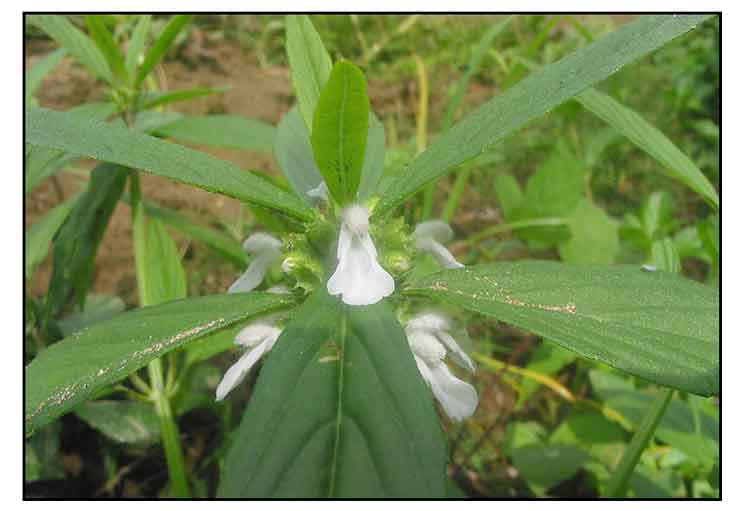
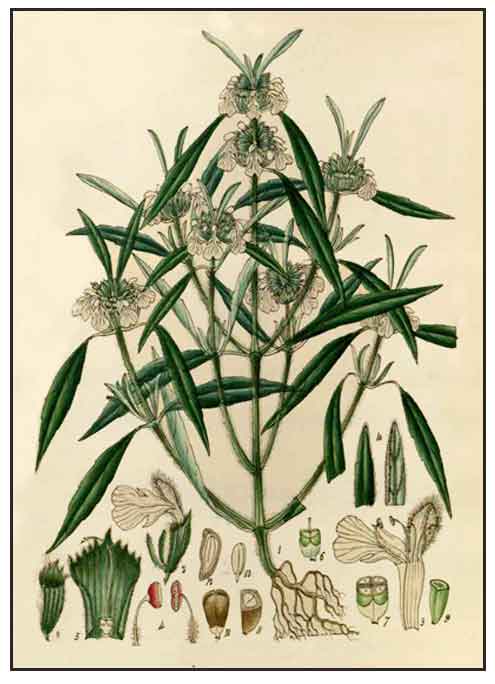
Guma-guma is an erect, annual, hairy herb growing to a height of 30 to 90 centimeters. Leaves are linear or elliptic-lanceolate, 5 to 7.5 centimeters long, blunt at the tip, and toothed at the margins. Whorls of many flowers are 1 to 1.5 centimeters in diameter. Calyx is 5 to 7 millimeters long, and obliquely turbinate, with minute teeth, erect or spreading horizontally. Fruits are four-seeded.
 Distribution Distribution
- I n open grasslands at low altitudes in Nueva Viscaya and Bataan Provinces in Luzon; and in Panay and Mindanao (Lanao and Davao).
- Also occurs In tropical Asia to Malaya.
Constituents
- On distillation, yields a small amount of essential oil.
- Decoction of herb boiled with soda solution emits a strong odor; when condensed, the vapor yields ammonia and a volatile alkaloid in the distillate.
- Methanolic extract of aerial parts yielded alkaloids, steroids, tannins flavonoids, and glycosides.
(9)
- Study of essential oil from the seed of Leucas zeylanica yielded 56 components. The major components of were oleic acid(12.57%), hexadecanoic acid(10.36%),1-octene-3-ol(7.96%), caryophyllene(5.98%), 2,4,6-trimethyl-1,3,6-heptatriene(5.63%), etc. (see study below) (4)
- Phytochemical screening of dried powder of leaves yielded alkaloids, flavonoids, glycosides, steroids, carbohydrates, tannins and phenolic compounds,
with absence of proteins and amino acids. (17)
- Essential oils from aerial parts, leaves, and stems yields were 0.015%, 0.012%, 9.027% and 0.008%. Major components EO aerial parts were sesquiterpenoids, ß- caryophyllene, α-humulene, germacrene D, ß-selinene, and caryophyllene oxide, as along with 1-tetradecanol and phytol. Stem EO was rich in tetradecanol, palmitic acid, and alkanes. (see study below) (20)
- Study of whole plant for phytoconstituents
isolated a new norditerpenoid isomer (1), along with 29 known compounds, including one norditerpenoid (2), three flavonoid glycosides (3-5), six flavonoids (6-11), two phytosterols (12-13), two phenylpropanoids (14, 19), two phthalate esters (15, 16), two phenolic compounds (17, 18), five terpenoids (20-24), one aliphatic glycoside (25), one nucleobase (26), one amino acid (27). (21)
- Study of methanolic extract of aerial parts yielded alkaloids, steroids, tannins, flavonoids, and glyclosides. (22)
Properties
- Considered a stimulant and antirheumatic.
- Pharmacognostic study of methanolic extract of aerial parts yielded deep green color, characteristic odor and mucilaginous and slightly bitter taste.
(9)
- Studies have shown antibacterial, antioxidant, mosquito repellent, antifungal, photoprotective, analgesic, cytotoxic, CNS depressant properties.
Parts used
Leaves, flowers, roots.
Uses
Culinary
- Herb has a bitter taste; used as flavoring or pot herb.
- In Bali, sometimes used as flavoring.
Folkloric
- Used for coughs, toothaches and abdominal pains.
- In China, used for coughs.
- In China and Malaya, poultice of leaves used for wounds and sores.
- Poultice of leaves also used for itches, headaches and vertigo.
- In Reunion, used as stimulant and antirheumatic.
-
A decoction of leaves and Nigella seed or the fresh juice of tumeric and rice, used for ulceration.
- Juice of leaves used for headaches and colds.
- In Ceylon, plant used for mild fevers associated with indigestion; also, for pain caused by intestinal worms.
- Leaves used for itches.
- Bitter roots and bitter and pungent leaves used for skin diseases and for scabies.
- Infusion used as insecticide.
- In Malaysia, leaves taken as sedative and for wound healing. Entire plant rubbed on the abdomen after child-birth. Leaves used as anthelmintic.
- In India, used for fever, scorpion and snake bites. Leaves and flowers used for jaundice. Leaves applied topically for wound healing; as poultice to treat itches, headaches, vertigo, scabies. Sap of leaves used for sores of the eyes and nostrils. (17)
- In Sri Lanka, a principle vermifuge ingredient. Used for anorexia, flatulence, colic; in mixture, used to treat malaria. (11)
- In Thailand, leaves, roots, and flowers are used for weaning: the plant parts are crushed and smeared on the nipple. (10) Poultice of leaves used for wound healing and to stop bleeding. (12)
Studies
• Antibacterial / Photoactivity: In a study of 32 plants species collected from serpentine (ultramatic) soils in Sri Lanka and screened for antimicrobial properties, L. zeylanica showed photo-mediated activity against S. aureus and B. subtilis. L. zeylanica showed population-level variation in photoactivity. Study suggests plants from serpentine environments may have altered antimicrobial activities compared to non-serpentine environments, and that attention is needed in deciding on the substrate and habitat when collecting plants to test for antimicrobial properties. (3)
• Essential Oil / Antioxidant / Antibacterial: Study of essential oil showed the major components were: oleic acid, hexadecanoic acid, 1-octenen-3-oil, caryophyllene, etc. The essential oil showed scavenging antioxidant activity. Antibacterial activity showed inhibition of test bacterial growth, especially E coli and Salmonella enteritidis. (4)
• Protection Against Ethanol and H2O2-induced Hepatic Oxidative Stress: Study of Leucas zeylanica showed protection against oxidative stress on hepatic tissue induced by exposure to ethanol and Fenton's reagent. Results were attributed to the presence of antioxidant phytochemicals, including polyphenols and flavonoids. (6)
• Essential Oil / Anthelmintic: Study evaluated the efficacy of L. zeylanica on Enterobius vermicularis infections by use of a whole plant decoction taken twice daily for seven days. Results showed L. zeylanica is a highly effective treatment for E. vermicularis infections in adults. (7)
• Antifungal / Leaves: Study evaluated the antifungal susceptibility of clinically isolated dermatophytes to methanol extracts of L. aspera and L. zeylanica leaves. Results showed remarkable antidermatophytic activity with zones of inhibition ranging from 5 to 10mm, with maximum inhibition on Penicillium sp and minimum inhibition for Candida tropicalis. (13)
• Photoprotective Potential: Study evaluated the aqueous extracts of eleven medicinal plants in Sri Lanka for photoprotective activity by determining the UV filtering potential. Extracts showed high antioxidant activity by DPPH and ABTS assays. Leucas zeylanica was one of six plants that displayed SPF value ≥ 25, which is higher than two commercial photoprotective creams. L. zeylanica and O. mungos exhibited high UV absorbance in 260-350 nm range suggesting potential in being broad spectrum sunscreens. (14)
• Antioxidant / Analgesic / Cytotoxic / CNS Depression: Study of an ethanolic extract of Leucas zeylanica showed dose-dependent CNS depressant activity by hole cross test, analgesic effect by acetic-acid induced writhing and formalin-induced paw licking and biting tests, cytotoxic effect with potent toxicity to Artemia salina (LC50 11.063 µg/ml) in Brine shrimp lethality assay, and concentration-dependent antioxidant effect. by DPPH assay (15)
• Anti-Inflammatory / Anti-Gout / Antimicrobial: Study evaluated the anti-inflammatory, antimicrobial, and anti-gout effects of various extracts of L. zeylanica. A dichlormethane extract efficienty inhibited 5-LO activity in stimulated human neutrophils (IC50=5.5µg/mL) and isolated human 5-LO and mPGES-1 (IC50=2.2 and 0.4 µg/mL). The same extract showed potent inhibition of XO with IC50 of 47.5 µg/mL. The extract also exhibited significant radical scavenging activity, Only the hexane extract exhibited antibacterial activity against Staphylococcus aureus and S. saprophyticus, with moderate anti-Candidal activity. GC-MS analysis revealed phytosterols, fatty acids, sesquiterpenes, diterpenes and several other types of secondary metabolites. The potent inhibition of 5-LO, mPGES-1 and XO supports the ethnopharmacological use of the plant as an anti-inflammatory and anti-gout remedy. (16)
• Elimination of 'S. aureus and E coli in "Etak" tissue: "Etak" or Corbicula fluminea is a freshwater mollusc species popularly consumed as a snack by the Kelantanese in Malaysia. Studies have showed that smoked and consumed half-cooked (etak-salai) ,may be contaminated with S. aureus and E. coli Study evaluated the antibacterial properties of L. zeylanica leaves and results suggest that L. zeylanica can be used as ingredient in the paste for "etak salai" preparation. (18)
• Analgesic / Antioxidant / Whole Plant: Study evaluated methanolic crude extracts and petroleum ether, chloroform, and ethyl acetate soluble fractions pf whole plant for possible analgesic. antioxidant, and antimicrobial activities using acetic acid-induced writhing and radiant heat tail-flick tests in mice, DPPH free radical scavenging and disk diffusion method, respectively. MCEs showed highest peripheral analgesic activity. All extracts and fractions showed significant decrease in tail-flicking time, with the methanolic extract showing highest activity. The ME also showed highest antioxidant potential. The whole plant showed weak antimicrobial activity. (19)
• Mosquito Larvicidal / Essential Oil: Study evaluated the essential oil of Leucas zeylanica for larvicidal activity against the Aedes mosquito vector. L. zeylanica essential oil showed good larvicidal activity against both Ae. albopictus and Ae. aegypti with median lethal concentration, LC50 values in 24 hours of 67 and 44 µg/mL, respectively. Results suggest potential for an inexpensive and environmentally benign agent for control of dengue virus vectors. (see constituents above) (20)
• Anthelmintic / Leaves: Study evaluated the anthelmintic activity of L. zeylanica leaves against Indian earthworm Pheretima posthuma. Ethanolic and acetone extracts of powdered leaves yielded carbohydrates, alkaloids, phenols, tannins flavonoids, steroids, and glycosides. Acetone and ethanolic extracts showed dose-dependent activity as evidenced by paralysis followed by death of earthworms. The ethanolic extract was more potent than the acetone extract. (23)
Availability
Wild-crafted.
|