 Gen info Gen info
- Lepisanthes is a genus of 24 or 25 species of trees or shrubs native to tropical Africa, South and South East Asia, Australia, and Madagascar. It includes species formerly classified in the genera Aphania, Erioglossum, and Otophora.
- Etymology: The genus name Lepisanthes derives from Greek words "lepis" meaning scaly and "anthos" meaning flower.
Species epithet 'rubiginosa' means 'red-brown.
Botany
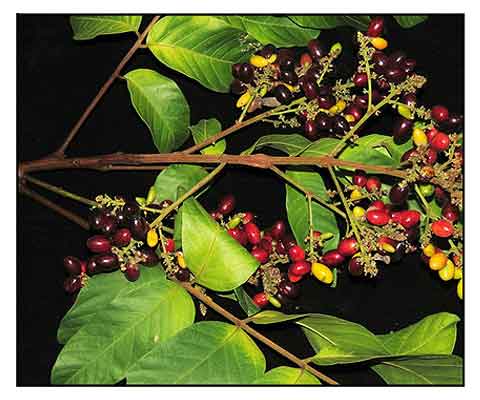
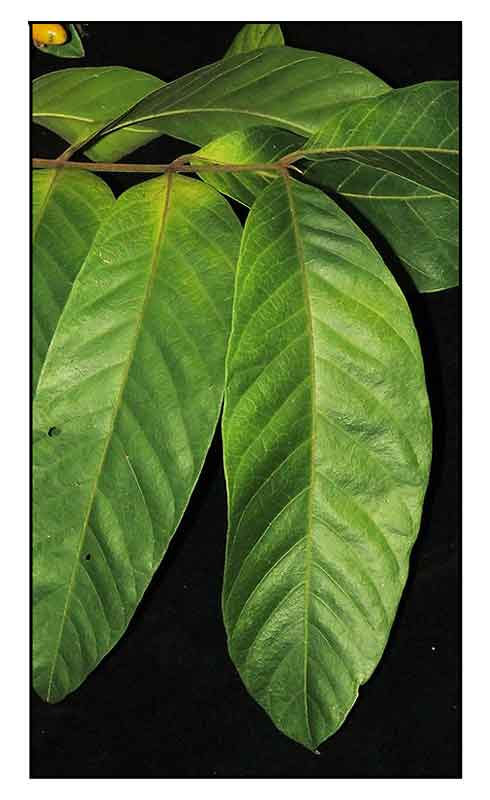
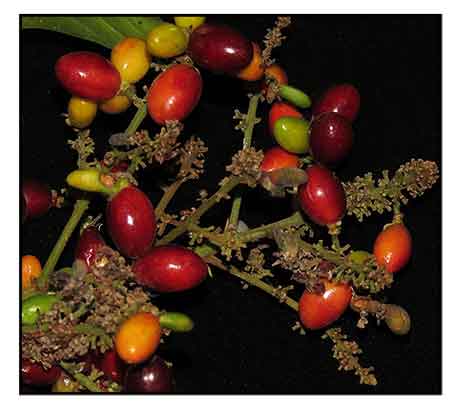
Kalayo is a shrub or small tree, with a compact, bushy crown. All parts are covered with hairs. Leaves are pinnate, 15 to 50 centimeters long, with 4 to 6 pairs of leaflets. Leaflets are narrowly elliptic, 7.5 to 18 centimeters long, 3 to 7 centimeters wide, and blunt on both ends. Flowers are very fragrant, white, about 5 millimeters wide, and arranged in small groups in upright panicles 12 to 30 centimeters long. Fruit is ovoid, in clusters, about 1 centimeter long and covered with fine hairs; in ripening it turns successfully yellow, orange, purple, and nearly black, and when ripe, with a thin, juicy, sweetish and slightly astringent pulp.
Distribution
- Native to the Philippines.
-
Common in forests at low and medium altitudes throughout the Philippines.
- Also native to Andaman Is., Assam, Australia, Bangladesh, Borneo, Cambodia, China, Himalaya, Hainan, India, Jawa, Laos, Lesser Sunda Is, Malaya, Maluku, Myanmar, Nepal, New Guinea, Nicobar Is., Sulawesi, Sumatera, Thailand, Vietnam. (1)
 Constituents Constituents
- Study analyzed the essential oil from flowers and fruits. Major components of flower essential oil were nerolidol (34.8%), palmitic acid (13.2%), and farnesol (10.0%). Fruit essential oil yielded palmitic acid (66.1%), myristic acid (10.0%), and linolenic acid (5.5%). (See study below) (4)
- Methanolic fraction isolated a tetrasaccharide derivative of farnesol named rubiginoside along with known triterpenoid saponins. (5)
- Study of methanol extract of barks
yielded alkaloids, flavonoids, phenols, saponins, and carbohydrates. Physiochemical evaluation showed moisture content of 8.07%, total ash value 18.00%, acid soluble ash value 21.00%, water soluble ash value 9.50^, alcohol soluble extractive value 1.00%, and water soluble extractive value of 0.50%. (see study below) (10)
- Study of ethanol extract of leaves isolated two new glycosides, lepisantheside A (1) and lepisantheside B (2), along with two known compounds acutoside A (3) and 3-O-[ß-D-xylopyranosyl-{1->3)-ß-D-glucopyranosyl-]-oleanolic acid (4), (see study above) (13)
- Study of ethyl acetate extract of plant yielded five compounds viz. lupeol, diosmetin, heptadecanoic acid, ß-sitosterol, and ß-
sitosterol-3-O-ß-D-glucopyranoside. (14)
- Study of methanolic extract of L. rubiginosa stem bark isolated three new triterpenoid saponins, lepiginosides A-C (1-2), a new farnesyl glycoside, lepiginoside D (4), together with lepisantheside B (5) and gleditsoside C (6).
(18)
- GC-FID and GC-MS studies of Lepisanthes rubiginosa leaves for essential oil identified 24 components, representing 99.5% of essential oil. Major compounds included α-cadinol (40%), safrole (12.6%), α-amorphene (9.5%), (E)-isosafrole (5.0%), δ-cadinene (4.2%), and t-muurolol (4.1%). (see study below) (16)
- Study compared the essential oils from flowers and fruits of L. rubiginosa by capillary GC and GC-MS. Major components of flower EO were nerolidol (34.8%), palmitic acid (13.2%), and farnesol (10.00%). Fruit EO yielded palmitic acid (66.1%), myristic acid (10.0%), and linoleic acid (5.5%) as major constituents. (see study below) (19)
Properties
- Roots are astringent.
- Roots and leaves considered febrifugal.
- Studies suggest anti-inflammatory, membrane stabilizing, antioxidant, anticancer, antimicrobial, CNS depressant, anti-acetylcholinesterase inhibitory properties.
Parts used
Roots, leaves and seeds.
 Uses Uses
Edibility
- Fruit is edible, with a sweet slightly astringent pulp; for some, not a pleasant edibility.
- In Java, shoots and leaves eaten as vegetable.
Folkloric
- Decoction of roots, leaves, fruits and seeds used for fevers.
- Malays apply a poultice of leaves and roots to the head during a fever and to the body for skin problems.
- In the Dutch Indies, leaves are used for poulticing.
- In Indonesia, young stems eaten to induce sleeping.
- Leaves eaten to cure insomnia.
- In Bangladesh, leaf juice taken for fever.
-
In India, plant used for treatment of leprosy. (7)
- Decoction of seeds used for whooping cough.
- Used by the Nicobarese for abortion, contraception, and anti-fecundation.
(15)
- In Indonesia, pounded young leaves mixed with water used as liniment to reduce fatigue. Chewed leaves applied for peeled skin. (17)
- Used by loocal people in Terengganu for treatment of bone fracture and muscle sprain.
(20)
- Leaf juice used for treatment of flatulence. Pills made from leaves used to treat constipation. Leaf juice used to treat epilepsy. Paste of leaves applied to lipomatous tumors. Decoction of roots and leaves used for fever. Seed decoction used for whooping cough. Leaf extract used in hot baths to treat skin diseases. (21)
Others
- Wood: In some places considered a valuable timber; in other places, used as fuel and for making tool handles and rice pounders.
- Superstition / Latex: In East Java, plant believed to produce "fossil latex" with magical ability to attract attention of others, even increase fishing catch; or used as a charm taliman. (17)
Studies
• Anti-Inflammatory / Membrane Stabilization: Study evaluated a methanol extract of Erioglossum rubiginosum in experimentally induced inflammation in a human red blood cell (HRBC) membrane stabilization method. Results showed significantly inhibited hypotonic solution induced lysis of human RBC membrane. The membrane stabilizing action and inhibition of erythrocyte lysis may be the possible mechanism of anti-inflammatory action. (3)
• Essential Oil of Fruits and Flowers / Antioxidant / Anticancer / Antimicrobial: Study analyzed Erioglossum rubiginosum fruits and flowers for essential oil. (See constituents above). In a study for anticancer activity against three human cancer cell lines, only the flower essential oil showed anticancer activity against NCI-H187 (small cell lung cancer). Flower essential oil also showed antioxidant activity. Both flower and fruit essential oils showed strong antimicrobial activity against Tricophyton mentagrophytes and moderate activity against E. coli, S. aureus, Pseudomonas aeruginosa and Candida albicans. (4)
• CNS Depressant Effect / Fruit: Study of an aqueous extract of pericarp of fruits at intraperitoneal doses significant reduced spontaneous locomotor activity, increased thiopental-induced sleeping time and affinity toward dopaminergic receptors, inhibited apomorphine-induced climbing behavior in mice, and exhibited affinity toward D2 receptors, suggesting dopamine D2 antagonism. (8)
• Antimicrobial / Low Cytotoxicity / Bark: Study of methanol extract of bark showed significant antibacterial activity against gram-positive Staphylococcus aureus, gram-negative Salmonella typhi and Shigella dysenteriae and mild antifungal activity against Aspergillus niger and Candida albicans. Cytotoxicity evaluation by brine shrimp lethality bioassay showed very low cytotoxic property with LC50 value of 29.47 µg/ml compared to vincristine sulfate standard (0.451 µg/ml). (see constituents above) (10)
• Acetylcholinesterase Inhibitory Activity / Fruits: In a study of six aqueous fruit extracts from 19 analyzed fruits for potential acetylcholinesterase inhibitors, A. sapota showed the highest AChE inhibitory activity (IC50 1.17 mg/ml) followed by L. rubiginosa, F. elephantum, T. bispinosa, Z. jujuba and P. peruviana. (11)
• Antioxidant / Analgesic / Antihyperglycemic / Neuropharmacological / Antidiarrheal / Leaves: Study evaluated ethanolic extract of leaves for antioxidant, analgesic, antihyperglycemic, neuropharmacological and antidiarrheal properties in mice. TLC analysis showed the presence of antioxidant compounds with IC50 of 31.62 µg/mL, compared to ascorbic acid with 12.02 µg/mL. In acetic acid and induced writhing, the extract showed 46.07% and 58.43% writhing inhibition. The extract showed significant (p<0.05) antihyperglycemic activity. In neuropharmacological evaluation, the animals showed a noticeable decrease in locomotion as evidenced by decrease in number of squared crossed and head dipping Extract showed 57.89% and 77.19% inhibition of defecation with doses of 250 and 500 mg/kg. compared to loperamide (3 mg/kg) 88.59% inhibition. (12)
• Cytotoxicity / Anticancer / Leaves: Study of leaves isolat4d two new glycosides along with two known compounds. Their cytotoxicity was tested against four human cancer cell lines: KB, HepG2, SK-LU-1, and MCF7. Compound 4 exhibited significant activity with IC50s of 9.57, 6.66, 6.97, and 18.32 µM, respectively. , compared with positive control ellipticine. (13)
• Anticholinesterase Activity / Essential Oil: Study evaluated the chemical composition and anticholinesterase inhibitory activity of essential oil from Lepisanthes rubiginosa leaves. GC-FID and GC-MS studies identified 24 components, representing 99.5% of essential oil. Using Ellman method, essential oil demonstrated moderate inhibitory activity against acetycholinesterase (75.2%) and butylcholinesterase (70.2%) at concentration of 1000 µg/mL. (see constituents above) (16)
• Anticancer / Antioxidant / Antimicrobial / Essential Oil of Flowers and Fruits: Study compared the essential oils from flowers and fruits of L. rubiginosa by capillary GC and GC-MS. The flower EO showed anticancer activity against NCI-H187 Small cell lung cancer with IC50 of 43.90 µg/mL. The flower EO also showed antioxidant activity (ABTS) with 25.4% inhibition. Both flower and fruit EO showed strong antimicrobial activity against Trichophyton mentagrophytes and moderate activity against
Escherichia coli, Staphylococcus aureus, Pseudomonas aeruginosa and Candida albicans.
see constituents above) (19)
• Anti-Inflammatory / Bark: Study evaluated L. rubiginosa bark for anti-inflammatory activity. Macrophage RAW 264.7 was induced with lipopolysaccharide. Inhibition of myeloperoxidase (MPO) activity indicated the presence of anti-inflammatory properties. At 20 µg/mL the methanol extract of bark decreased MPO concentration by 51.9%, which will lead to inhibition of neutrophil infiltration. (20)
Availability
Wild-crafted. |