Gen
info
• There are 40 species
of the genus Lantana.
• Some are extremely unpleasant and toxic to livestock, as is
L. camara.
• In some countries, considered an invasive weed, earning the
name, "Jekyll and Hyde of plants." It releases chemicals in
its surroundings, preventing germination of the native flora. It is
wont to form dense thickets, spreads very quickly, with one plant producing
as many as 12,000 seeds a year.
• In India, it has invaded 13.2 million hectares of pasture lands besides forest and fallow land. It dose not invade intact forests, but encroaches where intact forests have been disturbed by logging or fires creating gaps. (51)
• Butterflies are the most frequent pollinators of Lantana camara, as they constitute 62% of total visitors. Flowers are adapted to butterfly pollination (psychophilous flowers), open throughout the day, with shorter tubes or spurs that provide a landing platform for the butterflies. Much less frequent pollinators are bees, wasps, moths, and other insect groups. (51)
• Fruit dispersal is mainly through
fruigivorous birds, often the Mynah bird; and also by . goats, sheep, cattle, monkeys, fox, and rodents.
• The common name
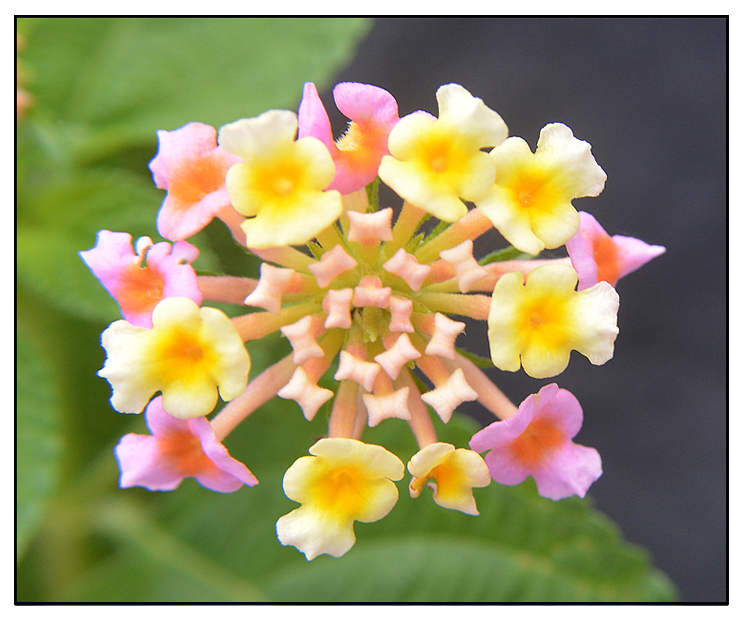
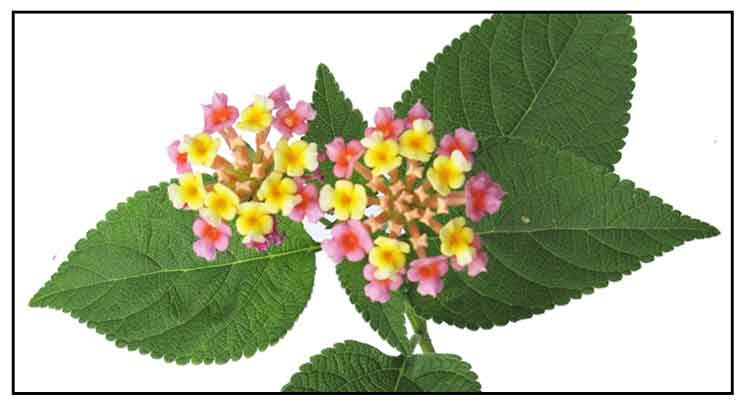
"Ham and Eggs"" refers to the adjacent pink and yellow inflorescences.
Botany
·
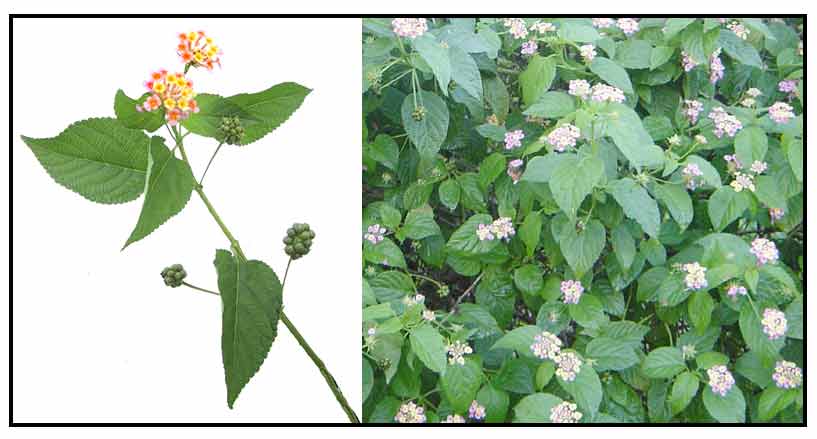
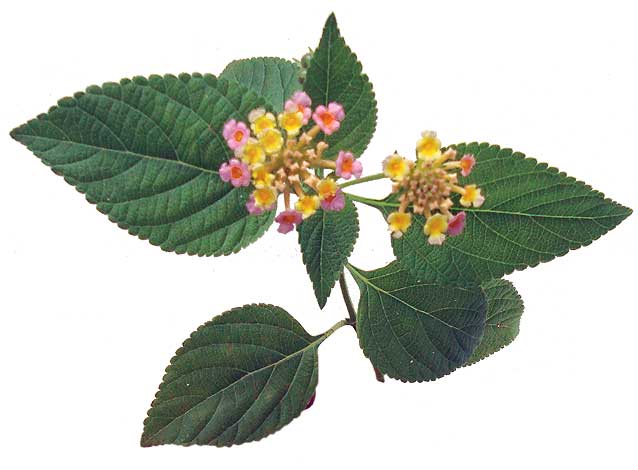
Lantana is a gregarious, erect or half-climbing, somewhat hairy aromatic shrub;
when erect, usually 1 to 2 meters high and when scandent, twice as high. Branches
four-sided with recurved prickles. Leaves are elliptic, 5 to 9 centimeters long,3 inches long, pointed at the tip and rounded at the base and toothed in the margins.
Flowers are pink, orange, yellow, white, lilac and other shades,
according to the variety and borne in stalked heads which are 2 to 3.5
centimeters in diameter. Calyx small. Corolla-tube is slender; the limb spreading,
6 to 7 millimeters wide, and divided into unequal lobes. Stamens 4, in 2 pairs. Ovary is 2-celled, 2-ovuled. Fruit is drupaceous, sweet tasting, purple or black, fleshy
ovoid, and about 5 millimeters long.
Distribution
- A gregarious weed in the
Philippines, in settled areas in thickets and waste places at low and medium altitudes.
-
Certain varieties are cultivated as a trimmed hedge either
alone or with other shrubs.
- Native of tropical America.
- Now pantropic in distribution.
Constituents
· Leaves yield a volatile
oil, 0.22%, called Lantanol, together with 80% caryophyllene-like bicyclic terpene, and 10-12 % of l-d-phellandrene.
· Dried flowers yield volatile oil, 0.07%.
· Bark: Lantanine, 0.08%.
· U.S.A. dispensatory reports an allied species, Lantana brasiliensis, containing a quinine-like alkaloid, lantanine, with an antispasmodic effect.
· Toxicity
is due to presence of toxic triterpenoids - the lantadenes (lantadene
A, B, C, D and icterogenin.)
·
Leaves contain a steroid, lancamarone, which is a fish poison and considered
a cardiotonic.
· Bark of stems
and roots contain a quinine-like alkaloid, lantanin, which is antipyretic
and antispasmodic.·
· Roots
are rich in oleanolic acid, a hepatoprotective triterpenoid.
· Phytochemical analysis detected common secondary metabolites–alkaloids,
phenolics, terpenoids and other minor compounds such as phytosterols,
saponins, tannins, phycobatannin and steroids (no steroids in the yellow
and lavender leaf extracts).
· Phytochemical screening of various extracts of L. aculeata roots yielded triterpenoids, phenolics, flavonoids, glycosides, anthraquinone, and tannins. (19)
· Study of leaves for essential oil yielded chemical compo 30 constituents, mostly mono and sesquiterpenes were identified. Dominant representative constituents were: germacrene D (24.90%), farnesene derivatives (22%) and (E)-cariophylene (14.31%). (see study below) (26)
· Leaves yielded six compounds viz. oleanonic acid (I), lantadene A (2), lantadene B (3), lantanilic acid (4), icterogenin (5) and 4',5-dihydroxy-3,7-dimethoxyflavone-4'-O-beta-D-glucopyranoside (6), and a new compound, camaroside (7). (27)
· Analysis of essential oil of leaves yielded 45 peaks. The major constituents were caryophyllene (16.37%), eucalyptol (10.75%), α-humelene (8.22%) and germacrene (7.41%), contributing 42.75 per cent of the total constituents. (see study below) (31)
· Analysis of methanolic extract of roots revealed ß-caryophyllene (21.22%), limonene (13.27%) isocaryophyllene (12.73%), oleanolic acid (9.98%) γ-terpinene (8.38%) and α- humulene (8.17%) as the main components. (see study below) (34)
· Analysis of ethanolic root extracts yielded six oligosaccharides (I-VI) and six iridoid glucosides (VII-XII) identified as: stachyose (I), verbascose (II), ajugose (III), verbascotetracose (IV), alpha-D-galac-(1-[-6)-alpha-D-galac(-1](3)-6-D-gluc(V ) , alpha-D-galac-(1-6)-alpha-D-galac(-1]-(4)6-D-)gluc(VI) , theveside (VII), 8-epiloganin (VIII), shanzhsid methyl ester (IX), theviridoside (X), lamiridoside (XI) and geniposide (XII). (40)
· Various leaf extracts yielded alkaloids, carbohydrates, flavonoids, glycosides, phytosterols, phenols, proteins and amino acids, saponins and tannins. (see study below) (47)
Properties
· Root: sweet and
bitter tasting, refrigerant, antifebrile.
· Leaves: aromatic, minty tasting, cooling natured, antiphlogistic, anti-dermatoses.
· Flowers: sweet tasting, mildly cooling, hemostatic.
· Lantinine considered antipyretic and a good substitute for quinine.
· Alkaloid fraction believed to lower blood pressure, increase
respiratory rate, and inhibit uterine motility in rats.
·
Plant considered antiseptic, antispasmodic, vulnerary, diaphoretic and
carminative.
· Phytochemical analysis detected common secondary metabolites–alkaloids,
phenolics, terpenoids and other minor compounds such as phytosterols,
saponins, tannins, phycobatannin and steroids (no steroids in the yellow
and lavender leaf extracts).
· Studies have suggested antimotility, thrombin inhibition, antimicrobial, anti-inflammatory, cytotoxic, antihyperlipidemic,
Parts utilized
· Leaves, bark,
roots, flowering tops.
· May be collected throughout the year.
· Sun-dry.
Uses
Edibility
· Fruit is eaten in Malay and Sierra Leone.
· Fruit used as flavoring.
· In some parts of India, leaves used as tea substitute.
Folkloric
· In the Philippines, decoction of fresh roots used as gargle for toothaches, and a decoction of the leaves and fruits to clean wounds.
· Decoction or syrup of roots (in sugared water) used for asthma.
· In Sinaloa, plant used for snake bites. Strong decoction of leaves taken internally and poultice of wounds applied to the wound.
· Influenza, cough,
mumps, incessant high fever, malaria, cervical lymph node tuberculosis:
use 30 to 60 gms dried roots or 60 to 120 gms fresh roots in decoction.
· Fever: Take decoction of bark or infusion of leaves and flowering
tops as tea.
· Hemoptysis, pulmonary tuberculosis: use 6 to 9 gms dried flowers
in decoction.
· Dermatitis, eczema, pruritus: use fresh stems and leaves.
· Rheumatism - Spread oil on leaves, warm over low flame and
apply on affected part.
· Sprains, wounds, contusions: Use pounded fresh leaves applied
as poultice.
· Leaf oil used for pruritic skin conditions and antiseptic for
wounds.
· Decoction of plant used for tetanus, rheumatism, malaria.
· Decoction of fresh leaves used as gargle for toothaches.
· In Java, leaves applied to swellings; also used as lotion or fomentation for rheumatism.
· Decoction of leaves used internally as emetic.
· In West Africa, an aromatic infusion of the leaves and flowering tops, sometimes mixed with Ocimum, is used as febrifuge and diaphoretic.
· In Uganda, used to treat symptoms of tuberculosis.
· In Costa Rica, leaf infusion used as stimulant.
· Infusion of leaves used for bilious fevers and catarrhal affections.
· Lotions used externally for eczematous eruptions.
· Infusion of flowers used as pectoral for children.
· Tincture of bark used as tonic.
· Pounded leaves used as antiseptic for cuts, ulcers and swelling.
· Decoction of leaves and fruits used for wounds.
Others
· Toothbrushes: In Taiping, toothbrushes are made from the stems.
· Repellent: Leaf smoke found to have mosquito repellent activity. (46)
· Mulching: Provides the ground with a fine leaf mulch that improves fertility of rocky, grave, or hard laterite soils, and helps retain humus in deforested areas and prevents soil erosion. (51)
· Phytoremediation / Mercury Management: It accumulates mercury from the soil and transport it to the shoots and after reduction releases the mercury to the atmosphere. (51)
· Agroforestry: Used as boundary, barrier, or support, for erosion control and dune stabilization. (53)
· Fodder: Used as animal feed.
 Studies Studies
• Antimotility / Leaves: Evaluation of
antimotility effect of Lantana camara L. var. acuelata constituents
on neostigmine induced gastrointestinal transit in mice: Methanolic
extract of L camara showed remarkable antimotility effect from an anticholinergic
effect and suggests a potential utility in secretory and functional
diarrheas. (2)
• Thrombin Inhibition: Translactone-containing
triterpenes show thrombin inhibitory activity.
• Antiinflammatory / Antimicrobial:
Pentacyclic triterpenoids are being studied for anti-cancer, antiinflammatory
and antimicrobial activities.
• Anti-hyperlipidemic / Anti-tumor:
Oleanolic and ursolic acids from the stems, roots and leaves have application
for human liver disorders, also as antihyperlipidemic and anti-tumor.
• Wound Healing / Antimicrobial: In an investigation of wound healing activity of Lantana camara L. in Sprague
dawley rats using a burn wound model, results showed antimicrobial activity but not wound healing activity on
burn wound in rats. (5) In a pre-clinical study evaluating the wound healing activity of Lantana
camara L. results showed LC is effective in healing
excision wounds in the experimental animal and suggests further evaluation
as a therapeutic agent in tissue repair processes associated with injuries. (6) Study showed Lantana camara leaf extract has antimicrobial activity by not wound healing promoting activity on burn wound. (34)
• Cytotoxicity / Leaves:
In a study for cytotoxic activity of Lantana camara Linn. results showed
the leaf extract of LC is cytotoxic in nature and may possess antitumor
activity that may be due to the presence of toxic lantanoids and alkaloids. (7)
•
Phytochemical / Termiticidal:
5% chloroform extract of Lantana camara var. aculeata leaves showed
termiticidal effects against adult termite workers. (8)
• Biochemical Compositions/ Antibacterial
Activity: Study of the leaves
and flowers of four Lantana camara plants with yellow, red, lavender
and white flowers showed three of the four to have similar carbohydrates
and lipid compositions. The carbohydrate levels were higher in the flowers
than the leaves, and the lipids higher in the leaves except for the lavender-
and white-flowered kinds. The carbohydrates in lavender L camara was very low.
Leaf protein electrophoresis also showed similarities and differences.
Antibacterial activities varied according to the type of tissue used. (9)
• Mosquito Larvicidal Activity / Phytol: Phytochemical screening of leaves and flowers yielded saponin, terpenoids, flavonoids and cardiac glycosides. Phytol, a diterpene, is present in higher concentration in the methanol leaf extract of Lantana camara. The larvicidal activity noted was attributed to the phytochemicals and results suggests the shrub may have a potential in the control of vector borne diseases. (10)
• Antimicrobial / Comparative Study on Various Plant Parts: Study on extracts of root, stem, leaf, flower and fruit of L. camara on a panel of organisms that included 10 bacterial and 5 fungi showed the leaf extract to have the highest antibiotic effect among all parts especially against Gram positive Bacillus cereus and Gram negative Salmonella typhi. Results support the use of the leaf extract in some infectious gastroenteritic disorders. (11)
• Anti-Hyperglycemic Activity: Oral administration of a methanol extract of Lantana camara leaves in alloxan-induced diabetic rats showed significant dose-dependent reduction of blood glucose concentration. (12)
• In vivo Toxicity Study: Study investigated the toxicity of methanol extract of various parts (root, stem, leaf, flower, and fruit) in Artemia salina. Results showed all tested extracts exhibited very low toxicity in brine shrimp larva. The root extract was the most toxic part of the plant and may have a potential as an anticancer agent. Study concludes L. camara is relatively safe on short-term exposure. (14)
• Oil / Antibacterial / Wound Healing: Study showed L. camara leaves oil have sufficient antibacterial activity on human pathogenic strains, and also wound healing properties. (15)
• Antimotility: Study of methanolic extract of Lantana camara against neostigmine as promotility agent showed an anticholinergic effect due to Lc constituents. Results suggests a utility in secretory and functional diarrhea and other GI disorders. Further study showed significant inhibition of castor-oil induced diarrhea in mice. (16)
• Insecticidal / Anti-Cockroach: Study evaluated an extract of flowers and leaves for insecticidal activity against cockroach (Periplaneta Americana). Baygon™ was used a control. Results showed an insecticidal effect, with the pure extract of flowers and leaves causing cockroach death. No significant difference was noted between the leaves/flowers and the commercial insecticide. (17)
• Anti-Mycobacterial / Roots: Study evaluated chloroform and methanol extracts of L. camara against three strains of Mycobacterium tuberculosis, including Rifampicin-resistant strain. The methanol extract showed the highest activity against all three strains tested. Results suggest L. camara contains principles active against M. tuberculosis. (21)
• Antihelmintic / Leaves: Study evaluated various extracts of leaves, stems and roots for anthelmintic activity against Pheretima posthuma. Results showed the methanolic extract of stems to be most active. (Jitendra patel, 2011) (22)
• Antispasmodic / Leaves: Study evaluated the antispasmodic effects of Lantana camara leaf constituents on isolated rat ileum, with atropine as standard anti-spasmodic agent. Results showed the methanolic extract of leaves to have promising antispasmodic action on excised rat ileum. (23)
• Cytotoxicity / Toxicity: Study evaluated the toxicity of Lantana camara methanol extract on adult mice and cytotoxicity test on Vero cell line. Results of both tests confirm L. camara shows a pro toxic effect. (24)
• Antiulcerogenic / Leaves: Study evaluated a methanol extract of leaves on aspirin, ethanol, and acid restraint stress induced gastric lesions in rats. Pretreatment showed gastroprotective effects on the ulcer models. (25)
• Anti-Leishmaniasis / Essential Oil of Leaves: Study showed the essential oil of leaves exhibited significant leishmanicidal against L. amazonensis and a potential toxic effect on Brine shrimp and macrophage assays. (see constituents above) (26)
• Antimicrobial / Leaves: Phytochemical analysis of leaves yielded alkaloid, volatile oil, tannins, sugars and saponin glycosides. A petroleum ether extract showed excellent antibacterial activity against E. coli, P. aeruginosa, B. subtilis and S. faecalis. PE and ME showed good and significant antifungal activity against Malassesia furfur, although not comparable with standard drug fluconazole. (28)
• Adulticidal to Mosquitoes / Essential Oil of Leaves: Study evaluated the essential oil isolated from leaves for insecticidal activity against mosquitoes. Results showed adulticidal activity against different mosquito species viz. Ae. aegypti, Cx. quinquefasciatus, An. culicifacies, An. fluvialitis, and An. stephensi. Findings suggest a potential for an oil-based insecticide as supplementary to synthetic insecticides. (see constituents above) (31)
• Phenol Adsorbent: Study evaluated the potential of L. camara, a forest waste, as an adsorbent for phenol reduction in wastewater. The adsorption process is feasible, spontaneous and exothermic in nature. Results enhanced the credibility of the forest waste as one of the most suitable precursors for adsorbent preparation for pollutant removal. (33)
• Antioxidant / Antibacterial: Study evaluated the antioxidant potential of various extracts of roots of L. camara. The methanol extract showed the most effective antioxidant activity. Total phenolic content of roots showed 39.32 µg pyrocathechol of phenols. (see constituents above) (35) Study
• Gold Nanoparticles / Catalytic Activity: Study reports on the Lantana camara leaf mediated green synthesis of gold nanoparticles. The method is simple, cost-effective and non-toxic in nature. The synthesized AuNPs were utilized as catalyst for the sodium borohydride reduction of 4-nitrophenol to 4-aminophenol. (37)
• Toxicological Studies on Leaf Extract: Study evaluated the a methanol leaf extract for toxicity. On acute toxicity test of extracts on mice, there was no toxicity up to 5000 mg/kbw. Study showed a level of toxicity at chronic stage (beyond two weeks of extract administration). Results seriously caution extended use of the medicinal plant to avoid hepatic and renal biochemical distortion. (38)
• Antibacterial: Study evaluated the antagonistic effect of water and organic solvents of L. camara extracts against 15 pathogenic strains of bacteria. Bacterial strains whose growth were inhibited by water solvent could not be inhibited by organic solvent extracts. Both solvent extracts showed high antibacterial effect towards Staph aureus, Staphylococcus sp. and Pseudomonas aeruginosa. (39)
• Repellent / Antifeedant / Anti-Termite / Leaf Extract: Study investigated a chloroform extract of dry leaves against eastern subterranean termite, Reticulitermes flavipes. Results showed excellent repellent and moderate toxic and antifeedant activities. (42)
• Hypoglycemic / Wound Healing / Toxicity: Study investigated the antihyperglycemic and wound healing activity of leaf extracts of Lantana camara on rats. An aqueous extract showed significant reduction of blood glucose. In wound healing studies, the leaf juice was found to be more active than the extract. However, study cautions on the use of the plant for diabetes until the alarming toxic principles of the plant are properly identified. (43)
• Decreased Defecation Frequency / Leaves: Study showed that kantutay leaves (Lantana camara) crude extract was effective in reducing the defecation frequency of male white mice. Results was attributed to an antimotility component in the extract. (44)
• Reproductive Effects: Study reports on the effects of hydroalcoholic extract of L. camara var. aculeata leaves on fertility, general reproductive performance and teratology in rats. Results showed the extract interfered in frequency of fetal skeleton anomalies from extract treated dams and induced embryotoxicity as evidenced by post-implantation loss, without signs of maternal toxicity. (45)
•
Phytochemistry of Mosquito Repellent Leaves: The plant leaves have been found to have mosquito repellent activity. Phytoanalysis showed the methanol extract to contain tannins, flavonoids, alkaloids, and steroids. The aqua extract yielded only flavonoids while the acetone extract yielded only alkaloids. (46)
• Antifungal / Leaves: Study evaluated the in vitro antifungal activities of various solvents of leaf extract of L. camara. Poisoned food technique to used to perform the antifungal activity. The methanol leaf extract showed better activity than other leaf extracts and showed broad antifungal activity against both test fungi viz. Aspergillus flavus and Aspergillus niger. (47)
• Herbal Gel Formulation / Leaves: Study evaluated an herbal gel formulation of Lantana camara leaf extract using Carbapol 940, leaf extract, propylene glycol, methyl paraben, propyl paraben and distilled water qs. The herbal formulation with 2.5% extract showed better better stability. The gel was non-irritant on skin application. (48)
• Effect of Canopies on Invasiveness / An 18-Year Follow-Up Study: Lantanacamara is primarily a bird-dispersed invasive plant species. Study evaluated the distribution of Lanta in a highly grazed communal area and an adjacent conserved area. R&T (Rodger and Twine) found Lantana was more common in the communal area than in the conserved area. Glyphosate herbicide was sprayed to to suppress Lantana from 2016 to 2019 in the conserved area only. Bird-dispersal hypothesis was examined by surveying subcanopy and intercanopy environments. There was more Lantana in the subcanopy area, and virtually none in the communal area. More concerning was the resprouting of Lantana despite the herbicide application. Aerial survey showed increase in woody cover, which may exacerbate the problem with the invasive plant. Study concludes it is not communal grazing per se that causes encroachment of Lantana, and has more to do with the woody cover of native plants. (50)
• CuO Nanoparticles / Leaves: Study reports on the synthesis of copper oxide nanoparticles by sol-gel method using L. camara leaf extract. CuO nanoparticle is used to to effectively react to solar light. In biological synthesis using L camara leaf extract, there enhancement in electron transition. (52)
• Threatened Species / Mechanisms: Review reports the many threatened species in Hawaii and the various mechanisms involved, namely: competition (smothering, monopolization of resources), allelopathy, alteration of food web, ecosystem change and habitat alteration, (53)
Toxicity concerns
• Considered on of the 10 most noxious weeds in the world; a major cause of livestock mortality and morbidity. (45)
• In Himachal Pradesh, L. camara variety
aculeata (red flower variety) has been responsible for livestock poisoning.
• Most of the livestock poisoning occur on grazing after prolonged
stall feeding and during fodder scarcity or draught periods.
• Toxicity: Toxic chemical constituents are toxic terpenoids:
lantadene A, B, C and D, and icterogenin. Lantadene A,B and C constitute
nearly 69% of total terpenoids. Triterpenoids are most rapidly absorbed
from the small intestine, but slow absorption from and stasis in the
rumen causes slow and continuous exposure of the liver that lasts for
days.
• Ingestion of lantana foliage causes decreased luminal motility
that may progress to ruminal atony and cause constipation and impaction
as the animals become anorectic and unable to defecate.
• Sometimes, the afflicted animals present with photosensitization
with swollen ears and eyelids.
• Ingestion of Berries by Children / No Significant Toxicity: Study reviewed the California Poison Control System database on 641 reported pediatric cases of ingestion of L. camara berries from 1997-2008. Reported effects were vomiting, abdominal pain, agitation, diarrhea, buccal irritation, tachycardia, drowsiness, nausea and mydriasis. No significant effects and no deaths were recorded. Report concludes the ingestion of L. camara (including unripe berries) was not associated with significant toxicity. The ingestion of unripe berries did not exhibit more frequent or more severe symptoms than ingestion of ripe berries or other plant parts. Children with asymptomatic ingestions or mild symptoms can be treated at home. (32)
* Accidental Poisoning of Ostriches that Fed on L. camara Hay: Letter reports an unusual case of poisoning from ingestion of L. camara by a flock of 14-month old ostriches. The report cautions farmers to prevent the encroachment of the plant onto pasture land where grass is cut and collected for purpose of making hay. (41)
• Hepatotoxic Plant / Review: Both ruminants and nonruminants such as guinea pigs, rabbits, and female rats are susceptible to the hepatotoxic action of lantana toxins. The hepatotoxins are pentacyclic triterpenoids called lantadenes. Green unripe fruits are toxic to humans. Allelochemicals have been identified as phenolics, with umbelliferone, methylcoumarin and salicylic acid as most phytotoxic. Recent studies have showed lantadene A and B as more potent allelochemicals. Lantana toxicosis in animals is managed by drenching with activated charcoal and supportive therapy. (48)
Availability
Wild-crafted.
|