 Gen info Gen info
- Since the Spanish times, Strychnos ignatii has been known in the Philippines, used as an aphrodisiac and stimulant and also as a lethal poison. It was brought to Europe in 1699 by the Philippine Jesuit missionary, Father Camelli, who named the beans in honor of Saint Ignatius, the founder of the Society of Jesus.
- The Latin Strychnos means "a kind of nightshade." The name derives from strychnos hypnoticas, the narcotic effect of the berries of Solanum dulcamara. Strychnos is applied to other plants with similar narcotic effects. (8)
- The family Loganiaceae consists of 20 genera and about 500 species of tropical trees, shrubs, and climbers commonly producing iridoids and monoterpenoid indole alkaloids. (11)
 Botany Botany
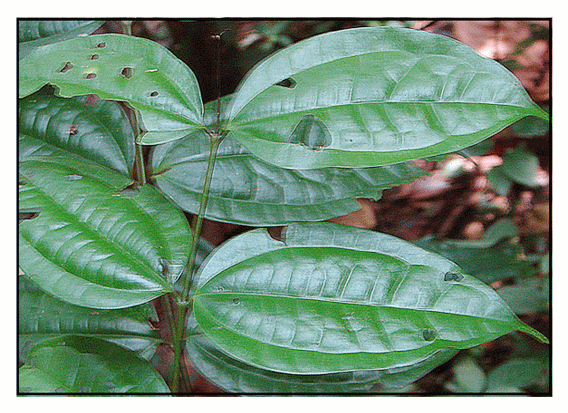
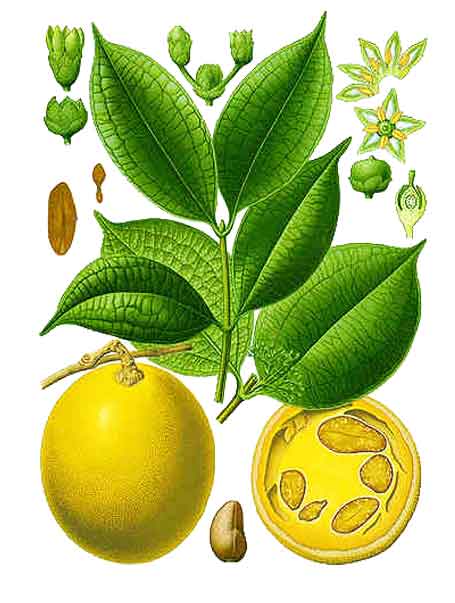
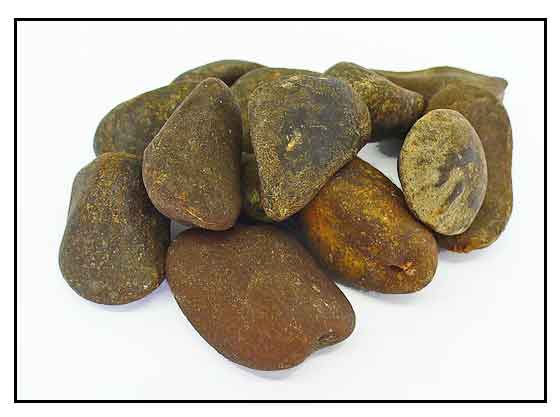
Katbalonga is a large, woody, forest vine, thornless creeping plant that climbs to the highest treetops. Trunk can exceed 10 centimeters, with a smooth, reddish bark. Leaves are opposite, smooth, leathery, oblong or elliptic, 8 to 20 centimeters long, pointed at the tip, pointed or somewhat rounded at the base, and prominently three-veined. Flowers are white, borne mostly in the axils of the upper leaves. Calyx is short and minutely toothed. Corolla is tubular, less than 1 centimeters long. Fruit is rounded, pale yellowish and brown, 10 centimeters or more in diameter, containing several seeds embedded in a soft, light-yellow pulp having a squash-like odor. Fresh seeds are greenish straw-colored, ovoid, triangular or bluntly angular, flattened, about 2.5 centimeters wide, covered with silvery, depressed hairs. Horny and brownish albumen is translucent, hard and difficult to split. Seeds are intensely bitter and highly poisonous.
Note: Hairs of the epidermis, albumen and cotyledons are similar in features to the same parts of Strychnos nux-vomica.
Distribution
- In damp, primary forests, at low and medium altitudes in the Biliran, Samar, and Leyte; and Agusan, Surigao, and Lanao Provinces in Mindanao.
- Also found in Borneo, China, and India.
Parts
utilized
Bark, seeds.
 Constituents Constituents
- Strychnine was first elucidated in 1947 with major contributions of H. Leuchs and Sir Robert Robinson. Since then, strychnine has been characterized from several Strychnos species i.e. S. ignatii Berg., S. wallichiana Steud. ex DC, and S. lucida R. Br. Along with the strong convulsive strychnine are a series of related alkaloids viz. brucine, colubrine, vomacine, and novacine.
-
The most important Strychnos species are S. nux vomica and S. ignatii. Strychnine is the alkaloids found in seeds of S. nux vomica and beans of S. ignatii. Seeds from these species contain 2-3% of total alkaloids, approximately one-half of the first, and two-thirds of the latter is strychnine. (9)
-
Study of seed yielded alkaloidal constituents - strychnine 1.5%, and brucine 0.5% - chemicals involved with the transmission of nerve impulses to the muscle.
- Study isolated a glucoside, loganin.
- Study of seeds yielded strychnine 2% and a small amount of berberine.
Properties
- Toxic principles of the seeds act on the spinal cord, being convulsive.
- Considered febrifuge, anticholeric, stomachic, tonic.
Uses
Folkloric
• Jesuits once valued the seeds as a remedy against cholera. (8)
• Because of stimulant effect, once used for enhancement of sports performance. (8)
•
Seeds mixed with wine used as stomachic.
• Bark and seeds used as febrifuge, tonic and anticholeric; used in some forms of paralysis.
• Seeds used for cholera, obstinate vomiting; for cold, phlegmatic conditions such as asthma, dropsy, rheumatism.
• Tincture, known as Tinctura Ignatiae, used as nervine tonic.
• Like nux-vomica, bean is tonic and stimulant, but cheaper.
• In Bengal dispensatory, seeds used as vermifugal medicine.
• In China, used for emotional disorders, depression, anxiety. Also used for headaches, sore throats, coughs and menstrual problems.
•
In China, used as counter-poison in ague, to expel intestinal worms, and treat postpartum problems. In Cambodia, Laos, and Vietnam, used to invigorate and to expel worms from the intestine.
• Used to prevent fainting; also used as a bitter and tonic. (11)
• In Siddha medicine, seeds or whole plant used as nervine tonic, aphrodisiac, and stimulant. Used in the treatment of epilepsy and psychic disorders. Oil extract of the plant used to treat male sterility and neurological problems.(10)
Homeopathy
• Seeds used in homeopathic remedy for its effects on the nervous system. Referred to as the "homeopathic Prozac." Although it contains the highly poisonous strychnine, homeopathic remedies undergo considerable dilutions, watering it down with low risk of side effects. Reported homeopathic benefits in anxiety, mood disorders, hysteria, insomnia, and menopausal emotional disturbances.
Others
• Poison: Seeds used for poisoning dogs; chopped and inserted into meat or bread. (•) Strychnine-containing baits are used mainly to poison birds, gophers, mice, moles, rats, rabbits, porcupines, and wild carnivores such as coyotes, foxes, and wolves. (8)
• Strychnine: Seeds used in the manufacture of strychnine.
• Hexes: Seeds were used to neutralise the effects of magical poisonings and love potions. (5)
• Pesticide: In 1978, the EPA guidelines classified strychnine as a restricted-use pesticide baits containing strychnine alkaloids at concentration of 0.5% or less. The baits are labeled for below-ground use for control of burrowing rodents. The manufacturer of strychnine alkaloid products for house mice control canceled its registration in 1989, thereby eliminating all indoor uses of strychnine pesticides. (8)
Toxicity
• Strychnine acts as a blocker or antagonist at the inhibitory or strychnine-sensitive glycine receptor, a ligand chloride channel in the brain and spinal cord. Because of strychnine's toxicity, its use in day-to-day medicine has long been abandoned. Recorded dosage for medicinal use was between 1/60th grain to 1/10th grain, equivalent to 1.1 and 6.4 M.G.. The lethal dose was cited as 1/2 grain (32 M.G.), but death has been known from a dose as little as 5 M.G. of strychnine.
• Strychnine is highly toxic with an LD50 of 1-2 mg/kg.
• Symptoms of mild strychnine poisoning are drooling, nausea, vomiting, delusions, involuntary muscle spasms, twitching, and vertigo. (5)
Studies
• Behavioral Effects / Anxiolytic: Study evaluated the activity of homeopathic Ignatia dilutions/dynamizations on experimental animal mice models. In LD the tested medicine showed anxiolytic-like activity, to a lesser extent than diazepam. Study concludes homeopathic Ignatia dilutions/dynamizations modify some emotion-related symptoms in laboratory mice without affecting locomotion. (5)
Availability
- Wild-crafted.
- Seed tablets, extracts, and homeopathic preparations in the cybermarket. |





.jpg)