 General info General info
Artocarpus is a genus of about 60 trees of Southeast Asian and Pacific origin, belonging to the family Moraceae.
Botany
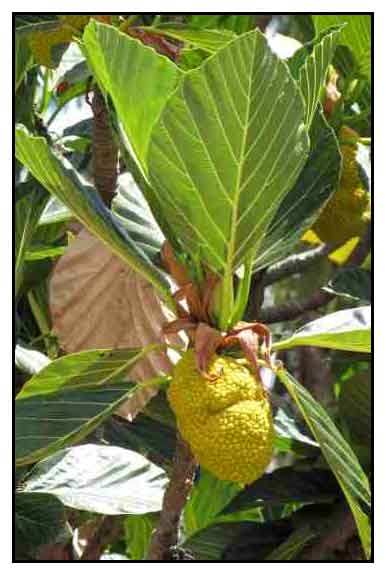
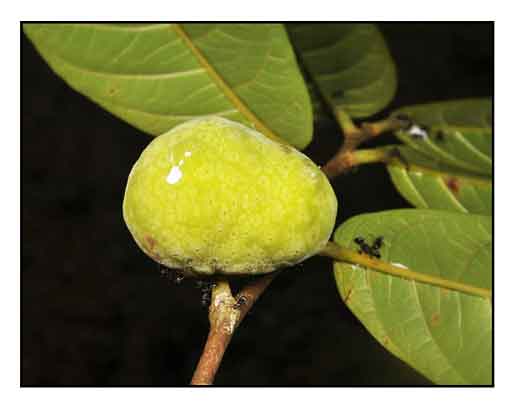
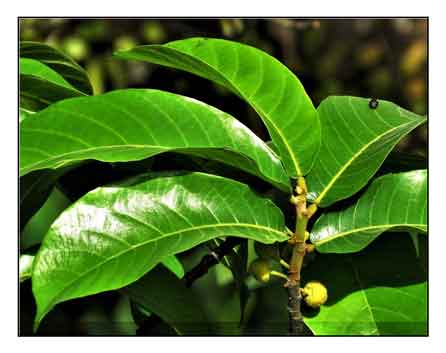
Kubi is a medium-sized tree growing to a height of 15 meters. Bark is black to brown, longitudinally fissured. Branchlets are cylindric, wrinkled, 2 to 3 millimeters thick, appressed puberulent, rapidly glabrescent. Leaves are oblong-ovate, acute, up to 12 centimeters long and 5 centimeters wide. with prominent veins. Flowers are small. Fruits are irregularly-shaped, 4 to 8 centimeters in diameter, several seeded and covered with yellowish brown or gray tomentum.
Distribution
- Artocarpus nitidus is found in China, Cambodia, Indonesia, Laos, Malaysia, Thailand, Vietnam and the Philippines.
- A. nitidus subsp. nitidus is restricted to the Philippines, and found in thickets and forests at low and medium altitudes in Luzon, Mindanao, and Cebu.
Constituents
- Study isolated 2 new isoprenylated 2-arylbenzofurans, artonitidin A and artonitidin B together with 14 known compounds, 3–16, were isolated from the stems.
- Study of the stems of A. nitidus subsp. lingnanensis yielded a stilbene possessing a g-aminobutyric acid lactam function, artocarpene, and a new flavanone, 2-hydroxynaringenin 4′-O-β-d-glucopyranoside, along with four known compounds.
- Artocarpus species are noted as an abundant source of phenolic constituents, viz., isoprenylflavonoids, stilbenoid and 2-arylbenzofuran derivatives, phenolic compounds.
- Study of yielded two new isoprenylated 2-arylbenzofurans, artonitidin A and artonitidin B, together with 14 known compounds. Compounds 3-16 were isolated from the stems. (see study below) (1)
- Study of stems of A. nitidus subsp. lingnanensis yielded a new flavan-3-ol, artoflavanocoumarin, along with three known compounds (+)-catechin, (+)-afzelechin 3-O-a-L-rhamnoside, and (+)-catechin-3-O-a-L-rhannoside. (8)
 - Study of stems isolated the first stilbene possessing a y-aminobutyric acid lactam function, artocarpene (1), and a new flavanone, 2-hydroxynaringenin 4'-O-ß-D-glucopyranoside (2) along with four known compounds, 2-hydroxynaringenin (3), oxyresveratrol (4), 3,4′,5-trihydroxy-3′-prenylstilbene (5) and norartocarpetin (6). (see study below) (9) - Study of stems isolated the first stilbene possessing a y-aminobutyric acid lactam function, artocarpene (1), and a new flavanone, 2-hydroxynaringenin 4'-O-ß-D-glucopyranoside (2) along with four known compounds, 2-hydroxynaringenin (3), oxyresveratrol (4), 3,4′,5-trihydroxy-3′-prenylstilbene (5) and norartocarpetin (6). (see study below) (9)
- Study of stems isolated two new isoprenylated 2-arylbenzofurans, artonitidin A (1) andn artonitidin B (2), along with 14 known compounds (3-16). (see study below) (10)
Properties
- Studies have shown antioxidant, cytotoxic, pancreatic lipase inhibitory, tyrosinase and collagenase inhibitory properties.
Parts used
Fruit.
Uses
Edibility
- Fruit, raw, with sweet, orange-coloured pulp.
- Bark and roots chewed as masticatory along with betel.
(13Ken Fern)
Folkloric
- No reported folkloric medicinal use in the Philippines.
- Elsewhere, fruit used medicinally.
Others
- Wood: Used for house construction, decorative furniture, making blow pipes, gun handles, joinery and paneling.. (6)
 Studies Studies
• Arylbenzofurans / Pancreatic Lipase Inhibitors / Stems: Study isolated 2 new isoprenylated 2-arylbenzofurans, artonitidin A and artonitidin B together with 14 known compounds; compounds 3–16 were isolated from the stems. The structures were elucidated by spectroscopic methods. Five compounds viz. norartocarpin (3), cudraflavone C (5), brosimone I (8), artotonkin (11), albanin A (13), and artopetelin M (14) showed inhibitory effects on pancreatic lipase wth IC50s ranging from 1.8±0.1 to 63.8±3.6 µM. (1)
• Antioxidant / Cytotoxicity / Stems: Study of the stems of A. nitidus subsp. lingnanensis yielded a stilbene possessing a g-aminobutyric acid lactam function, artocarpene, and a new flavanone, 2-hydroxynaringenin 4′-O-β-d-glucopyranoside, along with four known compounds. Compound 1, artocarpene, showed weak antioxidant activity and compound 2 exhibited weak cytotoxicity against human lung cancer A549 cell line. (4)
• Stilbenes and Flavonoids / Antioxidant / Cytotoxicity / Stems: Study of stems isolated the first stilbene possessing a y-aminobutyric acid lactam function, artocarpene (1), and a new flavanone, 2-hydroxynaringenin 4'-O-ß-D-glucopyranoside (2) along with four known compounds. Compound 1 showed weak antioxidant activity and 2 dislayed weak cytotoxicity against human lung cancer A54 cell line. (see constituents above) (9)
• Pancreatic Lipase Inhibitory / Stems: Study of stems isolated two new isoprenylated 2-arylbenzofurans, artonitidin A (1) andn artonitidin B (2), along with 14 known compounds (3-16). Norartocarpin (3), cudraflavone C (5), brosimone (8), artotonkin (11), albanin A (13) and artopetelin M (14) showed inhibitory effects on pancreatic lipase with IC50 values ranging from 1.8 ± o.1 to 63.8 ± 3.6 µM.. (10)
• Cloning of a Novel Lectin / Apoptosis Induction in Human B-Lymphoma Cells: Study isolated a novel lectin from A. nitidus subsp. lingnanensis (ALL) and showed its mitogenic activities. The ALL shares high sequence similarities with jacalin and Moinga G and belongs to jacalin-related lectin family. The antitumor activity of ALL was evaluated using Raji, a human B-lymphoma cell line. ALL nhibited Raji cell roliferation in a time- and dose-dependent manner through apoptosis. Also, the activation of p38 mitrogen-activated protein kinase (MAPK) signaling pathways is required for the pro-apoptotic activity of ALL. (11)
• Antioxidant / Tyrosinase and Collagenase Inhibitory Activity: Study isolated the antioxidative and inhibitory ativity of tyrosinase and collagenase for solvent extracts and silica column fractions. LC/MS analysis showed the major component of fractions were polyphenol with a total polyphenol extract content of 48.1 ± 2.6 mg GAE/g. Radical scavenging activity for DPPH showed for the extract, fraction 1 and 2 were 16.7, 42.0, and 10.1 µg/mL, respectively. Tyrosinase inhibitory activity of extracts and fractions showed IC50 of 64.9, 0.9, and 1.2 µg/mL, respectively, with activity higher than kojic acid and arbutin. For collagenase inhibitory activity, samples showed IC50s of 139.8, 20.6, and 16.8 µg/mL, respectively. Resutts usggest potential use as cosmetic material for antioxidant, skin whitening, and skin-aging prevention without adverse effects. (12)
Availability
Wild-crafted.
|