|
 Botany Botany
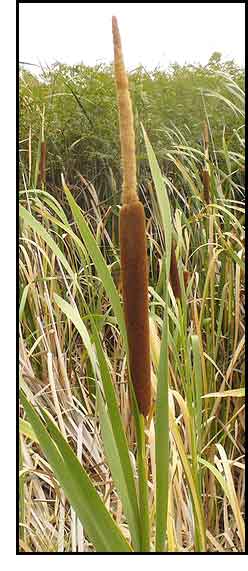
Lampakanay is an erect swamp plant reaching up to
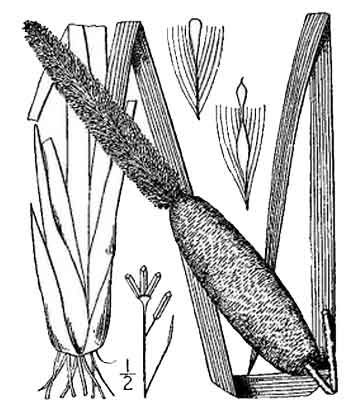
2 meters in height. Leaves are long, linear and 10 to 12 millimeters wide. Spikes are exserted, cylindric; the male flowers superposed above the female ones; the female ones when mature are brown, 12 to 20 centimeters long and up to 2 centimeters in diameter. Fruits are very minute, with membranous pericarp.
Distribution
- Widely distributed in the Philippines at low altitudes
in low wet places and in shallow or stagnant waters.
- Also used as ornamental in garden ponds.
- Also occurs from Africa and Madagascar to New Guinea.
Constituents
- Study isolated stearic and propanetriol ester, quercetin, naringenin.
- Hexane extract of rhizomes yielded two new bibenzyls, typharin and typhaphthalide, together with ß-sitosterol. An acetone extract yielded several flavan-3-ols in their free phenolic form viz. afzelechin, epiafzelechin, (+) catechin, and (-)-epicatechin. (15)
- Study of hexane extract of rhizomes of Typha capensis yielded two new phenolics, typhaphthalide (a benzylphthalide) and typharin (an isocoumarin) along with sitosterol. An acetone extract yielded afzelechin, epiafzelechin, and catechin. (19)
Properties
Considered anticoagulant, anti-contusive. anodyne, astringent, aphrodisiac, diuretic, emetic, emmenagogue, hemostatic, sedative, styptic, tonic, vermifuge, vulnerary.
Parts
utilized
· Whole inflorescence.
 Uses Uses
Culinary
· All parts of the cattail can be eaten.
· Core of young flower shoots are tender and can be eaten raw, with a taste of cucumbers.
· Rhizomes and seeds (with fluffy parts burnt off) processed to make flour.
· Green flower stems cooked on the stick and eaten like corn-on-a-cob.
Folkloric
• Hematomas: Mix 9 gms of the
dried material with 4 gms gumamela (Hibiscus rosa-sinensis), in one
cup of baby's urine (suckling). Boil to decoction and drink.
• Wooly soft Inflorescence is hemostatic, used for dressing ulcers and wound healing.
• For herpes labialis, cheilosis, swelling of the tongue: apply
powdered preparation on lesions.
• For dysmenorrhea, post-delivery pain: grind to powder 3 to
9 gms of dried pollen preparation and drink with warm water or wine.
• Pollen used for kidney stones, dysmenorrhea, abnormal uterine
bleeding, abscesses.
• Used for tapeworms, diarrhea, dysentery.
• Root infusion used for gravel.
• Roots are used as diuretic; used for urethritis and dysentery.
•Zulus use a decoction of root in the treatment of venereal diseases; Xoas use it as an aid to expel the placenta.
• Used to strengthen uterine contractions. Also used to promote fertility in women, to enhance male potency and libido, to improve circulation.
• In Chile and Argentina, used in folk remedies for tumors.
•American Indians
reported to use jelly from young leaves for wounds and skin problems.
Used for wound dressing. Rhizomes used as salve for wounds. Smoke from
burning of flower heads repel insects.(Source)
• Tea of roots and leaves used for stomach cramps.
• In South Africa used to treat male fertility problems.
• In India used as refrigerant, aphrodisiac and cure for dysuria.
• In Chinese medicine,
used for angina, brain clots, high lipids, difficult urination, chronic
colitis, hemorrhoids, boils, rash in infants. (Source) Also, used in treatment of hypermenorrhea. (Source) Also, used as astringent for dysentery and for hemorrhage of the bowels. Stamens, without the pollen, used as astringent and styptic.
• In Antilles the pollen is used as substitute for powder of licopodio; hairs and seeds used against burns.
• In South Africa, Typha capensis, along with Clivia miniata and Agapanthus africanus, used as ingredients for a traditional herbal medicine, Isihlambezo, for pregnant mothers. (20)
Others
• Weaving: Stems and leaves
used in making paper, woven into mats, hats.
• Building: As building material, used for making thatch.
• Fuel: Source of biomass, compost heap, or fuel.
• Pollen highly inflammable and used in making fireworks.
• Seeds used to stuff pillows and clothing insulation.
• Extensive root system makes it ideal for stabilizing wet banks of rivers and lakes.
 Studies Studies
• Immunosuppressive
Effect: Immunosuppressive activity of Pollen Typhae
ethanol extract on the immune responses in mice. Study showed
ethanol extract could suppress humoral and cellular response in mice.
• Cholesterol Lowering Effect:
Five aliphatic compounds were isolated from the pollen
of TA. Compound IV showed significant lowering of serum cholesterol.
• Cerebrosides
/ Vascular Smooth Muscle Effect: Study yielded two new
cerebrosides from the pollen of Typha angustifolia, both exhibiting
effect on the proliferation of cultured vascular smooth muscle cells
induced by fatal bovine serum.
• Processing
Effects on Flavonoids and Polysaccharides: Study showed
processing temperature, yellow wine and vinegar affected the chemical
constituents, influencing flavonoids and polysaccharides in different
degrees.
• Allergenic
Potential : TA has been reported to be the fourth most
common airborne pollen in Thailand. In a study of 513 patients, 68.42%
showed a positive allergenic reaction to TA extract; however, less than
the four other tested extracts. (5)
• Wastewater Treatment: Study showed narrow-leaved cattails can treat wastewater. (6)
• Nonacosanetriols / Anti-Platelet Aggregation: Study yielded two new nonacosanetriols from the pollen of TA, which exhibited weak anti-platelet aggregation in vitro. (7)
• Inhibition of Collagenase Activity / Free Radical Scavenging / Sperm Motility Effects: Study evaluated in vitro effects of aqueous extracts from the plant on male reproductive functions. Results showed rhizome extract had significant negative effects of all parameters (sperm vitality, motility, production of reactive oxygen species). Extracts from leaves and rhizomes showed dose dependent inhibitory effect for collagenase and free radical formation. The inhibitory activity for collagenase may indicate possible anti-cancer effects. (13)
• Antibacterial: Study evaluated various extracts and solvents of dried ground leaves and rhizomes of Typha capensis for antibacterial activity. Average total activity, a measure of potency, was highest for methanol leaves and rhizomes extracts. (14)
• Effect on Male Reproductive Functions / Rhizomes: Study of crude aqueous extracts of rhizomes of T. capensis yielded bioactive compounds i.e., quercetin and naringenin. Study showed enhanced production of testosterone and suggests possible use in treating male infertility and aging male problems. (17)
• Uptake of Heavy Metals from Wetland Sites: Study used Typha capensis, a good accumulator of heavy metals, to demonstrate the existence of metal-metal interactions in plants and the implications for absorption of toxic elements like Cr. and possible Cr. detoxification mechanisms within the plant are discussed. (18)
Availability
Wild-crafted. |