 Gen info Gen info
- Liriope is a genus of low, grass-like flowering plants from the /East and Southeast Asia. Although called lilyturf, it is neither a true grass *Poaceae family) nor a lily (genus Lilium).
- The genus has moved from family to family—Liliaceae to Convallariaceae
to Asparagaceae.
- The genus is derived from Greek mythology—the woodland nymph, Liriope, mother of Narcissus by the river god Cephissus, according to Ovid's metamorphoses.
(12) (13)
Botany
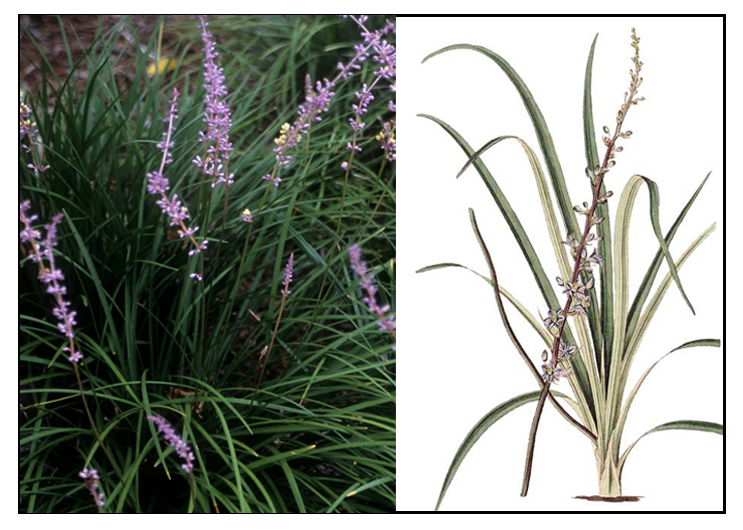
Lilyturf is an evergreen perennial stemless plant growing to a height of 0.3 meters. Tubers are pale yellowish-greenish, cylindrical and fleshy, translucent and flexible, 2.5 to 5 centimeters long, 0.3 to 0.6 centimeter in diameter, tapering at either extremity. Leaves are tufted, numerous, ensiform, 45 to 70 centimeters long, and 0.3 to 0.8 centimeters wide. Inflorescence is solitary, 20 to 33 centimeters long. Flowers are small and odorless, white or purplish.
Distribution
- Native to the Philippines. (9)
-
On open slopes at an altitude of about 1,400 meters in Luzon (Ilocos Norte, Rizal, Benguet Provinces) and in Batanes Islands.
- Also native to China and Taiwan.
- Also occurs in Japan and Korea.
Constituents
- Rich in mucilage.
- Root contains about 1.6% protein, 0.5% fat, 80% carbohydrates, and 2.3% ash.
- Study of underground parts isolated two new steroidal saponins--lirigramosides A and B along with four known compounds:Phytochemical investigation of the underground parts of Liriope graminifolia (Linn.) Baker resulted in the isolation of two new steroidal saponins lirigramosides A (1) and B (2) along with four known compounds, characterized as: 3-O-[β-d-xylopyranosyl-(1→3)-α-l-arabinopyranosyl-(1→2)-[α-l-rhamnopyranosyl-(1→4)]-β-d-glucopyranosyl-(25S)-spirost-5-ene-3β,17α-diol (1), 1-O-[α-l-rhamnopyranosyl-(1→2)-β-d-xylopyranosyl]-(25R)-ruscogenin (2), 1-O-β-d-xylopyranosyl-3-O-α-l-rhamnopyranosyl-(25S)-ruscogenin (3), 3-O-α-l-rhamnopyranosyl-1-O-sulfo-(25S)-ruscogenin (4), methylophiopogonanone B (5), and 5,7-dihydroxy-3-(4-methoxybenzyl)-6-methyl-chroman-4-one, (ophiopogonanone B, 6), respectively. (see study below) (2)
- Study of underground parts yielded an unusual novel C27-steroidal glycoside sulfate from the underground parts, together with three known compounds: (25S)-ruscogenin 1-sulfate-3-O-alpha-L-rhamnopyranoside (1), (25S)-ruscogenin 1-O-beta-D-xylopyranosyl-3-O-alpha-L-rhamnopyranoside (2), hesperidin (3), and 4', 7-dihydroxy-5-methoxyflavanone (4). (See study below) (6)
- An ethyl acetate extract yielded three compounds, viz. methylophiopogonanone B (compound 1),5,7-dihydroxy-6-methyl-3-(4-methoxybenzyl)-chroman-4-one (compound 2) and 7,4'-dihydroxy-5-methoxy flavanones (compound 3). A fraction of 50% ethanol yielded hesperidin (compound 4) and and 25(R, S)-ruscogenin-l-O-sulfate-3-O-a-L-rhamnopyranoside (compound 8). A 75% ethanol fraction isolated three compounds: 25(S)-ruscogenin-l-O-β-D-xylopyranoside-3-O-a-L-rhamnopyranoside (compound 5), 25(R)-ruscogenin-1-O-α-L-rhamnopyranosyl(1→2)-β-D-xylopyranoside (compound 6), (25S)-spirost-5-ene-3β,17α-diol-3-O-β-D-xylopyranosyl( 1→3)-α-L-arabinofuranosyl(l→2)-[α-L-rhamnogyranosyl (1→4)]-β-D-glucopyranoside (compound 7). (see study below) (10)
- Study
isolated eight compounds: methylophiopogonanone B (1 ), 5,7-dihydroxy-6-methyl-3-(4-methoxybenzyl)-chroman-4-one (2 ), 7,4'-dihydroxy-5-methoxyflavanone (3 ), hesperidin (4 ), 25(S )-ruscogenin-1-O -[beta]-D-xylopyranoside-3-O -[alpha]-L-rhamnopyranoside (5 ), 25(R )-ruscogenin-1-O -[alpha] -L-rhamnopyranosyl-(1[right arrow]2)-[beta]-D-xylopyranoside (6 ), (25S)-spirost-5-ene-3[beta] ,17[alpha]-diol-3-O -[beta] -D-xylopyranosyl-(1[right arrow]3)-[alpha] -L-arabinofuranosyl(1[right arrow]2)-[ð¼ -L-rhamnopyranosyl(1[right arrow]4)]-[beta] -D-glucopyranoside (7 ), and 25(R ,S )-ruscogenin-1-O -sulfate-3-O -[alpha] -L-rhamnopyranoside (8 ). All were isolated from the plant for the first time. (14)
Properties
- The drug consists of cylindrical fleshy tubers from 1 to 2 inches in length, and from 1/8 to 1/4 inch in diameter, tapering at either extremity, pale yellowish-gray in color, translucent, soft and flexible. A central ligneous cord runs longitudinally through each.
- Roots considered aphrodisiac, pectoral, and stimulant.
- Candied tubers considered tonic, pectoral and aphrodisiac.
- Plant considered refrigerant.
- Studies have suggested anti-tumor, antioxidant, cardiac stimulant properties.
Parts used
Tubers.
Uses
Edibility
- Roots, cooked. Also, candied.
- Root has a fleshy, tuberous part near its tip.
Folkloric
- Candied tubers eaten as tonic and aphrodisiac.
- In China, decoction of tubers used to fortify the lungs, for coughs, fevers and dysentery.
- In Chinese traditional medicine, used for asthma, bronchial and lung inflammation. Used as tonic to moisten yin.
- Decoction or infusion of tubers used for hemoptysis, dysentery, and as emmenagogue.
Candied tubers considered tonic and aphrodisiac. In China, whole plants used to treat diabetes.
Others
- Ground cover: A good drought-tolerant ground cover.
Studies
• Steroidal Saponins / Anti-Tumor Activities: Study isolated two new steroidal saponins - lirigramosides A and B along with four known compounds. The isolated compounds were evaluated for their cytotoxic activities against Hela and SMMC-7721 cells. (see constituents above) (2)
• Anti-Tumor: Study of isolated eight compounds. Compound 1 showed strong anti-tumor activity against human cervical carcinoma; compound 7, moderate anti-tumor activity against human cervical carcinoma and human hepatocellular carcinoma; compound 5, antiproliferative activity against human cervical carcinoma.
• Novel C27-Steroidal Glycoside / Cytotoxicity / Underground Organs : Study isolated an unusual novel C27-steroidal glycoside sulfate from the underground parts, together with three known compounds. Compound 1 (HR-MS, 1D and 2D NMR as (25S)-ruscogenin 1-sulfate-3-O-alpha-L-rhamnopyranoside) has cytotoxic activities against K562 and HL60 cells. (see constituents above) (6)
• Anti-Tumor: Study of Liriope graminifolia yielded various bioactive compounds. Compound 1 showed strong anti-tumor activities against human cervical carcinoma; compound 7 had moderate anti-tumor activities against human cervical carcinoma (Hela) and human hepatocellular carcinoma (SMMC-7721; compound 5 had antiproliferative activity to human cervical carcinoma (Hela). (see constituents above) (10)
Availability
Wild-crafted.
|