 Gen info Gen info
- Hibiscus tiliaceus is a species of flowering tree in the mallow family, Malvaceae, with a pantropical distribution along coastlines. (29)
- Etymology: The genus name Hibiscus derives from Greek ibiskos, which the Greek botanist Pedanius Discorides gave to a plant now scientifically labelled as Althaea officinalis. (29) The specific epithet tiliaceus refers to the resemblance
of the leaves to those of the related Tilia species.
Botany
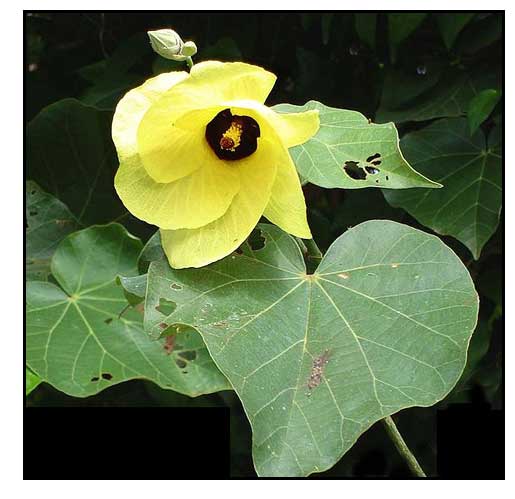
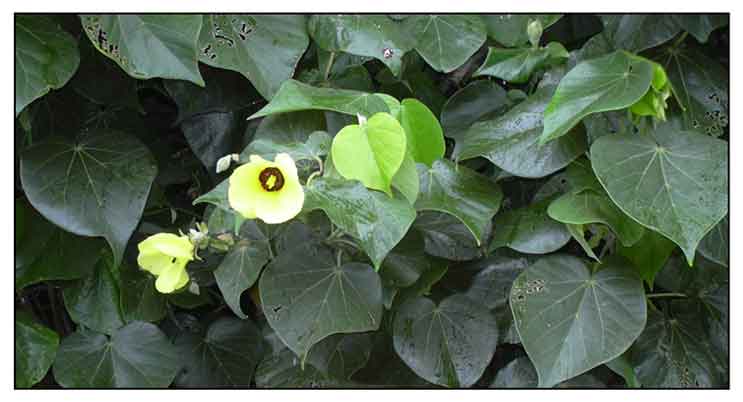
• Malabago is a much branched tree, 4 to 12 meters high. Leaves are suborbicular, 10 to 15 centimeters long, green, smooth and shining on the upper surface, grayish and hairy on the under surface, with a pointed tip and heart-shaped base, and minutely toothed margins. Sepals are hairy, 5 in number, oblong and about 2 centimeters long. Petals are yellow, dark purple at the inside base, orbicular-obovate or rounded, about 5 centimeters in length and width. Capsules are hairy, ovoid, 1.5 centimeters long, surrounded by persistent sepals and, at the base, by the bracteolar cup, falsely 10-celled, and 5-valved.
• Growth form: Small shrubby tree, up to 15m height in rich soils. Crown spreading to rounded, with many branches. Trunk: Greyish brown with numerous reddish-brown lenticels. Suckers often form at base of tree. Foliage: Leaves heart-shaped with pointed tip and finely-serrated margins, dark green above, covered with fine whitish hairs below, spirally arranged along stem. Flowers: Produced in few-flowered inflorescences, each flower large, funnel-shaped, bright yellow with purple eye, opening at around 9am, maturing to dull orange and dull pink in afternoon, before closing and dropping off at around 4pm. Sepals form a pointed-tip cup. Free-flowering. Fruit: Rounded explosive capsules, brown when mature, splitting into 5 parts to disperse numerous small kidney-shaped seeds.
(Flora & Fauna Web)
 Distribution Distribution
- Native to the Philippines.
-
Found throughout the Philippines, along the seashore and tidal streams.
- Occasionally planted inland for ornamental purposes.
- Pantropic along the seashore.
- Also native to Aldabra, Andaman Is., Assam, Bahamas, Bangladesh, Belize, Bismarck Archipelago, Borneo, Brazil North, Brazil Northeast, Brazil South, Brazil Southeast, Cabinda, Cambodia, Cameroon, Cape Provinces, Caroline Is., Cayman Is., Central American Pacific Is., China Southeast, Christmas I., Cocos (Keeling) Is., Colombia, Comoros, Congo, Cook Is., Costa Rica, Cuba, Dominican Republic, DR Congo, Ecuador, El Salvador, Fiji, French Guiana, Gabon, Gambia, Ghana, Gilbert Is., Guatemala, Guinea, Guinea-Bissau, Gulf of Guinea Is., Guyana, Hainan, Haiti, Hawaii, Honduras, India, Ivory Coast, Jamaica, Japan, Jawa, Kazan-retto, Kenya, Kermadec Is., KwaZulu-Natal, Laccadive Is., Laos, Leeward Is., Lesser Sunda Is., Liberia, Malaya, Maldives, Maluku, Marianas, Marquesas, Marshall Is., Mexican Pacific Is., Mexico Central, Mexico Gulf, Mexico Northeast, Mexico Northwest, Mexico Southeast, Mexico Southwest, Mozambique, Myanmar, Nansei-shoto, Nauru, New Caledonia, New Guinea, New South Wales, Nicaragua, Nicobar Is., Nigeria, Niue, Norfolk Is., Northern Territory, Ogasawara-shoto, Panamá, Pitcairn Is., Puerto Rico, Queensland, Rodrigues, Samoa, Santa Cruz Is., Senegal, Seychelles, Sierra Leone, Society Is., Solomon Is., Southwest Caribbean, Sri Lanka, Sulawesi, Sumatera, Suriname, Taiwan, Tanzania, Thailand, Tokelau-Manihiki, Tonga, Trinidad-Tobago, Tuamotu, Tubuai Is., Tuvalu, Vanuatu, Venezuela, Venezuelan Antilles, Vietnam, Wallis-Futuna Is., Western Australia, Windward Is.
(16)
 Constituents Constituents
- Study isolated 10 compounds: friedelin (1), pachysandiol (2), glutinol (3), lupeol (4), germanicol (5), stigmast-4-en-3-one (6), stigmast-4, 22-dien-3-one (7), ergosta-4, 6, 8 (14), 22-tetraen-3-one (8), β-sitosterol (9), and stigmasterol (10). (7)
-
Study of leaves and twigs isolated 14 compounds viz., friedelin (1), β-sitosterol (2), vanillin (3), syriacusin A (4),hibiscolactone (5), scopoletin( 6), cleomiscosin C (7), fumaric acid (8), kaempferol (9), quercetin (10), daucosterol (11), azelaic acid (12), succinic acid (13), and rutin (14). (20)
- Phytochemical screening of leaf extract yielded tannins, whereas the bark yielded alkaloid, reducing sugar, and tannins.
(see study below) (21)
- GC-MS analysis of methanol extract yielded N, N- Dimethylglycine (83.97%), 3,7,11,15-Tetramethyl-2-hexadecen-1-ol (phytol) (2.94%) and 4H-Pyran-4-one, 2, 3-dihydro-3, 5-dihydroxy-6-methyl- (2.69%). (23)
Properties
- Bark is mucilaginous.
- The flower color in certain species, such as Hibiscus tiliaceus and H. mutabilis, changes with age. (29)
- Considered aperitive, emollient, emetic, diuretic, febrifuge, sudorific, and laxative.
- Studies have suggested antioxidant, antiproliferative, antimutagenic, antinociceptive, anti-inflammatory, antiulcer, anti-tyrosinase, immunomodulatory, antidepressant,
antimicrobial, immunopotentiator, antifungal, anti-sickling, tyrosinase inhibitory, skin-whitening, anti-obesity, phytoremediation properties.
Parts
used
Flowers, bark, seeds, leaves, roots.
 Uses Uses
Edibility
• In the Pacific Islands, the bark is sometimes used as famine food.
• Roots used as food Queensland aborigines.
• Bark used as famine food.
Folkloric
• Macerated fresh bark in water is mucilaginous and used for dysentery.
• Infusion of roots used for fevers.
• Flowers boiled in milk used for cure of earaches.
• Flowers used for birth control and treating skin infections.
• Leaves used to treat cough, sore throats, and open wounds.
• In Amboina and Pahang, foot infusion used for fevers.
• In Java, decoction of roots used for fever.
• In Brazil, infusion of roots used as diuretic and febrifuge.
• Roots used in preparation of embrocation.
• In Mexico, roots and bark are used as aperitive, emollient, sudorific and laxative.
• Root preparation used externally for sprains and strains.
• In Indo-China, leaves used as laxative and resolutive.
• In Biduanda, leaves are rubbed over swellings.
• In Java, young leaves are boiled with sugar for bronchitis and coughs.
• Leaves and flowers used as emollient; used for ulcers.
• In China, flowers used for headache.
• In Brazil, infusion of seeds used as an emetic; infusion of roots used as diuretic and febrifuge.
• In the Antilles, decoction of flowers and root-bark used as laxative and emollient.
• In New Guinea, bark is used as cough remedy and also to treat tuberculosis. In Tonga, bark and young leaves are used for skin diseases. Leaf infusion used as aid in childbirth and to alleviate postpartum discharges. (18)
• In Fiji, leaves are wrapped around fractured limbs and sprained muscles; leaf juice used for gonorrhea. (18)
• In Vanuatu, juice from stem bark drunk to facilitate childbirth; likewise, sap obtained from a slit in the trunk is drunk. (189
Others
• Fiber: Bast fibers make a strong rope; also for making string and hog traps. (See study below) (9)
• Wood: Wood used for light boat and canoe construction, planking, firewood, carvings, fishing nets, household implements, axe handles. (18)
• Forage: Leaves are fed to cattle. (18)
• Fermentation: In Indonesia H. tiliaceus is used for fermenting tempeh. Soybeans are pressed into the leaf and stored; fermentation occurs resulting in tempeh. (29)
• Cosmetics: Seed used in perfumes and oils for hair.
Studies
• Antitumor Activity / Roots: Study of antitumor activity of the roots of Hibiscus tiliaceus against Dalton's ascitic lymphoma in mice showed a significant enhancement of survival time with inhibition of tumor cell growth. (1)
• Antioxidant / Antimutagenic / Flowers: Study on the methanolic flower extract of HT showed the a clear antioxidant activity, attributed to vitamins and phytosterols. Extract also showed significant antimutagenic action against oxidative mutagens in S cerevisiae. (2)
• Antioxidant / Flowers: Aqueous flower extract of H tiliaceus exhibited significant reducing power and free radical scavenging. The antioxidant activities were concentration dependent. The total phenolic content were gallic acid equivalents and the total flavonoids as catechin equivalents. (3)
• Antiproliferative / Cytotoxicity: Study showed the acetone extract of HS exhibited better cytotoxic effect on lung cancer cells than the methanol and water extract. Results show HS-AE exerts significant dose-dependent anti-proliferative effect on cancer cells in vitro and in vivo.
• Antinociceptive / Anti-Inflammatory: Study on the different leaf extracts of H tiliaceus showed significant anti-inflammatory activity and antinociceptive activity on two types of noxious stimuli. (4)
• Antimutagenic / Antigenotoxic: Study showed the methanolic extract strongly inhibited the mutagenic action of hydrogen peroxide and tert-butyl-hydroperoxide. Results showed antioxidant activity and both antigenotoxic and antimutagenic effects against oxidative DNA damage. (5)
• Antioxidant / Antityrosinase / Leaves and Flowers: The flowers and leaves of six Hibiscus species were studies for antioxidant, antityrosinase and antibacterial activities. The leaves and flowers of H. tiliaceus showed outstanding antioxidant property. Leaves of TH had the strongest antityrosinase activity. Results suggest HT have the potential for development into functional food and skin care products. (6)
• Hibiscus Yarn: Study evaluated the characteristics and properties of Hibiscus tiliaceus fiber of different ages. Results showed the 4-month H. tiliaceus fiber could produce the smallest and longest yarn (45 meters) while the 3-month yarn had the highest average strength (111.39 N). The differences on physical properties of fiber and yarn of different ages were statistically significant at level of 0.5. (9)
• Immunomodulatory / Leaves: Study evaluated the immunomodulatory effect of a methanolic leaf extract of H. tiliaceus in pyrogallol induced immunosuppressed Wistar rats. Oral administration of the MLHT showed dose-dependent immunomodulatory effect in Wistar rats with significant effect on both humoral and cellular immunity. The results may be attributed to the polyphenols and flavonoid content of the extract. (10)
• Antiulcer / Leaves: Study evaluated fresh leaf extracts of H. tiliaceus for anti-ulcer activity in albino rats. Results showed pretreatment of extract showed significant reduction in lesion index, total area affected and percentage of lesion in cold restraint stress-induced and pylorus ligation ulcer models. (11)
• Anti-inflammatory / Wood / Safety Study: Study evaluated the anti-inflammatory activity of a methanolic wood extract in experimental acute and chronic inflammatory animal models. Results showed dose-dependent significant results with the 200 and 4000 mg/kg body weight extracts. The acute toxicity study showed the methanolic extract of plant wood to be safe up to 200 mg/kbw. (12)
• Antidiabetic / Hypolipidemic / Flowers: Study evaluated the antidiabetic and hypolipidemic activities of a methanolic extract of flowers of H. tiliaceus in STZ-induced diabetic wistar rats. Results showed antidiabetic activity with significant improvement in body weight. There was also significant reduction of serum cholesterol and triglycerides, with improvement of HDL levels. (13)
• Antidepressant / Flowers: Study evaluated a methanol flower extract of HT for antidepressant, anxiolytic, and sedative effects in animal models using forced swimming test, tail suspension test, elevated plus maze test, and ketamine-induced sleeping time. Results showed an antidepressant-like action without sedative side effect. (14)
• Antioxidant / HPLC Profiling / Leaves: Study investigated the antioxidant activity and HPLC profile of ethanolic leaf extract. Catechin, rutin hydrate, ellagic acid, and quercetin were quantified by HPLC-DAD at 99.00 ± 1.88, 79.20 ± 1.59, 59.40 ± 1.36, and 69.30 ± 1.47 mg/100 g of dry extract, respectively. The extract showed potent antioxidant activity by ABTS assay with IC50 of 6.25 ± 0.15 µg/ml. Total antioxidant capacity, total phenolic, and flavonoid contents were considerable (595.2 ± 3.61 mg of ascorbic acid/g, 298.07 ± 2.01 mg/g of gallic acid, and 13.69 ± 0.06 mg/g of quercetin equivalent, respectively). (15)
• Antioxidant / Antimicrobial / Leaves: Study evaluated an ethanol extract of dried leaves for antioxidant and antimicrobial activities. The extract showed antioxidant activity with a significant inhibition of DPPH activity with IC50 of 86.5 µg/ml compared to ascorbic acid IC50 15.00 µg/ml. The extract also showed activity against three strains of bacteria viz., S. aureus, E. coli and S. paratyphi. (17)
• Cytotoxicity / Antibacterial / Neuropharmacological Effect / Leaf and Bark: In Brine Shrimp Lethality bioassay, the leaf extract exhibited moderate cytotoxic effect (LC50 20 µg/ml, LC90 40 µg/ml), while the bark extract showed low cytotoxic effect with LC50 of 50 µg/ml. The bark extract exhibited very little inhibitory effect against S. aureus and S. epidermis, while the leaf extract showed no activity against test bacterial strains. In neuropharmacologic evaluation, the leaf and bark extract produced a decrease in both time of onset of sleeping and total sleeping time. (see constituents above) (21)
• Effect of Leaves Extract on Liver Structure: Study evaluated the effects of natural extract of waru leaf on histology of liver tissue in rats. Dose of 100 mg/kg showed histopathological changed in hepatocyte cells in the form of hydropic degeneration, fat degeneration, necrosis, vascular congestion, and sinusoid congestion. The changes were still within normals due to the degree of minor damage of 25%. (22)
• Anthelmintic / Wood and Leaves:Study evaluated the anthelmintic activity of H. tiliaceus wood and leaves using Pheretima posthuma as test organism and parameters of time of paralysis and time of death. All extracts showed significant dose dependent anthelmintic activity compared to standard drug albendazole. Activity was attributed to secondary metabolites like tannins, saponins and alkaloids. (25)
• Tetracyclic Triterpenoids / Cytotoxicity
Against Cancer Cell Lines / Leaves and Branches:Study of MeOH extracts from air dried leaves and branches yielded two new tetracyclic triterpenoids (3β,24S)-19(10→9)-abeo-8α,9β,10α-eupha-5,25(26)-dien-3,24-diol (tiliacol A, 1), and (3β,23Z)-19(10→9)-abeo-8α,9β,10α-tircalla-5,23-dien-3,25-diol (tiliacol B, 3), together with one known analog (2). The compounds were tested for cytotoxic activity against three tumor cell lines, P388 (leukemia), HeLa (cervical carcinoma), and K562 (erythroleukemia). Compound 2 showed potent activity with IC 50s of 11.2, 11.5, and 13.5 mmol/L. (26)
• Diuretic / Laxative / Bark: Study investigated the diuretic and laxative activity of H. tiliaceus bark in albino rats using standards of furosemide for diuretic activity and agar agar for laxative activity. Results showed significant dose dependent diuretic and laxative activity. (27)
• Antifungal / Wood: Study evaluated 15 plants used as folk medicine in East Kalimantan, Indonesia for antifungal activity against dermatophyte, Trichophyton mentagrophytes. Using agar diffusion antifungal assays, five showed more activity than others with 35-61% inhibitory activity in comparison to commercial antifungal agent, miconazole. Hibiscus tiliaceus showed 47 ± 0.1% inhibitory activity. (28)
• Immunopotentiator of Terpenoid / Potential Vaccine Adjuvant / Leaf Fraction: Adjuvants are excipients in vaccine formulations to elicit an immune responmse to antigens and improved overall potency of the vaccine. Study evaluated the immunopotentiating activity of terpenoids extracted from H. tiliaceus leaf fraction as candidate for vaccine adjuvants. Nineteen terpenoid compounds were identified from the fraction, and triterpenoid groups demonstrated a high immunostimmulatory potential based on a probability to be active (oa) with value of >0.07. The triterpenoids showed immunopotentiator effect on TLR-2, TLR-4, NLRP-3, Dectin-1 based on binding affinity score. The triterpenoid group included ß-amyrin (BA<), glitinol (GLU), germanicol (GER), which demonstrated a high binding affinity against PRRs and toxicity prediction. Results suggest potential for the terpenoids from the leaf fraction as vaccine adjuvants, pending toxicity studies. (30)
• Immunopotentiator of Terpenoid / Potential Vaccine Adjuvant / Leaf Fraction: Sickle cell disease (SCD) is a neglected tropical disease (NTD) associated with severe health consequences, including death. Study evaluated the aqueous leaf extract of H. tiliaceus for activity against sickle cell disease, including its antisickling, antioxidant, and anti-inflammatory effects. TLC, HPLC-UV/DAD, LC-MS, and NMR identified kaempferol 3-O-rutinoside and rutin. Rutin exhibited potent antioxidant and anti-inflammatory activities with IC50s of 5 µg/mL and 2.5 µg/mL, respectively. Kaempferol 3-O-rutinoside exhibited superior antisickliing activity, normalizing sickled RBCs with IC50 <12.5 µg/mL. The combined effects of molecules in H. tiliaceus may help in normalizaing erythrocytes, inhibiting free radicals generated by early hemolysis, contributing to inflammatory processes reduction. Results validates traditional use of HY. tiliaceus extract for management of SCD. (31)
• Skin Whitening Emulsion Formulation for Topical Application: Preliminary studies have reported tyrosinase and melanogenesis inhibitory activity of H. tiliaceus leaves, which suggested H. tiliaceus leaves could be used as active ingredient in whitening products. Study evaluated a stable formulation using flaxseed oil and H. tiliaceus prtially purified extract (PE) and evaluated its physicochemical properties, microbial quality, storage stability, safety, and bioactivities. Partially purified extract emulsions (PEE1 and 2) witj 0.1% and 0.2% (w/w) showed remarkable inhibition of tyrosinase activity by 61% and 70%, respectively, with high efficacy in suppressing melanin content and tyrosinase activity in murine melanoma cells (B16F1). PEE 1 and 2 inhibited extracellular melanogenesis by 34% and 32% at 0.5 mg/mL. PEE1 showed better physicochemical properties, microbial quality and bioactivities. Results suggest potential for development of natural whitening products using coastal plants. (32)
• Anti-Obesity Effects / Leaves: Study evaluated the preclinical anti-obesity properties of Iraqi Hibiscus tiliaceus extract, alone or in combinationm with orlistat, on high-fat diet-induced obesity in male rats. Ethanolic extract in doses of 250 and 500 mg/kg, orlistat (Xenical 10 mg) alone or in combination with 250 mg/kg extract. After 8 weejs, there was significant reduction of body weight, food intake, serum triglycerides, total cholesterol, LDL cholesterol, and liver enzymes AST and ALT. Results showed anti-obesity effects with potential as therapeutic agent in managing obesity. (33)
• Natural Fiber from Bark / Alternative to Marine Polluting Synthetic Rope: Synthetic ropes used in marine boats for docking, anchor, tow, and sailing have advantages, being waterproof, strong, durable, and able to stretch, more resistant to rotting than natural fibers. Study introduces the bark of Hibiscus tiliaceus as candidate source of natural fiber for rope to reduce microplastic fiber pollutant from synthetic rope. The average tensile strength of a single fiber is around 44.604 MPa. Average of Modulus elasticity E is 365.864 MPa.Failure strain is 11.6%. Study suggests the use of H. tiliaceus baark to replace synthetic rope to reduce microplastic fiber pollutant in the ocean. (35)
• Phytoremediation Potential: Study evaluated the properties of H. tiliaceus leaves for its potential in oil spill management, comparing it to Ficus nota (Tibig). Overall, SEM images, contact angle results, and FTIR-ATR analysis showed how H. tiliaceus and F. nota differ in phytoremediation. Study data highlights the phytoremediation potential of both plants, particularly in oil spill cleanup and self-cleaning applications. (36)
Availability
Wild-crafted.
Cultivated. |