Botany Botany
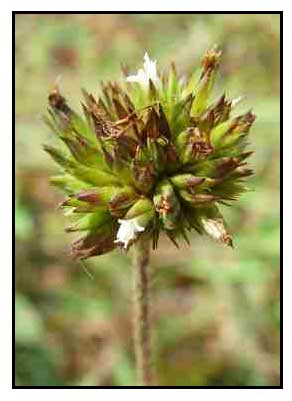
Malatabako is a tall, erect, more or less hairy herb, 0.8 to 1.2 meters in height, unbranched except for the inflorescence. Leaves are scattered along the stem, not basal, oblong to oblong-elliptic, 8 to 20 centimeters long, and pointed at both ends. Branches of the inflorescences are few, usually forked, and subtended by much-reduced leaves. Clusters of head terminating the branches are usually surrounded by three leaflike bracts which are ovate to oblong-ovate, 1 to 1.5 centimeters long, and heart-shaped at the base. Flowering heads are crowded in each cluster, each head usually 4-flowered. Involucral-bracts are 8 to 10 millimeters long. Corolla is purple, 8 to 9 millimeters long. Achenes are ribbed. Pappus is 4 to 6 millimeters long, with rigid bristles.
Distribution
- Throughout the Philippines, in open, waste places and grasslands, from sea level to an altitude of 2,000 meters.
- Native of Mexico.
- Also found in the Marianne and Caroline Islands, Taiwan and Borneo.
- In some places, considered a noxious weed.
 Constituents Constituents
- Study yielded phenolic compounds, i.e., caffeic acid, 3,5-dicaffeoylquinic acid, 1,4-dicaffeoylquinic acid, and 3,4-dihydroxy-cinamic acid methyl ester as the main constituents.
- Air-dried leaves yielded
molephantin (1), molephantinin (2), 2-deethoxy-2-hydroxyphantomolin (3), stigmasterol (4), α-amyrin fatty acid ester (5a), and lupeol fatty acid ester (5b).
- Study for chemical constituents yielded nine compounds: 2beta-deethoxy-2-hydroxyphantomolin (1), 2beta-methoxy-2-deethoxyphantomolin (2), 2beta-methoxy-2-deethoxy-8-O-deacylphantomolin-8-O-tigli-nate (3), molephantinin (4), betulinic acid (5), magnolol (6), honokiol (7), dibutly phthalate (8) and tricin (9). (8)
- Methanol extract of plant yielded a new sesquiterpene lactone, 2-de-ethoxy-2-hydroxyphantomolin, along with lupeol, lupeol acetate, epifriedelinol, molephantin, and 2-de-ethoxy-2-methoxyphantomolin. (9)
- Study of ethanolic extract of E. mollis yielded three novel cytotoxic antitumor germacranolides viz., molephantin, molephantinine, and phantomolin, along with three known triterpenes ß-amyrin acetate, lupeol acetate, and epifriedelanol, as well as stigmasterol. (see study below) (13)
Properties
- Antiviral, antibacterial, febrifuge, diuretic, vulnerary.
- Studies have suggested antitumor, antimelanogenesis, chemopreventive, radical scavenging, anti-leishmaniasis properties.
Parts used
Leaves, whole plant.
Uses
Edibility
- In China, plant reportedly eaten as salad. (12)
Folkloric
- Leaves, of whole plant or parts are used as diuretic and febrifuge.
- Leaves macerated between hands and the juice applied topically to relieve itching.
- In Burma, decoction of aerial parts drunk to treat irregular menstruation. (12)
- Used to treat fevers and stimulate urination.
- Used for treating hemorrhoids.
- In Taiwan, used for tiredness and arthritis.
- In Cameroon, plant used to facilitate bone fracture healing.
- In Ecuador, traditionally used in treatment of leishmaniasis. (3)
- In Vietnam, plant used treat hemostasis and dysentery. (14)
- In Mauritius, oiled crushed leaves applied to facilitate wound healing. (15)
- In the Guianas, used for body itches, athlete's foot; as tonic and diaphoretic. (16)
Studies
• Melanogenesis Inhibition in Murine Melanoma: Study showed E. mollis extract reduced melanogenesis by down regulating Mitf expression. In addition, melanocortin-1 receptor (MC1R) expression was downregulated suggesting desensitization to α-melanocyte-stimulating hormone of the cells treated with the extract. (1)
• Free Radical Scavenging: EM extract was found to possess significant free radical and superoxide radical scavenging activity, effectively protecting mouse brain lipid against oxidative stress.
• Phenolic Compounds / Chemopreventive Activity: Study yielded phenolic compounds as main constituents - caffeic acid, 3,5-dicaffeoylquinic acid, 1,4- dicaffeoylquinic acid, and 3,4-dihydroxy-cinnamic acid methyl ester, and suggested the compounds may play major roles in the chemo-preventive activity of EM. (2)
• Anti-Leishmaniasis: In an Ecuadorean study of 140 extracts, Elephantopus mollis was one that showed anti-leishmaniasis activity. (3)
• Antimicrobial: Air-dried leaves yielded molephantin (1), molephantinin (2), 2-deethoxy-2-hydroxyphantomolin (3), among other compounds. The three compounds exhibited moderate activity against Candida albicans. Compound one showed slight activity against S. aureus, and a mixture of 1 and 2, slight activity against B. subtilis. (5)
• Cytotoxic / Apoptotic: Study revealed an ethyl acetate extract as the most potent extract showing dose-dependent and time-dependent growth inhibition in human liver carcinoma HepG2 cells via induction of apoptotic cell death through the caspase-3-dependent pathway in HepG2 cells. (6)
• Chemopreventive / Radical Scavenging Activity: Study evaluated the chemopreventive effects of plant extracts of EM. An aqueous extract showed to possess significant free radical and superoxide radical scavenging activity and effectively protected mouse brain lipid against oxidative stress. Fractionation yielded phenolic compounds, i.e., caffeic acid, 3,5-dicaffeoylquinic acid, 1,4- dicaffeoylquinic acid, and 3,4-dihydroxy-cinnamic acid methyl ester, are the main constituents in the active ethyl acetate fraction, possibly playing roles in the chemo-preventive activity. (7)
• Cytotoxicity / Human Carcinoma Cell Lines: Study evaluated the cytotoxicity of six medicinal plants towards five human solid cancer cell lines. The methanol extract of whole plant of Elephantopus mollis showed IC50 values from 3.29 µg/mL (DLD-1 colorectal adenocarcinoma cells) to 24.38 µg/mL (small lung cancer A549 cells). EMW induced apoptosis in MCF-7 cells mediated by MMP loss and increased ROS production. (11)
• Germacranolides and Triterpenes / Antitumor: Study of ethanolic extract of E. mollis yielded three novel cytotoxic antitumor germacranolides viz., molephantin, molephantinine, and phantomolin, along with three known triterpenes ß-amyrin acetate, lupeol acetate, and epifriedelanol, as well as stigmasterol. Preliminary invivo tumor assays indicated molephantinin and phantomolin were potent inhibitors of Ehrlich ascites carcinoma and Walker 256 carcinosarcoma. Molephantinin also showed significant antileukemic activity in the P-388 lymphocytic leukemia screen. (13)
• Germacradiendiolides / Antileishmanial: Study evaluated seventeen sesquiterpene lactones (SLs) isolated from five species of the tribe Vernonieae for their in vitro activity against promastigotes of Leishmania amazoniensis and L. braziliensis. The most active compounds against L. braziliensis were 16 and 17 (IC50 values 1.45 and 1.34 µM, respectively). This is the first report of the known germacradiendiolides 16 and 17 from Elephantopus mollis. (17)
• Potential for Enhancing Skin Barrier Function: A US application was made for screening and evaluating agents promoting skin barrier function taking epidermal serine racemase and/or d-serine level as indicator. Of the candidate drugs in the screening, Lempuyang extract and Elephantopus mollis extract promoted serine racemase expression in differentiation-induced kertinocytes. Results suggest potential as an effective drug for enhancing skin barrier function. (18)
Availability
Wild-crafted.
|