 General Info General Info
- The family Convolvulaceae comprises about 59 genera and 1880 species. The genus Ipomoea is one of the largest in the family with approximately 700 species, mainly distributed in the tropical and warm temperate regions of the world and known as morning glories. most of which are twining climbing plants , including annual and perennial herbs, lianas, shrubs, and small trees. (Stevens 2020), (25)
Botany
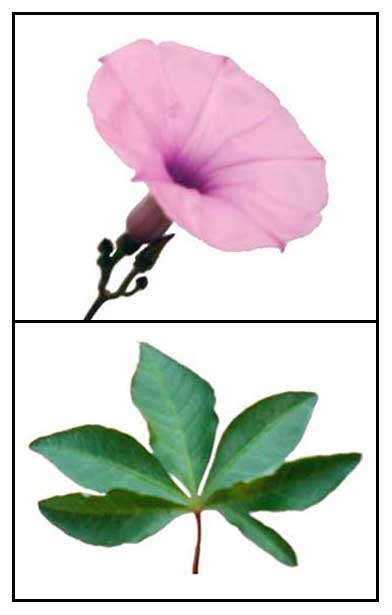
Ipomoea cairica is a vining perennial, twining and herbaceous, up to 4 meters long, smooth or muricate. Leaf blades are 3 to 10 centimeters long, palmately divided in 5 to 7 lobes. Flowers are showy, white to lavender, peduncles 5 to 80 millimeters long. Corolla is purple, bluish purple or white with a purple center, funnelform, 4.5 to 6 centimeters long.
 Distribution Distribution
- Widely distributed in the Philippines
- Widely cultivated and commercialized as a garden ornamental.
(25)
- Once naturalized, it has the potential to out-compete native plants.
- In some places it has become invasive and seriously harmful to the environment in China, Japan, Australia, Singapore, and many other islands in the Pacific region.
*( 5225)
Constituents
- Phytochemical analysis of methanol extracts of leaves and flowers yielded alkaloids, carbohydrates, tannins, phenolic compounds, proteins and amino acids, terpenoids, sterols, and saponins. (see study below) (7)
- Phytochemical screening of various extracts of flowers and leaves yielded the presence of alkaloids, sterols, flavonoids, reducing sugars, tannins, saponins, terpenoids, anthraquinones, glycosides, and phenols.
(17)
- Phytochemical screening of various extracts (petroleum ether, CHCl2, Ch3OH) of leaves and flowers
yielded alkaloids, sterols, flavonoids, reducing sugars, tannins, saponins, terpenoids, anthraquinones, glycosides, and phenols. (9)
- An ethanolic extract yielded compounds, 3,5-Di-O-caffeoylquinic acid and 4,5-Di-O-caffeoylquinic acid. (10)
- Study of aerial parts isolated six pentasaccharide resin glycosides, four new acylated pentasaccharide resin glycosides, namely cairicoside I-IV and two known compounds, cairicoside A and cairicoside C, (see study below)
(12)
- Study of aerial parts isolated the coumarins umbelliferone and scopoletin, and the dibenzyl-γ-butyrolactone lignans arctigenin, matairesinol and trachelogenin, along with β-sitosterol and fatty acids. (13)
- Study of methanol extract yielded 14 compounds viz., (+)-(8R,8′S)-thujaplicatin methyl ether (1), arctigenin (2), matairesinol (3), trans-2,3-dibenzylbutyrolactone (4), vanillic acid (5), p-hydroxybenzoic acid (6), methoxybenzoic acid (7), methylparaben (8), stearic acid (9), palmitic acid (10), olenic acid (11), friedelinol (12), and a mixture of β-sitosterol (13) and stigmasterol (14). (see study below) (15)
- Study of aerial parts yielded six pentasaccharide resin glycosides: four new acylated pentasaccharide resin glycosides, cairicoside I-IV (1-4), along with two known compounds, cairicoside A (5) and cairicoside B (6).
(see study below) (18)
- Phytochemical screening of various extracts (PE, CHCl, and CH3OH) alkaloids, sterols, flavonoids, reducing sugars, tannins, saponins, terpenoids, anthraquinones, glycosides and phenols.
(25)
Properties
- Studies suggest antioxidant, anti-diabetic, antinociceptive, antimicrobial, mosquito larvicidal,
α-glucosidase inhibitory, antioxidant, anticancer properties.
Uses
Folkloric
• No reported folkloric medicinal use in the Philippines.
• In Brazilian folk medicine, used for rheumatism and inflammation.
 Studies Studies
• Larvicidal / Essential Oil:
A study of the essential oil for its larvicidal effect against four vector species of mosquitoes showed remarkable larvicidal properties, inducing 100% mortality in the larvae of Culex tritaeniorhynchus, A aegypti, A stephensi and Culex quinquefasciatus. (2)
• Antinociceptive / Essential Oil:
Study yielded 3,5-di-O-caffeoylquinic acid and 4,5-di-O-caffeoylquinic acid which have been reported to have analgesic and antioxidative effects. The results show antinociceptive effects probably through release of pro-nociceptive mediators. The isolated caffeoylquinic acids can partly explain the antinociceptive effect of Ipomoea cairica polar extract. (3)
• Residual Bio-Efficacy Against Culex quinquefasciatus:
Study evaluated crude acethonilic extract of Ipomoea cairica leaves for residual and persistence effects against Culex quinquiefasciatus larvae. Results showed a short period of residual effectiveness of crude acethonilic extract of leaves with high percentage of larval mortality on the first few days that endorses less concerns of excess environmental residues, insecticide resistance and environmental pollution. (5)
• Biolarvicidal Against Key Dengue Vectors:
Study evaluated the efficacy of I. cairica extract against two different mosquito larvae: Ae. albopictus and Ae. aegypti. Results showed remarkable larvicidal properties and suggests exploration of alternatives to chemical larvicides such as Abate, Temephos for mosquito control program. (6) Study evaluated the larvicidal efficacy of different plant parts of Ipomoea cairica against third-stage larvae of Aedes albopictus and Aedes aegypti. Both acetone and methanol extracts showed 100% mortality at highest concentration (450 ppm) after 24h exposure. The larvae of Ae. aegypti appeared to be more susceptible to I. cairica extract with lower LC50 value compared with Ae. albopictus. Results suggest a potential for a more eco-friendly Aedes mosquito control program. (23)
• Antimicrobial / Antioxidant / Leaves and Flowers:
Study investigated methanol extracts of leaves and flowers of I. cairica for antimicrobial and antioxidant effects. Results showed very good activity against all bacterial and fungal strains tested. The extract also showed remarkable antioxidant activity, with DPPH scavenging activities correlating with its reductive potential. (7)
• Antinociceptive / Antioxidant / Leaves and Flowers:
Study of Ipomoea cairica extract showed dose dependent reduction of response in the formalin test inflammatory phase in mice. A possible explanation for the antinociceptive activity is the release of pro-nociceptive mediators unrelated to carrageenan-induced edema. The isolated caffeoylquinic acids could explain, in part, the antinociceptive effect. (8)
• Oviposition Deterring and Oviciding Potential Against Dengue Vectors:
Study of Ipomoea cairica demonstrated oviposition deterring and oviciding potentials against dengue vectors, Ae. aegypti and Ae. albopictus. Results suggest a potential alternative source for the development of novel plant based insecticides. (11)
• Pentasaccharide Resin Glycosides / α-Glucosidase Inhibitory Activity / Anti-Diabetic: Study of aerial parts yielded six pentasaccharide resin glycosides. Compounds 1-4, four new acylated resin glycosides, cairicoside 1-IV, all showed anti-diabetes or inhibitory activity against α-glucosidase. (see constituents above) (12)
• Mosquito-Larvicidal / Dibutyl Phthalate / Stems: Study for larvicidal activities of I. cairica stem extracts, fractions isolated a secondary metabolite,dibutyl phthalate. Findings demonstrated that the crude extracts and pure compound of stem showed potent larvicidal activity against C. quinquefasciatus and A. aegypti. Results suggest an ecofriendly and cost-effective larvicide for mosquito control. (14)
• Cytotoxicity Against Cancer Cell Lines: Study isolated 14 compounds from a methanolic extract. Compounds 2 (arctigenin) and 4 (trans-2,3-dibenzylbutyrolactone) exhibited significant cytotoxic activity against LNCaP cell line. Compound 4 also showed significant activity against A549 cell line. (see constituents above) (15)
• α-Glucosidase Inhibitory Activity / Pentasaccharide Resin Glycosides: Study of aerial parts of Ipomoea cairica yielded four new acylated pentasaccharide resin glycosides. Compounds 1-4 (cairicoside I-IV) showed strong inhibitory activity against α-glucosidase. (see constituents above) (18)
• α-Glucosidase Inhibitory Activity / Cairicoside A and B: Study isolated two new compounds from Ipomoea cairica. Evaluation for α-glucosidase inhibitory activity showed an IC50 of 25.3 ± 1.6 and 28.5 ± 3.3 µmol-L, respectively. (19)
• Antioxidant /
Leaves and Flowers: Study evaluated the in-vitro antioxidant activities of methanolic extracts of leaves and flowers by DPPH radical inhibition. The methanolic extract of I. cairica leaves showed maximum antioxidant activity (83.52%) while the methanolic extract of flowers showed maximum antioxidant activity at 81.85% at 500 µg/ml concentrations. (20)
• Insecticidal Potential on Dengue Vectors: Study evaluated the sublethal activities of I. cairica acethonilic extract against the life history trait of dengue vectors, Aedes albopictus and Ae. aegypti on late third instar larvae. Results showed significantly lower egg production (fecundity) and eggs hatchability (fertility) in Ae. albopictus There was also significant reduction of width of larval head capsule and wing length in both sexes of Aedes species. The reduced reproductive capacity suggests a potential as plant based insecticide to control dengue vectors. (21)
• Cytotoxicity Against HepG2 Cell Lines / Leaves: Study evaluated the anticancer activity of leaf extracts of ten Ipomoea Jacq. species on A 549 cell line and HepG2 cell line by SRB assay. Crude extract of leaves of Ipomoea species showed significant cytotoxic effect on HepG2 cell line and significant inhibitory effect on A549 cell line. Ipomoea cairica was the best growth inhibitor for HepG2 cell line. (22)
• Pinoresinol / Antioxidant / Calcium Antagonist Property: Cell cultures of Ipomoea produced a tetrahydrofuran lignan; (+)-pinoresinol, identified by UV, IR, MS, and NMR. The pinoresinol was found to have antioxidant and Ca+ antagonist propertied. (24)
• Antibacterial: A methanolic foliar extract exhibited inhibitory activity against Bacillus subtilis, Enterococcus faecalis, Escherichia coli, Klebsiella aeruginosa, Micrococcus luteus, Salmonella typhi and Streptococcus faecalis. An ethyl acetate soluble foliar extract inhibited all the selected bacteria. (26)
Availability
Wild-crafted. |